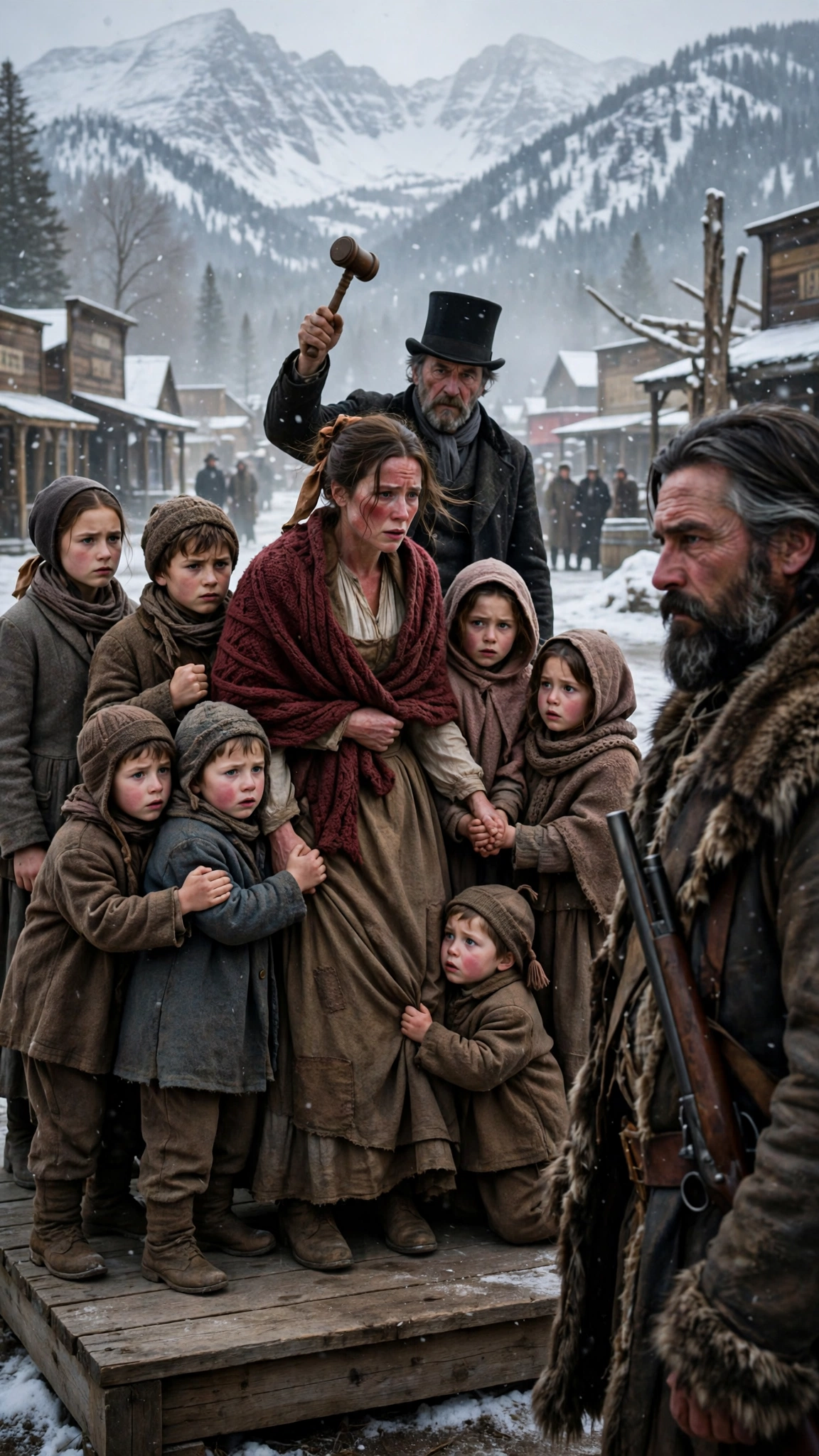
Spring came late to the mountain. It was April before the snow began to melt in earnest, and May before the first green showed on the south-facing slopes, and by then the cabin had settled into a rhythm that felt, to Eleanor's surprise, almost like a life.
The children had their chores and their lessons — Eleanor taught them reading and sums at the kitchen table each morning, the way she had in Philadelphia — and Caleb had his work, and the evenings were quiet and warm by the fire, and Edward's wooden horse had been joined by a wooden dog and a wooden bear, and Sarah had begun, cautiously, to ask Caleb questions about trapping, and Thomas had begun to follow him to the barn in the mornings, watching him work, learning the names of the tools.
Eleanor had almost begun to believe that the worst was behind them. She had almost begun to believe that the mountain would keep them safe. She should have known better. Safety, she had learned in Philadelphia, is never a place. It is only a time between one trouble and the next.
The trouble came on a Tuesday in late May, in the form of three riders on the mountain road.
Eleanor saw them first, from the doorway of the cabin, where she was shaking out a rug. Three men on horseback, picking their way up the switchbacks, and even at a distance she could see that they were not trappers and not hunters. Their coats were too clean. Their horses were too well groomed. And the man in front — a thin man in a black coat, with a ledger tucked under his arm — moved with a familiarity that made her stomach turn, because she had seen that walk before, in Philadelphia, in the hallway of her own house, three days after Daniel's funeral.
She went inside and closed the door and called the children in from the yard, and she told them to stay in the loft and not come down, no matter what they heard, and she stood at the window and watched the riders come up the road, and she felt the old fear rise in her throat, the fear she had felt in the square in Covenant Creek, the fear of a woman who has nothing and is about to lose even that.
Caleb was in the barn. She could see him through the window, currying one of the mules, and she wanted to run to him, to warn him, but her legs would not move, and by the time she found her voice, the riders were already in the yard, dismounting, and the thin man in the black coat was walking toward the cabin door with Mrs. Cromwell beside him, in her dark Victorian dress and her black bonnet, with her documents in her hands.
The knock on the door was polite. Three knocks, evenly spaced, the knock of a man who is certain he will be let in.
Eleanor opened the door.
"Mrs. Hayes," the thin man said, and he smiled, and his smile was exactly the same as it had been in Philadelphia — polite, and entirely without mercy. "My name is Silas Vane. I represent Mr. Aldous Crane, of Philadelphia. You may remember me. I called upon you after your husband's death, regarding a debt."
"I remember you, Mr. Vane," Eleanor said. Her voice sounded steady. She was proud of that. "What do you want?"
"Mr. Crane has sold the debt," Vane said, "to a party in this territory. And that party has instructed me to collect. The debt, with interest, now stands at a considerable sum. But there is a simpler matter." He glanced at Mrs. Cromwell, who stepped forward with her documents. "Mrs. Cromwell informs me that your marriage contract was entered into under false pretenses. You failed to disclose the debt. A contract entered into under false pretenses is void. The children, therefore, are not covered by the contract. They are, under territorial law, wards of the Bride Society, to be placed in custody."
The words fell on Eleanor like stones. She heard them, and she understood them, and for a moment she could not breathe. Void. The contract was void. The three hundred dollars meant nothing. The children were not covered. They were coming to take them.
"That is a lie," she said, and her voice shook, but she did not step back. "I disclosed everything. Mrs. Cromwell knew —"
"Mrs. Cromwell's records show no disclosure," Vane said smoothly. "And Mrs. Cromwell is a respected representative of the Society. Whose word do you think the territorial judge will take, Mrs. Hayes? Yours? Or hers?"
Mrs. Cromwell looked at Eleanor with her cold, calculating eyes, and she did not speak, and her silence was louder than anything Vane had said. Eleanor understood, in that moment, that this had been arranged — that Vane had found Mrs. Cromwell, and that together they had made a plan, and that the plan was to undo the auction, and to take her children, and to sell them, one by one, to whoever would pay.
"Where is Mr. Roar?" the third rider asked. He was a big man, with a sheriff's badge on his coat, and he looked uncomfortable, the way men look when they are being paid to do something they do not believe in.
"He is in the barn," Eleanor said.
"Fetch him," Vane said to the sheriff. "This concerns him as well. He has been harboring a woman under a void contract. He will want to hear the terms."
The sheriff went to the barn. Eleanor stood in the doorway, her hands clenched in her skirts, and she watched Caleb come out of the barn, wiping his hands on a rag, his face unreadable, his rifle nowhere in sight — it was inside, by the door, where he always kept it — and she saw him take in the scene in a single glance: Vane, Mrs. Cromwell, the sheriff, the papers in Mrs. Cromwell's hands, and her own face, white and shaking.
"Mr. Roar," Vane said, with his polite, merciless smile, "I am Silas Vane, representing Mr. Aldous Crane of Philadelphia. I am here regarding a debt owed by Mrs. Hayes, and a marriage contract entered into under false pretenses. The contract is void. The children are to be placed in territorial custody. I have the papers here." He held out a document, crisp and official, with a seal at the bottom.
Caleb did not take it. He looked at Vane, and then at Mrs. Cromwell, and then at the sheriff, and his pale eyes were cold and still, and when he spoke, his voice was low and flat, the voice of a man who did not repeat himself.
"My word does not break."
Vane blinked. "I beg your pardon?"
"My word," Caleb said. "I gave it to the boy. I gave it to his mother. I said the children stay together. Every one. My word does not break. Not for weather. Not for money. Not for any man."
He turned to the sheriff. "You know me, Sheriff. You have known me for ten years. Have I ever broken my word?"
The sheriff shifted his weight. He did not look at Vane. "No, Mr. Roar. You have not."
"Then you know," Caleb said, "that these children stay here. And this woman stays here. And if Mr. Crane wants his debt, he can come and collect it from me."
Vane's smile faltered. "The debt is considerable, Mr. Roar. With interest, it stands at —"
"How much?" Caleb asked.
Vane named the sum. It was more than Eleanor had ever heard spoken aloud. It was more than the cabin was worth, more than the land was worth, more than anything in the mountains could possibly be worth. Eleanor felt her knees go weak. She put a hand on the doorframe to steady herself.
Caleb did not flinch. He stood in the yard in his work clothes, his hands still dirty from the barn, and he looked at Vane, and he said, "Come inside."
They went inside, all of them — Vane, Mrs. Cromwell, the sheriff, Eleanor, Caleb — and the children stayed in the loft, silent, listening through the floorboards. Caleb went to the back of the cabin, to the locked door, and Eleanor's heart stopped, because she thought he was going to open it, and she did not know what was behind it, and she did not know what would happen if they all saw it.
But Caleb did not open the locked door. He went to the fireplace, and he lifted a loose stone from the hearth, and beneath it was a leather pouch, heavy and worn, and he set it on the table and opened it, and gold coins spilled out onto the wood — more gold than Eleanor had ever seen, coins from twenty years of trapping, coins saved one pelt at a time, coins he had never spent because there had never been anything he wanted to buy.
He counted them out, slowly, in stacks of ten, while Vane watched, and Mrs. Cromwell watched, and the sheriff watched, and Eleanor watched, and the coins clicked against the wood, one by one, until the whole of the debt was paid, with interest, down to the last cent, and there were still coins left in the pouch.
"There," Caleb said. "The debt is paid. The contract stands. The children stay."
Vane stared at the gold. His face had gone pale. He gathered the coins into a sack with shaking hands, and he folded his papers, and he looked at Mrs. Cromwell, and Mrs. Cromwell looked at the gold, and then at Caleb, and then at Eleanor, and something shifted in her cold, calculating eyes — something that might have been respect, or might have been fear, or might have been the beginning of understanding that she had chosen the wrong side.
"The Society will require a report," she said stiffly.
"Write whatever you like," Caleb said. "The debt is paid. The contract stands."
Vane and Mrs. Cromwell and the sheriff rode away down the mountain road, and Eleanor stood in the doorway and watched them go, and when they were out of sight, her legs gave way beneath her, and she sat down on the threshold, in the dirt, and she wept — not the silent tears of the first night in the cabin, but great, shaking sobs of relief, because her children were safe, and because a man she had feared had just spent twenty years of gold to keep his word to a boy of eleven.
She felt a hand on her shoulder. It was large and rough, and it was gentle. She looked up, and Caleb Roar was standing over her, and his pale eyes were not cold at all. They were tired, and they were kind, and they were waiting for her to be ready to stand up again.
"Thank you," she whispered.
He nodded, once. "My word does not break," he said. And then he went back to the barn, to finish currying the mule, as if nothing at all had happened — as if a man paid other people's debts with his life's savings every day, and thought nothing of it.
Up in the loft, the children were listening. And Thomas, who had heard every word through the floorboards, looked at his brothers and sisters, and he said, very quietly, "He meant it. He really meant it." And Sarah, who was thirteen and trying so hard to be grown, put her arm around Edward, and she nodded, and for the first time since they had come to the mountain, she believed it too.
That evening, they ate supper together at the kitchen table, all nine of them, and the meal was the same stew and bread as any other evening, but it did not taste the same. It tasted like safety. It tasted like a debt paid and a promise kept. The children were quieter than usual, and they kept glancing at Caleb, as if they were seeing him for the first time, and Eleanor watched them, and she understood that something had changed in the cabin that afternoon — that the man at the head of the table was no longer a stranger who had bought them, but a man who had chosen them, and paid for that choice with everything he had.
After the meal, when the younger children had gone up to the loft, Sarah lingered at the table. She sat across from Caleb, her hands folded in her lap, and she looked at him with the direct, fearless gaze that thirteen-year-old girls have when they have decided to ask the question that matters.
"Mr. Roar," she said, "that gold — you saved it for twenty years. And you gave it all away for us. Why?"
Caleb looked at her for a long moment. The firelight moved across his weathered face, and his pale eyes were steady, and when he spoke, his voice was low and rough, and it was the most honest thing Eleanor had ever heard a man say.
"Because a man is only as good as his word, Sarah," he said. "And my word was the only thing I had left that was worth anything. I was not going to spend twenty years saving gold and then let a man in a black coat buy my word back from me. Not for any price."
Sarah nodded slowly, and she stood up, and she went to the ladder, and she climbed up to the loft without another word. But Eleanor saw her pause at the top of the ladder, and look back down at Caleb, and the look on her daughter's face was something Eleanor had not seen in a very long time: it was trust. Not the frightened, desperate trust of a child clinging to her mother's skirt, but the real thing — the trust of a young woman who has looked a man in the eye and decided, for herself, that he is good.
Eleanor sat by the fire long after the children were asleep, and Caleb sat across from her, whittling, and neither of them spoke, and the fire burned low, and the wind moved through the pines outside, and Eleanor thought about the gold, and about the locked door, and about the name Anna, and she understood, at last, that the man across the fire from her had not bought a family. He had bought back a part of himself he thought he had lost forever — and she was going to make sure he never lost it again.