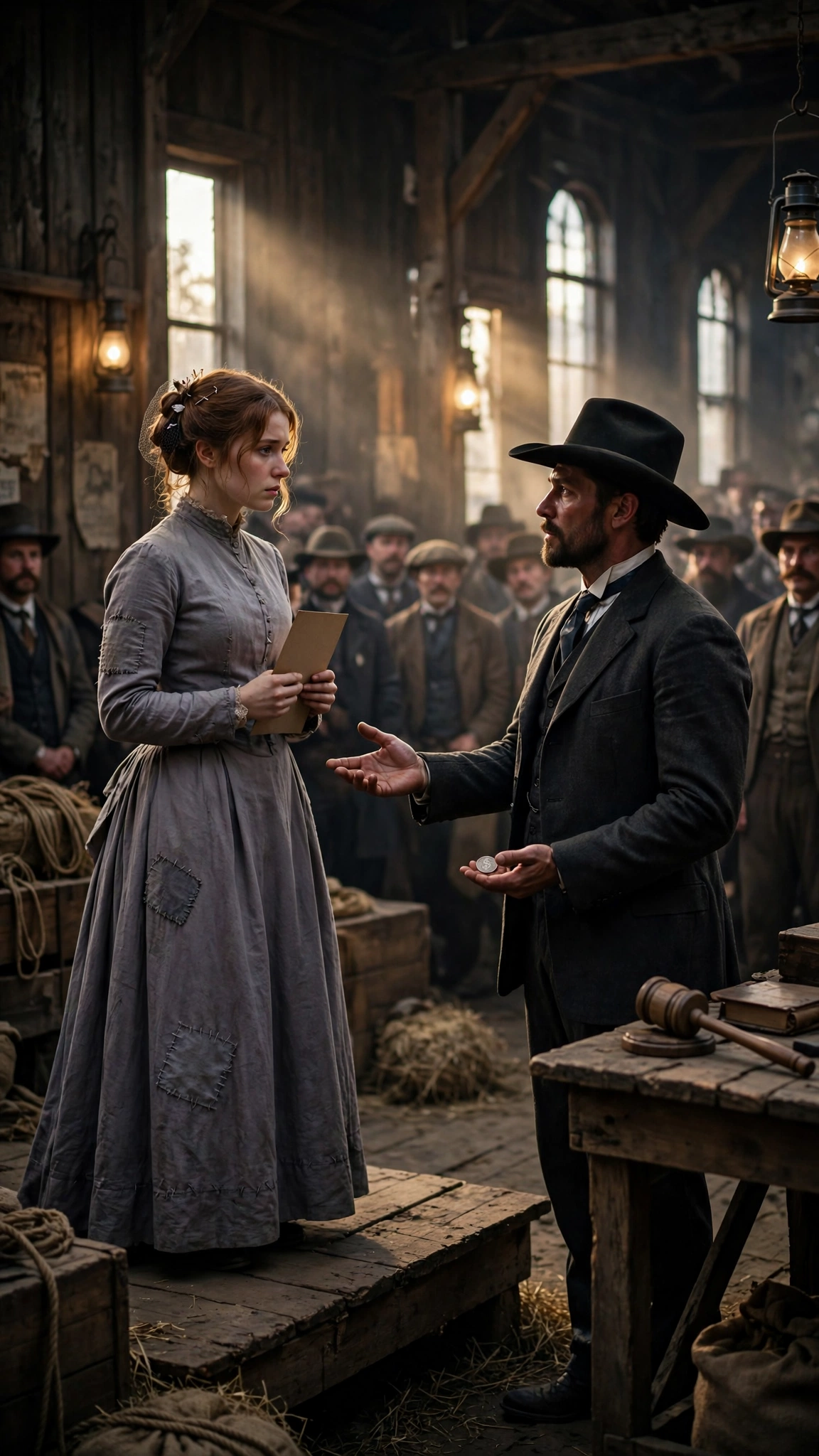
Silas Redmond had not gone to the warehouse to find a wife.
He had gone because Dutch Kellerman had asked him to, and Dutch asked for nothing twice in forty years. They had gone to Council Bluffs to buy horses — four good geldings for the spring roundup — and Dutch had heard about the auction in the livery stable and had said, over supper, that a man ought to at least look, and Silas had said nothing, and the next afternoon they had walked to the warehouse together, and Dutch had stood beside him in the shadows and watched the women go up one by one, and Silas had watched them too, with the polite, distant attention of a man looking at something that did not concern him.
He was forty-two years old. He owned eighteen thousand acres of Nebraska grassland and four thousand head of cattle and a ranch house so large that his own footsteps echoed in it. He had built it with his own hands and his father's money, beam by beam, over ten years, and it had a kitchen with a stove the size of a wagon and a library with three hundred books and a porch that looked out over the grasslands all the way to the horizon. It was the finest house in the county. It was also the loneliest.
His father had died when Silas was thirty, thrown from a horse on the north range, and his mother had followed two years later, quietly, of a heart that had simply worn out. Silas had buried them both on the hill behind the house, under a single stone, and he had gone on running the ranch the way his father had taught him: up before dawn, out with the hands, home after dark, supper alone at a table built for twelve. He had never married. The women of the county had tried, in their various ways, and he had been polite and distant and finally unreachable, and after a while they had stopped trying. A man who owned eighteen thousand acres did not need to explain himself to anyone.
But the silence had grown heavier every year. He noticed it most in the evenings, when the work was done and the hands had gone to the bunkhouse and the house settled around him like a held breath. He would sit in the library and read, and the pages would turn, and the clock would tick, and he would think about his father sitting in that same chair, and about how his father had always said that land without family was just dirt you happened to own.
Dutch had said it plainer, the winter before, while they mended a fence in the snow.
"You need a wife, Silas," Dutch had said. "Not a pretty girl. A woman with spine. The kind who can stand a Nebraska winter and not go soft in the head by February."
Silas had not answered. He had driven the next fence post and thought about it for three months, and said nothing, and then he had gone to Council Bluffs for the horses, and Dutch had mentioned the auction, and Silas had gone to look.
He had watched eleven women go up on the stage. Some were young and frightened. Some were hard-eyed and practical. One had a baby on her hip. He had felt nothing for any of them — not unkindness, just the absence of feeling, the way a man feels nothing for a stranger in a crowd.
Then lot twelve came up, and the gavel fell, and a man shouted, "She can't have children!" and the woman on the stage lifted her chin and said, "I cannot promise children," in a voice so quiet and so steady that the whole warehouse went silent.
And Silas Redmond, who had not felt anything in a long time, felt something move in his chest like a door opening.
It was not pity. He had seen pity in the eyes of the other men, and it had disgusted him. It was recognition. He knew what it was to stand in a room full of people and be judged and found wanting. He knew what it was to be the richest man in the county and still be alone. He looked at the woman on the stage — her mended dress, her straight back, her trembling hands — and he saw a person who had been told by the world that she was worthless, and who had refused to believe it.
"We can leave, sir," Dutch said beside him.
Silas did not answer. He was thinking about the library, and the clock, and the table built for twelve, and the eighteen thousand acres of silence. He was thinking about the way the woman had lifted her chin. He was thinking about the fact that he had come to Council Bluffs to buy horses, and that horses did not talk back, and did not laugh, and did not sit across a table from a man at supper and make the house feel less empty.
He stepped out of the shadows.
"Twenty dollars."
He had not planned to say it. The words were out before he had decided them. But once they were out, he knew they were true. He would pay twenty dollars, or two hundred, or two thousand, and it would not matter, because the price was not the point. The point was the hand he was about to offer, and the question he was about to ask.
And then, when she told him the doctor had said she was barren, and when she warned him not to choose her if he needed children, he understood something else: that she was giving him the chance to walk away. That she was being honest with him in a way no one had been honest with him in years. And that honesty was worth more than any dowry.
So he had reached into his waistcoat pocket, and he had taken out a single silver dollar, and he had held it between his fingers, and he had said, "One dollar."
Not twenty. One. Because twenty dollars was the price of a woman at an auction, and one dollar was the price of a promise between two people who understood each other. Because she was not livestock, and he would not buy her the way a man buys a cow.
"You're not livestock," he had said, and the warehouse had gone silent, and he had extended his open hand, and he had asked her the only question that mattered.
"Do you accept?"
She had lifted her trembling hand toward his. And in the space between their hands — in that single breath before their fingertips touched — Silas Redmond had understood that his life was about to change, and that he was not afraid of it.
They were married three days later, in the parlour of the ranch house, by a justice of the peace from Council Bluffs who had ridden out with his law books in a saddlebag and a bottle of whiskey for the occasion. There was no church wedding. There was no white dress. Evelyn wore the lavender-grey dress, washed and pressed, and Silas wore his charcoal suit, and Dutch stood as witness, and the ranch hands stood in the doorway with their hats in their hands, and the justice read the words, and Evelyn said "I do" in a voice that did not tremble at all.
Afterward, they ate supper at the long table in the kitchen — roast beef and potatoes and bread that the cook, a stout woman named Mrs. O'Leary, had baked that morning — and the hands drank to the bride's health, and Dutch made a short speech that consisted mostly of clearing his throat, and Evelyn smiled, and Silas watched her smile, and thought that the house sounded different already. Fuller. Less like a held breath.
That night, Evelyn stood in the doorway of the bedroom that would be hers — a large room with a window that looked out over the grasslands — and she set her small bag on the floor, and she took the number card, the hand-lettered "12," out of her Bible, and she laid it carefully in the top drawer of the dresser.
"For luck," she said, when she saw Silas watching her. "Or for reminding. I haven't decided which."
"Keep it," Silas said. "It brought you here."
She looked at him then, really looked at him, in the lamplight of the big quiet house — the black hat hung on its peg by the door, the charcoal suit, the trimmed beard, the pale grey eyes that had not left her face since the warehouse — and she saw what she had not been able to see on the stage. She saw a man who was lonely in exactly the way she was lonely. A man who had everything, and no one to share it with.
"I don't know how to be a rancher's wife," she said.
"You know how to hold your head up," Silas said. "The rest you can learn."
She slept that night in the big bed with the window open to the grasslands, and she listened to the wind moving through the grass, and to the cattle lowing in the far pasture, and to the house settling around her, and for the first time in two years, she did not feel alone.
In the morning, Dutch took her around the ranch. He showed her the kitchen and the pantry and the root cellar, the bunkhouse and the stables and the corral, the vegetable garden behind the house that had gone to weeds since Mrs. O'Leary had taken it on alone, and the hill behind the house where Silas's parents were buried under a single stone.
"He talks to them sometimes," Dutch said, nodding at the stone. "Not often. But sometimes, when the work goes bad, or when the winter is long. He stands up there and talks to his father like the old man can still hear him."
Evelyn looked at the stone for a long time. Then she looked out over the eighteen thousand acres, at the grass moving in waves under the wind, and at the cattle scattered across it like dark stones, and at the horizon that went on until the sky took it.
"It's beautiful," she said.
"It is," Dutch said. "And it's his. All of it. But land doesn't keep a man warm, Mrs. Redmond. You're the first warm thing this house has had in twelve years."
She went back to the house and rolled up her sleeves and went to work. She cleaned the kitchen. She weeded the garden. She mended the curtains in the parlour, and the tablecloth with the burn mark on the corner, and Silas's shirts, which had been mended before by hands that did not care about the work. She cooked supper that night — a stew, because that was what she knew — and she set the table for two, and she sat across from Silas, and they ate together, and they talked, slowly at first, about small things: the weather, the cattle, the garden, the books in the library.
"Did you like teaching?" she asked him, because she had noticed the books.
"I didn't teach," Silas said. "My father did. He taught me to read in that library, by lamplight, when I was a boy. He said a man who can't read is a man who can be cheated."
"Thomas taught," Evelyn said, and the name came out of her mouth before she could stop it, and she waited for the awkwardness, for the shadow to fall across the table.
But Silas only nodded. "Tell me about him," he said.
So she told him. She told him about the schoolhouse, and the primer, and the list of names on the back, and the pneumonia, and the burial, and the doctor, and the small house with the leaking roof, and the winter of mending dresses. She told him everything, because he had asked, and because he listened the way Thomas had listened — without interrupting, without looking away.
When she had finished, Silas was quiet for a long time. Then he said, "He sounds like a good man."
"He was," Evelyn said.
"Then we'll remember him well," Silas said. "This house has room for remembering."
That night, Evelyn lay in the big bed and listened to the wind, and she thought about the list of names on the back of the primer — Samuel, Grace, Joseph, Clara, Rose, Abigail — and she thought about the doctor's cold hands, and about the words he had spoken in the back bedroom. And she thought about the man across the hall, who had offered her one silver dollar and told her she was not livestock, and who had asked her to tell him about her dead husband on their wedding night.
She did not know what the future would hold. She did not know whether the doctor had been right. But for the first time in two years, she went to sleep without being afraid of the morning.