Silas Crowe rode into Brenner Hollow on the ninth morning like a man inspecting his own property, which, in every way that mattered to Silas Crowe, he believed it was.
He sat a big bay horse worth more than Lenora's whole farm and let his eyes travel — the mended fence, the patched roof, the cows grazing the creek pasture with the beginnings of flesh on their bones — the way a slaughter buyer walks a pen. Lenora came out of the barn with a milk pail in each hand and set them down in the dirt and waited, because she had already learned that the man who speaks second in a conversation with Silas Crowe loses less.
"Well now," he said at last. "You've done wonders, Miss Vale. The county's been talking. Girl from the Dawson kitchen buys a graveyard and raises the dead." He smiled with his mouth. "I came to save you some trouble. That offer I made still stands — better than stands. Forty dollars for the deed, cash money, and I'll throw in a good word to the Ellerys about hiring you on. That's a year's wages to walk away from a quarter-section of rocks."
"Mr. Crowe," Lenora said, "you offered me twenty dollars for this grave before you'd seen it. Now you've ridden four miles to offer forty. A thing doesn't double in price in nine days unless somebody's seen something in it."
The smile thinned. "What's been seen is a foolish amount of work spent on land that can't pay. Let me educate you, since the county won't. This hollow sits in a dry belt. That creek of yours—" he nodded toward the water shining through the willows "—has failed twice in my memory, and when it fails, everything here dies standing up. I'm offering you a kindness."
"You're offering me forty dollars for a hundred and sixty acres with a living creek, a sound well, and the only sheltered grass in the township," Lenora said. "My mother used to say a kindness you have to hurry a body into isn't a kindness, it's a trade with the truth left out. What do you want it for, Mr. Crowe? The truth this time."
For a moment, something honest looked out of his face — the way weather shows briefly through a tear in canvas — and it was not a pleasant thing to see. Hunger, plain and patient.
"The Bar-T has grazed this hollow for ten years," he said. "Cattle need water in August, Miss Vale. That's the whole of it. Water and grass, and you're sitting on both, and you haven't got the stock to use a tenth part of it." He gathered his reins. "There's another matter you should think on. Those cows." His eyes went to May, standing watchful at the pasture gate. "Stray stock goes to whoever files the claim. Nobody's seen a bill of sale with your name on it for a single one of Amos Hart's animals. It would be a pity if the county decided they weren't yours to milk."
He rode out the way he'd come, through her yard gate, and did not trouble to close it behind him.
Lenora stood in the yard a long time with her hands hurting, and realized she had been squeezing the pail handles hard enough to leave marks. She was not a woman who frightened easily — you cannot be frightened easily and survive six years of the Dawson kitchen — but she understood exactly what she had heard. It was not an offer. It was a survey of her defenses, conducted out loud.
That afternoon she saddled the horse and rode the ridge trail to the Ellery place, because there are things a woman needs to know before she decides how frightened to be, and Ruth Ellery was the county's memory.
She found Ruth shelling peas on the porch, and she told her everything — the twenty dollars, the forty, the stray-stock threat — and Ruth listened without interrupting, which Lenora was learning was what Ruth did instead of breathing.
"The Pruitts," Ruth said at last, "held the claim west of here in eighty-five. Good people. Good farm. Silas Crowe decided the Bar-T needed their water, and he never raised a hand to them, Lenora, I want you to understand that. He raised paper. First an offer, fair-seeming. Then a question about their fence line. Then a notice about their brand registration. Then their well went brackish in a dry month and there was a rumor in town — nobody ever traced it — that the Pruitts had been watering stock off Bar-T grass at night, which is to say stealing, which is to say a hanging sort of word to have hung on you in this county." The pea pods snapped like small bones. "They sold to him in October for a third of its worth and were grateful. They were grateful, Lenora. That's the masterpiece of it. He doesn't rob people. He arranges for people to rob themselves."
"And nobody stopped him."
"Who was going to? Every word of it was legal, and the Pruitts couldn't read a survey any more than they could read Greek." Ruth's eyes came up, hard and bright. "You can read a survey?"
"My father kept the books for a freight company before the fever," Lenora said. "I can read anything a man can write down, Mrs. Ellery. And I keep my own books in ink."
"Then you're the first problem he's had in ten years," Ruth said, with enormous satisfaction, and dumped the peas into her apron. "Stay for supper. Tom will want to hear about the cows, and I've got beans on, and a woman facing Silas Crowe needs beans and information both, and in that order."
At supper Tom listened to the whole account with his fork stopped halfway, and when she'd finished he said only: "The stray claim is the one to watch. The deed's a courthouse fact — he'd need the county itself to move. But stock law out here is custom and loud voices. You want witnesses who've seen those cows in your barn, eating your feed, answering to names you gave them." He thought a moment. "Ruth's seen them. I've seen them. Harmon will see the butter. Get the whole county to have seen them, Lenora, the way you said — make it so a claim on those cows would have to be made in front of fifty people who know better."
"I intend to," Lenora said. "Friday. First butter. Cedar Flats."
She rode home in the dark with her spine straight and her mind made up, and if Silas Crowe had been watching her from the ridge that night, what he would have seen was not a woman being squeezed. He would have seen a woman loading.
She wired the gate. She checked the cows twice. And that night, as if the day had not already taken enough, Button went down.
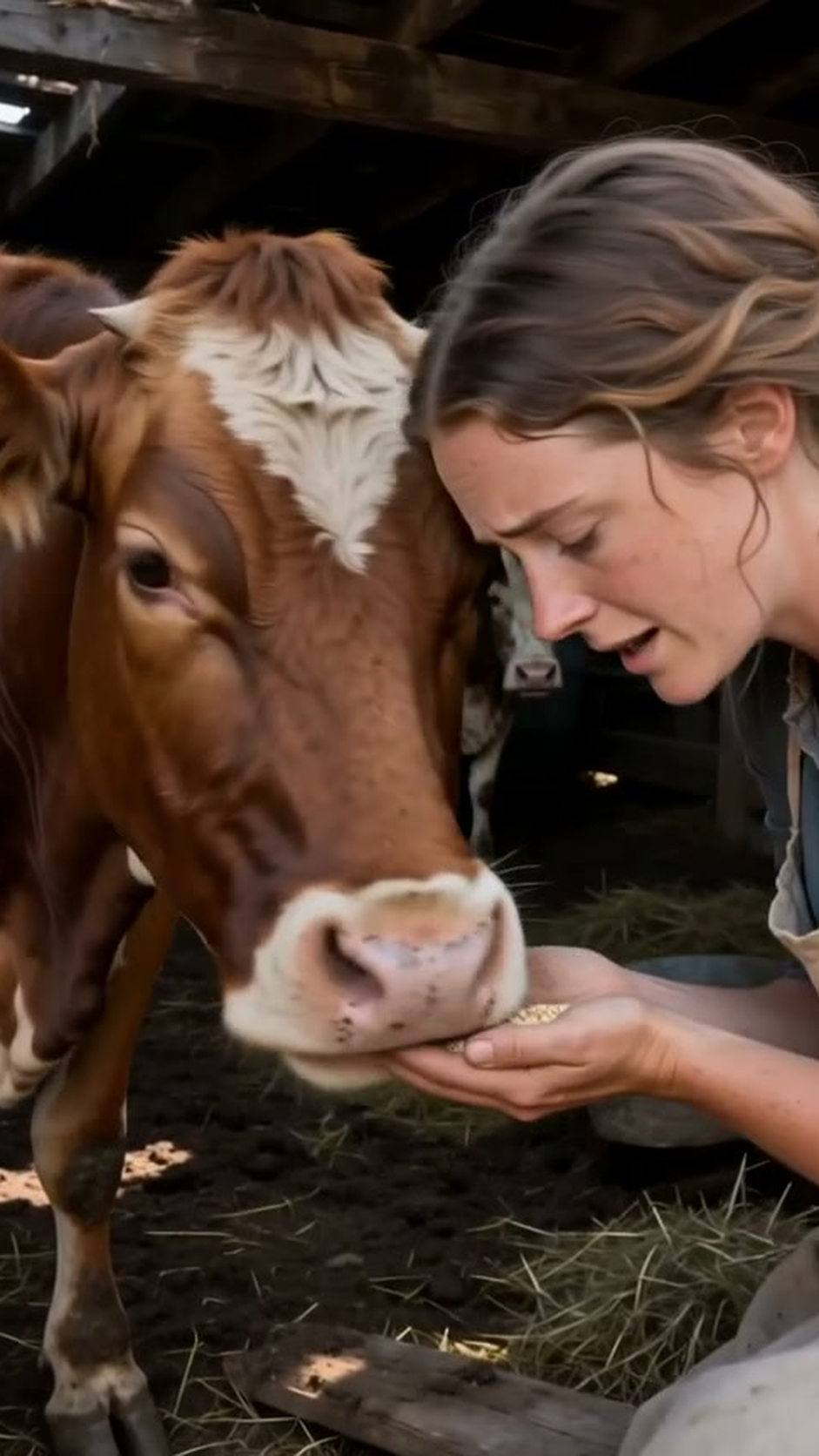
She found the little dun cow at midnight, lying flat in the straw with her legs folded wrong, breathing fast and shallow, eyes rolled to the whites. Bloat, or a fever coming up out of two months of starvation like a debt finally called in — Lenora never knew for certain, and it didn't matter. What mattered was the work, and she did it the way her mother had taught her in another barn in another life: she got the cow's head up and propped. She drenched her slow and patient with warm water and molasses. She walked her in circles in the lantern light at two in the morning, one shoulder braced under the little cow's flank, talking steadily, nonsense and scripture and threats, while Button staggered and leaned and breathed like a torn bellows.
Twice she ran back through the dark to the cabin and heated bricks on the hearth and carried them out wrapped in sacking to pack around the little cow's body, because warmth was the only medicine she had ever actually seen work, and her mother — who had raised eleven calves in a dugout in Kansas with less than this — had always said that a creature fighting to live mostly needs a witness and a warm place to do it in. Lenora sang, because her hands needed the bricks and her voice was what was left over: the hymns first, then the lullaby her mother sang over churns and cradles alike, then, past caring, the words of it turned into a plain running account of everything Button was going to live to see. The new barn she was going to have. The grass in September. The calf she'd maybe have someday, if she behaved. The man from the Bar-T who was going to have to stand in a store in Cedar Flats someday and eat his words with her butter on them.
"You are not a stray," Lenora told her fiercely, at the darkest point of the night, with her forehead pressed against the little cow's warm neck and the lantern burning low. "You hear me? Whatever that paper in town says, whatever any man says. You were left in the dark by people who should have known better, and you waited, and somebody came. That's the whole story. Nobody gets to rename it."
Button's tail switched once against her leg. In the economy of that night, it was a speech.
"If you die," Lenora told her at the worst of it, around three, with sweat running down her back in the cold barn and her arms shaking so hard she could barely hold the lantern, "Silas Crowe wins the whole argument. He gets to tell the county the place killed its stock after all. I will not have it, Button. Do you hear me? I will not have him saying that over your bones. You stand up. You stand up and you eat your breakfast like a Christian and we will show him what this hollow is."
Whether it was the drench, the walking, the warmth of her own quilt that Lenora had dragged off her bed and packed around the little cow's body, or simply that Button, like everything else on that farm, had decided that being written off was not the same as being finished — at first light the cow sighed, folded her legs properly beneath her, and stood. On her own. Wobbly as a newborn, but standing. And at the sight of the bran mash she lowered her head and ate.
Lenora sat down in the straw where she stood and laughed until she cried, and cried until the laughter won, and May came and breathed warm cow breath into her hair like a blessing.
She was still sitting there, wrung out and filthy and happier than she'd been in a year, when Tom Ellery rode in with the county surveyor's notice in his saddlebag — he'd met the rider on the road and taken the delivery as a neighborly favor, and his face told her before the paper did that it was trouble.
NOTICE OF BOUNDARY EXAMINATION, it said, in the county's cramped official hand. Filed at the instance of the Bar-T Cattle Company: a claim that the survey of 1861 underpinning her tax deed was in error, that the true line of the old Spanish grant put the creek, the pasture, and the best fifty acres of Brenner Hollow — everything, in short, except the ruined cabin on its stony patch — on Bar-T land.
And there was a second thing, which she found herself an hour later, riding the fence line to think, with the notice burning in her apron pocket like a coal.
The creek above her pasture had been dammed.
Not beavers. Fresh work — brush and sods and cut willow wands woven tight, a man's work, two days old at most, turning half the creek aside into a dry gully on the Bar-T side of the ridge. Her pasture stream ran already noticeably lower and slower, and in the mud at the dam's edge, printed as clear as a signature, were the tracks of shod horses and one boot with a star-shaped spur rowel.
Lenora looked at the dam for a long time. Then she looked up the empty valley toward the Bar-T, and down at the water that was the life of everything she owned, being stolen an armful of brush at a time.
First the offer. Then the threat about the cows. Then the paper about the line. Then the water itself.
"All right," she said aloud, to the creek, to the hollow, to the man who had decided to squeeze her off this land one quiet piece at a time. "Now I know how we're doing it."