BANG!
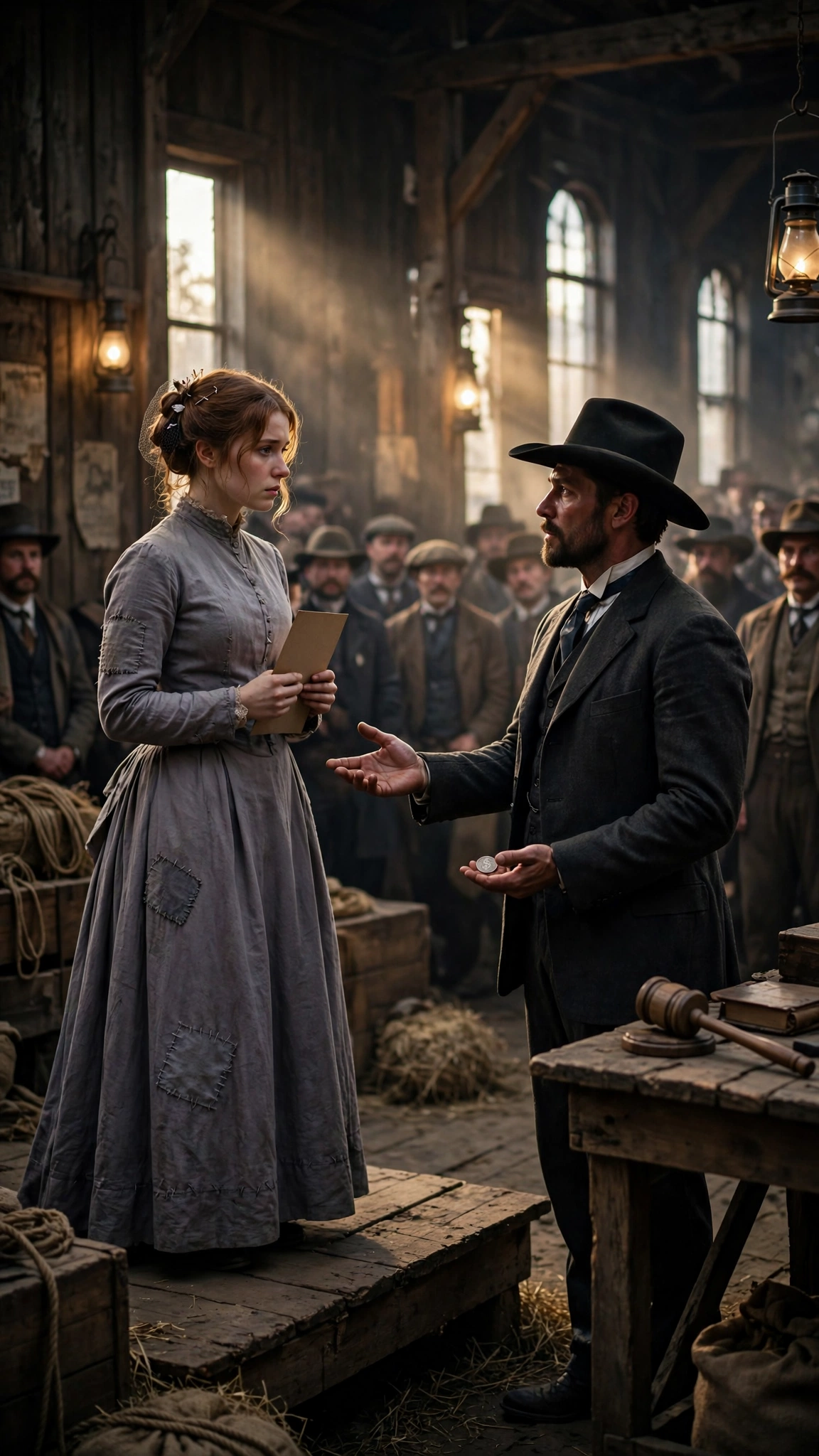
The gavel came down on the rough table and the sound of it went through the warehouse like a rifle shot. Dust rose from the floorboards and hung in the late-afternoon light that came slanting through the tall windows, and for one moment every man in the room stopped talking and looked toward the small wooden stage at the front.
Evelyn Mercer stood alone on the stage, clutching a hand-lettered number card marked "12."
Her dress was lavender-grey, long-sleeved, buttoned to the throat, and carefully mended at the cuffs and the hem where the fabric had worn thin. Her auburn hair was pinned into a modest Edwardian updo, and a few loose strands had come free and lay against her cheek. Her fingers trembled slightly where they held the card. But her posture remained straight.
She had practised that posture all the way from the boarding house on the edge of Council Bluffs. Straight back. Chin level. Eyes forward. She had told herself that if she could hold that posture for one hour, she could hold it for the rest of her life.
The auctioneer, a nervous man with a damp collar, raised his gavel again and cleared his throat.
"Lot twelve," he said, and his voice cracked a little. "Missus Evelyn Mercer. Twenty-eight years of age. Widow. Good health, good character, and —"
"She can't have children!"
The voice came from the crowd, loud and amused, and a ripple of uncomfortable laughter moved through the warehouse. Men in period hats turned to look at one another and shook their heads. One folded his arms dismissively. Another spat on the floorboards.
Evelyn lowered her eyes for one brief moment, fighting the humiliation. She had known the words would come. She had heard them in the street, in the general store, in the churchyard after Thomas was buried. She had heard them so often that she had begun to hear them even when no one spoke. But hearing them here, in front of a hundred men, with the number card shaking in her hand, was worse than she had imagined.
The auctioneer adjusted his collar and looked between Evelyn and the silent crowd, and his gavel hovered in the air, uncertain.
Evelyn raised her chin and looked directly toward the bidders. Her voice was quiet, but it carried to the back of the warehouse.
"I cannot promise children."
The room became noticeably quieter. The men who had been laughing stopped. She could feel the exhaustion beneath her composed expression showing through, and she did nothing to hide it. There was no point in hiding it. She held her number card tighter.
Somewhere near the rear wall, in the shadow of the timber beams, a tall man stood watching her without looking away. He wore a black cowboy hat and an expensive charcoal three-piece suit with a dark blue necktie, and the men around him instinctively gave him room. His beard was neatly trimmed. His hair, long and dark and wavy, touched his collar. His eyes were pale grey, and they had not left her face since the gavel fell.
Beside him stood an older man in plain work clothes, his face weathered by forty years of Nebraska wind. Dutch Kellerman, foreman of the Redmond ranch, leaned closer and spoke softly, the way a man speaks when he is afraid of being overheard.
"We can leave, sir."
Silas Redmond did not respond. His pale grey eyes remained fixed on Evelyn. His expression changed slowly, the way weather changes over the plains — from guarded discomfort to unexpected interest, and then to something quieter and harder to name.
He stepped out of the shadows into the warm, dusty warehouse light. His boots struck the wooden floor with deliberate, unhurried steps, and the surrounding men made room for him without being asked.
"Twenty dollars."
Several men immediately turned toward him in disbelief. The auctioneer froze with his gavel raised. Evelyn looked up sharply, stunned that anyone would make an offer at all. Her lips parted slightly, but she said nothing.
Silas stopped at the edge of the wooden stage and looked up at her. The crowd remained visible in soft focus around them, murmuring, shifting, waiting.
Evelyn met his gaze. Her expression showed suspicion and cautious hope in equal measure, and she swallowed before she spoke, maintaining her dignity the way she had maintained it through the burial and the doctor's visits and the long empty winter that had followed.
"The doctor said I was barren."
A brief silence fell. Silas studied her face rather than looking away. She swallowed again and held his gaze.
"If you need children, don't choose me."
His expression softened almost imperceptibly. There was no dramatic swell of sound. Only the creaking of the warehouse boards and the subdued murmurs of the crowd, and the dust turning slowly in the light from the windows.
Then the mood in the room changed.
Silas reached slowly into his waistcoat pocket. The auctioneer leaned forward, expecting payment. Silas removed a single silver dollar and held it between his fingers, and the light caught it and threw a small bright coin of sunshine onto the floorboards.
"One dollar."
The auctioneer stared at the coin. Several men exchanged astonished looks. Evelyn's hopeful expression faltered, believing she had been insulted again — that after everything, she was worth less than the price of a mule.
But Silas remained completely serious.
"You're not livestock."
The warehouse fell silent. Even the dust seemed to stop moving.
Silas extended his open hand toward her. The silver dollar rested in his other palm. Warm sunlight cut through the dusty warehouse windows behind them and laid a bar of gold across the stage.
Evelyn looked down at his offered hand. Her eyes filled with restrained emotion, but she did not cry. She had not cried in front of anyone since the day they buried Thomas, and she would not start now.
Silas held her gaze.
"Do you accept?"
Evelyn slowly lifted her trembling hand toward his. Their fingertips were about to touch —
And this is where the story truly begins. Not in the warehouse, with the gavel and the silver dollar and the hundred watching men. It began two years earlier, on a cold morning in February, in a small house in Omaha with a leaking roof and a woodstove that never quite warmed the back bedroom, where a young woman sat beside her husband's bed and listened to him breathe.
Thomas Mercer had been a schoolteacher. He was twenty-nine years old, kind in the unshowy way that good men often are, with ink on his cuffs and a laugh that came easily and a habit of reading aloud to Evelyn in the evenings, his feet propped on the stove rail, while she mended his shirts. They had been married four years. They had a house with a garden that grew beans and squash in the summer and a mortgage that Thomas paid on time every month. They had plans. They had a list of names for children, written in Thomas's neat hand on the back of a spelling primer — Samuel, Grace, Joseph, Clara — and Evelyn had added Rose and Abigail in pencil underneath, and they had laughed about which of them would get to choose first.
Then the pneumonia came.
It came in the middle of January, after a week of cold rain, and it took Thomas the way a river takes a fence post — slowly at first, and then all at once. The doctor came twice a day. Evelyn sat beside the bed and held Thomas's hand and read to him from the primer, and when he could no longer hear her, she read to him anyway, because it seemed wrong to stop. On the third morning of February, his breathing changed. It grew shallow and uneven, and then it stopped, and the house went so quiet that Evelyn could hear the stove ticking as it cooled.
She buried him on a grey day with a thin fall of snow, and the whole of the school came to stand in the churchyard, and the children Thomas had taught sang a hymn in thin, brave voices. Afterward, people brought food and left it on the table, and said kind things, and went home to their own warm houses. Evelyn stayed in the small house with the leaking roof and learned what widowhood was: not a single sharp grief, but a long, slow emptying. The bed was too big. The table was too big. The silence at supper was the worst of it, because Thomas had always talked through supper, telling her about the children at school, and now there was no one to talk to, and the food went cold on her plate.
The doctor came to see her in the spring. Dr. Harlan was a careful man with cold hands and a careful voice, and he had delivered half the babies in Omaha. He examined her in the back bedroom with the curtains drawn, and when he was finished he washed his hands for a long time and did not look at her.
"There was damage," he said at last. "From the fever you had three winters ago. The scarring. I am sorry, Mrs. Mercer. You will not bear children."
Evelyn sat on the edge of the bed with her hands folded in her lap and listened to the words go through her like a cold draught. She had never been ill in her life except for that one fever, three winters before, when she had burned for a week and Thomas had sat up with her through the nights. She had recovered. She had thought she had recovered completely.
"Are you certain?" she asked.
"As certain as medicine allows," Dr. Harlan said. "I would not tell you this if there were doubt."
She thanked him, because that was what one did, and she walked him to the door, and she stood at the window and watched him climb into his buggy and drive away down the street. Then she went back to the kitchen and washed the dishes and swept the floor, because there was nothing else to do, and because if she stopped moving, she would have to think.
She did not tell anyone what the doctor had said. She did not need to. In a town the size of Omaha, a doctor's careful voice travels. Within a month, the women at church looked at her differently. Within two months, the invitations stopped. A widow who could not bear children was a closed door. No man would marry her. No family would take her in as anything but a burden. She was twenty-eight years old, and the world had already decided what her life would be: alone, in the small house with the leaking roof, growing older and quieter every year until she disappeared.
By the autumn, the money was gone. Thomas's school had paid her a small sum, and it had lasted through the summer, but the mortgage did not wait for grief. The bank sent a letter. Then another. In November, she sold the house. She sold the furniture, and Thomas's books, and the spelling primer with the list of names on the back — she kept that, folded into her Bible, because some things are not for sale at any price.
She took a room in a boarding house in Council Bluffs, across the river in Iowa, and found work mending dresses for a seamstress who paid her by the piece. The work was honest and the pay was thin, and the winter was long, and the other boarders were kind in the distracted way of people with their own troubles. She mended dresses. She ate little. She slept badly. She prayed, some nights, and on other nights she did not, because she had begun to wonder whether anyone was listening.
It was the seamstress who told her about the auction.
"They hold them in the warehouse, twice a year," the woman said, snipping a thread. "Widows, mostly. Girls from the orphan train, sometimes. Men come from all over the territory. It's not respectable, Evelyn, and I won't pretend it is. But a woman in your position — a woman with no family and no money — it's a door. You walk through it, or you don't. Nobody will think the less of you for going. And nobody will think the more of you for staying here and starving."
Evelyn thought about it for three days. She thought about the small house and the garden and the names on the back of the primer. She thought about Thomas, and what he would have said. Thomas would have laughed, she thought, and then he would have said, "Go and see, Evelyn. Seeing costs nothing." And then he would have added, in the careful way he had, "But hold your head up. Whatever happens, hold your head up."
She went.
She wore her best dress — the lavender-grey one, washed and pressed and mended at the cuffs and the hem — and she pinned her hair up the way she had worn it on her wedding day, and she walked to the warehouse on the edge of town with her hands folded and her back straight, the way she had practised it all the way from the boarding house.
The warehouse was dim and full of men and the smell of tobacco and kerosene, and the auctioneer was already working through his list. She sat on a wooden bench at the back and watched the women go up one by one, and she watched the men bid, and she understood, with a clarity that frightened her, that this was a market, and that she was about to be sold in it like a horse or a chair.
When her number was called — "Lot twelve!" — she stood up, and her legs shook, and she walked to the stage with the number card in her hand, and the gavel came down, and a man in the crowd shouted what the whole town had been saying for a year.
"She can't have children!"
And then a tall man in a black cowboy hat stepped out of the shadows, and offered her one silver dollar, and asked her if she accepted.
Evelyn Mercer stood on the wooden stage with her trembling hand lifted toward his, and the whole of her life — the small house, the primer with the names, the doctor's cold hands, the winter of mending dresses — balanced on a single moment, on the space between two hands that had almost touched.