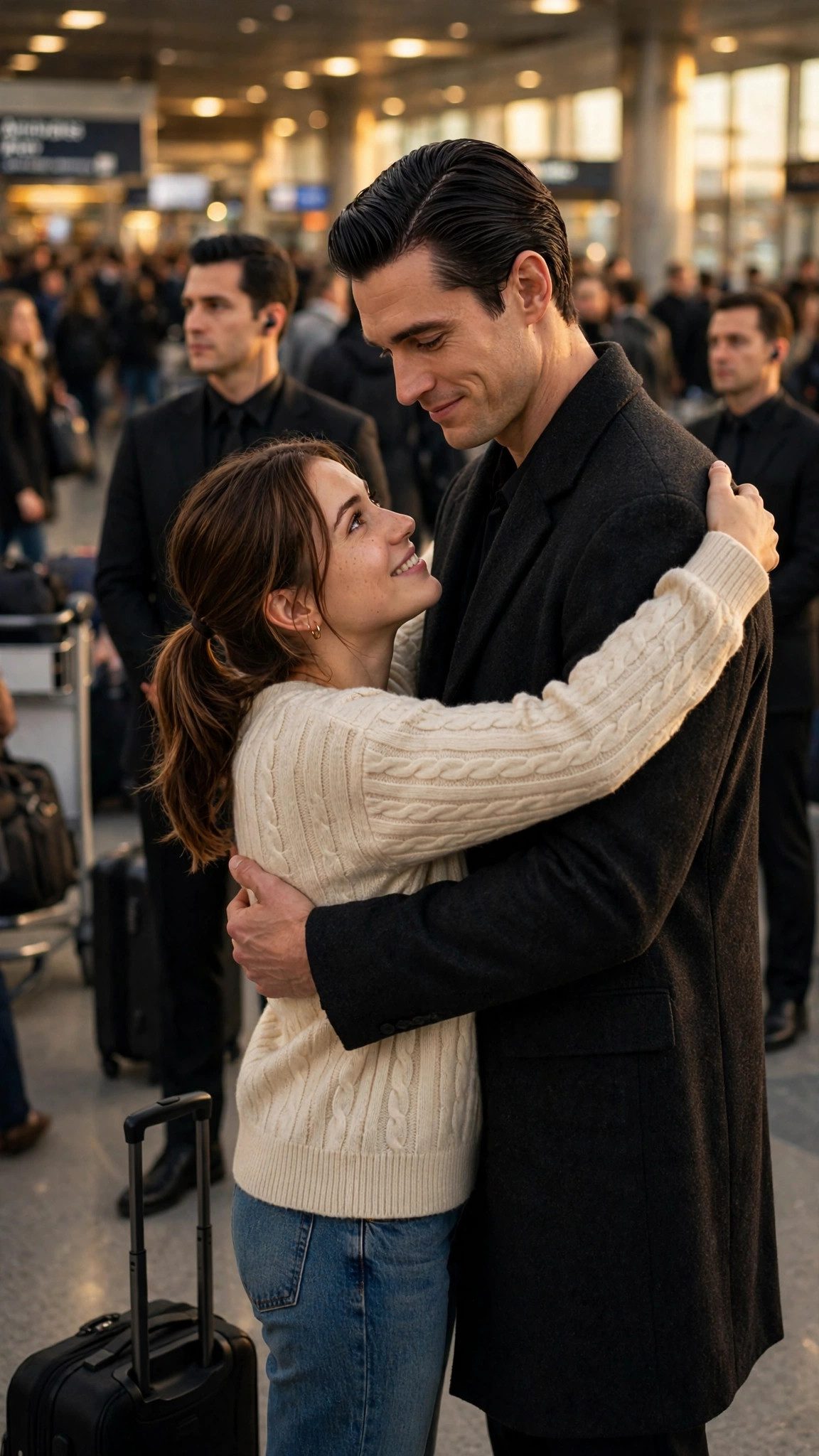
Voss made his move on a Thursday, at the Meridian Freight yard, in broad daylight — because traitors who think they are untouchable do not bother with the dark.
I was at work when it happened. Priya was the one who saw it first — she was wiping down table twelve when her phone buzzed, and she went pale, and she held the phone out to me without a word. It was a text from Luke. Three words.
*Yard. Men. Now.*
I didn't think. I grabbed my apron off and ran — ran through Terminal C, past the security line, past the travelers with their suitcases, out into the parking lot, into a cab, shouting the address of the Meridian Freight yard on the South Side like a woman in a movie. The cab driver took one look at my face and didn't ask questions. He just drove.
The yard was a maze of trucks and containers and chain-link fences, and when I got there, I could hear shouting. I ran toward it, my shoes slipping on the gravel, and I found them behind a row of trailers: Luke, backed against a container, and three men in dark jackets closing in on him. One of them had a crowbar. Another had his hand inside his jacket.
And then, before I could scream, before I could do anything at all, a black car screeched into the yard, and Ethan Caldwell got out of it with Rocco and Marco behind him, and the whole world seemed to stop.
"Step away from him," Ethan said. His voice was quiet. It was the quietest, most terrifying sound I had ever heard.
The man with the crowbar turned. "Mr. Caldwell. This isn't your business."
"That man is my business," Ethan said. "He is my driver. He is my family. And you are on my property, holding a weapon, threatening one of my men. So I am going to ask you once, very politely: who sent you?"
The man laughed. "Nobody sent us. We're just here to talk."
"Then talk," Ethan said. "Talk to me."
What happened next happened very fast and very quietly. Rocco moved first — a blur of motion, and the crowbar was on the ground, and the man who had been holding it was on his knees with Rocco's hand on the back of his neck. Marco took the second man before he could get his hand out of his jacket. The third man tried to run, and Ethan caught him by the collar with one hand and set him back on his feet like a teacher correcting a child.
"Now," Ethan said, looking at the man on his knees. "Who sent you?"
The man spat on the ground. "Voss," he said. "Voss sent us. He said the driver was asking questions, and he said to make him stop."
"Did he say how?" Ethan asked.
The man didn't answer. He didn't have to. The crowbar on the gravel said it for him.
Ethan let go of the man's collar. He looked at Luke, who was standing against the container with his fists clenched and his breathing ragged, and he looked at me, standing in the gravel in my work shoes with my apron still half-tied around my waist, and he said, very calmly, "Take them to the office. Call the police. And call Voss. Tell him I want to see him. Now."
An hour later, in the Meridian Freight office — a room with a metal desk and a window that looked out over the yard and a smell of diesel and old coffee — Dominic Voss walked in, and the whole room went still.
Voss was forty-five, with silver at his temples and a suit that cost more than my car, and he had the relaxed, confident walk of a man who had been the second most powerful man in Chicago for twelve years and had never once doubted it. He looked at Ethan, at Rocco and Marco, at the three men sitting handcuffed on the floor, at Luke, at me — and his face did something I will never forget. It didn't panic. It calculated. It ran through the exits, one by one, and found them all closed.
"Ethan," Voss said smoothly. "What is this?"
"This," Ethan said, "is the end of a three-year lie."
He laid the manifests out on the desk, one by one. Eleven of them. Each one with Voss's signature. Each one with the weight wrong. Then the gambling-room ledgers. Then the police report with *Buried. Voss.* written at the bottom. Then the photograph of Marcus Doyle, laughing, holding a fish — and on the back, in Marcus's handwriting, three words: *Look at Voss.*
"I know about the money," Ethan said. "I know about the Castellanos. I know about the eleven trucks. I know about the police contact — Detective Harlan, in case you were wondering. He confessed an hour ago. He has been closing files for you for three years, and he is very sorry, and he is going to testify."
Voss's face went white. "Ethan—"
"And I know about Marcus Doyle," Ethan said, and his voice dropped lower, and the room seemed to get colder. "I know that he called Luke the night before he died because the manifest was wrong. I know that you sold his route to the Castellanos. I know that he fought, and that you let him die, and that you buried the file. I know all of it, Dominic. I have known all of it for a week. I was just waiting for you to prove it to me yourself."
Voss looked at the three men on the floor. He looked at the manifests. He looked at Ethan. And then, very slowly, he laughed — a short, bitter laugh, the laugh of a man who has run out of moves and knows it.
"You were in New York," Voss said. "You were never here. You never saw the day-to-day. You sat in your clubs and your offices and you let me run the real business, and the real business is dirty, Ethan. It has always been dirty. The money has to move. The routes have to be protected. Somebody has to do the ugly work, and you were never willing to do it. So I did it. I did it for twelve years, and I made you rich, and this is how you repay me?"
"I repay you," Ethan said, "by not killing you."
The room went silent. Even Rocco and Marco went still.
"Three years ago," Ethan said, "you got a good man killed, and you buried the truth about it. Today, you sent three men with a crowbar to kill his best friend. You did that on my property, to my driver, to the brother of the woman I—" He stopped. He looked at me. He started again. "To the brother of a woman who matters to me. And for that, you will go to prison. You will go to prison for a very long time. And you will never, ever touch my people again."
He nodded at Rocco. Rocco picked up the phone and called the police.
Voss sat down in a chair, very slowly, like an old man, and he put his face in his hands. "You were supposed to be in New York," he said, almost to himself. "You were never supposed to look."
"I looked," Ethan said, "because a barista hugged me in an airport, and her brother asked too many questions, and I finally started asking my own."
The police came. They took Voss away in handcuffs, and they took the three men with him, and the yard went quiet, and Luke stood in the middle of it with his fists still clenched, and I walked over to him and put my arms around him, and he held on to me like he was drowning.
"It's over," I said. "Luke, it's over. Marcus — it's over."
Luke nodded against my shoulder. He didn't say anything. He didn't have to.
Behind us, Ethan stood in the doorway of the office, watching us, and when I looked up at him, he was smiling — not the dry smile, not the careful smile, but the real one, the one that changed his whole face.
And I realized, standing there in the gravel with diesel in the air and my brother in my arms, that the most feared man in Chicago had just risked everything — his empire, his right hand, his own safety — for a dead truck driver he had never met, and a living one who had been asking too many questions, and a barista who had hugged him by accident.
And I realized something else, too. I realized that I had stopped being afraid of him a long time ago. I just hadn't noticed yet.
That evening, Ethan took us to the Meridian Club on Rush Street.
I had never been inside it before. From the outside it looked like nothing — a dark door, a brass plaque, a doorman who nodded at Ethan like he was the king of the city, which, in a way, he was. Inside it was all warm wood and low light and quiet music, and the bartender set down drinks without being asked, and nobody stared, because in a place like that, staring was rude and also dangerous.
Ethan sat us down in the back booth — the same booth, Priya's cousin had told me, where he sat twice a month at midnight, watching the room like he was counting something — and he ordered food, and for the first time since I had met him, he looked tired. Not the careful, controlled tiredness of a man who never slept enough, but the deep, bone-tired exhaustion of a man who had just cut off his own right hand and was still standing.
"Voss confessed," he said, pouring wine for Luke and me and sparkling water for himself. "Not to the police — to me, in the car, on the way to the station. He told me everything. The skimming, the Castellanos, the police contact. He told me he started small — a few thousand here, a few thousand there — and then it got bigger, and then Marcus found the manifest, and Voss panicked, and he sold the route, and Marcus died, and after that there was no going back."
"Why didn't you kill him?" Luke asked. It wasn't an accusation. It was a genuine question, asked by a man who had spent three years imagining what he would do to the person who killed his best friend.
"Because," Ethan said, "killing him would have made me the man he thought I was. And because Marcus Doyle deserves justice, not revenge. Justice means a trial. Justice means the truth on the record. Justice means his family gets to hear, in a courtroom, that their son did not die for nothing."
Luke was quiet for a long time. Then he picked up his glass and held it out, and Ethan clinked his glass against it, and I did the same, and none of us said anything, because there was nothing to say that a toast could not say better.
"There's one more thing," Ethan said, setting his glass down. "Salvatore Castellano. His men hit that truck. His family took the money. I have known it for a week, and I have been deciding what to do about it."
"What are you going to do?" I asked.
"Nothing," Ethan said. "Not yet. Castellano is old, and his sons are reckless, and a war with him would cost lives — drivers, bartenders, men who have nothing to do with any of this. Voss was the rot in my house. Castellano is a problem for another day, and I will deal with him the way I deal with everything: quietly, and on my own terms. But Marcus's death was Voss's doing, not Castellano's. The Castellanos were the weapon. Voss was the hand that held it."
After dinner, Ethan walked me out to the car. Luke had already gone ahead — Rocco was driving him home, and Marco was standing by the door like a shadow that had learned to be polite. The street was quiet, and the rain had stopped, and Chicago smelled like wet pavement and possibility.
"Hannah," Ethan said, and he stopped walking, and he looked at me in the streetlight, and for the first time since I had met him, he looked nervous. Not afraid — Ethan Caldwell was not afraid of anything, I was fairly sure — but nervous, the way a man gets nervous when he is about to say something that matters.
"My mother," he said, "died when I was nineteen. She was the only person in my family who ever told me I could be something other than what my father was. She used to say that a man is measured by what he remembers — and by who remembers him. I have spent fourteen years building an empire, and I have spent fourteen years wondering if anyone would remember me for anything except fear."
He took a step closer. "And then you hugged me in an airport, and you told me you'd missed me, and you had never met me, and you meant it for someone else, and I have not been able to stop thinking about it. Because in fourteen years, no one has ever held me like that. No one has ever looked at me and seen a person instead of a name."
I stood there on the sidewalk on Rush Street, in my work shoes with my apron still folded in my bag, and I looked at the most feared man in Chicago, and I saw what he was asking me, and I saw what it cost him to ask it.
"Ethan," I said, and my voice was steady, even though my heart was hammering. "I hugged you by accident. But everything after that was a choice. And I chose to come to table twelve. I chose to help you. I chose to trust you. And I'm choosing it again now."
He reached out, slowly, the way you reach out to something you are afraid of frightening away, and he took my hand. His hand was warm. It was steady. It was the hand of a man who had just dismantled his own empire's rot for the sake of a dead truck driver and a living one, and it was shaking, just a little.
"Then," he said quietly, "may I walk you home?"
"Yes," I said. "You may."
And he did. All twelve blocks, through Logan Square, past the violin player's building, past the corner store with the flickering sign, all the way to my door. And when we got there, he did not kiss me. He just stood on the sidewalk and looked at me, and he said, "Good night, Hannah Reed. Thank you for hugging a stranger."
"Good night, Ethan Caldwell," I said. "Thank you for being worth hugging."
I went inside, and I stood at my window, and I watched him walk away down the street in the dark, and I thought about Marcus Doyle, and about Luke, and about my mother, who had taught me that kindness was a kind of courage.
And I thought about the invisible thread that had connected me to Ethan Caldwell from the very beginning — and I finally understood what it was. It wasn't fate. It wasn't luck. It was Marcus. It was Luke. It was a dead man and a living one and a barista who had hugged the wrong man in an airport, and all of them had been pulling me toward table twelve from the very first day.
I had spent my whole life being sensible. But sensible had never felt like this. Sensible had never felt like standing at a window at midnight, watching the most feared man in Chicago walk away, and wishing he would come back.