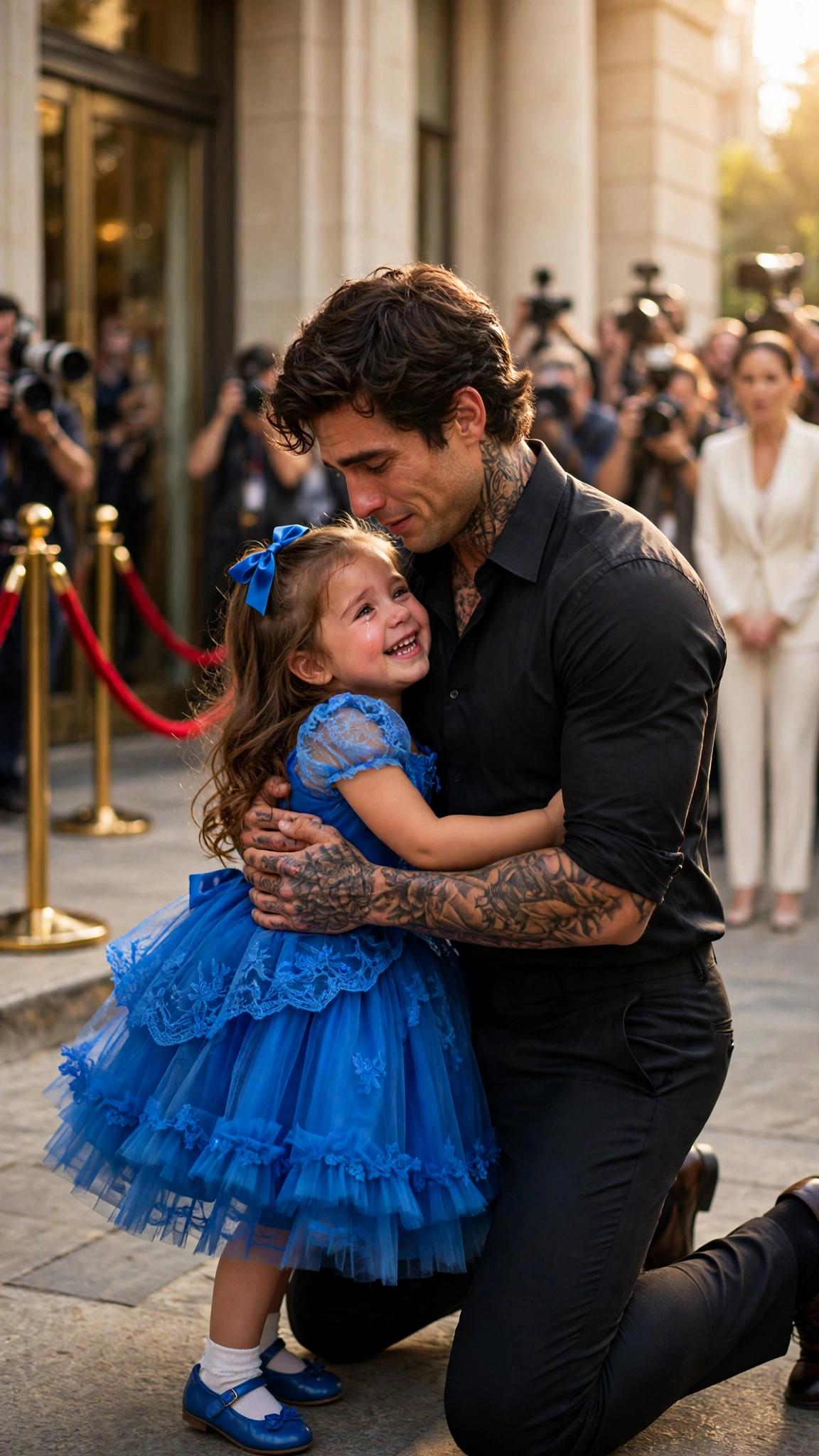
Michael Rivers had not believed in love at first sight until the night of the Hope Foundation gala, seven years before the afternoon at Sunrise Children's Home.
He had been twenty-five, newly in charge of his father's company after Richard's first heart scare, and he had hated every gala he was obliged to attend. That night he had stood near the bar with a glass of water he was not drinking, watching rich people congratulate themselves for their generosity, when a young nurse in a simple navy dress had walked up to the podium and told three hundred donors, in a clear and steady voice, exactly what their money did and did not do.
"It does not buy a child a mother," Claire Bennett had said. "It does not buy a night nurse for a ward of six. What it buys is time. And time, for a sick child, is everything."
The room had gone quiet in a way Michael had never heard a room go quiet. Then it had applauded. And Michael had crossed the floor before he knew he was going to, and he had said, "I'd like to know more about the ward of six," and Claire had looked at him with warm brown eyes and said, "You can come and see it. Tuesday. Bring comfortable shoes."
He had gone on Tuesday. He had worn comfortable shoes. He had spent four hours in a children's ward in Queens, holding a basin while a small boy was sick, reading a picture book to a girl with a bandage over one eye, and watching Claire move between the beds like a woman who had been born knowing exactly where she was needed. On the way out she had said, "You didn't flinch once. Most rich men flinch."
"I didn't know I was a rich man until you said it," he had answered, and she had laughed — a real laugh, unguarded — and something in his chest had shifted, quietly, like a door opening.
He came back the next Tuesday. And the Tuesday after that. The children began to know his name. A small boy named Tommy, who had a broken leg and an endless supply of questions, appointed himself Michael's official guide to the ward. "That's the medicine room, and that's where the good blankets are, and that's Nurse Claire, and she's the best one," Tommy told him, with great authority. Claire watched them from the nurses' station with an expression Michael could not quite read — amusement, and something softer underneath it. On the fourth Tuesday, as they walked out together into the late afternoon sun, she said, "You keep coming back. Why?" And Michael, who had rehearsed a dozen clever answers, said the true one instead: "Because this is the only place in my whole week where I feel like myself."
For two years they were happy in the plain, unremarkable way that happy people are. Claire kept her small apartment in Queens and her job at the clinic. Michael kept his office on the fifty-second floor and his father's expectations. They met in the middle — Sunday mornings in Central Park, cheap dinners that Michael insisted on paying for and Claire insisted on splitting, long walks after her night shifts when the city was quiet and the streetlights were still on. He learned the names of her patients. She learned the names of his anxieties. He told her things he had never told anyone: that he was afraid of becoming his father; that he did not know whether he wanted the company or whether the company wanted him. She listened the way she listened to everything, completely, without reaching for her phone or for an answer.
"You're not your father," she told him once, lying beside him on a blanket in the park with the sun going down behind the trees. "You're the man who spent four hours in a children's ward and came back the next Tuesday. That's who you are."
He had believed her. For two years, he had believed her.
Their courtship had been unhurried and ordinary in the best possible way. Their first real date was a walk across the Brooklyn Bridge at midnight, after one of Claire's late shifts, when the city was quiet and the river was black and shining below them. Michael had bought two cups of hot chocolate from a cart, and Claire had laughed at him for getting whipped cream on his nose, and somewhere in the middle of the bridge he had stopped walking and said, "I think I'm falling in love with you," and she had said, "I think I'm falling in love with you too," and they had stood there while the traffic hummed beneath their feet and the whole of Manhattan glittered around them.
He met her mother that Christmas. Mrs. Bennett was a small, sharp-eyed woman from New Jersey who looked Michael up and down in her kitchen doorway and said, "You're the rich one, then." Michael had nodded, bracing himself. "I was a nurse for thirty years," she had said. "I've seen rich men and poor men, and I can tell you the money doesn't matter. What matters is whether you show up. Do you show up, Mr. Rivers?" Michael had said, "I try to, ma'am," and she had studied him for a long moment and then nodded once, as if he had passed a test she had not told him he was taking.
Claire met his father exactly once. Richard Rivers had invited them to dinner at his apartment — a vast, cold place full of dark wood and old paintings — and he had spent the evening asking Claire polite, surgical questions about her job, her family, her education, as if he were interviewing a job applicant. Claire had answered every one of them with calm, unshakeable dignity. On the way home in the car, Michael had apologised, and Claire had said, "Don't. Your father is afraid, Michael. Men like him are always afraid — of losing control, of losing the company, of losing you. Fear makes people cruel. It doesn't make them right."
In the second year, Michael told her he loved her properly — not on a bridge at midnight, but on an ordinary Tuesday evening, in her small kitchen, while she was making pasta and he was failing to help. "I love you, Claire Bennett," he had said, and she had put down the wooden spoon and turned to him with flour on her hands and said, "I love you too, Michael Rivers. Now wash the lettuce."
Those were the two happiest years of his life. He did not know it then. Happiness, he would learn, is almost always something you only recognise in the rear-view mirror.
Then his father began to die in earnest.
Richard Rivers had been a hard man his whole life — a man who had built an empire out of nothing and trusted no one who had not earned it twice over. When the doctors told him the cancer had spread, he did not become gentle. He became urgent. He summoned Michael to his bedside and laid out the future the way he had always laid it out: as a set of terms.
"The Ashford merger," he said, his voice thin but his eyes still sharp. "You marry Eleanor Ashford, the companies combine, the family is safe for a generation. That's the deal, Michael. That's what I built all of this for."
"I love Claire," Michael said.
His father closed his eyes. "Love is a luxury, son. I loved your mother, and look what it got her. A small house and a short life. You want to be a good man? Be a rich one. Be a powerful one. That's what protects people. Not feelings."
Michael did not marry Eleanor Ashford. He told his father so, and they fought about it for weeks — the last real conversations they ever had. But the pressure did not stop. The board began to ask questions. The Ashfords began to make their displeasure known. The company's share price wobbled. And all the while Richard lay in his hospital bed, growing thinner and greyer, telling anyone who would listen that his son was throwing away everything he had built.
It was in the middle of that storm that Claire missed her period.
She did not tell Michael at first. She told herself she wanted to be sure. She took a test in the small bathroom of her Queens apartment on a Tuesday morning before her shift, and when the second line appeared she sat down on the edge of the bathtub and put her hands over her face and cried — not because she was unhappy, but because she was so happy it frightened her, and because she knew, even then, what the news would cost them.
She waited three days. She took two more tests. She went to her own doctor, who confirmed it with a blood test and a smile. And then she went to Michael's penthouse on a rainy night, holding a small white stick in her hand, and she told him.
She told him, and he said, "You can't be serious."
She told him again, and he walked to the window and put his hands on the glass and talked about not being ready, and about the company, and about his father, and about money. And when his phone rang — his father's nurse, calling him to the hospital — he took the call like a lifeline and said, "We'll talk about this tomorrow."
Claire stood in the doorway of the penthouse with her coat in her hands, and she looked at the man she loved, and she understood something she had not understood five minutes earlier: that love, on its own, was not always enough. That a man could love you and still walk away from you. That the words "I love you" and the words "I'm staying" were not the same words.
"I love you," she said. "Whatever you decide tomorrow, I want you to know that."
Then she went home to Queens, and she waited for tomorrow.
Tomorrow came, and Michael did not call.
The next day came, and he did not call either. On the third day, Claire put on her coat and went to his office. The receptionist, a young woman Claire had once chatted with at a company party, looked at her with genuine pity and said, "I'm sorry, Miss Bennett. Mr. Rivers is not available. He's asked not to be disturbed."
Claire nodded. She did not cry in the lobby. She walked out into the sunshine and stood on the pavement for a long time, one hand resting lightly on her stomach, and she made a decision that would shape the next five years of her life.
She would not beg. She would not chase a man who needed to be chased into loving his own child. She would raise this baby herself, and she would raise her well, and she would tell her daughter every good thing about her father — because a child deserves to believe her father is a good man, even when he has not yet proved it.
She went back to the clinic the next morning and worked her shift. She told her supervisor she was pregnant. She began to save money in a jar on her kitchen counter, a dollar here, five dollars there, the way her own mother had taught her. She bought a small secondhand crib and set it up beside her bed. She read books about pregnancy and made lists of names.
And at night, alone in her small apartment, she talked to the baby.
"Your daddy is a good man," she whispered. "He's just lost right now. But he's going to find his way back. I promise you, little one. He's going to come."
She did not know, then, that his father had already told him a lie that would keep him lost for five years. She did not know that Richard Rivers, dying in his hospital bed, had looked his son in the eye and said, "She took the money and she's gone."
She only knew that she loved her baby, and that love would have to be enough.
It was, for a while. It was enough for the morning sickness, and the swollen ankles, and the nights when she woke up alone and put her hand on her stomach to feel the baby kick. It was enough for the day in the delivery room when the nurse placed a tiny, red-faced, perfect girl in her arms and said, "It's a girl, Claire. She's beautiful."
Claire looked down at her daughter — at the dark eyes that were Michael's eyes, at the fine light-brown hair — and she whispered the name she had chosen five years ago, in the dark, holding Michael's hand.
"Emma," she said. "Your name is Emma."