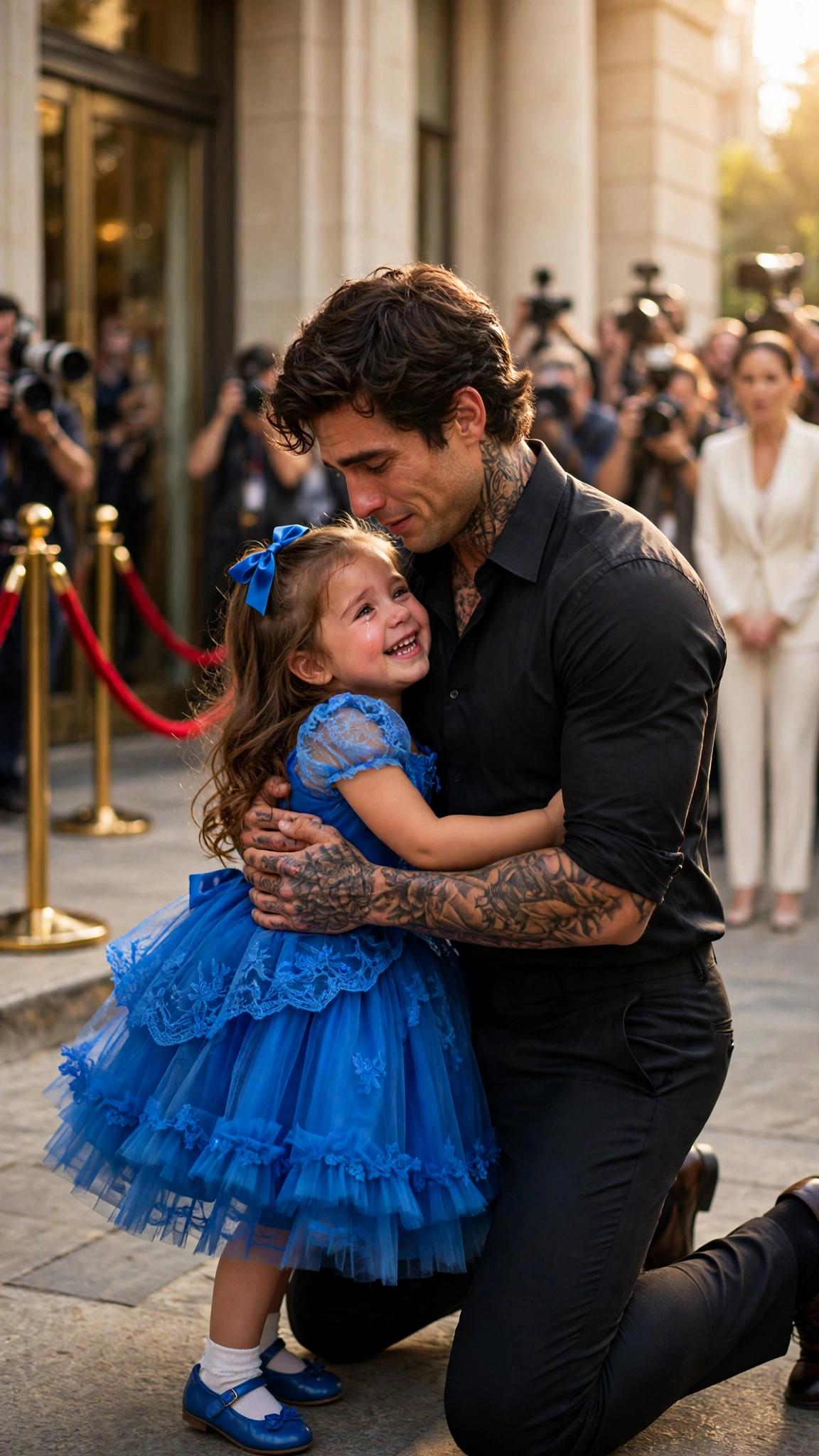
Emma Bennett was born on a cold February morning, in a small hospital room in Queens, while snow fell softly past the window and Claire held the nurse's hand hard enough to leave marks.
She was five pounds, eleven ounces. She had a shock of fine light-brown hair and dark eyes that opened almost immediately, as if she were already looking for someone. The nurse laughed and said, "She's alert, this one. She's going to be trouble." Claire laughed too, through her tears, and held her daughter against her chest and thought, with a fierceness that surprised her, that no one would ever hurt this child. Not the world. Not poverty. Not the absence of a father who should have been standing right there beside the bed.
The first year was the hardest. Claire went back to work at the clinic when Emma was ten weeks old, because the rent did not pause and neither did the bills. She worked night shifts and slept in snatches. Her mother, who lived two hours away in New Jersey, came to help when she could, and Claire's neighbour, an elderly woman named Rosa, watched Emma for a few dollars and a great deal of love. Emma grew the way healthy, loved children grow — quickly, and all at once. She rolled over. She sat up. She said "Mama" at nine months, and Claire cried in the kitchen with her hand over her mouth.
When Emma was two, Claire started the photograph ritual.
It was a simple thing. Every Sunday morning, after breakfast, Claire would take a framed photograph down from the shelf — a photograph of a tall man with thick dark-brown wavy hair and a strong jawline, standing on a beach in a black shirt, smiling at the camera with his arm around Claire — and she would set it on the table in front of Emma.
"That's your daddy," she would say. "His name is Michael. He's very tall and very strong, and he has tattoos on his arms, and he loves you very much."
"Where is Daddy?" Emma would ask.
"He's far away right now," Claire would say, and she had practised this answer until it came out steady. "But he's going to come. He promised — well, he doesn't know he promised. But he's going to come, sweetheart. I know it in my heart."
Emma accepted this the way children accept everything their mothers tell them: completely. She kissed the photograph goodnight. She drew pictures of the three of them — Mama, Daddy, Emma — holding hands in front of a big house with a blue door. She told her dolls that her daddy was a king who lived in a castle in the city, and that one day he would send a car for them.
The second year brought nursery school, and with it, new questions. Emma came home one afternoon and announced that her friend Sophie had a daddy who picked her up every day, and why didn't her daddy pick her up? Claire knelt down and smoothed Emma's hair and said, "Your daddy is very busy, sweetheart. He has a big job in the city. But he's thinking about you, I promise." Emma considered this, and then she said, "When he comes, will he pick me up every day?" Claire said, "Every single day," and Emma seemed satisfied.
That year, Claire worked double shifts whenever she could, and Rosa — the elderly neighbour — became a second grandmother, feeding Emma soup on Sundays and teaching her to say "thank you" in Italian. On Emma's third birthday, Claire made a cake herself, a little lopsided, with blue frosting, and Emma blew out the candles and wished — out loud, because she was three and did not know wishes were supposed to be secret — "I wish Daddy comes this year." Claire smiled and cut the cake, and later, after Emma was asleep, she sat at the kitchen table and cried quietly into a dish towel, and then she washed her face and went to bed, because there was work in the morning.
Emma's questions grew more detailed as she grew older. "Does Daddy have tattoos like the man in the picture?" she asked one Sunday. "Yes," Claire said. "On his arms and his neck. They're very beautiful." "Is Daddy tall like a giant?" "Almost," Claire said. "He's six foot two. That's very tall." "Does Daddy like princess dresses?" Emma asked, twirling in her blue dress. "I think," Claire said, "that your daddy is going to love that dress more than anything in the world."
And all the while, Claire saved money in the jar on the kitchen counter, and paid the rent, and worked her shifts, and never once let Emma see her afraid.
Claire never told her the truth. She never said, "Your father walked away." She never said, "He chose his company over us." She told herself it was for Emma's sake, and it was — but it was also for her own. Because as long as Emma believed her daddy was coming, Claire could believe it too, just a little, in the quietest corner of her heart.
When Emma was three, Claire began to get tired in a way that sleep did not fix.
At first she told herself it was the night shifts. Then she told herself it was the winter. But by spring she was breathless climbing the stairs to her apartment, and her heart would race for no reason, and twice she woke in the night with her chest tight and her hands cold. She went to her doctor, who listened to her heart for a long time with a frown, and sent her to a cardiologist, who ran tests and looked at the results with a face Claire had seen too many times on the other side of a hospital bed — the face of a person about to deliver bad news.
"You have a faulty heart valve," the cardiologist said gently. "It's been there a long time, probably since you were born, and it's been getting worse. You need surgery. A valve replacement. It's a serious operation, but it's a routine one, for the right surgeon. Without it —" He paused. "Without it, Claire, you have perhaps a year. Perhaps less."
Claire sat in that office with her hands folded in her lap, and she thought about the rent, and the clinic, and Emma's shoes, which she had just outgrown again. She thought about the cost of the surgery — a number so large it did not seem real — and about the months of recovery, and about who would look after Emma while she was in the hospital.
"I'll think about it," she said.
She did not think about it. She went home and made dinner and helped Emma with a puzzle, and she put the cardiologist's card in a drawer, and she did not call him back. She told herself she would find a way. She told herself there was time.
That night, after Emma was asleep, she called her mother in New Jersey. She had not cried on the phone to her mother since she was a teenager, but she cried then, quietly, so Emma would not hear. Her mother listened, and then she said, "Claire. Come home. Bring Emma. We'll look after you both." Claire wiped her eyes and said, "I can't, Mama. I can't ask you to carry this. And Emma has her school, her friends — I won't uproot her." Her mother was quiet for a moment, and then she said, "Then let someone help you there. Pride is a fine thing, my girl, but it doesn't pay a surgeon's bill, and it doesn't hold a little girl's hand when her mother is in an operating theatre." Claire promised she would think about it. She hung up, and she sat at the kitchen table for a long time, looking at the cardiologist's card in the drawer, and at Emma's drawings on the fridge, and at the jar of saved dollars on the counter.
In the end, it was Rosa who decided her. The old woman came over the next morning with soup, as she always did, and she took one look at Claire's face and said, "You're worse. Don't lie to me, child. I can see it." Claire told her everything — the valve, the year, the cost. Rosa nodded slowly, and then she said, "My sister's granddaughter works at Sunrise Children's Home, in Manhattan. A beautiful place. Kind people. Go and talk to them, Claire. Just talk. That's all I'm asking."
There was not time. The tiredness got worse. Her ankles swelled. She had to stop working night shifts, and then she had to stop working altogether for two weeks when she collapsed in the clinic hallway and woke up with Rosa holding her hand and Emma crying in the corner.
It was Rosa who said what Claire could not say to herself.
"You need help, child," the old woman said, sitting on the edge of Claire's bed with a cup of tea. "You need to let someone help you. That little girl needs her mother alive more than she needs her mother proud."
Claire cried then — really cried, for the first time in years — and Rosa held her, and when the tears stopped, Claire did the hardest thing she had done since the night in the penthouse.
She made a plan.
She went to Sunrise Children's Home, a beautiful old building in Manhattan with cream limestone walls and tall glass doors, a place she had once toured with Michael for a charity event, back when they had been happy and the future had seemed simple. She met the director, a kind-eyed woman named Helen Marsh, and she told her everything — the pregnancy, the abandonment, the photograph, the failing heart, the little girl in the blue dress who believed her daddy was coming.
Helen listened without interrupting. When Claire finished, she said, "You don't have to leave her here forever. We have a respite programme. She can stay with us while you get your treatment. And when you're better, you come back for her."
"And if I'm not better?" Claire asked.
Helen took her hand. "Then we'll make sure she's safe, and loved, until her father comes. Because he will come, Claire. Men like that always come, in the end. They just need someone to show them the door."
Claire went home and packed Emma's small suitcase. She packed the blue princess dress — the one Emma loved most, with the lace and the puffed sleeves and the full tulle skirt — because she wanted her daughter to feel like a princess on the days when she felt most afraid. She packed the blue bow for her hair. She packed the photograph of Michael, wrapped carefully in a soft cloth.
And she wrote a letter.
She wrote it at the kitchen table, late at night, after Emma was asleep, and she cried while she wrote it, and she crossed things out and started again, and when it was finished she read it three times to make sure it said everything she needed it to say. She sealed it in an envelope and wrote on the front, in her clearest handwriting: For Michael Rivers — to be opened only by him.
Then she wrote a second document — a short, plain statement, signed and witnessed, naming Michael Rivers as Emma's father and giving Helen Marsh temporary guardianship until he could be found.
On Emma's last morning at home, Claire dressed her in the blue dress and pinned the blue bow in her hair, and she knelt down in front of her daughter and held her small hands.
"You're going to stay at a beautiful place for a little while, sweetheart," she said. "A place with a garden and kind ladies, and lots of other children to play with. Mama has to go to the hospital so the doctors can fix my heart. And while I'm there, you're going to wait for Daddy. Because your daddy comes to that place every year, Emma. He comes to give money to the children. And this year, when he comes, he's going to see you."
Emma's eyes went wide. "This year, Mama?"
"This year," Claire said. "I promise."
She took Emma to Sunrise Children's Home that afternoon. She handed Helen the sealed letter and the guardianship paper. She kissed Emma a hundred times. And then, before she could change her mind, she walked out through the tall glass doors and got into a taxi, and she did not look back, because if she had looked back she would never have been able to leave.
Three weeks later, Claire lay in a hospital bed at St. Vincent's, her heart fluttering weakly in her chest like a bird against a window, and she asked the nurse the same question every morning.
"Has he come yet?"
And every morning the nurse said, "Not yet, Claire. But today might be the day."
On the twenty-second morning, the nurse came in smiling.
"Today's the day, Claire," she said. "It's the donation event. He's coming today."
Claire closed her eyes. She put her hand over her heart. And she whispered, to no one and to everyone, "Go to him, Emma. Run to him, baby. Don't be afraid."