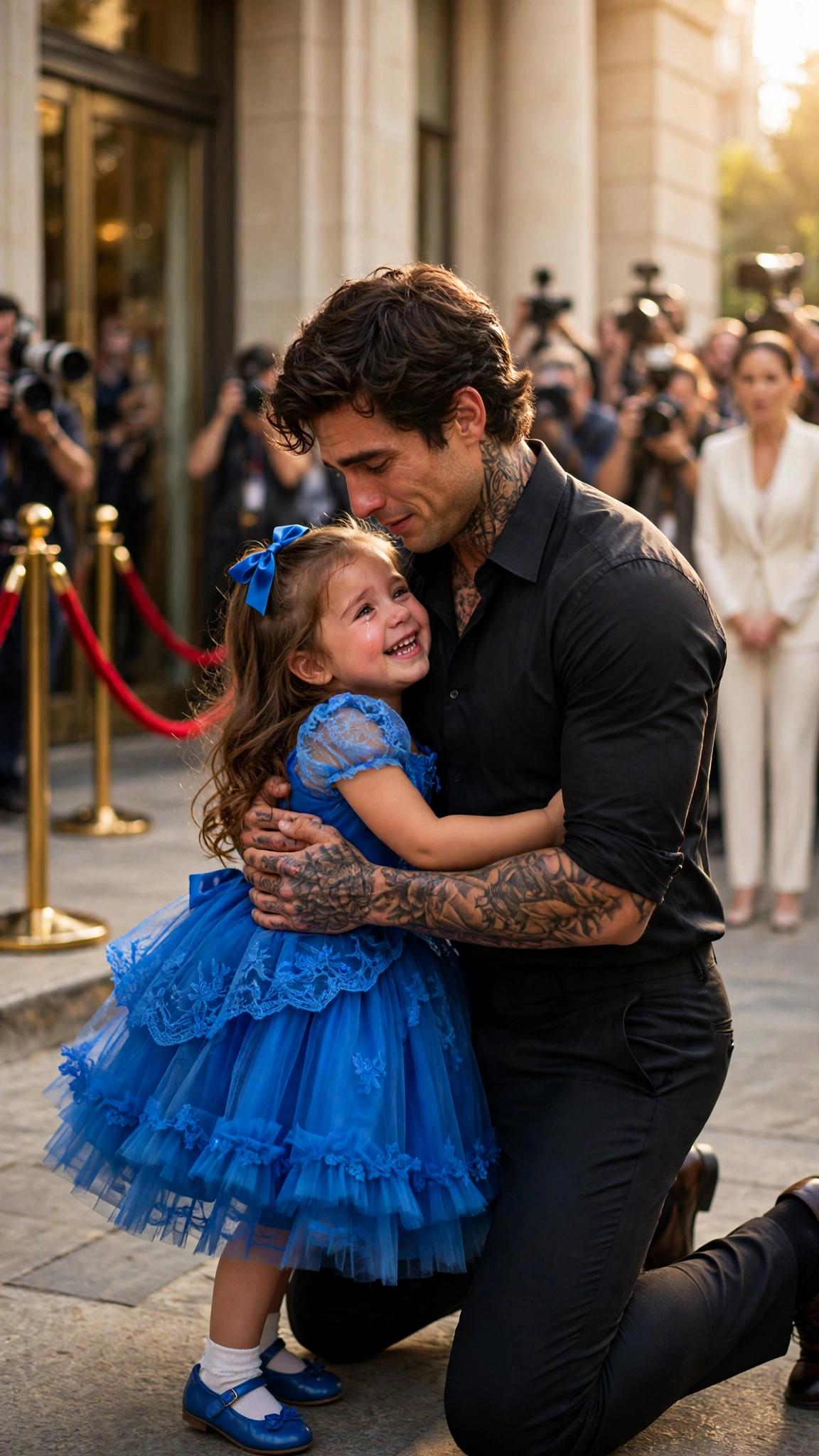
The letter waited for him in Helen Marsh's office, in a cream-coloured envelope with his name written on the front in Claire's clear, careful handwriting.
Michael sat in a chair that was too small for him, in a room full of children's drawings and small bright furniture, with Emma asleep on a little sofa beside him — exhausted by the afternoon, her blue bow slightly crooked, one small hand still curled around the edge of his jacket as if she were afraid he would disappear if she let go. He had not let go of her hand either.
Helen set the envelope on the desk between them. "She wrote it three weeks ago," she said quietly. "She asked me to keep it safe, and to give it to you only if you came. She said if you didn't come, I should burn it."
Michael stared at the envelope. His name, in Claire's handwriting. He had not seen her handwriting in five years, and it hit him harder than anything that had happened on the pavement outside — harder than the cameras, harder than Emma's cry, harder than the words "her name is Emma." He picked it up with both hands, the way you pick up something fragile.
"There's something else," Helen said, and she opened a drawer and took out a folded document. "A birth certificate. Emma Bennett, born February 14th, five years ago, at Queens General Hospital. Father: Michael Rivers. Claire registered it herself, the day Emma was born. She never asked you for anything, Mr. Rivers. She never asked anyone for anything. But she made sure the truth was written down somewhere."
Michael unfolded the birth certificate with shaking hands. There it was, in black and white, in an official registrar's type: Father — Michael Rivers. He read it twice. Then he put it down very carefully on the desk, and he opened the letter.
My dearest Michael,
If you are reading this, then Emma found you. I told her you would come, and I have never been so glad to be right.
I want you to know three things before anything else. First: I never took your money. Your father came to see me the week after I told you I was pregnant. He offered me a great deal of money to disappear, and I refused it. He told me that if I didn't take it, he would make sure you never believed me anyway. I think he was right about that part. I don't write this to make you hate him. He's gone now, and I believe he thought he was protecting you. But you deserve to know the truth. I loved you. I never sold that.
Second: Emma is yours. You will know it the moment you look at her, because she has your eyes, and your stubborn chin, and your habit of tilting your head when you're listening hard. She is the best thing I have ever done. She is brave and kind and funny, and she has waited for you every single day of her life. Please don't make her wait any longer.
Third: I am in St. Vincent's Hospital, on the cardiac ward, room 412. My heart is failing, Michael. The doctors say I need a valve replacement, and soon. I have put it off for too long because I was afraid of the cost, and afraid of leaving Emma alone. I am not afraid anymore. I am only afraid of running out of time before you know the truth.
Come and find me. Not for me — for her. She needs her father. And, if I'm honest, I need you too. I have needed you for five years.
All my love, always,
Claire
Michael read the letter twice. The second time, tears fell onto the paper, and he wiped them away quickly, carefully, with the side of his hand, because he could not bear to smudge a single word of it.
"Your father came to see me," he whispered. "He offered me money. I refused it."
Helen nodded. "She told me the whole story, the day she brought Emma here. Your father told you she took the money. She never took a cent."
Michael closed his eyes. He could see his father in the hospital bed, grey and thin, taking his hand and saying, "She took the money and she's gone." He had believed it because it was easier than believing the truth. He had believed it for five years. And all that time, Claire had been raising his daughter alone in Queens, saving money in a jar on her kitchen counter, showing Emma his photograph every Sunday morning.
"Room 412," he said. "St. Vincent's."
"Yes," Helen said. "But Mr. Rivers — she's very weak. The doctors say the surgery can't wait much longer. She needs the best surgeon in the country, and she needs him now."
Michael sat back in the small chair, the letter in his hands, and Helen — seeing that he needed a moment, and seeing also that he needed the truth in full — told him the rest.
"Claire brought Emma here three weeks ago," she said quietly. "She was so weak she could barely climb the front steps. But she held Emma's hand the whole way, and she smiled for her daughter until the taxi drove away. She calls the hospital every morning to ask about Emma, and she calls us every evening to ask if you've come. Emma asks about her mother every day, and every day I tell her that Mama is getting better, and that Daddy is coming. I didn't know if it was true, Mr. Rivers. I only knew it was what they both needed to hear."
Michael looked down at Emma, asleep on the sofa with her hand curled around his jacket, and he thought about Claire in a hospital bed, calling every morning to ask about her daughter, and about Emma asking every day whether her daddy had come, and he felt something break open in his chest — not his heart, but the wall he had built around it five years ago, brick by careful brick, so that he would never have to feel anything like this again.
"Tell me about Emma," he said hoarsely. "Tell me everything. What does she like? What does she eat? Is she — is she happy here?"
Helen smiled, a little sadly. "She's brave, Mr. Rivers. Braver than any child I've ever known. She likes drawing — she draws your photograph, did you know that? She draws the three of you, every day, holding hands in front of a house with a blue door. She likes her sandwiches cut into triangles. She's afraid of thunderstorms, so we let her sleep with the hall light on. And every afternoon at four o'clock, she goes and stands by the front window, because that's when the cars come, and she watches for a black car. She's been watching for three weeks, Mr. Rivers. Today, she saw one."
Michael closed his eyes. "And the blue dress?"
"She picked it herself this morning," Helen said. "She told me it was her lucky dress. She said, 'Today is the day, Miss Helen. I can feel it.' She was right."
Michael stood up. He folded the letter with great care and put it in the inside pocket of his jacket, over his heart. He picked up the birth certificate and folded it too. Then he looked down at Emma, asleep on the sofa with her hand curled around his jacket, and he gently, gently, freed his jacket from her grip and laid it over her like a blanket.
"I'll be back," he whispered to her, even though she was asleep. "I promise, sweetheart. I'll be back."
He turned to Helen. "Will you stay with her?"
"Of course."
"And will you tell her — when she wakes up — will you tell her I didn't leave? That I went to find her mother?"
Helen's eyes filled with tears. "I'll tell her."
Michael walked out of Sunrise Children's Home and into the late afternoon sunlight, and the reporters were still there, and the cameras were still flashing, and he ignored every single one of them. His driver opened the car door. Michael got in and said, "St. Vincent's Hospital. As fast as you legally can."
On the way, he made three phone calls. The first was to his lawyer. "Find me the best cardiac surgeon in America. I don't care what it costs. I don't care where he is. Get him on a plane."
The second was to his assistant. "Cancel everything. Everything. For the next month. If the board complains, tell them to complain to me in person."
The third was to a number he had not called in five years. He stared at it for a long time before he pressed it, and when a woman answered — a nurse, on the cardiac ward — he said, "This is Michael Rivers. I'm coming to see Claire Bennett, room 412. Please tell her — please tell her I'm coming."
He arrived at the hospital twenty minutes later. The drive through Manhattan had felt like the longest twenty minutes of his life. The traffic on Fifth Avenue was slow, and Michael had sat in the back seat with Claire's letter open on his lap, reading it again and again, while the city slid past the windows — the same streets he had driven a thousand times, now utterly transformed, because somewhere in this city his daughter had been living without him for five years, and somewhere in this city the woman he loved was lying in a hospital bed with a failing heart.
On the way, he made three phone calls. The first was to his lawyer. "Find me the best cardiac surgeon in America. I don't care what it costs. I don't care where he is. Get him on a plane." The lawyer, who had worked for Michael for six years and had never heard him sound like that, said only, "Consider it done."
The second was to his assistant. "Cancel everything. Everything. For the next month. If the board complains, tell them to complain to me in person." His assistant began to protest, and Michael said, "Sarah. Please. Just do it." And she did.
The third call was to the hospital itself. A nurse answered on the cardiac ward — a tired, kind voice — and Michael said, "This is Michael Rivers. I'm coming to see Claire Bennett, room 412. Please tell her — please tell her I'm coming." There was a pause, and the nurse said, "Oh, thank God. She asks about you every morning, Mr. Rivers. Every single morning she asks, 'Has he come yet?'"
Michael closed his eyes. "Tell her today is the day."
He walked through the hospital lobby and into the lift, and his hands were shaking, and he kept thinking about the letter in his pocket, and about his father's lie, and about five years of Sundays when a little girl had kissed a photograph goodnight. The lift smelled of disinfectant. The corridors were quiet, lit with a pale, even light. A nurse at the station looked up as he passed, and something in his face must have told her everything, because she simply pointed down the corridor and said, "Last door on the right. She's awake."
Room 412 was at the end of a quiet corridor. The door was half open. Through the gap he could see a narrow bed, and a window with the evening light coming through, and a woman lying in the bed with her eyes closed, her light-brown hair spread on the pillow, her face pale and thin — thinner than he remembered, so much thinner — and a monitor beside the bed beeping softly, steadily, like a small heart that refused to give up.
He stood in the doorway for a long time. He did not want to wake her. He did not want to frighten her. He stood there and looked at the woman he had loved and abandoned, and he thought about everything he had lost, and everything he still might save, and he whispered her name.
"Claire."
Her eyes opened.
For a moment she just looked at him, as if she were not sure he was real. Then her lips curved into the smallest, bravest smile he had ever seen — the same smile she had worn five years ago, in his penthouse, holding a small white stick in her hand.
"You came," she whispered.
"I'm here," Michael said, and he crossed the room in three strides and took her hand in both of his, and he lowered his forehead to her fingers, and he said the words he should have said five years ago. "I'm here, Claire. And I'm not leaving again. Not ever."