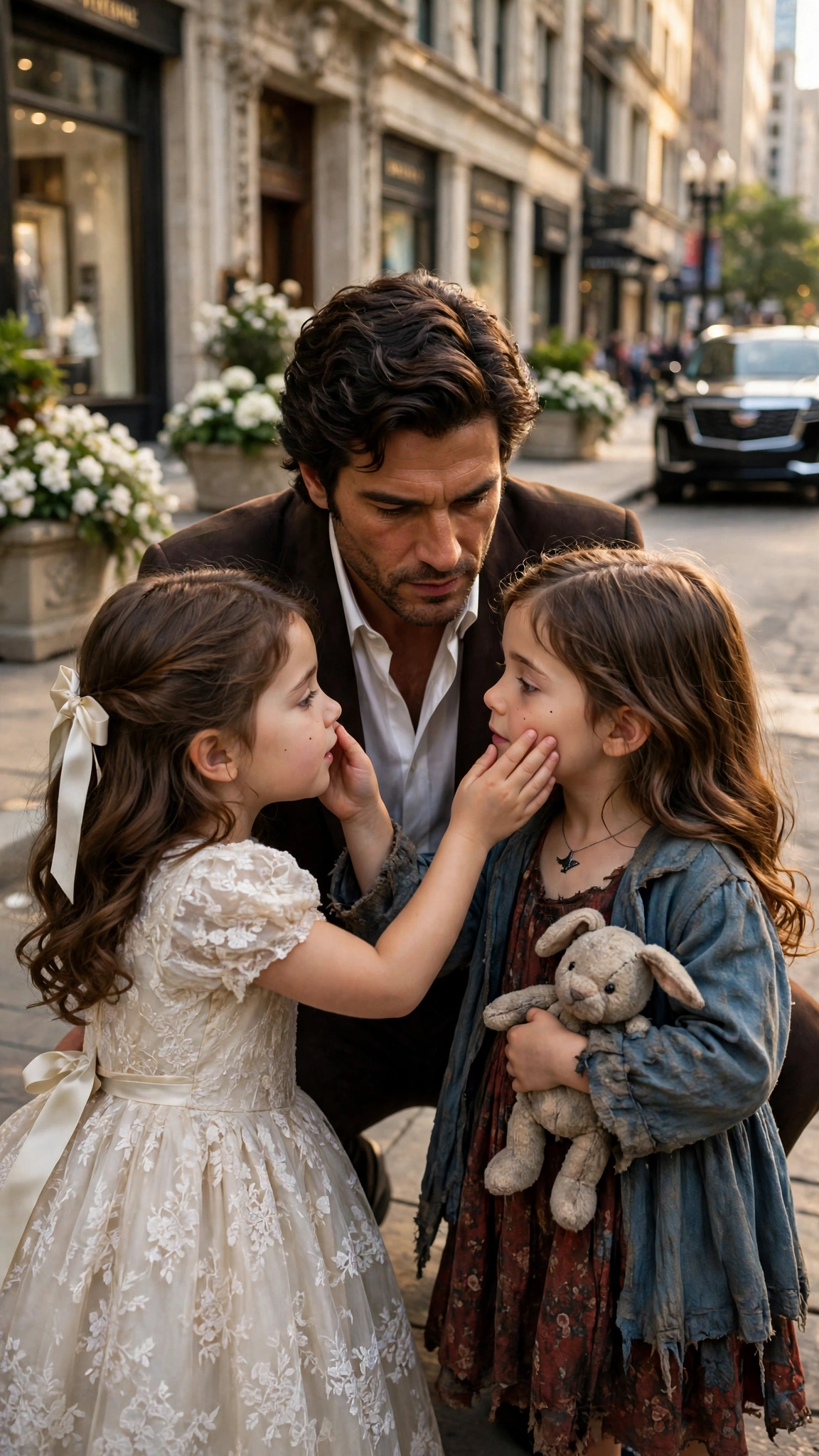
One year later, on a bright morning in late September, we stood on the sidewalk on Michigan Avenue in front of the flower planters, and the white blossoms were out, and the sun was warm, and Sophie and Ruby — six years old now, tall and strong and brown from the summer — held a small cake between them, with two candles in it, and the whole world seemed to be walking somewhere happy.
"Make a wish," Elena said, kneeling down with them, her dark-blonde hair loose around her face, the silver blackbird necklace catching the light at her throat.
Ruby closed her eyes very tight. Sophie closed her eyes very tight. And together, in one breath, they blew out the candles, and the smoke curled up into the September air, and the crowd around us applauded, because Chicago is a city that applauds children blowing out birthday candles, even when it does not know their story.
It had been a year of firsts. Ruby's first real bedroom — red, as promised, with a bed of her own and a bookshelf and a window that looked out over the lake. Her first day of school, walking in hand in hand with Sophie, both of them in matching dresses, one pink and one red, the teachers doing a double-take in the hallway. Her first Christmas, with a tree so tall it touched the ceiling and presents stacked underneath it like a small mountain. Her first time in a car that was hers to ride in, not a bus she had to wait for in the cold. Her first time saying the word "Daddy" and meaning it, which happened on a Tuesday in November, in the kitchen, over a bowl of soup, and which I will remember until the day I die.
Sophie had her firsts too. Her first sister. Her first time sharing a room, a bathroom, a mother, a father — all the things she had always had to herself, now doubled, now better. Her first time teaching someone to read, sitting cross-legged on the floor with a picture book, pointing at the words with enormous patience. Her first time understanding that the world is bigger and stranger and more wonderful than she had thought, and that sometimes the most impossible things are true.
And Elena — Elena had her firsts too. Her first morning waking up in her own bed, in her own house, with her husband beside her and her daughters down the hall. Her first time singing in the kitchen again, off-key and unbothered, while I stood in the doorway and listened with my eyes closed. Her first flower shop — not the little closet on State Street, but a real shop, on Michigan Avenue, with white blossoms in the window and her name above the door: ELENA'S. She opens it every morning at seven, and I walk her there sometimes, and the smell of the flowers follows us down the street like a song.
The Carter Shipping Company is hers again, and mine, and one day it will be the girls'. We run it honestly now, the way it should have been run all along, and the men who work for us know that the Moretti family keeps its promises and pays its debts, and that the days of fear are over. Marco still drives for us, and he still sits three paces behind us on Michigan Avenue with the shopping bags, and he still pretends not to smile when the girls make him carry their stuffed animals.
The house by the lake is gone — we sold the land, and a young family is building a new house there now, a house with no ghosts in it. The mansion in Lake Forest is our home, and it is full of noise now: two girls practicing the piano, two girls arguing about whose turn it is to feed the dog (we got a dog, a big shaggy thing named Biscuit, after the bear), two girls laughing so hard they fall off the sofa. The cold, careful quiet of those five years is gone, and I do not miss it. I do not miss it at all.
On the twins' sixth birthday, we did what we had done on their first birthday, all those years ago, before the fire: Elena made a small cake with two candles, and the girls smashed their hands into it, and we laughed until our sides hurt. And then we went downtown, to Michigan Avenue, to the exact spot where it had all begun, and we stood in front of the flower planter, and I told the girls the story — the real story, the whole story, in words a six-year-old can understand — about how they were separated when they were babies, and how their mama never stopped looking for them, and how their daddy never stopped loving them, and how a little girl in a shabby blue coat sat down on a flower planter one sunny afternoon and changed everything.
"And then what happened?" Ruby asked, the way she always does at the end of a story.
"And then," I said, "we all came home. And we never let go of each other again."
Sophie took Ruby's hand. Ruby took Elena's hand. Elena took mine. And we walked down Michigan Avenue together, the four of us, in the warm September sun, past the storefront windows and the flower planters and the black SUV waiting at the curb, and the city went on around us, ordinary and beautiful, and I thought about how strange and wonderful it was that the worst day of my life and the best day of my life had happened on the same sidewalk, five years apart, and that the difference between them was two little girls with the same face, and a silver blackbird, and a woman in a beige coat who had never stopped being brave.
Ruby looked up at me as we walked, her gray eyes bright, her rabbit tucked under one arm and her sister's hand in the other, and she said, "Daddy, is today a yellow day?"
Sophie had taught her the colors. Yellow days are good days. Gray days are sad days.
I looked at my wife. I looked at my daughters. I looked at the sun on Michigan Avenue and the white blossoms in the planters and the whole wide world spread out in front of us.
"Today is a yellow day, baby," I said. "Today is the yellowest day there has ever been."
And we walked on, together, into the light.
That evening, we had a party. Not a big one — Elena said the best parties are small, and she was right, as she usually is. Marco came, and Mrs. Alvarez, and the girls' three friends from school, and the lady from the bakery who had given Ruby a free roll every morning for a year and had never once asked why a little girl in a shabby coat was always hungry. Elena cooked all afternoon, and the house smelled like her cooking again — garlic and tomatoes and fresh bread — and I stood in the kitchen doorway and watched her, and I thought about how five years ago I had stood in this same doorway and watched her sing, and how I had thought I would never see it again, and how wrong I had been.
The girls wore their birthday dresses — Sophie in pink, Ruby in red — and they danced in the living room to music from Elena's old phone, spinning in circles until they fell down laughing, and Ruby's rabbit sat on the sofa watching them, and Biscuit the bear sat beside it, and the dog Biscuit — the real one, the shaggy one — lay under the table, thumping his tail every time someone dropped a piece of cake.
After the cake, after the presents, after the friends had gone home, I called the girls over to me, and I took two small boxes out of my pocket. I had been carrying them for a week, waiting for the right moment, and this was it.
"Sophie," I said, opening the first box, "this is for you." Inside was a delicate silver necklace with a tiny blackbird pendant with spread wings — a perfect match for Ruby's, made by the same jeweler, from the same silver. "Your mama wore hers every day. Ruby wears hers every day. And now you have one too. So that you both carry the song."
Sophie put it on immediately, turning around so Elena could fasten the clasp, and she touched the little blackbird with one finger, very gently, and said, "It is beautiful. Now we match."
Ruby touched her own necklace, and then she touched Sophie's, and she said, very seriously, "Now we are really sisters. Now everybody will know."
Elena came and sat beside us on the sofa, and the girls climbed into her lap — both of them, somehow fitting, all arms and legs and laughter — and she started to sing. Off-key, the way she always sang, the lullaby she used to sing to them when they were babies, the one about the blackbird who flew over the lake and came home before dark. And the girls went quiet, and then sleepy, and then they were asleep, one on each side of her, their heads on her shoulders, their necklaces glinting in the lamplight.
I carried them up to bed, one at a time, the way I used to carry Sophie when she was small, and I tucked them in — Ruby's rabbit on one side, Sophie's bear on the other, the two girls holding hands in the middle — and I stood in the doorway for a long time, the way I have stood in that doorway a hundred times, watching them sleep.
Elena came up behind me and put her arms around my waist and rested her chin on my shoulder. "Yellow day," she whispered.
"The yellowest," I said.
And in the quiet house, with my wife beside me and my daughters asleep down the hall, I thought about the long road that had brought us here — the flower shop and the lilies, the wedding and the blackbird, the fire and the lies, the five hard years, the sunny afternoon on Michigan Avenue, and the little girl in the shabby blue coat who had sat down on a flower planter and changed everything — and I understood, finally, what Elena had always known and what it had taken me five years and a miracle to learn: that a family is not a house, or a name, or a fortune. A family is the people who come looking for you, even when they have been told you are gone. A family is the people who hold your hand on a sunny sidewalk and say, "Daddy, look." A family is the people who never stop singing, even when the song is off-key, even when the night is dark, even when the whole world tells them to be quiet.
The next morning, the first morning of their seventh year — no, their sixth year, but the first morning of their life together as a whole family — Elena opened the flower shop at seven o'clock sharp, the way she always does, and I walked her there, the way I sometimes do, and the girls came with us, because it was a Saturday and there was no school, and they arranged the white blossoms in the window while Elena swept the floor and I stood in the doorway with a cup of coffee, watching the three of them, thinking about how the shop on Michigan Avenue was only a few blocks from the flower planter where it had all begun, and how the whole story had come around in a circle, the way the best stories do.
A woman came in to buy lilies for her mother, and Elena wrapped them in brown paper, the way she had wrapped mine all those years ago, and the woman said, "You have a lovely shop," and Elena said, "Thank you. My husband bought me the lilies once, before he knew anything about flowers, and I have been teaching him ever since."
The girls sat on the step outside the shop, sharing a roll from the bakery, and Ruby said, "Mama, when I grow up, I want a flower shop too."
"Then you shall have one," Elena said. "Right next to mine."
"And I will have a ship," Sophie said, very firmly. "A big ship. With a flag. And Ruby can be the captain with me."
Ruby considered this. "We can both be captains," she said. "There can be two captains. That is allowed, because we are twins."
I stood in the doorway of my wife's flower shop on a sunny Saturday morning, and I listened to my daughters planning their futures, and I thought: this is it. This is the whole thing. Not the business. Not the money. Not the revenge. Just this. A flower shop, and a roll from the bakery, and two little girls on a step, and a woman who sings off-key, and a man who finally learned how to listen.
I turned off the light. I took my wife's hand. And we went to bed, in our own house, in our own life, together at last — and for the first time in five years, I was not afraid of what the morning would bring.
THE END