The adoption was final on a bright morning in April, when the cherry trees on the hill were in blossom and the whole city smelled of rain and new leaves.
Judge Vance signed the papers, and she looked at Alexander, and at the four girls in their best dresses, and she said, "Mr. Hayes, by the power vested in me by the State of Illinois, you are now, legally and forever, the father of Gabriella Hayes, Harper Hayes, Nora Hayes, and Sophie Hayes."
And the courtroom — which had been so silent at the first hearing — erupted. Sister Agnes clapped. Rosa wept openly. The social worker smiled. And the four girls threw their arms around Alexander, all at once, and he knelt down in the middle of the courtroom, in his black suit, and he held them, and he did not care who was watching.
They celebrated at the house on the hill, and it was the kind of celebration the mansion had never seen in all its long history.
The children from St. Agnes came — all fourteen of them, dressed in their best clothes, their faces scrubbed, their hair combed — and they ran through the garden, and they played on the lawn, and they ate Rosa's cakes until their stomachs hurt. Sister Agnes sat in the shade of the old oak tree, watching them, her face lined with happiness, and she told anyone who would listen that she had always known it would turn out all right in the end.
There were balloons in the great hall, and flowers on every table, and a cake so large that it took two people to carry it — a cake with four candles on it, and the words "Welcome Home, Hayes Family" written in pink icing.
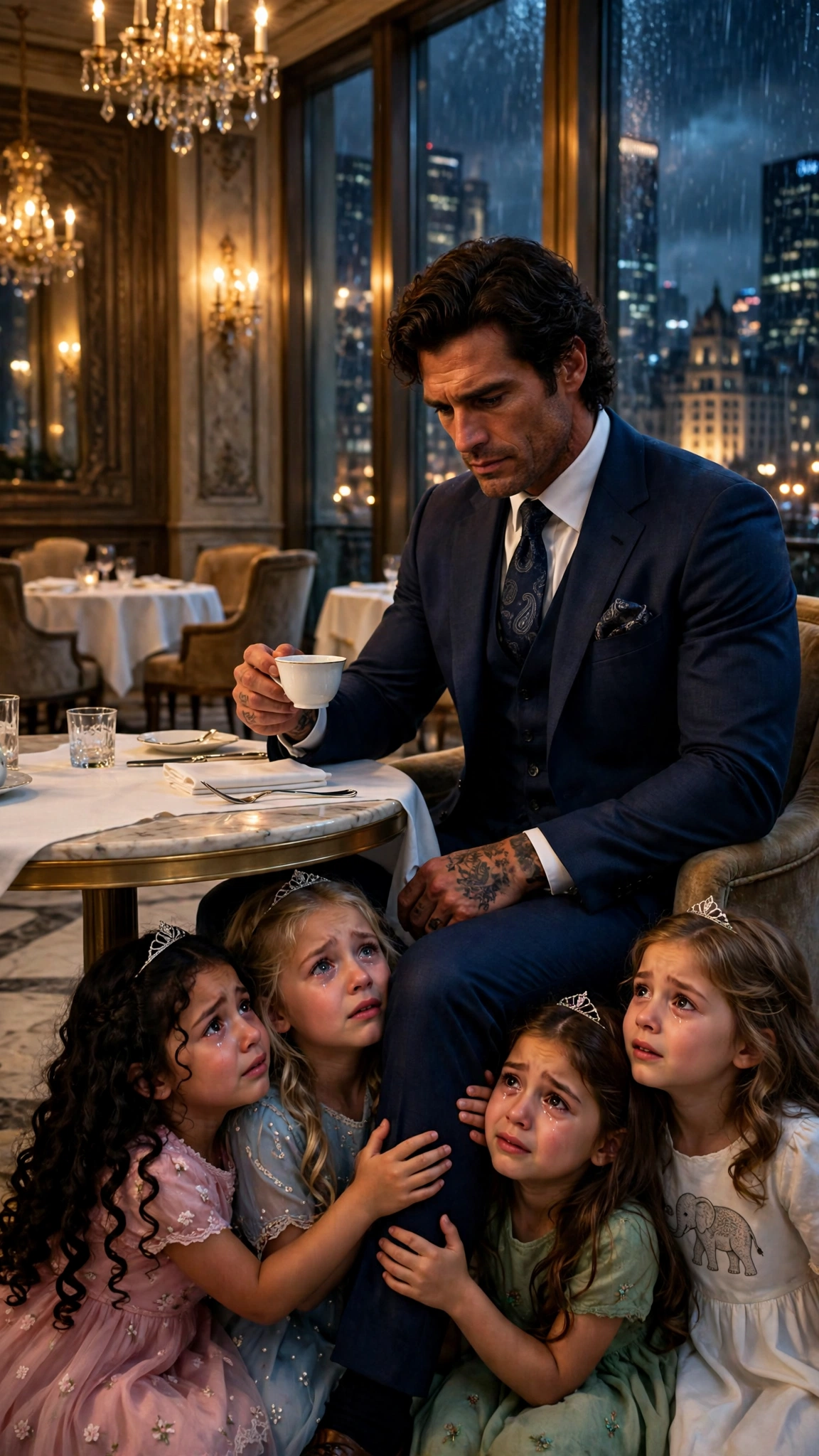
Alexander stood in the doorway of the living room, watching it all, and he thought about the night the girls had come — the rain, the dark, the restaurant table, the small frightened faces — and he thought about how far they had all come, and he felt his heart so full that he thought it might burst.
In the evening, when the guests had gone and the children from St. Agnes had been driven home in a borrowed bus, and the house was quiet again, the family gathered in the living room, just the five of them, and Rosa, who was family too.
The room had changed. The dark wood was still there, and the marble fireplace, and the tall columns — but now the sofa was covered in soft blankets, and the shelves were full of the girls' books and toys, and the windows were open to the spring evening, and the light that came through them was warm and golden, and the whole room glowed.
Nora sat at the grand piano, her small hands on the keys, and she played — not a halting little melody, but a real song, a long and beautiful one, the song Sister Agnes had taught her, about a river and a road and a home at the end of it. She played it all the way through, without stopping, and when she finished, the room was silent, and then everyone clapped, and Nora blushed, and smiled, and played it again.
Sophie sat on the plush sofa beside Alexander, her elephant in her lap, her head resting against his shoulder, her eyes heavy with sleep. Harper sat on his other side, peeking at him from behind a cushion, giggling every time he pretended not to see her. Gabriella leaned against his shoulder, her long black curls falling over his arm, her pink dress with its white flowers bright in the lamplight.
And on the mantelpiece, glowing warmly, stood the old brass lantern — the lantern the girls had held together on the night of the fire, the lantern Rosa had lit every night for thirty years.
Alexander looked around the room — at the piano, at the sofa, at the lantern, at the four small girls who had walked into his life on a rainy night and remade it entirely — and he understood, finally, what his mother had meant when she told him, so long ago, that a strong man protects people who cannot protect themselves.
He had spent his life believing that strength meant being feared. He had been wrong. Strength meant this: a warm room, a full house, and four small girls who trusted him with their whole hearts.
"Daddy," Nora said softly, from the piano bench, her fingers resting on the keys. "Daddy, can we stay forever?"
Alexander looked at her. He looked at Gabriella, and Harper, and Sophie, and Rosa, who was sitting in her chair by the fire, smiling through her tears.
"Forever," he said, and his voice was steady, and sure, and full of a happiness he had not felt in five years — a happiness he had thought he would never feel again. "Forever, my girls. This is your home. I am your daddy. And nothing — no man, no fire, no storm — is ever going to change that."
Sophie lifted her head from his shoulder, and she looked up at him with her bright innocent eyes, and she said, in her soft, clear voice, "Good. Because we are never leaving."
And Gabriella laughed, and Harper clapped her hands, and Nora began to play again — a happy song this time, a dancing song — and Alexander Hayes, the most feared man in Chicago, sat on his sofa in his living room, with his four daughters around him, and he laughed, and he cried, and he held them close, and he knew that he was, at last, home.
Before the cake was cut, Alexander stood up, and the room went quiet, and he looked at his daughters, and at Rosa, and at Sister Agnes, and at all the children from St. Agnes, and he cleared his throat, because he had something to say, and he had never been good at speeches.
"I am not a man of many words," he began, and Gabriella whispered, "That's true," and everyone laughed, and Alexander laughed too. "But there are some things I need to say. Five years ago, I lost my wife, and I lost my daughter, and I decided that the world was a cold place, and that the best thing a man could do was to be colder than the world. I was wrong."
He looked at the four girls, sitting in a row on the sofa, their dresses bright, their faces shining.
"These four girls came to my house on a rainy night, with nothing but each other, and they were afraid, and they were brave, and they asked me for something I did not think I had left to give. They asked me to be their father. And I said yes — not because I was brave, but because they were. They taught me that a house is not a home until it is full of laughter. They taught me that strength is not about being feared. Strength is about being there — at breakfast, at bedtime, in the rain, in the fire — and never leaving. So I want to thank them. Gabriella, for your courage. Harper, for your gentleness. Nora, for your music. Sophie, for your elephant, and for your heart, which is the biggest heart I have ever known."
He raised his glass. "To my daughters. To my family. To forever."
"To forever!" everyone cried, and the glasses clinked, and the cake was cut, and the children cheered, and Rosa wept into her handkerchief, and Sister Agnes stood up, and she raised her own glass, and she said, in her clear, steady voice, "To Alexander Hayes — who was once the most feared man in Chicago, and who is now, quite simply, the best father I have ever known."
And then the girls had a surprise for him. They had been planning it for weeks, in secret, with Rosa's help, and they had kept it hidden in the library, under a cloth, and now Gabriella and Harper carried it out together, and set it on the table in front of him, and pulled off the cloth with a flourish.
It was a drawing — a big one, on four sheets of paper taped together, drawn in crayon and coloured pencil, in the girls' four different hands. It showed the big house on the hill, with a red roof and a yellow sun, and in front of it stood five figures, holding hands: a tall man in a black suit, and four small girls in pink and blue and green and white. And above them, in Gabriella's careful handwriting, were the words: "Our Daddy. Our Home. Forever."
Alexander looked at the drawing for a long time, and he did not say anything, and then he picked it up, very carefully, as if it were the most precious thing in the world, and he said, "This goes on the wall. In the study. Where everyone can see it."
And then Sophie tugged at his sleeve, and she held out something small and wrapped in tissue paper, and when he opened it, he found a new lantern — a small brass one, just like the old one on the mantelpiece, but new, and shining, and engraved on its side, in tiny letters, were the words: "For Daddy, who found us in the dark."
Alexander knelt down, and he took Sophie in his arms, and he held her, and he whispered, "Thank you, my love. Thank you."
That night, after the party, after the dancing — Harper had danced with Rosa, and Gabriella had danced with Sister Agnes, and Nora had played a waltz on the piano while Alexander had danced, very badly and very happily, with Sophie standing on his feet — after all of it, Alexander sat in his study, and he hung the drawing on the wall, right where he could see it from his desk, and he set the new lantern beside the old one on the mantelpiece, and he looked at them both, and he thought about how much light four small girls could bring into a dark house.
One year later, the roses came back at St. Agnes, red and pink and white, and the home was full of children again, and the new shed stood where the old one had burned, and Sister Agnes planted a new oak tree in the garden, to replace the one that had been damaged in the fire.
One year later, Gabriella won first prize in the school reading competition, and Harper's roses won a ribbon at the county fair, and Nora played her first recital — a real one, on a real stage, with a hundred people listening — and Sophie, who had decided that she would be a doctor for elephants, had already begun saving her pocket money for the trip to Africa, which she planned to take when she was ten.
One year later, the house on the hill was no longer the dark house, or the feared house, or the empty house. It was the house with the bicycles in the driveway, and the drawings on the refrigerator, and the piano playing in the evening, and the lantern glowing in the window — a light for anyone who was lost in the rain, and looking for a home.
Outside, the spring rain began to fall softly on the roof of the big house on the hill. Inside, the lantern glowed, the piano played, and the fire crackled in the marble fireplace, and the house — which had been cold and dark for so very long — was warm, and bright, and full of life.
A simple childlike courage had saved a broken heart. And a broken heart, made whole again, had saved four small girls.
And they lived, all of them, happily — not just ever after, but every day, in the small, ordinary, wonderful ways that make a family: in pancakes burned and laughed over, in stories told at bedtime, in braids that came out crooked and were loved anyway, in songs played on the piano, and in a lantern, held together, glowing warm against the dark.
And if you walk past the big house on the hill on a rainy night, even now, you will see the lantern burning in the window, and you will hear the piano, faint and sweet, and you will know that inside, a family is sitting together by the fire — a tall man with dark hair and tattooed forearms, and four small girls in pink and blue and green and white — and that none of them is afraid of the dark anymore, because they have each other, and they have a home, and they have love enough to light the whole house.
Forever.