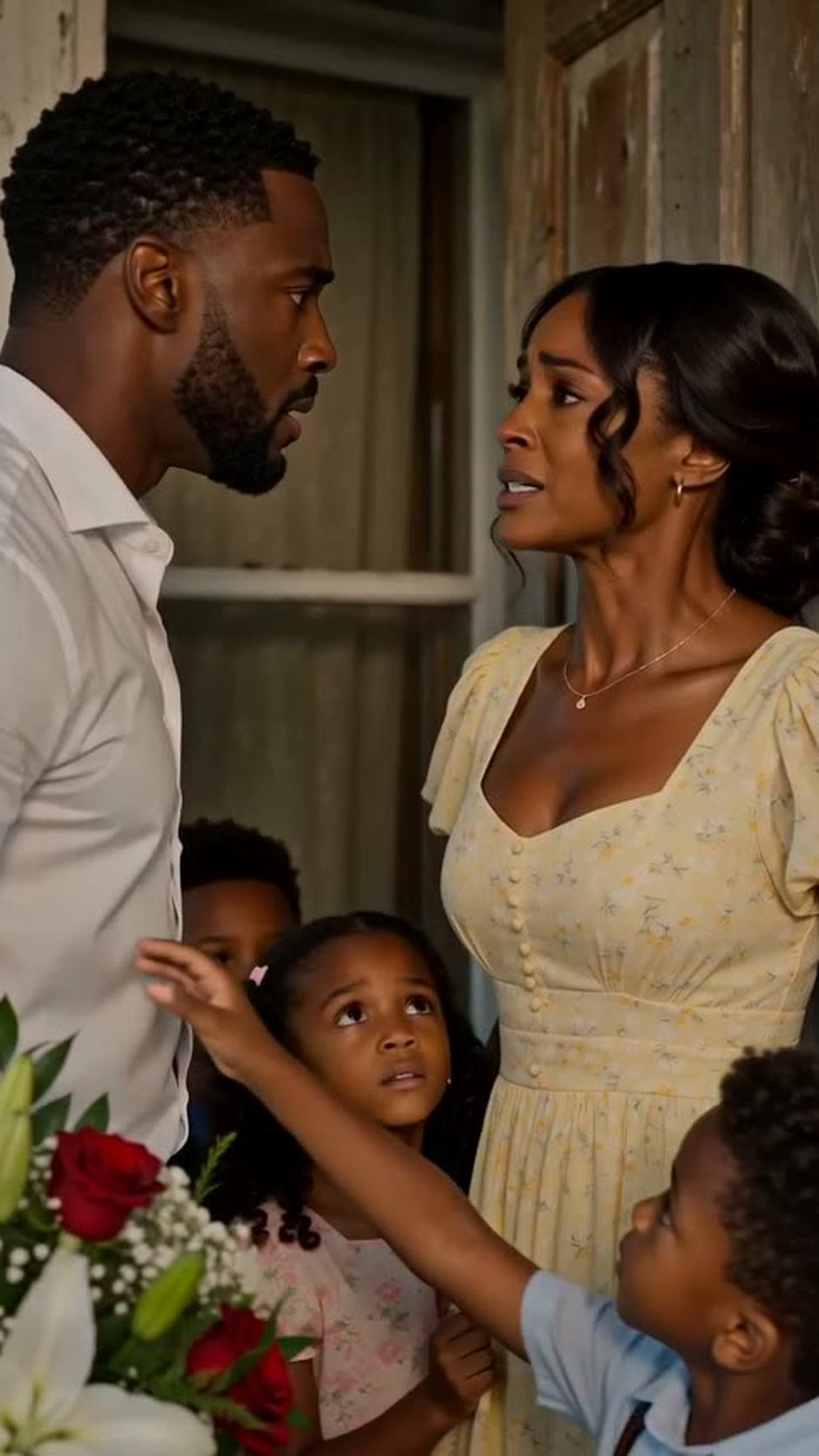
The door swung open before his hand could knock.
Daniel Whitmore stood on the weathered porch of a farmhouse he had driven eleven hours to find, a bouquet too large for the doorway crushed against his chest — red roses, white lilies, baby's breath, wrapped in brown paper and tied with a deep red ribbon — and for one suspended second, everything he had rehearsed in the car was still possible.
Then Emily stepped into the doorway, and the nine years stood between them like a wall of glass.
She was thinner. Her dark curls were gathered up, loose strands framing her face, and the pale-yellow floral dress she wore was the kind of dress the woman he had married would never have been photographed in — modest, faded, mended at one sleeve with stitches so small you had to love the dress to bother.
Her eyes widened. Her hand found the doorframe and held it.
"Emily," he breathed.
A little girl in a pink dress came running from the dim hallway behind her and seized the skirt of Emily's dress with both hands. A small boy in a blue shirt and brown suspenders pressed in at her other side, clutching her fingers, staring.
Daniel looked down.
The bouquet shifted in his hands. The brown paper crinkled, sharp in the quiet. He looked at the girl's face — at the eyes, dark and wide and unmistakably, impossibly familiar — and then at the boy, and something in his chest simply stopped.
"Emily…" His voice came out thinner than a whisper. "Who are they?"
Emily moved before he finished the sentence. One arm swept the girl behind her; her other hand pulled the boy close against her hip. Her whole body angled across the doorway like a shield.
A gust came down off the Kentucky hills and worried the edge of the porch. The folded letter Daniel had been gripping against the bouquet — the anonymous letter that had arrived at his penthouse four days ago with no return address and nine words in a stranger's handwriting — slipped from his trembling fingers.
It fluttered. It landed face-up on the porch boards between them.
*If you still remember Emily, come here.*
Emily looked down at it, and the color left her face so fast that Daniel felt it in his own stomach. She knew that letter. Whatever it was, whoever had written it, she knew.
"Where did you get that?" she asked quietly.
It was the first thing she had said to him in nine years.
Daniel bent, instinctively, to pick it up, and saw her stiffen — saw the girl begin to bend too, reaching toward the paper with a child's open curiosity, and saw Emily catch her daughter's hand in midair and hold it, gently, absolutely.
The boy stepped forward instead. Five years old, maybe. He stepped out from behind Emily's skirt and stood in the full sunlight of the doorway and looked up into Daniel's face with an unblinking, searching stare, the way a child looks at a photograph he is trying to place.
Daniel straightened slowly. In his head, unbidden and merciless, another voice spoke — his own voice, nine years younger, cold as a closing door.
*Leave.*
Shame moved through him like a change in the weather. He swallowed. The bouquet brushed the rough doorframe and a single red petal loosened and fell, turning once in the sunlight, landing on the boards beside the letter.
"I should have come sooner," he said, barely audible.
Emily's eyes filled — and hardened in the same instant, the tears held back by something stronger than grief. The little girl looked from her mother's face to Daniel's. The boy, deciding something, took his sister's hand in his.
Daniel's grip on the flowers loosened. His shoulders, which had carried an empire for a decade, dropped an inch and stayed there.
"What haven't you told me?" he asked, trembling.
Emily looked at him for a long time. The wind moved through the wildflowers by the porch. Somewhere down the hill a screen door banged, and neither of them turned.
"Daniel…" she whispered, and her voice broke on his name.
The little boy reached out, small hand open, toward the red roses.
Emily's hand shook against the doorframe. She drew breath — the first words of the rest of Daniel Whitmore's life.
"There's something you never knew about—"
* * *
Nine years earlier, Daniel Whitmore had believed he was the luckiest man in Manhattan, and he had believed it in the specific, arrogant way of a man who has never once been refused anything that mattered.
He met Emily Carter at his own foundation's spring gala, in a ballroom so white and gold it hurt, where she was not a guest. She was twenty-four years old, a program coordinator three rungs below the people drinking champagne, and she was standing on a chair in her work shoes at six in the evening, re-hanging a crooked banner with her own hands because, as she informed the events manager without getting down, "the children in that photograph deserve to be straight, even if nobody here notices."
Daniel, twenty-six and already spoken of as the future of Whitmore Capital, noticed.
He held the chair. She looked down at him with the particular exasperation of a woman being helped by a man who has never been tired, and said, "If you're going to stand there, at least tell me if it's level."
"It's level," he said. "You're not."
"I beg your pardon?"
"You're standing on a chair in heels, Miss—"
"Carter. And these are not heels, they're—" The chair leg skidded two inches on the polished floor. Emily Carter came down off that chair with considerably less dignity than she had climbed up with, and Daniel caught her, one hand at her elbow, the other at her waist, and held her a half-second longer than physics required.
She looked up at him — startled, flushed, furious — and Daniel Whitmore, who had been bored by every beautiful room he had ever stood in, understood all at once that he was in trouble.
He courted her the way he did everything: completely. Not with the penthouse or the cars — Emily, who itemized donated school supplies down to the pencil, was immune to all of it — but with attention. He learned that she grew up in Kentucky, in her grandmother Rose's farmhouse, in a house that leaned a little and smelled of rain and cornbread. He learned that her parents were gone, that her younger sister Hannah was in nursing school, that Emily sent money home every month before she spent a cent on herself. He learned that she laughed with her whole face and that she could not lie — that deception moved across her features like weather across water, visible from a mile away.
He proposed in October, on the roof of the Whitmore building, with his grandmother's ring and no audience at all, because Emily had once told him that the truest things people said were the ones nobody clapped for.
She said yes with tears standing in her eyes, and Daniel's mother said nothing at all — which was, though he did not yet know it, the most dangerous sound in the world.
Vivian Whitmore had built an empire out of a widow's inheritance and an iron refusal to grieve in public. She had plans for her only son that had been drawn up like acquisition documents, and those plans ended, as such plans do, in a merger: Daniel was to marry into the Ashford family, whose shipping fortune would dovetail with Whitmore Capital like two halves of a hinge. Emily Carter of Kentucky, with her mended dresses and her sister in nursing school, appeared nowhere in those documents.
"You are confusing gratitude with love," Vivian told him, the one time she deigned to discuss it. "She held your chair, Daniel."
"I held hers," he said.
It became the story they told at dinner parties, in the good months. And there were good months — eleven of them, so good that Daniel would spend nine years trying to forget them in exact detail and failing in exact detail. Emily moved into his world like light into a shuttered room. She made the foundation's board sit through presentations from the children their money fed. She made Daniel laugh in boardrooms. She kept, on their refrigerator, a photograph of a leaning farmhouse under a Kentucky sky, and when she was homesick she touched it the way other people touch a rosary.
They were married in December, in a small chapel Emily chose because the light came through the windows sideways, and Daniel — who had been offered, by his mother, a cathedral, a hotel ballroom, and a private island, in that order — stood in the front of that little chapel with his hands shaking too hard to manage his cufflinks and understood that he had never once, in twenty-six years of being given everything, actually wanted anything before. Vivian attended. She wore gray. She kissed her son's cheek and, over his shoulder, looked at Emily in her simple dress — a dress with no designer in it anywhere, only a bride — with an expression the photographer, to his credit, did not capture.
"I give it a year," Vivian said to the Ashfords' table, before the year was out, though Daniel did not hear about it until much later, when there was no longer anything it could break that was not already broken.
The first Whitmore family dinner at the Connecticut house, Emily arrived carrying a pie she had made in the penthouse kitchen, because her grandmother had raised her to never enter a house with empty hands. Vivian received the pie the way customs receives a suspicious parcel. Over dinner, she conducted what Daniel, even then, recognized as an examination: the foundation's staffing, the literacy program's numbers, Emily's opinions on endowment strategy — and Emily, who could smell condescension the way other people smell smoke, answered every question plainly and then, into a silence, asked Vivian about the rose garden visible through the dining room windows, in the dark, in December.
"It's dormant," Vivian said.
"Everything's dormant in December," Emily said. "That's not the same as dead. My grandmother used to say a garden in winter is just a garden keeping its own counsel."
Something moved across Vivian Whitmore's face then that her son had never seen there. It was not warmth. It was closer to the expression of a chess player who has just revised an assessment. She had come to that dinner believing Emily Carter was a climber or a fool. She left it understanding that Emily was neither, and there are people in the world for whom that is the most frightening discovery of all, because climbers can be bought and fools can be managed, and Emily Whitmore could be neither.
Daniel knew none of this. Daniel knew that his wife fell asleep on the drive home with her head against the window and her shoes off, and that he carried her into the penthouse without waking her, and that she woke on the couch at midnight, disoriented, and said, "Did I pass?"
"Pass what?"
"Your mother." She yawned. "She has a whole grading system, Daniel. I could feel it. Like weather."
"She's not the weather," he said. "She's just—" and stopped, because he had been about to say *she's just my mother*, as if that explained her, as if mothers were exempt from being weather.
"You get your stubborn from her," Emily said comfortably, and fell back asleep, and he sat awake beside her for a while in the dark of the penthouse, listening to the city, believing — with the whole, untested confidence of a man whose life has never once refused him — that love and stubbornness between them would be enough to outlast any climate at all.
It very nearly was. That is the part nobody believes afterward, and it is the only part that matters: the marriage was not a delusion. She steadied him. He astonished her, constantly, with a tenderness he showed no one else on earth. She kept the refrigerator photograph of the leaning farmhouse and he learned to make her grandmother's cornbread badly and then less badly, and when she cried — once, in the spring, over a child in one of her programs who had been moved to a foster home three counties away — he held a chair for her in their own kitchen and said, "Tell me if it's level," and she laughed through the tears exactly as she had the day they met.
Then, in the twelfth month of their marriage, a man named Garrett Cole — Daniel's oldest friend, his partner, the best man at his wedding — began, very gently, to ask questions.
And one gray March morning, an unmarked envelope was delivered to Daniel's office by a courier who signed nothing, and Daniel Whitmore opened it standing at his window, with the whole of Manhattan glittering below him, believing for exactly four more seconds that he was the luckiest man alive.
Inside the envelope was a photograph.
And in the photograph, his wife was not alone.