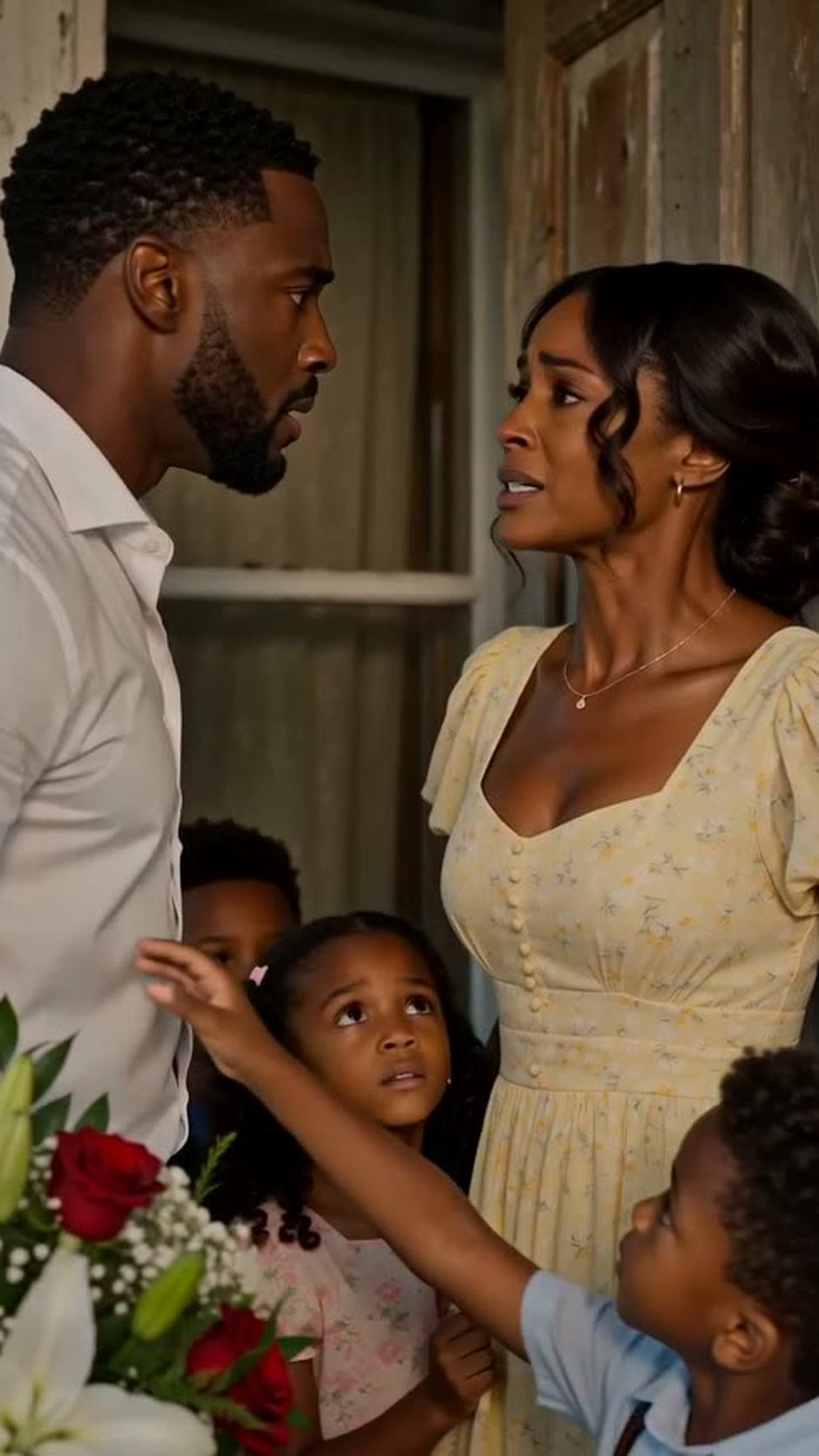
The photograph showed Emily in the garden of the Whitmore house in Connecticut, in the blue dress she had worn to the foundation's summer benefit, standing close — too close — to a man Daniel did not know.
The man was laughing. Emily's head was tilted toward him. His hand rested at the small of her back with the ease of long ownership, and her face was turned up to his with an expression Daniel had believed belonged to him alone.
There was no note. There was only, paper-clipped behind the photograph, a hotel receipt from the Regency Grand, dated three weeks earlier, for a room booked under the name E. Whitmore.
Daniel stood at his window for a long time.
He was a man who trusted evidence. It was the religion of his family and the engine of his fortune: do not feel, verify. So he did the thing that would damn him. He did not go home and ask his wife. He verified.
It is important to understand that he almost asked. That night Emily was in their kitchen in one of his shirts, barefoot, stirring soup and singing badly along with the radio, and when she turned and saw him in the doorway her face did the thing it had done the first time he ever saw her — it lit, entirely, without calculation — and his hand went, actually went, to the inside pocket of his jacket where the envelope was.
Then Garrett called, as if on cue, as if he had a window into the penthouse itself. "You look like a man who's seen the numbers," Garrett said. "Whatever it is, Daniel — don't confront it emotionally. You know what this family stands to lose. Get the facts."
The facts accumulated the way snow accumulates: silently, and then all at once, and then the roof is in danger.
The foundation's auditors found a discrepancy — forty thousand dollars, moved in small tranches out of a discretionary account that bore Emily's authorization code. Emily, when the foundation's director mentioned it to her in passing, laughed and said there must be a coding error, and her face — Daniel studied it later, in memory, a hundred times — her face had shown nothing but mild annoyance. But Daniel no longer trusted her face. He had begun, instead, to trust paper, and the paper was being supplied to him by an invisible hand, in envelopes, at intervals so precise they might have been scheduled.
He tried, once, to ask her. It was the foundation's winter benefit, two weeks after the first envelope. Emily had spent the evening doing what she did — she had found the scholarship children in their rented suits and fed them first, before the donors; she had remembered every name; she had laughed, at one point, so hard at something the caterer said that she had to hold on to a doorframe, and Daniel, watching from across the ballroom with the photograph burning in his memory like a coal in a pocket, had thought: *There. That. A woman does not laugh like that and live a lie.* He drove her home determined to lay the envelope on the kitchen counter and watch her face and be done with the whole nightmare by midnight.
In the car she talked about the children. In the elevator she leaned her whole weight against his shoulder, the way she did when her feet hurt, and said, "If we ever have a daughter, I want her to learn to hang a banner straight. It's a life skill."
"Emily," he said.
"Mm?"
The elevator doors opened onto their floor. He looked at his wife — coat over her arm, hair coming down, pencil still in it from the seating charts — and the question he had built all evening stood in his throat and would not come out, because he understood, suddenly and completely, what the question would do if he was wrong. There is no un-asking a thing like that. A man who asks his wife whether she has betrayed him has already moved out of the marriage, whatever she answers; he would be living in the asking for the rest of his life.
"Nothing," he said. "You have a pencil in your hair."
She pulled it out, looked at it, laughed, and went to run a bath, and Daniel stood in his own hallway and hated himself with a precision he usually reserved for competitors. He told himself he was protecting her from a suspicion that evidence would either confirm or dissolve. He told himself a week. Two. He told himself that love, real love, was patient enough to verify.
What he was actually doing — though the sentence would not assemble itself in him for nine years — was shopping for a version of the truth that would not require him to be brave. Paper could be brave for him. Paper did not have to watch her face.
So the paper kept coming.
A second photograph: Emily at a café in the West Village, leaning across a table toward the same man, both of them serious now, conspiring. A printed email thread, obtained by his investigator from God knew where, in which "E.C." discussed "the transfer" and "when he's in Chicago." A witness — a driver the investigator produced — who had seen Mrs. Whitmore at the Regency Grand on the date in question and was willing to say so, for a fee Daniel paid without blinking.
He read the email thread at two in the morning, in the penthouse office, with the city ticking below him like a held breath. *The transfer clears Friday. When he's in Chicago, we'll finalize.* He had been in Chicago. That much was true, and the truth of it did the lying's work, the way a single real coin can pass a purse of counterfeits. He remembered the Chicago trip. He remembered the closing dinner, the hotel bar, the long empty evenings of it. And he remembered — this rose in him uninvited, an exhibit for the other side — calling home on the second night and Emily answering on the first ring, breathless, standing in a flooded laundry room because a pipe had burst, laughing at the water around her ankles, saying, *Daniel, the house is drowning and I am the captain and I refuse to abandon ship, come home and bail.*
He had laughed. On the phone, in Chicago, on the very trip the emails named as the window of her betrayal, he had stood in a hotel room laughing while his wife bailed out a laundry room and told him about the plumber, and the neighbor's boy, and the exact sound the water made.
Daniel sat with that memory for a full minute, in the office dark, with the printed thread in his hands.
Then he put the memory aside — gently, the way you set down something fragile you have decided not to look at — and read the thread again, and let the paper be the truth, because the paper did not laugh, and did not bail water, and did not require anything of him at all.
That was the night Daniel Whitmore chose his evidence over his wife. The library, when it came, was only the paperwork.
The investigator's name was Sloane. He was expensive and discreet and he sat in Daniel's office in the last week of March with a folder and the air of a man delivering a weather report.
"I'm not going to soften it," Sloane said. "The man is Anthony Reyes. Freelance consultant. He's done work for two firms that compete with Whitmore Capital for port contracts. The meetings go back at least four months. The money moved out of the foundation account in the same window. I can't prove what she sold him. I can prove she met him, repeatedly, in secret, and that money followed."
"And the hotel?"
Sloane slid the receipt copy across the desk. "Room 614. One night. Booked in her name."
Daniel picked it up. His hand was perfectly steady. He noted the steadiness with pride, the way his mother would have.
Daniel drove home the long way, down the river, with the folder on the passenger seat like a second person in the car. Twice he picked up the phone. The first time he called Garrett, because Garrett was the load-bearing wall of his adult life — Garrett, who had roomed with him at school, who had talked him through his father's funeral at nineteen, who held a power of attorney and a key to the penthouse and the standing of a brother. "Sloane reported," Daniel said. "It's bad, Garrett. It's — he has a *receipt*."
There was a pause on the line, one beat long, and then Garrett's voice came back warm and concerned and steady as a hand on a shoulder. "I'm sorry," he said. "God, Daniel, I'm sorry. Listen to me. Whatever you decide, you decide it clean. Not at midnight. Not in the kitchen. You lay it out in daylight, with witnesses, so she can't rewrite it afterward. I've seen these things. The rewriting is how they win."
"Witnesses," Daniel repeated. "My mother."
"Your mother has suspected something for months. She told me at Christmas she thought Emily was — she didn't want to poison you. She said a son has to arrive at it himself." A pause. "You've arrived, Daniel. Don't un-arrive."
The second call he almost made was to Emily. Her name was at the top of his phone. Below it, by the tyranny of the device, was a photograph she had sent him at six that evening, while Sloane was still arranging his papers: the dining table at home covered with the annual report, a bowl of soup going cold beside it, and her message beneath, the whole of it: *Saved you the good chair. Come home before I promote myself to your seat and seize the company.*
He stared at that message at a red light on the West Side Highway until the car behind him honked, and something in him — some last, loyal animal part of him — understood that a woman does not send that message on her way to a lover. And then he thought of the receipt, room 614, her name in print, and of Sloane's level voice, and of his mother at Christmas *suspecting*, and the light changed, and Daniel Whitmore drove on home through the city with the evidence riding beside him like a passenger who had already decided the destination.
He understood later — it was one of the thousand things he understood later, all of them too late to be anything but tuition — that this was the exact moment the thing was decided. Not in the library. In the car. The library was only where the paperwork was signed.
That night he came home at nine, and Emily was at the dining table with the foundation's annual report spread around her and a pencil in her hair, and she looked up and smiled and said, "You're late, I saved you the good chair," and Daniel stood in the doorway of his own dining room with the investigator's folder in his briefcase and understood, with a clarity so cold it felt like peace, that he could not live one more day inside a question.
He would ask her tomorrow. He would lay it all on the table tomorrow, and she would explain, the way she had explained the banner, the chair, the soup — plainly, with her whole face — and the paper would turn out to be a trick of light.
That was what he told himself, at midnight, watching her sleep.
He did not know — how could he have known — that the tomorrow he was planning had already been planned by someone else. That the photograph had been taken at a benefit with four hundred guests, at the moment a stranger asked Emily the time. That the hand at her back had touched her for one second and been removed by Emily herself, out of frame. That the hotel receipt had been manufactured by a man who had once stood beside Daniel at an altar and sworn to stand beside him all his life.
That night, while Daniel watched his wife sleep and practiced his questions, Garrett Cole sat in a black car outside the Whitmore house with Daniel's mother, and Vivian Whitmore looked up at the lit windows of her son's home and said, with terrible calm:
"Tomorrow, then. Before she has time to prepare a story."