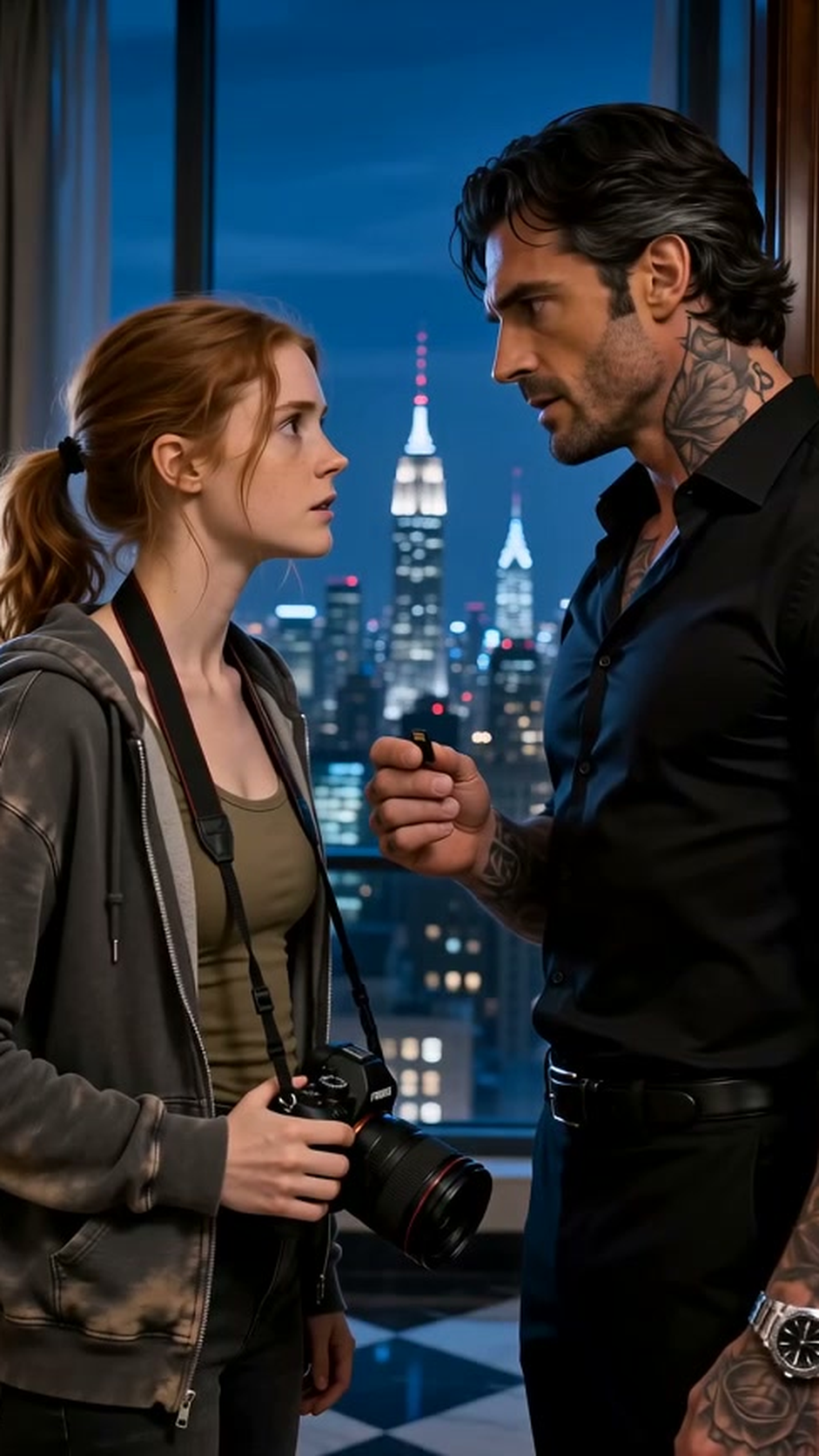
The door of the penthouse suite opened, and the man who filled it was not a man you said no to.
Lily Carr had spent four years photographing weddings, bar mitzvahs, product launches, and one extremely awkward mayoral fundraiser, and she had developed a photographer's instinct for power the way other people developed an instinct for weather. She could feel it coming off this man in waves. He was tall enough that she had to tip her chin up, broad enough that the doorway seemed to narrow around him, dressed in a black button-down with the top buttons undone over a chest and neck inked with black-and-gray tattoos that climbed like smoke out of his collar. His dark hair was swept back, his jaw was shadowed with stubble, and his brown eyes went from irritated to something much colder in the space of one breath.
They dropped to her hand.
Between her thumb and forefinger, held out toward him like an offering she already regretted, was a tiny black memory card.
"I found this outside room 1407," Lily said. Her voice came out calmer than she felt, which was the only gift nerves had ever given her. "Down the hall. On the carpet."
He did not take it. He did not even reach for it. He just looked at the card the way a man looks at a wire he suspects is attached to something.
"Did you look at what's on it?" His voice was low and controlled, and somehow that was worse than shouting would have been.
"Just one second." She swallowed. "I saw two men in a hallway."
Behind her, in the dim corridor, the suited man who had been shadowing her since the elevator shifted his weight. She heard the soft tick of his shoe on marble. Down at the far end of the hall, near the elevator alcove, a second figure in a dark suit stood half in shadow, and as her eyes flicked toward the movement she saw his head begin to turn—
"Don't turn around."
The words were barely above a whisper, and they nailed her feet to the floor.
The man in the doorway moved then—not fast, never fast, he was a man who had never once needed to hurry—and shifted his body until he stood between her and the corridor, between her and whatever was behind her. He extended one hand, palm open, gesturing not at the card but past himself, into the warm golden light of the suite.
"Come inside," he said. "Now."
Lily's fingers tightened on her camera strap. Every sensible instinct she owned told her that walking into a stranger's hotel suite at eleven o'clock at night was the first line of a story that ended badly. But she had seen the one second of footage. She had seen the two men. And she understood, standing there with her heart hammering against her ribs, that whatever danger existed in this hotel was not waiting for her inside the room.
It was already behind her.
She stepped inside.
The door closed with a soft, expensive click. The man took the memory card from her fingers at last, closing his own around it, and for the first time his expression—guarded, carved, unreadable—shifted into something almost human as he looked at her. Not at the card. At her.
"Am I in danger?" Lily asked.
His eyes went to the closed door, then came back to hers, and he weighed the answer like it cost him something.
"Not while you're with me," Damian Kane said.
***
Twelve hours earlier, Lily Carr had been standing barefoot in her Brooklyn kitchen, eating cereal directly out of the box, reading a letter that said she had thirty days to vacate her apartment.
It wasn't an eviction, technically. The landlord's lawyer had used gentler words—non-renewal, restructuring, exciting new direction for the building—which all translated to the same thing: the rent was going up forty percent, and a twenty-eight-year-old freelance photographer whose biggest client paid net-sixty was not part of the exciting new direction.
Her roommate Jess, a night-shift nurse with the survival instincts of a cockroach and the optimism of a golden retriever, read the letter over her shoulder and said, "We'll figure it out. We always figure it out."
"We have four hundred dollars between us."
"We'll figure it out dramatically, then."
Lily's camera sat on the counter between them like a third roommate: a Fujifilm medium-format she had bought used, repaired twice, and loved with the embarrassing completeness other women reserved for men. It was the last thing she owned that was worth anything. Her father had been a photojournalist—the kind who ran toward things—and he'd put a camera in her hands before he'd put her on a bicycle. He'd been dead six years. The camera was hers, not his, but every time she raised it she could hear him: Don't take the picture everyone else is taking, Lil. Find the second before. Find the second after.
Her phone buzzed. An agency she'd done two jobs for in September: MERIDIAN GRAND HOTEL — CASTELLANO FOUNDATION CHARITY GALA — SECOND SHOOTER CANCELLED, NEED REPLACEMENT TONIGHT, BLACK TIE VENUE, STAFF ATTIRE, $900 FLAT, PAYABLE ON DELIVERY.
Nine hundred dollars was half the rent increase's first month. Nine hundred dollars was breathing room.
She typed back YES before she'd finished reading.
Jess called it at two o'clock, on her break, with hospital noise behind her. "Please tell me the fancy hotel people are paying you in money and not exposure."
"Nine hundred. On delivery."
"Then go be brilliant. And Lily—" Jess's voice went uncharacteristically serious. "Eat something first. You get noble when you're hungry, and noble is expensive."
Lily promised, hung up, and ate half a sandwich standing over the sink, which she decided counted. Then she laid out her gear the way her father had taught her, in order, like laying out instruments for surgery: camera, two lenses, batteries, a fistful of memory cards in a hard case, the little adapter she'd bought for a job in March and never used again. She cleaned the big lens with the corner of her shirt. She checked the charge on everything twice.
She did not let herself think about the letter on the fridge. She did not let herself think about the fact that the agency had called her because she was cheap, fast, and—this was the part that stung—available on a Saturday with six hours' notice, forever, because her life contained nothing that ever outranked work. She thought about nine hundred dollars and the skyline after dark and the small, stubborn pleasure of being good at something in a world that kept sending her letters.
On the train into Manhattan, an old man across from her was doing a crossword in pen, and Lily framed him without raising the camera—chin, hands, the light coming through the grime of the window—and thought, not for the first time, that the city was one long hallway of strangers carrying evidence of their lives, and almost nobody ever stopped to look at any of it.
She stopped. It was the whole job. It had always been the whole job.
She never imagined it would be the thing that nearly got her killed.
The Meridian Grand rose over Fifth Avenue like it had been poured rather than built, all limestone and gold light and flags snapping in the November wind. Lily arrived at six with her camera bag, her one good blazer over a charcoal hoodie she hadn't had time to change out of, her chestnut hair pulled into a ponytail that had given up around hour two of the subway ride. The events manager, a woman named Priya with a headset and the haunted eyes of a general, looked her up and down and decided the hoodie was acceptable because it was, technically, dark.
"Ballroom level and the mezzanine," Priya said, walking fast. "Cocktail hour, donor wall, speeches at nine, silent auction. And—" she stopped, pressed two fingers to her headset, listened, and her expression did something complicated. "New request. The foundation director wants skyline shots from the fourteenth-floor lounge for the auction display. Before the keynote. Can you—"
"Fourteenth floor," Lily said. "Sure."
"Service elevator to twelve, then the guest lift. The top two floors are a private booking—residents only—but the lounge is cleared for the foundation until eleven."
Lily shot the cocktail hour. She shot oil men and opera patrons and women in gowns that cost more than her car, all of them laughing at the precise volume wealth required. She shot the donor wall. She shot a senator asleep standing up.
At eight-fifteen the room changed temperature, the way rooms do when someone important enters them, and Lily turned with the camera already rising. The woman in the doorway wore red the way other people wore armor—floor-length, fearless, poured on—and she was beautiful with the kind of completeness that takes a team: hair like poured bronze, diamonds at her throat, a smile assembled for cameras. Men twice her age straightened. Waiters rerouted. An older gentleman with silver hair and a signet-heavy hand rose from the bar to take her arm and present her, actually present her, to the room, the way you present a painting at auction.
Lily took the shots because it was her job. Frame one: the woman's entrance. Frame two: the silver-haired man's hand at her elbow, guiding. Frame three: the woman's smile, which, zoomed through the long lens, did not reach her eyes at all.
Whoever she was, she was the evening's centerpiece—the foundation director had used the word alliance at the podium, twice, with a meaningful look at the Castellano table. Lily, who understood nothing about the families and everything about faces, photographed the red dress and the empty eyes and thought: That's not a guest of honor. That's a gift being delivered.
She was still thinking about it at nine-forty, with the speeches droning through the ballroom doors, she slipped away to the service corridor, rode the freight elevator to twelve with a cart of oysters, and crossed to the guest lift.
The fourteenth floor was a different country. The carpet was deeper. The light was lower and warmer. The noise of a thousand rich people spending money fell away behind the closing doors like a tide going out, and Lily stood alone in a corridor of black marble panels and brass, breathing in lemon polish and quiet.
She had heard about the top floors downstairs, the way you hear about weather in another country. One of the bartenders, refilling her water glass during cocktail hour, had nodded at the ceiling and said, "Whole fourteenth's bought out. Three days. Nobody goes up but staff, and half the staff won't." Priya, passing with a tray of place cards, had added the name without being asked, in the tone of a woman identifying a gas leak: "Mr. Kane's people. If one of them asks you for anything, smile and do it and don't write it down."
Lily had smiled and not written it down. She had also—photographer, professional stranger—filed the name away. Kane. She had no idea what it belonged to. A fund. A family. A small country, judging by the bartender's face.
The lounge was at the far end, past the residences. She could see its glass doors glowing.
She raised the camera anyway, once, halfway down that silent hall, because through the lounge glass the city was doing its nightly miracle—ten thousand lit windows, the Empire State dressed in white and gold—and her father's voice said find the second before, and her finger found the shutter out of pure reflex. She took three frames of the skyline through the glass doors. In the third frame, at the edge, out of focus, the corridor behind her was reflected faintly in the glass, and in the reflection there was something she would not notice until much later, looking at the file on a bigger screen, with a man's life depending on whether her eyes were as good as he believed they were.
She lowered the camera.
She never got there.
Halfway down the corridor, outside the door of room 1407, something on the carpet caught the light and threw it back at her—a tiny, bright, wrong glint, like an eye opening.
Lily stopped. She crouched. Her photographer's eye had already framed it before her brain caught up: a small black memory card, lying face-down on the deep blue carpet, exactly where a man in a hurry might have fumbled it out of a pocket or a palm.
And from the service stairwell door, twenty feet behind her, she heard a man's voice—low, urgent, furious—say:
"—because if Kane finds that card before midnight, we're all dead men."
The stairwell door clicked open.