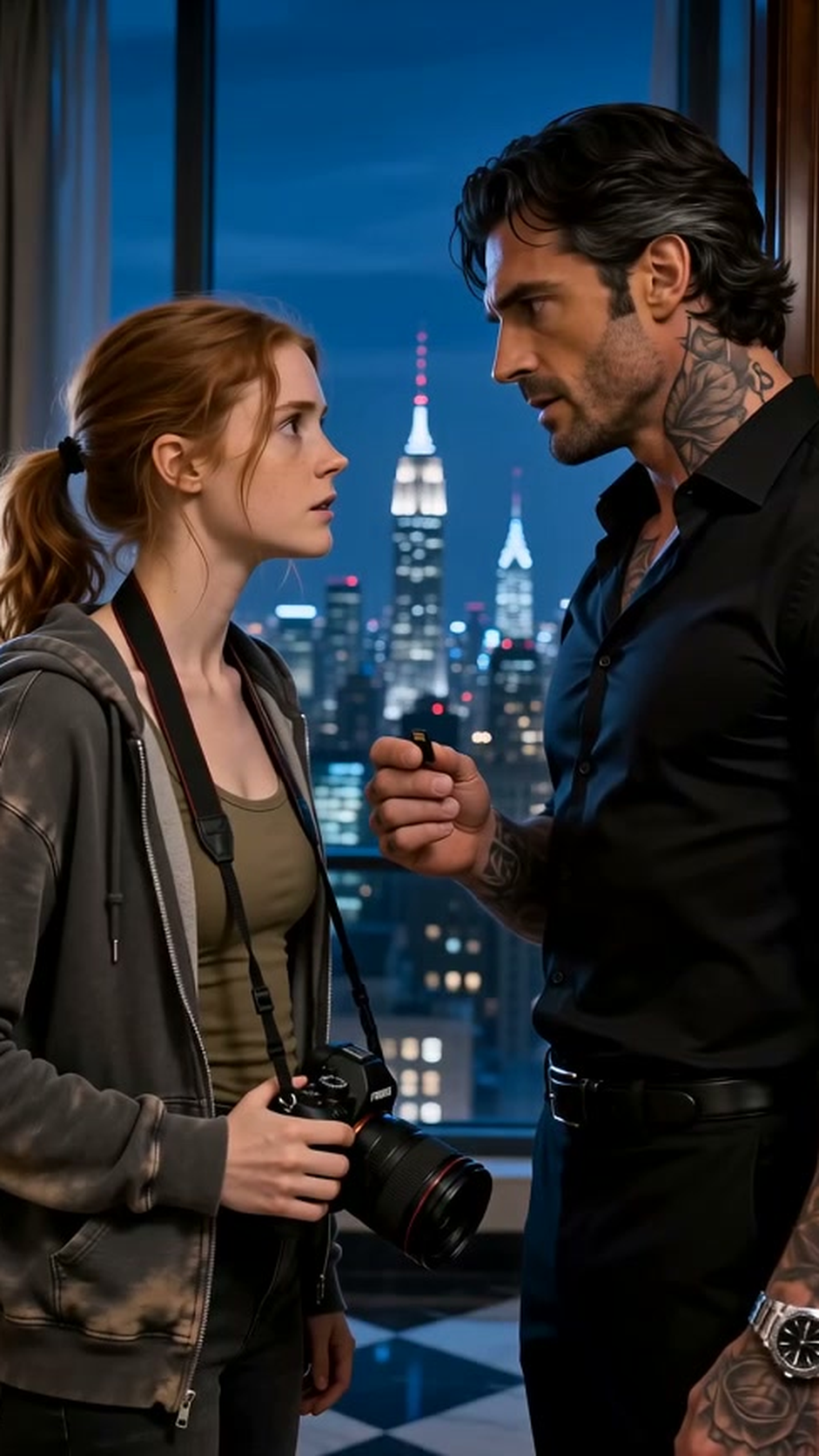
Lily did the thing her father had taught her to do in the bad neighborhoods of other people's wars: she became furniture.
She stepped backward—slowly, heel first, the way she'd learned to move around sleeping babies at weddings—into the shallow alcove of the lounge doors, pressed her spine against the cold glass, and held her camera against her stomach with both hands so nothing on it could swing, click, or catch the light. She did not breathe in any way that counted.
The stairwell door swung open and two men came out onto the fourteenth floor.
Neither of them was dressed like staff. One was thick through the shoulders with a shaved head and the careful walk of a man carrying something heavy under his jacket. The other was younger, leaner, with a phone already at his ear and fury coming off him in a smell of cologne and sweat. They did not look at the lounge. They looked at the floor.
"It was here," the younger one said. "He came down this hall. I watched him come down this hall."
"Then it's here." The big one got down on one knee with a grunt and swept a huge hand across the carpet outside room 1407, palm flat, the way a man searches a beach for a ring. "Check the seams. Check under the door."
Lily's heart was a fist against her ribs. On the carpet, not three feet from the big man's knee, the little black card sat catching the light. She could see it. If he turned his hand six inches—
His phone rang. Both of them flinched like men in a world where a ringing phone was rarely good news. The younger one answered, listened, and his face changed.
"The car's downstairs. Castellano's people just called the summit forward—dinner's tomorrow, but Sal wants everyone in the suite tonight." He looked at the carpet, at the big man's hands, at the doors. "We go. Now. If it's here, it's here. We'll come back with a magnet and a story."
"You want to tell Marco we lost it?"
"I want to tell Marco we lost it a hell of a lot more than I want to tell him we were standing here when Kane's door opened."
The big man stood. They went—not to the elevators, but back through the stairwell door, quick and quiet, and the door sighed shut behind them, and the fourteenth floor was lemon polish and silence again, and Lily Carr was alone in it, shaking so hard her teeth hurt.
She counted to fifty the way her father had taught her. Find the second after. Then she walked to the carpet outside room 1407 on legs made of water, and picked up the memory card.
It weighed nothing. That was the obscene part. It weighed less than a coin, less than a breath, and two grown men—men with guns in their jackets, she would have bet her rent money on it—had been on their knees for it.
Her first honest thought was: Give it to Priya. Her second, which arrived like ice water: Priya works for the hotel, and the hotel works for whoever can buy three floors of it, and the men searching for this card knew the floor, the doors, and the name Kane like employees.
Her third thought was her father's, and it was the one that ruined her life in the most interesting way available: Look at it. You're the only neutral pair of eyes it's ever going to get. Look, and then decide.
She had the adapter in her kit—March, a wedding videographer with the wrong card format, she'd never used it since. Her hands shook too badly for the first attempt. On the second, the card slid home, and her camera's screen woke up in her palms.
There were eleven files. Ten of them showed grey padlocks. One—the first, the smallest—did not.
She pressed play.
One second. That was all it gave her, and for the rest of her life she would be able to describe it the way you describe the frame your whole career hangs on. A hallway—this hallway, she knew it instantly, the black marble, the brass, the door of 1407 standing open at the edge of the frame. Two men. The nearer one, dark-haired, in a suit too good for a hallway at night, was passing something small and flat into the other man's hand, and the other man—older, silver-haired, seen only from behind and the side—wore a watch with a heavy crest on its face, and as his hand closed over the object, the watch caught the corridor light and threw it back at the lens—
The clip ended. The padlock icons swam back.
Lily stood in the corridor with the camera in both hands and understood, with a clarity that emptied her stomach, that the silver-haired man's watch was the same watch she had photographed at eight-fifteen that evening, on the wrist of the gentleman presenting the woman in red to the Castellano Foundation gala like a painting at auction.
She knew whose floor this was. She knew the card documented something that men with guns were willing to crawl for—and that the man in the footage receiving God-knows-what in Damian Kane's own corridor was, as of two hours ago, downstairs drinking Kane's champagne.
She should have gone to the police. She knew that then and she'd know it forever. But she also knew what a second shooter with a non-renewal letter could prove to a police precinct at midnight: nothing, in words nobody would write down, about a one-second clip that would be "lost in evidence" by Tuesday.
The man the card could kill was forty feet away, behind the last door on the floor.
She tried the other door first. Of course she did. She was a photographer from Brooklyn with nine hundred dollars of unfinished work in her camera bag, not a heroine, and every cell in her body was voting for the elevator, the lobby, the street, the train home to Jess and the cat and the non-renewal letter—all the ordinary disasters that had seemed so enormous at breakfast.
She pressed the call button with the side of her thumb. The guest lift chimed, opened onto emptiness, and she got in and rode it down with her heart slamming, watching the numbers fall. Twelve. Nine. Six. The mezzanine. The doors opened on the ballroom level—
—and the lean young man from the fourteenth floor was standing at the far end of the mezzanine rail with his phone to his ear, looking down over the gala, looking for something in the crowd. Looking, she understood in one frozen instant, for whoever had been on the fourteenth floor. He wasn't watching the party. He was watching the exits. His eyes moved across the room with the slow patience of a man reading a list, and the list was every face in the building, and hers was on it the moment she stepped out of this elevator in a charcoal hoodie with a camera on her hip.
The doors stood open. The brass light above them burned. Three seconds. Two.
Lily put her hand flat on the button panel and pressed fourteen, and then, because her hand was already moving and her father's whole life was in her head, she pressed twelve and nine and six as well, and when the doors sighed shut she exhaled a sound that was almost a laugh and almost not.
Let the man do arithmetic. Let him watch four floors.
She got out at fourteen in a corridor that was—mercy—empty, and stood with her back against the cold black marble while her heartbeat slowed from a sprint to a march, and she looked at the little black card in her palm, and faced the truth she had been avoiding since the carpet outside room 1407: there was exactly one door in this hotel behind which the card was evidence instead of a death sentence, and it wasn't the front door, and it never had been.
Lily took the card out of her camera with fingers that had finally stopped shaking—fear does that, burns itself off and leaves the strange calm after—and she walked down the corridor, past the lounge with its painted skyline, to the penthouse door.
***
The knock, when it came, found Damian Kane doing the thing he had done for six nights running: standing at a wall of glass fourteen floors above Fifth Avenue with a glass of whiskey he wasn't drinking, reading the city like a threat assessment.
Behind him the suite was lit low and warm. Rocco Bell, his head of security, sat at the desk by the door with a tablet and the posture of a man who had personally vetted the air. Salvatore Kane—Uncle Sal, consigliere, the last living man who had known Damian's father—stood at the sideboard with his sleeves turned back exactly one fold, pouring coffee he would also not drink, a heavy crested watch riding his wrist.
"Eddie Rusk checked in at nine-oh-four," Rocco said. "Said he had something you needed to see with your own eyes. Said it couldn't go through channels." He turned the tablet around. "He hasn't checked in since. His phone died at nine-oh-seven. On this floor."
"On this floor," Damian said. "In a building with four hundred cameras."
"Fourteen's cameras have a six-minute hole in them. Nine-oh-two to nine-oh-eight." Rocco's mouth was a flat line. "Professional hole. Not a glitch. Somebody with our own codes."
Sal made a sound in his throat, gentle, reasonable, poisonous. "A hole in the cameras and a missing man—Damian, this is what I've been saying. The Castellanos are probing. They want you rattled before tomorrow's table. You're giving them what they want."
"What I want," Damian said, "is Eddie Rusk."
What he did not say—what he had not said to any living person—was that he could feel the shape of it now, the way you can feel a storm by the ache in an old break. A year of small leaks. Routes that went cold a day early. A warehouse in Red Hook that the feds had found gift-wrapped, with only the family's fingerprints wiped off it. Somewhere inside his own house there was a door standing open, and everything he had built since he was twenty-six years old—since the winter they buried his father with his hands folded over a ruined chest—was draining out through it, one secret at a time.
And onto that stage, at eleven o'clock, his uncle had arranged for him to receive a bride.
Isabella Castellano. Twenty-six, beautiful the way magazine covers are beautiful, and offered to him across a foundation gala like the signature on a treaty. Marry the girl, merge the bloodlines, end forty years of low-grade war. It was, as Sal kept saying, the elegant solution. It was also a leash with diamonds on it, and a pair of Castellano eyes in his bedroom for the rest of his life, and Damian—who had survived this long by trusting exactly four people, two of whom were dead—had agreed only to receive her. Tonight. A drink. A first look. His uncle's word against his instincts.
The knock came at eleven-oh-two.
Rocco was on his feet with his hand inside his jacket before the sound finished. Sal set the coffee down very carefully.
Damian looked at the clock. Isabella Castellano was early, or his uncle had scripted her to be. He felt the old exhaustion move through him—the particular tiredness of a man whose entire life had been arranged by other people's strategy—and he set down the whiskey and straightened his cuffs like a man going to his own sentencing.
"Boss?" Rocco said, at the door, peering through the security glass. His voice changed. "It's not— Boss. There's a girl at the door. Hoodie. Camera." A pause. "She's holding up something small and black between two fingers, like a white flag."
Sal went absolutely still.
And Damian Kane, who was expecting a woman in a red dress with a practiced smile and a treaty hidden in it, said the words that ended his old life:
"Open the door."