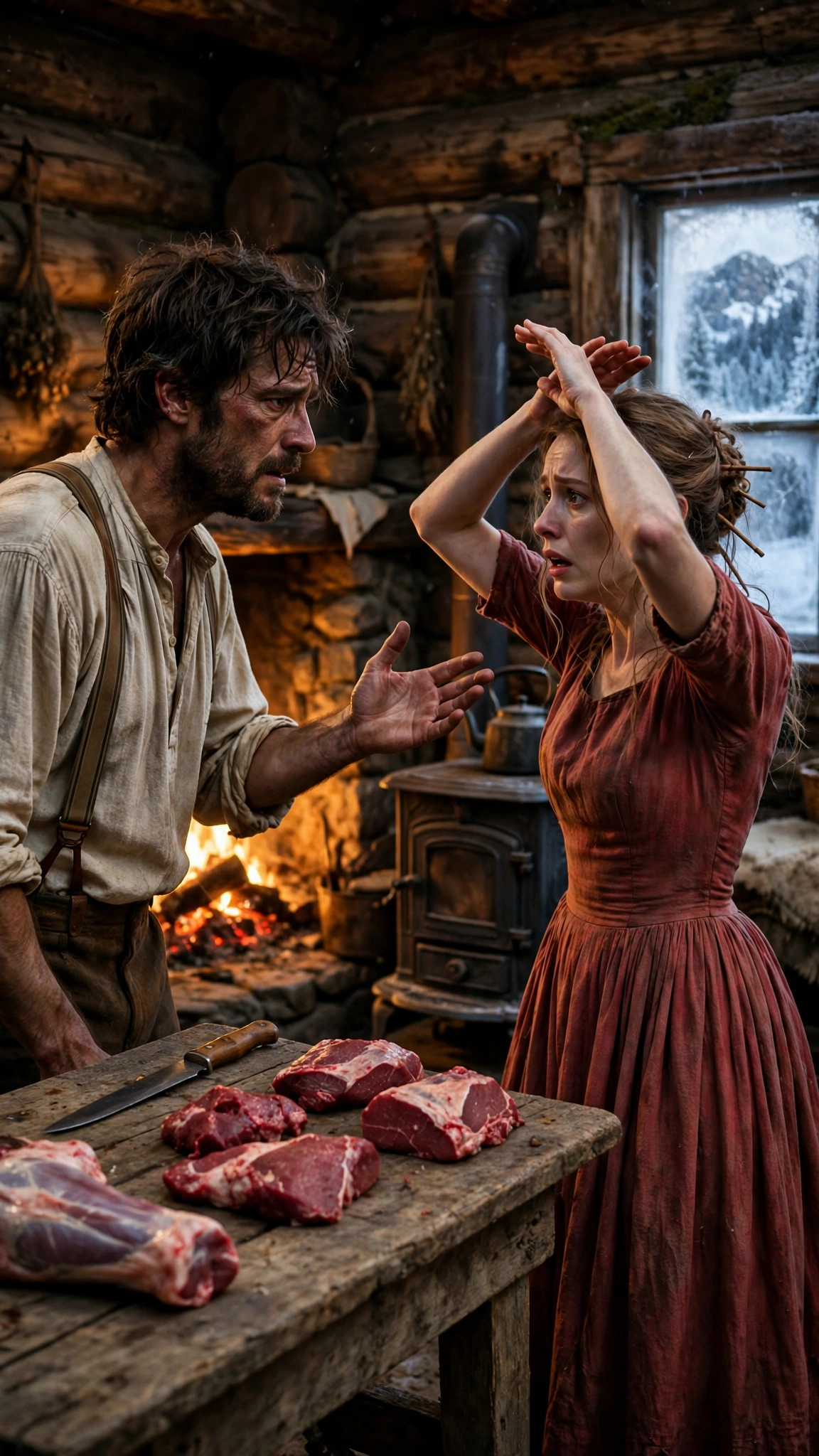
The paper was folded small, creased and soft from years of being hidden, and when Mave unfolded it by the light of the fire, her hands were shaking so badly she could barely hold it still.
It was a letter. She knew Jonah's hand at once — the big, slow, careful letters, the way he formed his name, the way he pressed too hard on the pen and made the ink blot at the ends of his words. He had never been a good writer, and he had always been ashamed of it, and he had written this letter slowly, painstakingly, as if every word cost him something.
She read it by the firelight, her lips moving silently over the words, and as she read, the tears began to fall, slow and quiet, onto the paper in her hands.
Mave, my love, the letter said. If you are reading this, then something has happened to me, and I am sorry. I am sorry I could not come home to you. I am sorry for every hard word and every empty pocket. But I need you to know something, and I need you to believe it, because it is the truest thing I have ever written.
I never sold you. I would never sell you. You are my wife, and you are worth more to me than every dollar in this valley, and no paper in this world could make you belong to any man but the one you choose.
Merritt Voss has been pressing me for money I do not owe. He raised the prices at the post, and he charged me for goods I never bought, and he wrote figures in his ledger that were never true. My last freight run paid my account in full — I counted it myself, in coin, on the counter of his own store, and the reverend saw me do it. If Voss ever tells you otherwise, he is lying. If he ever shows you a paper with my name on it, it is a forgery. I would cut off my own hand before I signed such a thing.
Go to the reverend, Mave. He has the record. He wrote it down in the church book, in my own hand, the week before I left. And then go and live your life, and be happy, and do not let any man tell you that you belong to him. You belong to yourself, and to God, and to no one else.
I love you. I will always love you. Jonah.
Mave sat by the fire for a long time after she finished reading, the letter trembling in her hands, the tears running down her face and falling onto the paper, and she thought about all the years she had believed the lie — the years in the back room of the trading post, the bruises, the silence, the fear — and she thought about Jonah, who had loved her enough to hide a letter in her mother's Bible, and who had warned her, and who had been right about everything, and she thought about how close she had come to never knowing the truth at all.
Gideon woke then. He had heard her moving in the dark, and he had risen from the pallet by the fire, and he stood behind her now, his hand on the back of her chair, saying nothing, waiting.
She turned to him, and she held the letter out to him, and her voice, when she spoke, was steady for the first time since she had come up the mountain — steady, and clear, and unafraid.
"Read it," she said. "Please. Read it."
Gideon took the letter, and he read it slowly, by the firelight, his brow furrowing, his lips moving over the difficult words, and when he finished, he folded it carefully and handed it back to her, and he sat down at the table across from her, and he placed both his hands flat on the wood, where she could see them, empty and open, and he waited.
And Mave told him everything.
She told him about the river, and the empty coffin, and the ninety-four dollars, and the ledger that never shrank. She told him about the back room of the trading post, and the evenings when Voss came into the kitchen, and the hand on her side, and the bruises along her ribs, and the shape of four fingers pressed hard into the flesh. She told him about the paper Voss had shown her, and the signature she could not read, and the lie she had believed for five years — that Jonah had sold her, that she belonged to Voss, that she had no right to run.
And then, at last, she told him the rest of the sentence. The sentence that had begun on the sixth day of their marriage, in the firelight, when he had asked her who did this to you, and she had looked at the door and whispered, "He told me…"
"He told me Jonah sold me to him," she said, and her voice did not shake. "He told me I was his property. He told me if I ran, he'd bring the law after me. He told me I belonged to him, and I believed him, because I had no one to tell me otherwise. But Jonah never sold me. The debt was paid. The paper was a lie. And I am not his property. I never was."
The words hung in the air between them, and the fire crackled, and the cabin was silent, and Gideon sat across the table from her with his hands flat on the wood, and his face was very still, and his eyes were very dark, and when he spoke at last, his voice was low and controlled, the voice of a man holding a great anger very carefully in check.
"Then we'll prove it," he said. "The reverend has the record. Jonah's letter is here. Voss has a forged paper and a ledger full of lies, and we have the truth, written in Jonah's own hand, and witnessed by the church. When he comes back with the law, we'll show the law the truth. And if the law won't listen, then I'll ride down to the county seat myself, and I'll lay it before the judge, and I'll stand there until he listens."
Mave looked at him, and she saw the truth of it in his face — the same steady, unmovable look he had worn in the yard, standing between her and Voss, his hands empty and open at his sides. He was not a violent man. She knew that now, after a whole winter of living beside him. But he was a man who would fight for what was right, with the truth, and with the law, and with every honest means God had given him, and he would not stop until it was done.
"What if the law believes him?" she whispered. "He's a respectable man. He owns the trading post. He has money. I'm only a widow with bruises."
Gideon reached across the table then, slowly, so slowly that she could see his hand coming and could have pulled away if she had wanted to, and he laid his hand over hers, palm down, fingers spread, warm and rough and steady.
"You're my wife," he said. "And you're telling the truth. And the truth is stronger than any paper Voss ever forged. I believe you, Mave. And I'll stand beside you until the whole valley believes you, too."
Mave looked down at his hand over hers, and she felt the warmth of it through her skin, and she felt something inside her — something that had been locked away for five years, behind silence and fear and a lie — begin, very slowly, to open.
She turned her hand over beneath his, and she laced her fingers through his, and she held on, and for the first time since Jonah died, she was not afraid.
The next morning, Gideon saddled the mule and rode down the mountain to Bitterroot, carrying Jonah's letter folded inside his coat, and Mave stayed behind in the cabin, and she waited, and she prayed, and she kept the fire going, and she thought about the days ahead — about the reverend, and the church ledger, and the marshal, and the end of the week, when Voss had promised to return with the law.
She was afraid. She would not pretend otherwise. But the fear was different now. It was not the fear of a woman who believed she belonged to a man who hurt her. It was the fear of a woman who knew the truth, and who was waiting to tell it, and who had a husband standing beside her who believed her.
And that, she thought, as she stood at the window and watched the trail below for Gideon's return, was a very different kind of fear. It was the kind of fear that could be faced. It was the kind of fear that could be beaten.
When Gideon came back that evening, the light was failing, and the rain had begun again, soft and steady on the roof, and he came in wet and cold, and he stamped the mud from his boots, and he looked at her across the cabin, and he smiled — a slow, tired, triumphant smile she had never seen on his face before.
"The reverend has the record," he said. "And he's written to the county marshal himself. Marshal Eben Cross is riding up from the county seat tomorrow, and he's bringing the judge's clerk with him. Voss's paper is a forgery, Mave. The reverend saw Jonah pay his account in full, and the church book proves it. It's over. It's finally over."
Mave stood in the middle of the cabin, her hands pressed to her mouth, and she looked at him, and she laughed — a small, startled laugh, half tears, half joy — and then she crossed the room, and she put her arms around him, and she held on, and Gideon held her back, gently, carefully, as if she were something precious and breakable, and the fire crackled in the stone fireplace, and the rain fell soft on the roof, and the mountain stood silent and white around them, and for the first time in five years, Mave Calloway was free.
Before they slept that night, Mave did one more thing. She took Jonah's letter from where she had folded it into her mother's Bible, and she read it aloud — all of it, from the first word to the last — while Gideon sat beside her on the pallet and listened, his hands folded, his eyes on the fire. When she finished, she folded the letter again, and she put it back in the Bible, and she set the Bible on the shelf beside Gideon's father's books, where it belonged, and she thought about Jonah, and about the last thing he had written to her: You belong to yourself, and to God, and to no one else.
"I believe him now," she whispered. "I believe every word of it. I wish I had believed it sooner. I wish I had gone to the reverend the first winter, instead of the fifth."
Gideon shook his head. "You went when you were ready," he said. "That's all any of us can do. Jonah knew that. That's why he hid the letter where you'd find it when you needed it most — not a day sooner, and not a day later."
They sat together by the fire until it burned low, and Mave told Gideon the rest of it then — the small things she had never told anyone, the way Voss counted the candles, the way he locked the back door at night, the way she had hidden a crust of bread in her dress pocket on the days he forgot to feed her, saving it for the morning, because she had learned that a hungry day was easier to bear if you knew there was something waiting. She told him about the winter she had caught the lung fever and worked through it, scrubbing floors with a fever burning in her chest, because Voss had said a sick woman was a useless woman, and a useless woman was turned out into the snow. She told him about the night she had stood at the window of the back room and watched the snow falling on Bitterroot and thought about walking out into it and never coming back, and about the morning she had woken up and decided, instead, to live.
Gideon listened to all of it, and he did not interrupt, and he did not try to comfort her with easy words, and when she finished, he simply took her hand, and he said, "You're here now. That's what matters. You're here, and he's finished, and tomorrow the marshal comes, and the day after that, we start again."