The ring weighed almost nothing, and Ryan Mercer could not stop his hand from shaking.
He stood under the awning of the Mercer Grand with the rain coming down in silver sheets beyond the marble steps, less than an hour from the moment he was supposed to walk into a candlelit private dining room, kneel in front of two dozen witnesses, and ask Amelia Brooks to become his wife. Everyone was already upstairs. His mother. Her parents. The photographers his mother had hired, because in the Mercer family even love was a press release.
Ryan opened the black velvet box.
The diamond caught the golden Christmas light strung along the hotel's facade and threw it back in a cold, brilliant flash. Three carats. Flawless. The most beautiful object he had ever bought for a reason he could not name.
"Mommy… who's that man?"
The voice was small, high, and so clear that the rain seemed to step aside for it.
Ryan raised his eyes.
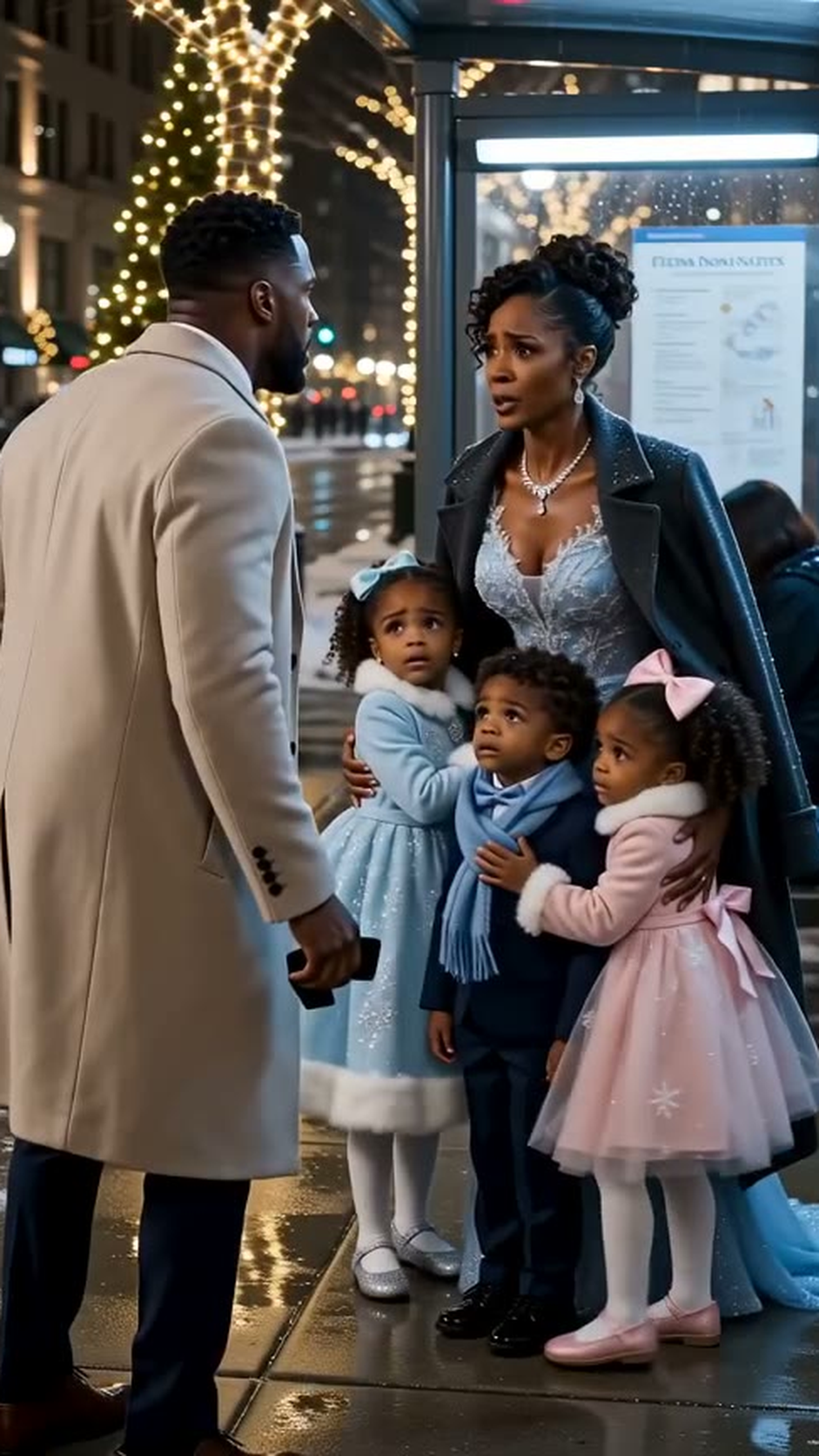
Across the wet pavement, beneath the decorated bus shelter, stood a woman in a rain-darkened coat thrown over an icy-blue evening gown, one hand gripping the white fur stole at her throat. Grace. His Grace — no. Not his. Not for three years. His ex-wife, with her dark curly hair pinned up the way she used to wear it to galas, diamonds at her throat, and an expression that changed the instant she saw him looking.
Because she was not alone.
Three children stood pressed against her, the way small animals press against their mother when thunder gets too close. A girl in a pale-blue dress with white fur trim and a blue bow, clear-eyed and watchful. A girl in pink, half hidden behind Grace's skirt, her small fingers knotted in the fabric. And a boy in a navy suit with a blue scarf, standing a fraction in front of his sisters like a tiny sentry — a boy who tilted his head, studying Ryan, and in that tilt Ryan saw his own gesture so exactly that the breath stopped in his chest.
The boy had his eyes. Gray-blue. Unmistakable.
"Grace…?" Ryan barely heard his own voice.
Every trace of color drained from her face. She moved — not toward him, never toward him — pulling the children in against her body with both arms, turning half-sideways so that her own shoulder stood between Ryan and them, and taking one involuntary step back into the rain.
He stepped forward without deciding to. "Grace—"
She flinched. Grace, who had once fallen asleep with her head on his chest through a thunderstorm that knocked out half of Chicago, flinched from him. He stopped as if he had walked into glass.
His eyes moved over the three small faces. Doing math he did not want to do. "How old are they?"
Grace swallowed. Her fingers tightened around the children's hands until the boy winced, and she loosened her grip at once, stroking his knuckles in apology.
"Three," she whispered.
Three. The word went through Ryan like the cold off the lake. Three years since the divorce. Three years since signatures on paper in a lawyer's office he had not even attended. Three years of a bed too big and a house too quiet and a mother saying, at intervals, that he had been lucky to escape.
"Are they—" He had to stop and find air. "Are they mine?"
Grace's breathing stopped with his. She looked at the wet pavement, at the children's wet shoes, at the ring box trembling in his hand — anywhere but at his eyes. One of the girls gripped her dress harder. The boy moved closer against her leg, watching Ryan the way you watch weather coming.
Ryan reached toward her hand, slowly, the way you reach toward something injured.
She drew it back. Not in anger. In fear so old it had become reflex.
Headlights swept the street. A bus came down Michigan Avenue and braked hard beside the shelter, water exploding up from its tires, air brakes sighing, and the sudden noise made all three children jump against Grace. She gathered them toward the opening doors with the swift, practiced efficiency of a woman who had done a thousand departures alone.
"Grace, wait!" Ryan came forward two steps into the rain. "Please—"
She turned at the bus steps. Her eyes were wet, and it was not only the rain.
"I've already lost too much," she said.
She lifted the children aboard one by one. The boy went last. At the top of the steps he turned and looked back, and for one annihilating second Ryan was not standing on a Chicago street in the rain — he was four years old in his grandmother's hallway, staring out of an old photograph at himself.
The doors closed. The bus pulled away into the gold and silver blur of the avenue, carrying his whole life with it.
Ryan stood in the rain until his coat was soaked through. Then he got into his car.
He did not drive upstairs to the dining room where Amelia Brooks waited in white. He drove after a city bus.
His phone lit up against the passenger seat, again and again. Amelia: Where are you? Everyone's waiting. He glanced once at the diamond ring still open in its box beside him, then back at the bus's red taillights smearing through the rain on his windshield, and he tightened both hands around the wheel.
Twenty minutes later, the bus sighed to a stop beneath an illuminated sign, and Ryan's world, which had already cracked, split cleanly in two.
CHILDREN'S MEDICAL CENTER.
Grace came down the steps with the children, steadying the little girl in pink when her shoe slipped on the wet pavement, and hurried all three through the glowing glass doors like a woman who had made this journey in the dark many times. Ryan pulled in across the street with his hand gone slack on the wheel. The velvet box slipped from his fingers and struck the passenger seat with a soft, heavy sound he would hear in his sleep for the rest of his life.
He crossed the street at a run.
Through the glass entrance he watched Grace lead the children past the information desk, past the elevators, toward a corridor marked with small painted stars — a specialized pediatric treatment wing. She moved with terrible familiarity. One child held her hand tightly. Another looked toward the treatment doors the way other children look toward the deep end of a swimming pool.
Grace paused at the doors. She turned. Through the glass, through the rain still streaming off Ryan's coat, she saw him standing there.
Her eyes widened in pure panic.
"Which one…?" Ryan whispered. He did not know he had spoken aloud. "Grace. Which one?"
She drew the children against her as the automatic door began to close between them. A nurse appeared beyond the doorway, speaking Grace's first name like an old friend, and Grace looked at the nurse, and then back at Ryan, and her lips parted at last — three years of silence balanced on a single breath.
"Ryan… there's something you don't—"
The door closed.
– – –
Three years and four months earlier, Grace Mercer had still believed that love was a place you could not be evicted from.
The end, when it came, did not knock. It arrived as an envelope, hand-delivered to the penthouse on a Tuesday, containing six photographs of Grace in a café on Wabash Avenue, laughing, her face close to a tall man's face, his hand cradling the back of her head. The man was her brother. James Ellis had flown in from Seattle for exactly one day to tell her, face to face and holding both her hands across the table, that his wife was pregnant. Grace had laughed with her forehead against her brother's forehead, the way they had since childhood, and someone across the street with a long lens and a short conscience had turned a sister's joy into an adulteress's evidence.
She never got to explain. That was the genius of it, she would think later, in the years when thinking was all the company she had. By the time the envelope reached her, it had already reached Ryan's mother. And Eleanor Mercer had been waiting three years of marriage for proof of what she had believed from the first day: that a scholarship girl from the South Side who coordinated charity events for a living had married her son for the name on the buildings.
Ryan was in London. Ryan was in meetings. Ryan's assistant said Mr. Mercer had asked not to be disturbed. Ryan's assistant said — on the fourth day, in a voice like a closing door — that Mr. Mercer had seen the photographs, that he was "processing them with counsel," and that Mrs. Mercer should direct all communication through the family's attorneys.
Grace stood in the marble kitchen of the home she had made — his home, the lawyers would shortly clarify — and understood that she had not lost an argument. She had lost the right to be heard.
The divorce took eleven days. She signed the papers alone at a conference table downtown, in an empty chair beside the one reserved for a husband who did not come, and a lawyer she had never met slid a settlement check across the polished wood with the embarrassed air of a man paying a tradesperson. She left it on the table. She walked out of the building with her maiden name, one suitcase, and a winter coat, into the first snow of November.
The doorman of the Mercer Grand — the other Mercer Grand, the residential tower two blocks from the law firm, where she and Ryan had lived — held the door for her that evening without recognizing her in her plain coat, and she had ridden the service elevator up one last time, with the super's permission and a thirty-minute limit that had been conveyed to her like a restraining order, to collect what was hers. Thirty minutes for three years. She took her mother's china, wrapped in her own sweaters. She took her books, her sewing machine, the ridiculous ceramic frog Ryan had won her at a county fair in the first summer and hidden, ever afterward, in a new absurd place in the apartment every few months like a private postal service of affection. She found it that last evening in the fruit bowl, wearing a paper crown. She stood in the kitchen holding a ceramic frog in a paper crown, in a home emptied of her name, and she laughed — and the laugh terrified her, because it had an edge on it like a breaking branch.
She left the frog. That was the thing she would confess to no one, in all the years of telling herself she had taken everything that mattered: she set the frog back in the fruit bowl, exactly where he would find it, crown and all, because some traitor clerk in her heart was still filing things under us.
On the train to Indianapolis she sat with her suitcase between her knees and her hands folded over a flat, secret stomach, and she composed, and tore up, and composed again, the letter she would eventually write on the penthouse stationery she had taken — accidentally, she would tell herself — from the desk drawer. Ryan — I am writing this because your assistant says you will not take my calls… She had the words by heart before the train crossed the state line. It would be another two weeks before she had the courage of them, and by then she would be standing in a marble lobby, learning what Amelia Brooks's smile meant.
Seven days later, standing in the bathroom of her cousin's spare room in Indianapolis, Grace stared at a plastic stick and watched two pink lines darken — while a second test, and then a third, laid out on the sink like a firing squad, told her the same impossible thing.
She went back to Chicago once. Once. She stood in the lobby of Mercer Tower, pregnant and shaking, and asked to see her husband — her ex-husband, she corrected herself to the security guard, whose face changed when he found her name on a list he did not show her. She waited two hours on a marble bench. And then Amelia Brooks came down in the private elevator, in a cream suit, with her hand resting lightly on the guard's desk, and smiled at Grace the way you smile at weather you have personally arranged.
"Ryan asked me to tell you," Amelia said gently, "that whatever it is, he doesn't want to know. He's moved on, Grace. Let him."
Grace looked at the elevator doors closing on the life she had built, set both hands over a stomach that had not yet begun to show, and made the vow that would carry her through everything that came after.
Never again. Not to them. Not for anything.
She walked out into the snow.
Four months later, in a small clinic across town from a life she no longer had, an ultrasound technician went quiet over the monitor, then smiled the careful smile of a woman delivering miraculous and terrifying news in the same breath.
"Grace," she said. "There are three heartbeats."