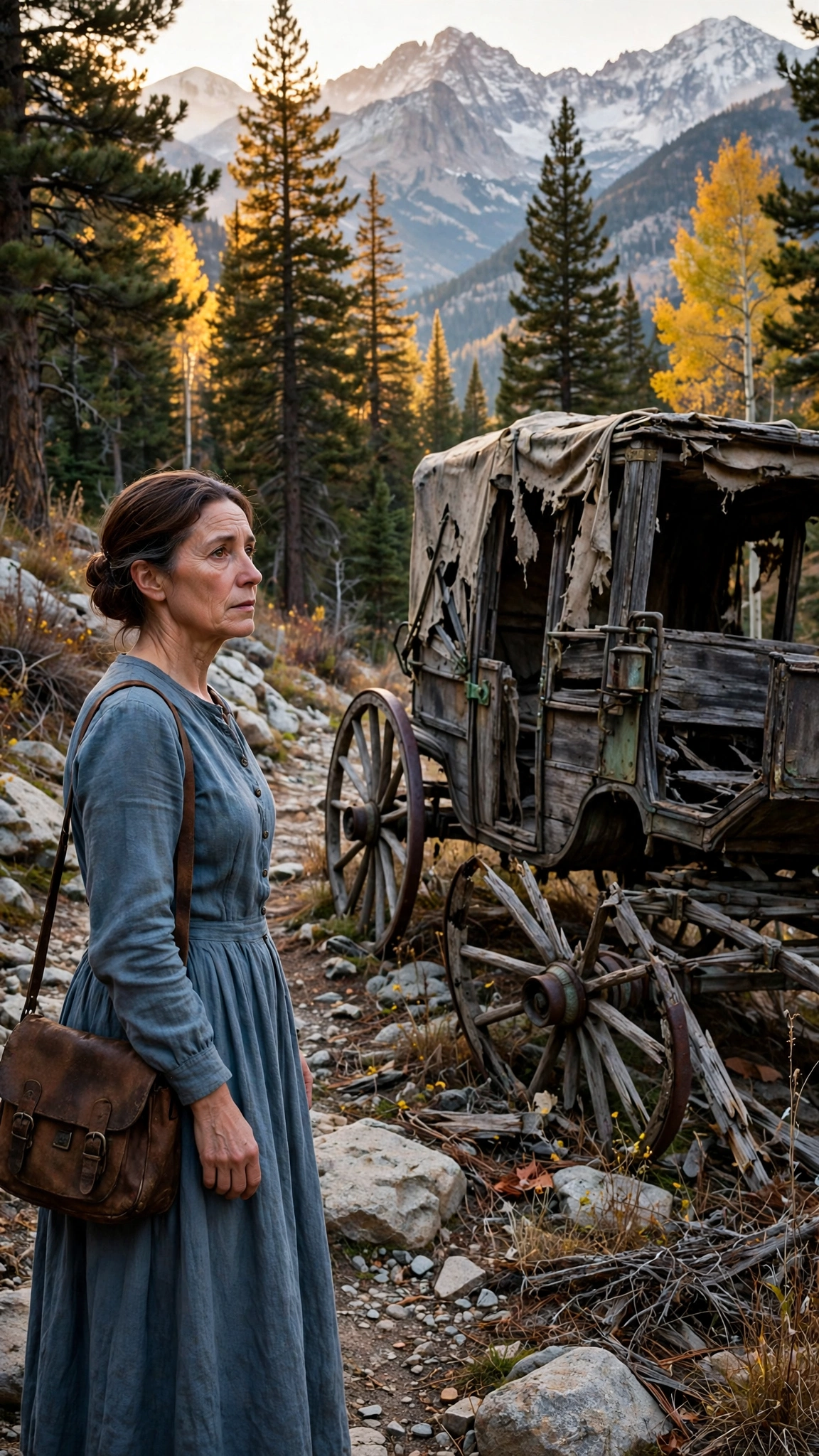
One year later, on a Saturday in late October, Claire Bennett stood on a trail in the San Juan Mountains, and the air was cold and clean, and the pines smelled of resin, and the mountains stood around her in their late-afternoon light, and she was not afraid.
She had come back to the mountains on her own terms. She had driven down from Denver that morning with Maggie O'Connell and Ruth Ann Crowe, and the three of them had hiked the old wagon road together, slowly, stopping often, laughing about how out of shape they all were, carrying sandwiches and water and a thermos of coffee in Maggie's backpack. Claire's left shoulder ached a little by the end of the climb — it always would, the doctor said, in cold weather — but it carried the weight of her satchel without complaint, and she had learned to listen to it the way you listen to an old friend: with respect, and without fear.
They were here for the marker.
The Colorado Historical Society had preserved the carriage where it stood, in its hollow in the ravine, and had built a short trail to it, and had placed a bronze marker at the trailhead. The marker told the story — the real story, this time. It told of Elias Crowe, who filed his claim in 1898 and died in these mountains. It told of the Mason family, who took the land on a forged document and held it for a century. It told of Warren Mason, who wrote a letter in 1999 and hid the truth in the carriage, and who died before he could bring it down. And it told of the woman who found the letter, twenty-seven years later, and carried it out of the ravine.
Claire had argued against putting her name on the marker. Ben Osei had argued back, gently, that the story was not complete without her, and that the truth had needed someone to carry it, and that the someone had been her. In the end, they had compromised: the marker named Elias Crowe and Warren Mason, and it named the Crowe family, and at the bottom, in smaller letters, it said, "The documents were recovered in 2026 by Claire Bennett Mason, attorney."
She stood in front of the marker now, with Maggie on one side of her and Ruth Ann on the other, and she read it all the way through, and she thought it was fair. It did not make her a hero. It made her a witness, and a witness was enough.
The unveiling had been small — a dozen people, a table with coffee and doughnuts, a cloth over the marker that Ruth Ann's children pulled away together, shrieking with delight when it came off in their hands. Ben Osei gave a short speech, about Elias Crowe, and about Warren Mason, and about the way a story could wait a hundred years to be told truly, and about the woman who had carried the truth down a mountain in a brown leather satchel. People clapped. Ruth Ann cried. Maggie pretended not to cry, and failed.
Ruth Ann's children were there, too — a boy of nine and a girl of seven, running ahead on the trail, shouting back over their shoulders, their voices bright in the mountain air. Ruth Ann watched them with the look of a woman who had gotten something back that she had not known, until the day she walked into a lawyer's office in Denver, that she had lost.
"They're going to grow up knowing this story," Ruth Ann said. "Not the version where the land was just lost. The real version. Where their great-great-grandfather filed a claim, and a family kept it, and a woman carried the truth down a mountain."
"That's a good story," Claire said.
"It's the true story," Ruth Ann said. "That's what makes it good."
They walked down to the carriage together, and the children ran ahead, and Maggie pointed out the wheel that leaned at its unnatural angle, and the brass fittings gone green with age, and the canvas hanging loosely over the damaged frame, and the pines and the peaks behind it, and Claire stood in the left foreground of that scene, on the rocky mountain path, her satchel resting against her side, and she looked at the carriage the way you look at a place where something ended and something else began.
The boy, who was nine, stopped in front of the carriage and stared up at it, and then he turned to Claire and asked, in the direct way children ask things, "Is this where the bad man left you?"
Claire crouched down so she was at his height, carefully, favoring her left shoulder, and she said, "This is where I found the truth. The carriage was here for a very long time, waiting for someone to find it. And I found it. And that's why your family has its land back."
The boy thought about that, and then he nodded, and he ran off after his sister, and Ruth Ann put a hand on Claire's good shoulder, and said, "Thank you," and Claire said, "You're welcome," and they both knew that those two words were not enough, and that they were everything.
The clinic was thriving. In the year since the hearing, the Mountain Justice Legal Clinic had taken on eleven more cases like Ruth Ann's — families whose land had been taken on paper that did not hold up, whose grandmothers had kept boxes of documents in closets, whose stories had waited decades for someone to read them. The trust that San Juan Consolidated had funded was paying out grants, and Maggie had hired two young lawyers, and Claire had started teaching a seminar at the law school, on the law of old claims, and the students called her Professor Mason and then corrected themselves, because she had gone back to Bennett, and she liked the sound of her own name again.
Her shoulder was better. Not perfect — it never would be — but better. She could lift her arm above her head. She could carry a bag of groceries. She could sleep on her left side, some nights, if she was careful. She had stopped measuring her recovery in inches and started measuring it in the things she could do: hike, work, laugh, sleep through the night.
Daniel was in prison, and she did not think about him often. She had forgiven him, in the way that forgiveness means you stop carrying a person's weight on your own back — not because he deserved it, but because she did. She had not visited him, and she did not intend to. Some doors, once closed, stay closed, and that was all right. The marriage had lasted nineteen years, and it had ended on a ledge, and she had survived it, and survival was not a small thing. It was everything.
Meredith wrote to her once more, at Christmas, a short letter, without excuses. Claire answered it this time, briefly, kindly, and without promises. She wished Meredith well. She meant it.
That evening, as the light went gold over the peaks and the cold came down into the ravine, the three women walked back up the trail together, and the children ran ahead, and Maggie told a story about a judge she had once argued before who fell asleep during his own ruling, and Ruth Ann laughed until she had to stop walking, and Claire laughed too, and the sound of it surprised her, because it had been a long time since she had laughed like that, freely, without thinking about it first.
At the trailhead, they stopped, and they looked back down at the ravine, at the pines and the pale boulders and the little hollow where the carriage stood, and Claire thought about the day she had lain there with her cheek against the cold dirt, whispering to herself to stay alive, and about everything that had happened since — the letter, the hearing, the land, the trust, the marker, the year of healing — and she understood, finally, what the number twenty-seven had meant, all along.
It had not been a curse. It had been a clock. Twenty-seven years for a letter to be found. Twenty-seven years for a family to get its land back. Twenty-seven years for a woman to walk down a mountain carrying the truth, and to walk back up it, a year later, carrying nothing at all — no satchel full of secrets, no weight on her shoulder that did not belong to her — just herself, and her friends, and the long road home.
"Ready?" Maggie asked.
Claire nodded. She took one last look at the mountains, and then she turned toward the car, and the road, and Denver, and the life she had built from the pieces of the old one — a life that was hers, entirely hers, for the first time in nineteen years.
"Ready," she said, and she walked up the trail, into the last of the afternoon light, and she did not look back.
The drive home was long and golden, the sun low over the peaks, the children asleep in the back seat before they reached the highway, their heads tipped together like two birds on a wire. Maggie drove, and Ruth Ann rode beside her, and Claire sat in the back with the children, and they did not talk much, because there was nothing that needed saying. The radio played low, an old song Claire half-remembered, and the mountains fell away behind them, and the valley opened up ahead, and Claire thought about the marker, and the carriage, and the letter, and the year that had passed since she had lain in a ravine with her cheek against the cold dirt — and she thought that she had come a very long way, and that the road ahead was long, too, and that for the first time in a long while, she was not afraid of it.
Ruth Ann, in the front seat, told Maggie about the fence they were going to build in the spring, along the creek, and about the garden her daughter wanted to plant, and about the school board meeting on Tuesday, and her voice was light and ordinary, and it was the most hopeful sound Claire had heard in a year — a woman planning a future on land that was finally, legally, hers.
In the weeks that followed, the life she had fought for settled into its shape.
Claire's seminar at the law school had become, to her surprise, the most popular class she had ever taught. The students were young and fierce, and they asked hard questions. One of them, a young woman named Priya, asked her once whether the law could ever really fix a wrong that was a hundred years old.
"No," Claire said, honestly. "The law can't give Elias Crowe his life back. It can't give Warren Mason his twenty-seven years back. What it can do is smaller, and it matters anyway: it can say, on the record, what happened. It can give the land back. It can put the truth where everyone can read it. And sometimes, that's enough to let the living go on."
Another student, a young man in the back row, raised his hand. "But what if the truth comes too late? What if everyone who was wronged is already dead?"
"Then the truth is for the living," Claire said. "For the grandchildren. For the people still standing on the land, wondering whether it was ever really theirs. The law can't raise the dead. But it can stop the living from being robbed twice — once by the crime, and once by the silence."
That evening, back home in Denver, she cooked dinner for herself — pasta, badly, the way she had always cooked it, with too much garlic and not enough salt — and she ate it at the kitchen table with a glass of wine, and she looked around the house, at the books on the shelves, and the photographs on the wall, and the quiet rooms, and she thought that the house felt like hers again, for the first time in nineteen years. It was not a large life. It was not a dramatic life. It was hers, entirely hers, and she had fought for it, and she intended to keep it.