Daniel Mason pleaded guilty.
It happened six weeks after the hearing, in the same Durango courtroom, with the same high windows and the same afternoon light. He stood before Judge Okafor in a suit that no longer fit him quite the way it had, and he said, in a calm voice, that he was guilty of attempted murder, and that he accepted the consequences.
His lawyer had negotiated the plea down from the maximum: twelve years, with the possibility of parole after eight, in exchange for a full statement about what had happened on the ledge, and about what had happened on the road in 1999, when his father died. The statement was sealed, but Sheriff Begay told Claire, quietly, in his office, what Daniel had said.
"He says his father had a heart attack at the wheel," the sheriff said. "He says he was following his father's car that day, because Warren had told him he was going up to the carriage to bring the proof down, and Daniel wanted to talk him out of it. He says he saw the car go off the road, and he stopped, and his father was already gone. He says he did not touch the car. He says he simply drove away, and let the accident be an accident, and told himself that the land was his family's now, and that his father would have understood, in time."
"Do you believe him?" Claire asked.
The sheriff was quiet for a moment. "I believe he believes it. I believe he has told himself that story for twenty-seven years, until it feels true. And I believe that on the ledge, he made a different choice, and this time there was no accident to hide behind."
Meredith Mason pleaded guilty to a lesser charge — accessory after the fact — and received a suspended sentence, in exchange for her testimony. She sold her real estate business in Denver and moved to Silverton, where she volunteered at the historical society, cataloguing mining records, and where, people said, she was the first to arrive in the morning and the last to leave.
The land went back to the Crowe family, as the judge had ordered. Ruth Ann Crowe stood on her sixty acres in the spring, with her husband and her two children, and watched the surveyors drive the new markers into the ground, and she cried, and then she laughed, and then she went back to teaching school in Silverton, because the land had never been about money. It had been about belonging.
The physical therapy was slow, and it hurt, and it worked, but not in a straight line. Her therapist was a woman named Ana, with infinite patience and strong hands, who taught Claire to move the joint again one degree at a time. There was a pulley on the wall, and a set of rubber bands, and a chart where Ana marked Claire's progress in pencil. The first time Claire lifted her left arm above her shoulder, she cried — not from pain, but from the shock of it, the simple fact of her arm going where she told it to go. A month later, she had a setback: she reached for a file on a high shelf at the clinic, and something caught, and the pain came back white-hot, and she sat at her desk with her head in her hands for twenty minutes, convinced she had undone everything. Ana told her that setbacks were part of healing, that the joint was learning, that the body kept its own schedule. Claire went back the next day, and the day after that, and she learned to be patient with her own body in a way she had never been patient with anything.
The trust's first grant went to a widow in Ouray named Mrs. Delgado, sixty-eight years old, whose husband's family had lost their parcel the same way, in 1912, on a document that did not hold up. Claire went to the ceremony, although she had not planned to, and she stood at the back of the little community hall while Mrs. Delgado cried, and thanked the clinic, and said that her husband had died believing the land was lost forever. Claire thought about Warren Mason's letter, and about the carriage, and about the way the truth moved slowly, like water finding its way through rock, and she was glad she had come.
The divorce was final in March, in a hearing that lasted eleven minutes. Daniel did not attend. His lawyer read a short statement, the judge asked Claire three questions, and it was done. She kept the house in Hilltop — it had always been hers, bought with her own money before the marriage — and she took nothing else. Daniel's lawyer offered her a settlement, a large one, with a confidentiality clause attached, and Claire refused it without hesitation. She did not want his money. She did not want his silence. She wanted her name back, and her life back, and the truth on the record, and she had all three.
Meredith wrote her a letter, once, handwritten, three pages long. "I have no right to ask for your forgiveness," it began, "and I am not asking for it. I am writing to say that I know what I did, and that I will carry it for the rest of my life, and that I am sorry — not in the way Daniel was sorry, on the ledge, as a price for what he wanted, but in the way a person is sorry when she finally understands what she helped to do." Claire read it twice, and then she put it in a drawer, and she did not answer it, and she did not throw it away.
Her first week back at the clinic, the staff threw her a small party — a cake from the bakery down the street, a card signed by everyone, a banner that read "WELCOME BACK, CLAIRE" in crooked letters, hung by the young associate who usually drafted the responses. Claire cried a little, and laughed a little, and ate two pieces of cake, and then she went back to work, because the work had not stopped while she was gone, and because it was the work that had kept her alive on the mountain, in the most literal way: the thought of Monday, and Mrs. Alvarez, and the hearing.
Mrs. Alvarez won her case that Monday. The judge ruled that the landlord had not followed the proper procedure, and that the eviction was void, and Mrs. Alvarez cried, and hugged Claire so hard that Claire's shoulder ached for an hour afterward, and Claire did not mind at all. It was a small case, as cases went — one apartment, one woman, one landlord — but it was the kind of case that mattered, because it was a person's home, and because the law, when it worked, worked for people like Mrs. Alvarez, and not only for people like the Masons.
A young associate named Daniel — a different Daniel, twenty-six, earnest, with a habit of asking too many questions — stopped by her office that week and asked, carefully, whether she was all right, and whether she needed anything, and Claire told him the truth: that she was all right, and that she needed nothing except for him to read the Crowe file, all of it, because the clinic was going to take on eleven more cases like it, and she needed him to understand why.
He read it. He came back the next day with a notebook full of questions, and Claire answered all of them, and she thought, watching him, that the clinic would be all right, and that the work would go on, and that she would go on with it.
In April, she went back to the ravine.
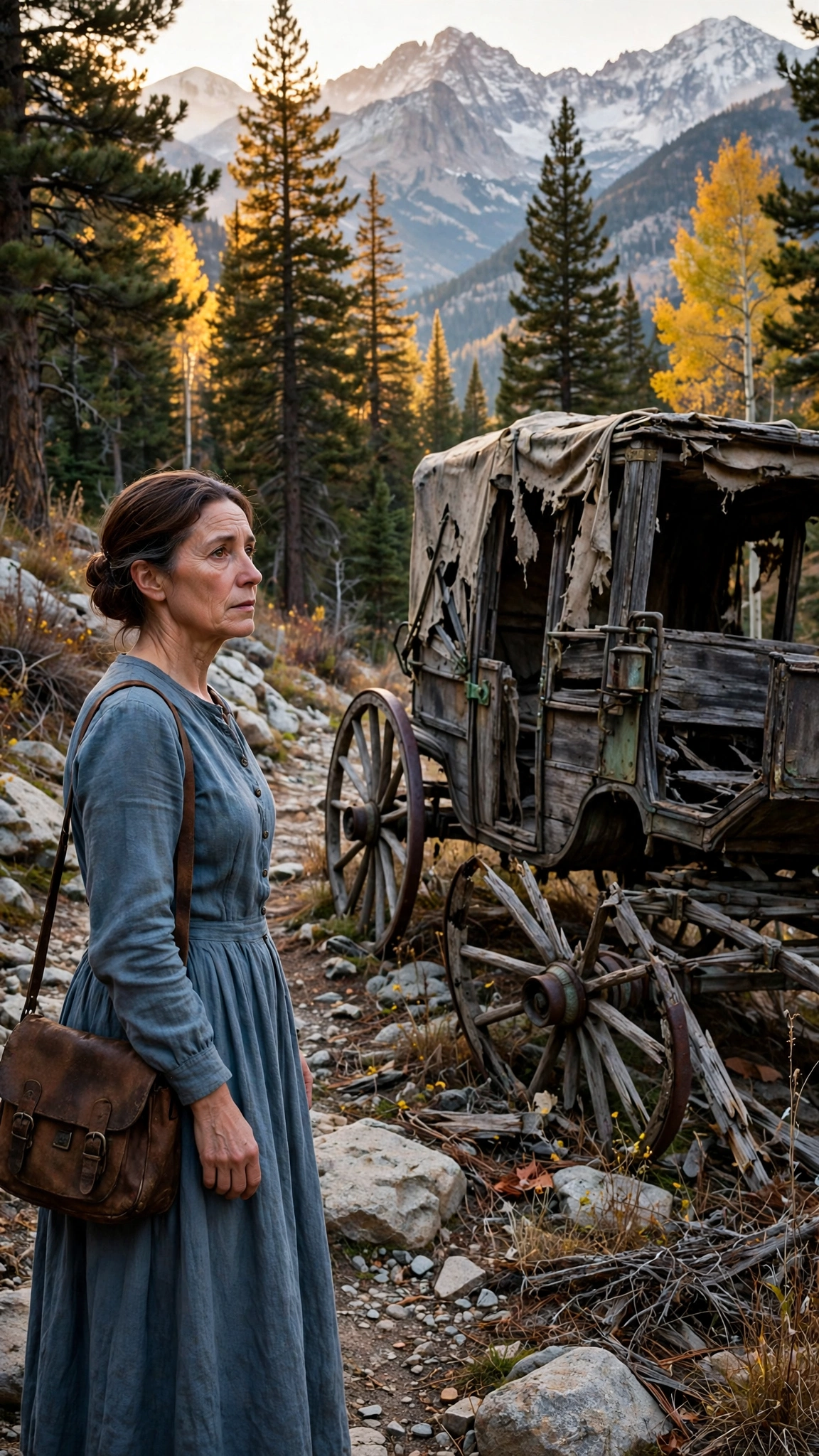
She did not go alone. She went with a historian from the Colorado Historical Society, a young man named Ben Osei, who had read Warren's letter and the certificate and had spent the winter researching Elias Crowe, and with Sheriff Begay, who knew the road. They walked down together, slowly, in the spring light, and the pines smelled of resin, and the mountains stood around them, and the carriage was still there, in its hollow, weathered and gray-black and forgotten, exactly as she had left it.
Ben Osei walked around the carriage for a long time, taking photographs, making notes, measuring the wheel that leaned at its unnatural angle. "We'd like to preserve it," he said. "Not move it — preserve it where it stands. Put a marker on the trail. Tell the story. The real story, this time."
Claire stood beside the carriage and looked at the place where she had lain, that October afternoon, with her cheek against the cold dirt, and she thought about Warren Mason, who had hidden the truth here and died trying to bring it down, and about Elias Crowe, who had driven his carriage into these mountains in 1898 and never come back, and about herself, who had come down here because a man she loved had pushed her, and who had walked out carrying the truth in her satchel.
"Yes," she said. "Tell the real story."
Ben Osei had spent the winter researching Elias Crowe, and on the walk back up he told Claire what he had found: a coroner's report from October 1898, in the county archive, recording that a prospector named Elias Crowe had died when his wagon went off the mountain road in a storm, and that the body was never recovered; a newspaper notice from the Silverton Standard, two weeks later, offering a reward for information about the missing man; and a deed, filed in 1899, transferring Crowe's claim to the Mason family — a deed whose signature, Ben said, the historical society's own archivist had always thought looked "too careful to be honest."
"He was twenty-six," Ben said. "He had a wife in Leadville, and a baby daughter. The daughter grew up, and married, and had a daughter of her own, and that daughter was Ruth Ann's grandmother. Four generations, all waiting for someone to read the paper properly."
Ben had found one more thing, and he told her about it as they walked: a letter, in the county archive, from Elias Crowe's wife in Leadville, written in the winter of 1898, asking the sheriff whether anyone had seen her husband, and whether the road was passable, and whether she should come up the mountain herself to look for him. The sheriff had written back, kindly, that the road was not passable, and that she should wait for spring. She had waited. Spring came, and her husband did not, and she raised their daughter alone, in Leadville, on a seamstress's wages, and she never remarried.
"She kept writing," Ben said. "Once a year, every year, until 1912. Asking whether anyone had found the wagon, or the papers, or anything at all. The county kept the letters. Nobody ever answered the last ones."
Claire thought about that on the way back up — four generations, a hundred and twenty-eight years, a tin box under a bed, a letter in a carriage — and she thought about how the truth had survived all of it, in paper and ink, waiting for someone to carry it down the mountain.
On the way back up, she stopped at Warren Mason's grave. It was in a small cemetery outside Silverton, a plain stone with his name and his dates, and nothing else. She stood there for a long time, with the spring wind moving the loose strands of her hair, and she said, out loud, to a man who had been dead for twenty-seven years, "You were right to write the letter. I'm sorry it took so long."
Then she bent down, carefully, favoring her left shoulder, and picked a wildflower from the grass beside the path — a small white one, the kind that grows anywhere, even in thin mountain soil — and she laid it on the stone, and she stood up, and she looked at the mountains one more time, and she thought that Warren Mason had been a good man, in the end, and that being a good man had cost him everything, and that it had still been worth it.
Then she walked back to the road, and drove home to Denver, and went back to work.