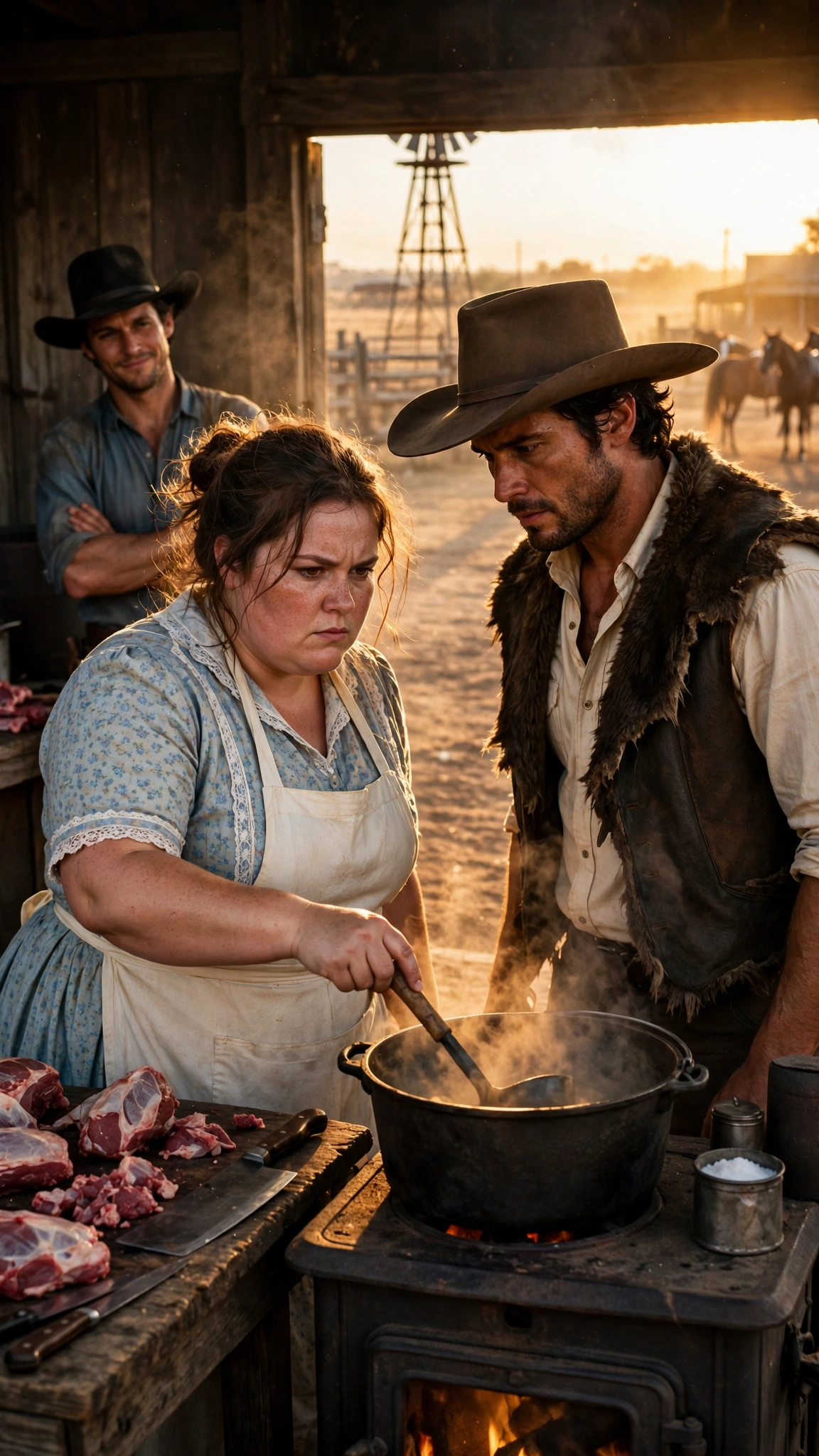
The day of the tasting dawned hot and still, and the air over the prairie shimmered, and the windmill turned slow against a white sky.
Abigail had been awake since four o'clock. She had gone to the cookhouse in the dark, and she had lit the stove, and she had begun, because the meal she was going to serve that evening was not an ordinary meal. It was the meal Caleb Reynolds had given her one chance to make. It was the meal thirty men would judge. And it was the meal Wyatt Granger had tried, twice now, to destroy.
She had chosen her mother's stew. She had chosen it because it was the best thing she knew how to make, and because it was the only thing that could turn a scrawny goat into a feast. Goat ribs and shoulder, browned hard in the pan until the edges were dark and crisp, then laid into the pot with onions and water, and left to cook slow all day, until the meat fell off the bone and the broth turned rich and dark. Dried chiles, crushed between her palms. Cumin, wild garlic, a pinch of sugar to balance the heat. And at the end, when the stew was nearly done, she would stir in the dumplings — small, soft, made from cornmeal and lard — and let them swell in the broth until they were tender. Beside it, molasses beans, slow-baked in the oven. And skillet cornbread, golden and crisp at the edges, made in the big iron skillet that had belonged to Silas and that Silas had left behind because he could no longer lift it.
She worked all day. She worked the way her mother had taught her to work — steady, unhurried, with care in every movement — and she did not think about Wyatt, and she did not think about the silver dollar, and she did not think about the boot print or the open gate. She thought about the pot. She thought about the fire. She thought about the salt, measured out in her own hand, and the cumin, and the chiles, and the dumplings, and nothing else. A cook feeds people. That is the whole of it.
At four o'clock, Caleb came to the cookhouse door. He did not come inside. He stood in the doorway, and he looked at her, and he said, "Sundown is at seven."
"I know," Abigail said.
"The men will be here at seven," Caleb said. "All thirty of them."
"I know," Abigail said.
He was quiet for a moment. Then he said, "Mrs. Thornton. Whatever happens tonight — you did your best. I want you to know that I know it."
She looked at him, and she saw something in his face that she had not seen before — not mockery, not suspicion, not cold command. Something softer. Something that looked, for all the world, like respect. And she said, "Thank you, Mr. Reynolds. But I did not do my best. I did better than my best. You will see."
He nodded once. He went away. She went back to the pot.
At six o'clock, Wyatt came.
He came when the yard was empty and the men were still out in the fields, and he leaned in the cookhouse doorway the way he always did, with his arms folded and his black hat pulled low, and he said, "Smells good, Mrs. Thornton. For goat."
Abigail did not look up from the pot. "Thank you, Mr. Granger."
"I was just thinking," Wyatt said, and his voice was casual, the way a man's voice is casual when he is about to do something cruel. "Thirty men are a lot of men to feed with one pot of goat stew. And goat is such a poor meat. Stringy. Tough. The men have been eating beans and hard bread for weeks now, and they are hungry, and hungry men are not kind to a cook who disappoints them. I would hate to see what happens tonight if that stew is not as good as you think it is."
Abigail set down her spoon. She turned around. She looked at him, and her face was calm, and her voice, when she spoke, was calm too, because she had decided, a long time ago, that she was not going to be afraid of this man.
"Mr. Granger," she said. "You have tried to drive me off this ranch three times now. You opened the gate. You planted a silver dollar in my pocket. And you came here today to frighten me before sundown. I am telling you now, so that there is no misunderstanding between us: it is not going to work. I am going to serve that stew tonight, and the men are going to eat it, and whatever they think of it, they will think it because of what is in the pot — not because of anything you have done."
Wyatt's smile flickered. "You are a bold woman, Mrs. Thornton."
"I am a cook," Abigail said. "And a cook feeds people. That is the whole of it."
Wyatt looked at her for a long moment. Then he tipped his black hat — a mocking little gesture, nothing like Caleb's silent tip — and he went away, and Abigail stood in the cookhouse with her hands on the table, and her heart beat hard, and she took a deep breath, and she went back to the pot.
At seven o'clock, the sun touched the horizon, and the yard filled with men.
Thirty cowboys came in from the fields, dusty and tired and hungry, and they washed their hands at the pump, and they came into the cookhouse, and they sat down at the long tables, and the room went quiet. Not the quiet of men who are angry. The quiet of men who are waiting. Caleb sat at the head of the table. Wyatt sat halfway down, with Jed beside him, and his arms were folded, and his smile was ready.
Abigail stood at the stove with the ladle in her hand, and she looked out at the room — thirty faces, thirty pairs of eyes, thirty hungry men — and for one moment, she was afraid. Not of Wyatt. Not of failing. She was afraid of the silence, and of the weight of all those eyes, and of the knowledge that everything she had — the cabin, the debt, Martha, the grave on the hill, the whole of her life on this ranch — depended on what was in that pot.
Then she thought of her mother, standing on a stool in a kitchen in San Antonio, saying, "If it is made with care, it is enough." And she lifted the ladle, and she began to serve.
She went down the table with the pot, and she filled every bowl, and the steam rose, and the smell filled the room — rich, dark, spiced, the smell of meat cooked slow and long — and the men watched her, and nobody spoke, and nobody moved, until every bowl was full. Then she set the pot down, and she stepped back, and she folded her hands in front of her apron, and she waited.
Caleb lifted his spoon. He took a bite. He chewed, slow. He swallowed. He took another bite. And then he looked up, and he looked around the room, and he said, in a voice that every man in the room could hear, "Eat."
The room erupted. Not in words — in spoons. Thirty men bent over their bowls and ate, and the sound of it filled the cookhouse, spoons against tin, bread tearing, men reaching for the cornbread, and nobody spoke for a long time, because nobody could speak with their mouths full, and nobody wanted to stop eating long enough to try. Eli finished his bowl and held it up without a word, and Abigail filled it again. Sam did the same. Dutch did the same. One by one, the bowls came back empty, and one by one, Abigail filled them, and the pot went down, and down, and down, until there was nothing left but the broth at the bottom, and the men were leaning back in their chairs, and the room was full of the sound of men breathing, and somebody — she never knew who — said, very quietly, "God bless the cook."
And then Wyatt stood up.
He stood up slow, and the room went quiet, and his smile was on his face, and he said, in a voice that carried across the whole cookhouse, "Well. I suppose even a blind hog finds an acorn now and then. But I wonder —" and he paused, and he looked around the room, and he said, "I wonder where a widow gets meat like that. Goat meat, in a ranch that has no goats left. Unless she bought it with money that is not hers."
The silence that followed was worse than any shouting. Thirty men looked at Wyatt. Thirty men looked at Abigail. And Abigail stood at the stove with the ladle in her hand, and she felt the room tilt, and she felt her face go hot, and she felt the old familiar fear — the fear of being accused, the fear of being disbelieved, the fear of being a woman with no husband and no money and nothing but a cabin and a garden and a dead man's name — rise up in her throat like bile.
And then Caleb Reynolds stood up.
He stood up slow, and he was taller than Wyatt, and his face was cold, and his voice, when he spoke, was low, and it carried across the whole room, and every man in the room heard it.
"Wyatt," he said. "Sit down."
Wyatt did not sit down. "I am only asking —"
"Sit down," Caleb said. "And listen to me, because I am only going to say this once. The goats were driven off by a man who opened the gate in the night. The silver dollar in Mrs. Thornton's pocket was planted there by a man who steals from the store. And the meat in this pot was bought with my money, from a trader in town, because this ranch has no beef left and I would rather feed my men goat stew made by a good cook than beef made by no cook at all."
He looked around the room. "Mrs. Thornton cooked this meal. She cooked it with meat I bought, in a pot she scrubbed herself, with spices she ground with her own hands. And every man in this room has just eaten two bowls of it. So if any man here has a complaint about this meal, he can make it to me. Now."
Nobody spoke. Wyatt stood there for a moment longer, and his smile was gone, and his face was white, and then he sat down, slow, and he did not look at anyone, and Jed stared at his own hands, and the room stayed quiet for a long moment, and then Eli — big, slow, honest Eli — pushed his chair back, and he stood up, and he took off his hat, and he said, "Mrs. Thornton. That was the best meal I have had on this ranch in eleven years. And I would like to thank you for it."
One by one, the men stood up. One by one, they took off their hats. And Abigail Thornton stood at the stove with the ladle in her hand and tears in her eyes, and she looked out at thirty men standing in her cookhouse with their hats in their hands, and the sun went down outside the window, and the room went gold, and she knew — she knew, the way you know a thing in your bones — that she had won.
Not the job. The ranch. She had won the ranch.
Afterward, when the men had gone back to the bunkhouse and the cookhouse was quiet, Caleb stayed behind. He stood in the doorway with his hat in his hands, and he looked at her across the room — at the empty pot, at the wiped tables, at the woman standing at the stove with flour on her apron and tears drying on her face — and he said, very quietly, "Sundown came, Mrs. Thornton. And you were right."
Abigail looked at him. She thought about the morning she had walked into the cookhouse at dawn, and about the goat meat on the table, and about the words "One chance," and about everything that had happened since. She thought about the open gate, and the silver dollar, and the ledger, and the thirty men who had stood up and taken off their hats for her. And she said, "Thank you, Mr. Reynolds. For believing me. For stopping his hand. For all of it."
Caleb nodded once. He put his hat back on. He went out into the yard, and the door closed behind him, and Abigail stood in the cookhouse alone, and she banked the stove, and she washed the pot, and she hung her apron on its hook, and she went home to the cabin in the dark, and the stars were out over the prairie, and the windmill turned slow, and she was tired in every bone of her body, and she had never felt so alive.