The spoon came down on the table like a gunshot.
It was a wooden spoon, heavy and worn smooth by years of stirring, and when the enormous man at the head of the table slammed it down beside the steaming iron pot, the metal mugs rattled in their places and every cowboy in the room froze with his spoon halfway to his mouth. The fire in the stone fireplace popped and hissed. Outside the big windows, the blizzard pressed its white face against the glass and howled.
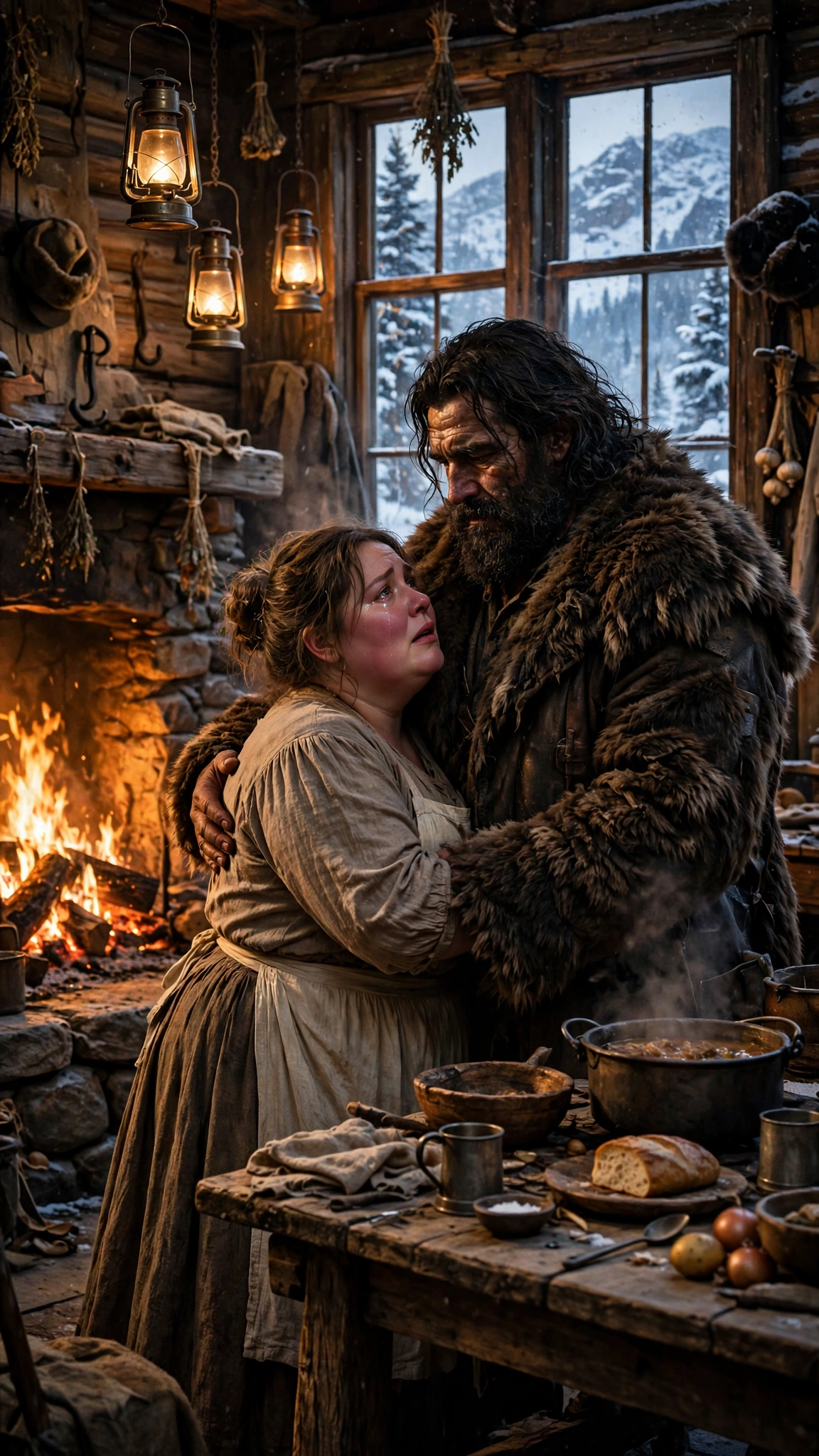
The man rose slowly from his chair, and the room seemed to shrink around him. He was seven feet tall if he was an inch, broad as a barn door, his long dark hair falling in waves over the shoulders of a coat made from the whole dark hide of a grizzly bear. His beard was thick and unkempt, and his eyes, when they found her, were the pale, piercing blue of ice on a river in January.
Matilda Hart stood beside the table with the ladle still in her hand, and her heart beat so hard she could feel it in her throat. She was thirty-five years old, round and heavy, her brown hair coming loose from its messy bun, her cream apron stained with the day's work, and she had never in her life been looked at the way this man was looking at her — as though she were the only thing in the room, and as though the only thing in the room were a question.
"Who cooked this?"
His voice was deep and thunderous, and it seemed to come up out of the floorboards. The cowboys did not move. Silas McCready, the foreman, set his spoon down very carefully, as though the table might break. Young Tom Ellery stared at his bowl. The wind shrieked around the eaves of the boarding house, and the oil lanterns swayed on their hooks.
Matilda pressed one trembling hand against her chest. Her lips parted, and her eyes filled with tears she did not want and could not stop. She had been afraid all day — afraid of the storm, afraid of the cold look Abigail had given her that morning, afraid of something she could not name — and now the fear rose up in her like water in a well.
"I did, sir."
It came out soft and shaky, barely louder than the fire. Behind her, she heard the sharp click of Abigail Thatcher's shoes on the wooden floor, and then Abigail was there, tall and stiff in her dark blue dress, her dark hair pinned back so tightly it pulled at the corners of her eyes, her face set in the cold, satisfied expression Matilda had come to dread.
Abigail did not look at the trapper. She looked at Matilda, and her hand shot out and closed around Matilda's apron, twisting the cream cloth in her fist, and she jerked her toward the heavy entrance door.
"Get out! Now!"
The door swung partly open, and the storm came in — a white rush of snow and freezing wind that tore through the warm room and made the lanterns gutter and the fire bend sideways in the hearth. Matilda recoiled, clutching at her apron with shaking fingers, and the wind lifted the loose strands of her brown hair and threw them across her face. Tears gathered in her eyes, hot against the sudden cold, and she looked desperately toward the enormous man at the table, because there was no one else in the room to look toward, and no one else who might speak.
"I'll die out there."
She whispered it, and the whisper seemed louder than the wind. Outside, the world was white and blind and twenty below, and the road to Leadville had vanished under the snow hours ago, and there was no cabin, no barn, no shelter between this house and the next settlement ten miles down the mountain. A woman alone in that storm would walk until her legs gave out, and then she would sit down in the snow, and then she would not get up again. Everyone in the room knew it. Abigail knew it. The cowboys knew it. The trapper knew it.
And then the chair scraped against the floor.
Jedodiah Boon rose from his wooden chair, slowly, the way a mountain rises, and his massive fur-covered shoulders filled the whole end of the room. His jaw tightened. His icy-blue eyes turned from Matilda to Abigail, and the entire dining room fell silent — silent in a way it had never been silent before, as though even the fire had stopped to listen. He did not raise his voice. He did not raise his hand. He simply stepped forward, between Matilda and the open door, and his enormous frame blocked the freezing wind the way a wall blocks the wind, and he looked directly at Abigail, his expression controlled but unmistakable, firelight flickering across his rugged face.
"She stays."
The words landed in the room like stones dropped into still water. Abigail's mouth opened and closed, and no sound came out. The cowboys did not move. The wind beat against the trapper's back and found no way through.
And then Jedodiah Boon did a thing Matilda would remember for the rest of her life, in every detail, down to the smell of woodsmoke and cold air on the fur.
He shrugged out of his enormous grizzly-fur coat — the coat he wore through every storm, the coat no one had ever seen him take off in a house — and he laid it gently around her trembling shoulders. It was so heavy it nearly bowed her knees, and so warm it felt like stepping into sunlight, and it smelled of pine sap and snow and woodsmoke and the long clean winters of the high mountains.
She looked up at him in stunned disbelief, her eyes glistening, her lips parted, and she could not speak at all. Behind them, Abigail stood speechless, her hand still half-raised toward the door, her face white. The cowboys watched in absolute silence. Jedodiah took Matilda's elbow with a gentleness that seemed impossible from hands so large, and he led her to the warm chair beside the fireplace, and he settled her into it as carefully as if she were made of glass, and the firelight played across her tearful, astonished face.
She did not know it then. None of them knew it then. But the story of how Matilda Hart came to stay in that house — and of how a trapper's coat came to rest on her shoulders — had begun three months earlier, on a cold September morning, with a woman walking up a mountain road alone, carrying everything she owned in the world in a single carpetbag, and a recipe book held tight against her chest.
—
Three months earlier, the aspens on Cutthroat Creek had turned gold, and the air smelled of pine and woodsmoke and the first cold coming down from the peaks. Matilda Hart walked up the mountain road from the stage stop at Fairplay, and her shoes were caked with dust, and her carpetbag banged against her hip with every step, and her mother's recipe book — bound in cracked red leather, the pages soft as cloth from years of use — was pressed against her chest under her shawl, where no one could take it from her.
She was thirty-five years old, and she was a widow, and she was alone in the world in a way that still surprised her every morning when she woke up. Her husband, Thomas Hart, had died of mountain fever in the summer of 1877, on the trail west, in a wagon with a canvas top and a broken wheel, and she had buried him under a pine tree beside a creek whose name she had never learned, and she had kept walking, because there was nothing else to do. She had cooked for mining camps and for stage stations and for a hotel in Denver that had paid her in promises and then closed its doors, and now she had walked fourteen miles up a mountain road because a man at the Fairplay stage stop had told her that the Thatcher Boarding House needed a cook, and that the woman who ran it paid eight dollars a month and a room of her own, and that the road to Leadville passed right by its door.
Eight dollars a month. A room of her own. A roof before the snow came.
She had not eaten since the day before, and her feet hurt, and her dress was damp with sweat under her shawl, and when the boarding house came into view around the bend — a big, square, two-story log house with a stone chimney and a barn behind it and smoke rising straight up into the blue September sky — she stopped in the road and pressed her hand to her chest, the way she always did when she was afraid, and she said a small prayer to her mother, who had taught her everything she knew about a kitchen and almost everything she knew about being brave.
"Please," she whispered. "Please let them need me."
The woman who opened the door was tall and stiff and fifty-five years old, with dark hair pinned back so tightly it seemed to pull her whole face upward, and a dark blue dress with a white apron, and eyes that went over Matilda from her dusty shoes to her messy brown bun and back again, and found everything wanting.
"I am Abigail Thatcher," the woman said. "This is my house. You are the cook?"
"Yes, ma'am," Matilda said. "Matilda Hart. I cooked at the stage station in Fairplay all summer, and before that at a mining camp on Clear Creek. I can bake bread and butcher a deer and keep a kitchen clean, and I do not drink and I do not steal and I do not —"
"I am not interested in your history," Abigail said. "The kitchen is through there. The men eat at six in the morning and six in the evening. The boarders are cowboys. They are not particular, but they are hungry, and they will complain if the food is late. You will have the small room at the back of the kitchen. Eight dollars a month. You will take your meals standing. Do not speak to the boarders beyond what is necessary. Do not —" Her eyes flicked, very briefly, to Matilda's broad waist, to the way her dress pulled across her belly. "Do not make a spectacle of yourself."
Matilda felt the heat rise in her face, and she pressed her hand to her chest, and she said the only thing there was to say.
"Yes, ma'am. Thank you, ma'am."
The kitchen was big and dark and cold, with a great iron stove and a work table scarred by a hundred knives and a window that looked out on the barn and the mountains beyond. It was the finest kitchen Matilda had seen in a year, and she stood in the middle of it with her carpetbag at her feet, and she took a long breath, and she began.
She scrubbed the stove. She swept the floor. She found the flour bin and the salt pork and the dried beans, and she set a pot of beans to soak, and she mixed bread dough with her hands, the way her mother had taught her, pushing and folding until the dough went smooth and warm under her palms. By the time the cowboys came in for supper, the kitchen smelled of baking bread and simmering beans and fried salt pork, and the men fell on the food like wolves, and Silas McCready, the foreman, a man of fifty-five with a grey moustache and kind eyes, pushed his empty plate back and looked at her across the table and said, "Ma'am, that is the first decent meal I have had in this house in two years."
Young Tom Ellery, who could not have been more than twenty-four, nodded so hard his hat nearly fell off. "Ma'am, if you stay, I will never leave."
Abigail said nothing. She stood in the doorway with her arms folded, watching, and her face gave nothing away. But that night, when Matilda went to her small room at the back of the kitchen, she found a clean folded blanket on the bed and a chipped enamel mug of hot water on the table, and she did not know who had put them there, and she cried a little, quietly, into her pillow, because kindness, even a small one, had become a rare thing in her life.
The weeks went by, and the gold left the aspens, and the first snow dusted the peaks. Matilda learned the house. She learned that Silas took his coffee black and that Tom would eat anything sweet if she let him and that Wade Conroy liked his biscuits burnt at the edges and that Ephraim Doyle said grace over every meal in a low, serious voice. She learned that Abigail rose before dawn and worked until midnight and kept a ledger book in the pantry where she wrote down every penny, and that she had not smiled once since Matilda had arrived. She learned that the house was cold at night and that the wind found every crack in the logs, and she stuffed the cracks with rags the way her mother had taught her, and she did not complain.
She also learned, slowly, that Abigail watched her. Not the way a mistress watches a servant, but the way a woman watches a rival — with a cold, measuring attention that never quite went away. When the cowboys praised the stew, Abigail's mouth went thin. When Tom Ellery carried in Matilda's firewood without being asked, Abigail's eyes narrowed. When Silas McCready told a story at the table about a cook he had once known in Texas, and said, "She could make a boot taste good, that woman," and everyone laughed, Abigail left the room.
Matilda did not understand it. She was a widow in a stained apron, too fat and too tired and too plain to be anyone's rival. She kept her head down and her hands busy, and she told herself that Abigail's coldness was only the way of a woman who had buried a husband and carried a house alone, and that it would pass.
It did not pass. In November, Abigail began to find fault — the bread too dark, the beans too salty, the floor not swept to her liking — small things, said in front of the men, in a voice like the edge of a knife. Matilda took it, because she had nowhere else to go, and because the snow was coming, and because a room of her own and eight dollars a month were worth more than pride.
And then, on a grey December morning, the sky turned the color of iron, and the wind began to come down from the peaks, and Silas McCready stood at the window and said, "That is a blizzard coming, boys. That is the big one. Batten everything down."
Matilda set a pot of venison stew on the stove — the deer Wade had shot the week before, cut up fine, with onions and potatoes and carrots, and at the end, the way her mother had taught her, a spoonful of chokecherry jam stirred in, sweet and dark, to give the broth its depth. She kneaded bread. She set the table. She did not know that before the night was over, a seven-foot trapper would walk in out of the storm, shaking snow from a grizzly-fur coat, and that the whole course of her life would change in the space of a single spoonful of stew.
She only knew that the wind was rising, and the house was warm, and the stew was on the stove, and that for the first time in a long while, she was exactly where she was supposed to be.
=== STEP 2 — APPEND Chapter 2 ===