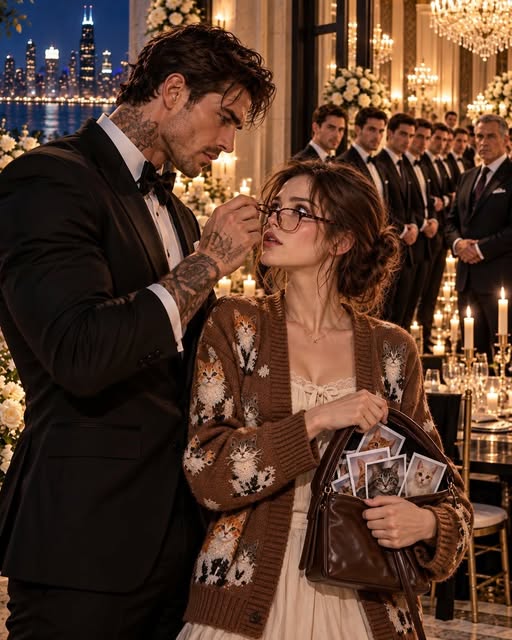
"My father doesn't lie," I said, and heard how it sounded — a daughter's reflex, not a fact.
"No," Lucas said. "Your father is drowning. There's a difference. Liars sign bad deals for profit. Your father is signing this one because Victor Romano has held his head underwater for six years, and this is the first breath he's been offered."
The terrace door was glass. Inside, the gala glowed on without us — my father at the head table, silver-haired and smiling the smile he'd been practicing since my mother died, the smile that said Mercer Hospitality was still a name. Beside his chair, the leather folder.
"Six years ago," Lucas said, "three weeks after your mother's funeral, Mercer Hospitality missed a covenant payment. The banks circled. Your father needed forty million by Christmas or he'd lose the company his grandfather built. The only door that opened was Romano's."
"He told me it was a consortium loan," I said. "Banks. A bridge facility."
"It was Victor Romano, at nine and a half percent, with clauses in it like fishhooks." He watched my face the way he'd watched my hands. "Since then, the Romanos have run money through two of your father's hotels — the Marigold and the Pierce. Cash businesses. High churn. Perfect plumbing. Two years ago your father figured out what was moving through his own properties. Do you know what he did?"
"He would have gone to the police."
"He went to Victor Romano and begged for more time instead," Lucas said, without cruelty, which made it worse. "Because by then Romano had photographs. You at conferences. You at your office — your other office, Miss Mercer. The one with the consulting firm nobody knows about. Romano doesn't forgive debts. He collects leverage. The partnership, the marriage to Ethan — that's not an alliance. It's a receipt. In three weeks your father signs over the hotels, you marry into the family that owns him, and everyone at that table tonight goes home calling it a celebration."
The wind moved across the lake and through the railing and through me.
"Why are you telling me this?" I said. "The DeLucas and the Romanos hate each other. If my father's company collapses into their hands—"
"It already costs me money," he said. "The laundering runs against two of my properties' contracts. Federal attention follows Romano money like weather, and I don't conduct my affairs in a storm." He paused. "And my auditors, with six weeks and full access, produced a correction memo that you produced under your breath in four seconds. I have a use for the truth, Miss Mercer. You're the only person near that folder who can read it."
I laughed, and it came out unsteady. "So this is a job interview."
"This is a warning. The interview is up to you." He took a card from his inside pocket — plain, heavy, a phone number and nothing else — and set it on the railing between us. "The signing is at the Founders' Ball, three weeks from Friday. After it, nothing can be undone. Before it — almost anything can."
His hand closed over my glasses in his pocket, briefly, like a man checking a holster.
"Keep faking for your father," Lucas DeLuca said. "It may be the only armor he has. But stop faking for me. It wastes both our time."
He went back inside. I stood on the terrace until my hands stopped shaking, and then I walked back into the ballroom with my plain-glass glasses on my face — he'd returned them at the door without a word, in the same motion as holding it open for me — and I played the silly daughter for two more hours. I asked Ethan's empty chair if it wanted dessert. I told Sofia DeLuca that Chairman Meow screams at mirrors because he can see the other side. She laughed so hard she had to hold the table, and her brother Marco said, "I like her, she's insane," and Lucas, at the far end, said nothing at all and missed nothing at all.
At home, in the apartment my father believes I can't afford without his allowance — the allowance I quietly invest while Wren Consulting pays my actual rent — I did not sleep. At two in the morning I sat down with my laptop and my real life: the grey, beautiful machinery of Wren. Two years earlier we had audited a hotel in Milwaukee for a nervous private owner. The Grand Aurelia. Not a Mercer property. Not a DeLuca property. A Romano-adjacent investment vehicle — and I remembered, with the specific nausea of a door unlocking, that we had flagged an occupancy anomaly in its projections and the client had thanked us, paid us, and never called again.
I pulled the file. Stabilized occupancy: ninety-one percent. Convention calendar: double-counted. Year two: covenants clearing on numbers that were not numbers at all, but wishes.
The same signature. The same lie, in the same hand, two years before my father ever carried a leather folder into a ballroom.
My own firm had found the edge of this thing and I had billed it and forgotten it, because two years ago I was busy being invisible.
By dawn I had read everything Wren had. It wasn't proof of laundering. But it was proof of the pattern, and the pattern had a tailor, and the tailor worked for whoever prepared the Lakeview projections — which meant the tailor worked inside my father's company, close enough to put a folder beside his chair.
I built the timeline the way I'd build any fraud model, because that is what it was. Six years ago: my mother's funeral, the covenant miss, the loan. Four years ago: Bluewater — no. Four years ago the laundering starts; I didn't know that yet, but I wrote Romano takes the hotels in the margin and underlined it until the pen tore the paper. Three years ago: Wren flags the Aurelia anomaly, and the client goes quiet. Three years ago, also: my father produces suitor number one, a shipping heir with a family office and a sudden interest in a girl he'd never met. I had always assumed the marriage campaign was a widower's panic, a rich man's grief looking for instructions. Sitting at my kitchen table at three in the morning, with Lucas DeLuca's card propped against the sugar bowl like a place setting, I re-read my own life as a sequence of Romano decisions. The suitors were never random. Every one of them had Romano money somewhere in the family tree — a fund, a partner, a cousin on a board. They weren't candidates. They were options contracts. Ethan wasn't the seventh suitor. He was the only one who was ever actually going to be allowed to win.
I called Priya at four. She answered on the second ring, because Priya's relationship with sleep is purely theoretical.
"Tell me I'm not on speaker," she said.
"You're not on speaker. I need the Aurelia file. Everything, including the working papers we didn't send."
A pause. Keyboard sounds. "Grace. That client paid us to go away."
"I know what the client paid us. Pull it."
"Already pulling." Another pause, warmer. "Is this the thing where I finally learn what you look like?"
"Priya."
"Because I've had a bet with myself for three years. I say five-eight, terrifying cheekbones, resting face of a woman who has read everyone's diary." Keys, rapid. "There's something in the working papers I never put in the report. The occupancy model — the double-count — it wasn't in the client's draft. It arrived in a revised file from an outside preparer the week before we were engaged. The metadata survived." I sat up so fast the chair complained. "Preparer name's in the document properties, Grace. Somebody at a firm called Harrowgate Advisory. Ring any bells?"
It did not. It does now. Harrowgate Advisory was a two-man consultancy that dissolved eighteen months ago — but at three in the morning I only knew it was a thread, the first one I'd ever been handed that led away from my father's desk instead of toward it. Somebody outside Mercer had built the lie my father was about to sign. Somebody outside Mercer had been building it for years, in Milwaukee, in Chicago, anywhere Romano money needed a clean shirt.
"Send me everything," I said. "And Priya — the bet. Five-seven. The cheekbones are classified."
"Called it," she said, and hung up, and I sat in the blue dark of my own kitchen and did the arithmetic I had been avoiding since the terrace. If the lie had an outside author, then my father might be exactly what Lucas said he was: not the fraud, but the fraud's favorite chair — the man seated in it when the music stopped. And if that was true, then three years of cat photographs had not been a daughter wasting her father's time. They had been the only strategy in the family that had worked even once.
I made coffee. I made a second pot. And when my father came downstairs in his dressing gown, grey-faced, reaching for the antacids he thinks I don't know about, I was sitting at his kitchen table with two cups and the printout of a loan covenant from six years ago.
"Sit down, Dad."
He sat. Fathers know. Whatever else is theater in that house, that morning wasn't.
"The bridge facility," I said. "The consortium. Tell me their names."
A long silence. The coffee steamed between us.
"There were no banks, Grace." He looked at his hands. "It was Romano money. I signed in this kitchen, three weeks after we buried your mother, and I have regretted it every day since in ways I can't— you were twenty-three. You'd just finished your degree. The company was your grandfather's name. I thought: a loan is a loan. I'll pay it and be done." His mouth did something bitter. "Nobody is ever done with Victor Romano. That is not how his arithmetic works."
"The hotels," I said. "The Marigold. The Pierce."
His head came up. "What about them?"
"Nothing," I said, and lied to my father for the first time in my life with my whole chest, because Lucas DeLuca had said a word on a terrace that I couldn't get out of my ears — leverage — and until I knew how deep the rot went, I didn't know who was listening to my father's kitchen. "Nothing. Eat something, Dad. You look terrible."
He almost smiled. "You sound like your mother."
"You look like a man who hasn't slept since 2019."
"Then we're both performing," he said mildly, and reached for his coffee, and I saw his hand tremble and hated everyone on earth who had made it tremble.
Before I left the kitchen, my father did a thing he has done since I was small and frightened of thunder: he made me eat. Toast, buttered to the edges, cut diagonally — the full protocol of a man whose vocabulary of comfort is mostly catering. He stood at the counter in his dressing gown with the covenant printout still open on the table between us like a guest who had overstayed, and he said, "At your mother's funeral, a man I didn't know stood by the door for the whole service. Black coat. Didn't sign the book. I told myself he was from her charity." A breath. "He was at the loan signing three weeks later, standing in exactly the same place. By the door. I've thought about that man every day for six years, Grace. Romano doesn't send signatures. He sends witnesses."
"Why are you telling me now?" I said.
"Because last night a DeLuca watched you correct a projection at my table, and this morning my daughter is asking questions in her own voice at my kitchen table, and the arithmetic of this house has changed." He pushed the toast toward me with one finger. "Whatever you're about to do — do it as her. Not as the—" He gestured, helpless and precise, at the whole architecture of the last three years. "Not as the girl with the cats. If that family is going to be beaten, it will be by the woman who runs the numbers. I have met her at exactly one breakfast. I liked her enormously. I should have said so years ago."
I ate the toast. All of it, to the edges. Then I kissed my father's grey cheek at the door like a girl going to school, and he held on to my hand one second longer than the gesture required, and neither of us mentioned it, and both of us counted it.
On the train downtown, with the city sliding grey past the windows, I took Lucas DeLuca's plain heavy card out of my clutch and typed the number before I could talk myself out of it.
One sentence. The first completely honest thing I'd sent anyone in three years.
Where do we start?