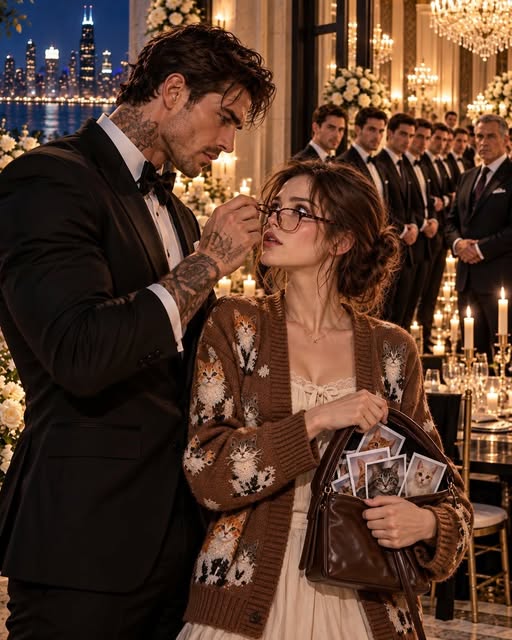
We started in my father's own building, which was either the safest place in Chicago or the most dangerous, depending on who was watching the security feeds.
The beauty of my costume — and I understood its beauty properly for the first time in those three weeks — is that Grace Mercer the silly daughter can go anywhere in Mercer Hospitality and be invisible. I fetched coffee for the finance floor. I asked the comptroller, in my brightest voice, whether "the cloud" was where the spreadsheets lived now. I sat outside my father's CFO's office swinging my feet and asking Walter Briggs if he thought my cardigan made me look "approachable," while his assistant backed up his terminal to the shared drive, exactly as she did every Friday, exactly as I had timed she would.
Briggs is sixty-one, silver, soft-spoken, a man who has signed my birthday cards since I was nine — Uncle Walter, who taught me to read a balance sheet at his kitchen table before my father ever knew I could. It took me four days of fetching and smiling and swinging my feet to find the second set of books, and it took me one evening to understand them, and both of those facts are going to sit in my chest for the rest of my life.
There was a shadow ledger. Not clever, not offshore, not cinematic — just patient. Cleaning contracts at the Marigold inflated by eleven percent, the skim routed through a vendor called Bluewater Services. Banquet "no-show fees" at the Pierce, thousands of them, for events that had never been booked, paid out to a logistics company with a Romano cousin on its board. Two streams, meeting in one account, quarter after quarter, for four years. And above every stream, in the authorization column, two initials in rotation: W.B. — and, twice a year, on the largest transfers, a countersignature I recognized better than my own.
My father's.
I sat in my apartment with the printouts until the numbers stopped swimming. Then I did the thing I should have done first and called my best analyst.
Priya has worked for Wren for three years and has never once asked why the firm's owner only appears on video calls with the camera off. I sent her the Bluewater vendor file with the names redacted. She called back in forty minutes.
"Grace. Whoever built this built the Aurelia thing too. Same scaffolding. Same guy's habits — he rounds the same way, he hides the same way, he's lazy in the same three places. It's not a department. It's a person."
"One person," I said.
"One person with a countersignature above him, or one person who can fake one. How deep are you in this?"
"Up to my neck," I said. "Keep digging."
The strange thing about going undercover as yourself is how much of the work is waiting. For eleven days I was a fixture of Mercer Tower: delivering folders, admiring the new lobby art, asking the IT manager — a man named Doug who has the patience of a glacier — whether passwords were "still the little sticky notes, or have we gone fancy." Doug laughed for a week. On day nine he also mentioned, in the way of a man filling a silence, that Mr. Briggs had a standing instruction: all Lakeview working files were to be archived to physical media and kept off the shared drive. "Compliance thing," Doug said. "Since the spring. Everything else is cloud, but Lakeview's on a drive in the archive. Old school. His call." I smiled my silly smile and asked if the archive was where the building kept its ghosts. Doug said, "Forty-one boxes of them," and went back to his glacier.
On day ten, Walter Briggs took me to lunch. He does that — has done it since I was small, birthdays and report cards and the terrible spring after my mother died, when Uncle Walter appeared every Sunday with soup and sat with my father in silence, two men holding a house up by sitting in it. We went to the little Italian place on Wabash where the owner calls him Maestro. He ordered for both of us, the way he has since I was nine, and halfway through the veal he said, without looking up, "Your father tells me you're fond of the Romano boy."
"Ethan's very nice," I said. "He has strong opinions about wives."
"And you have strong opinions about cats." He turned his glass a quarter turn, precise as a dial. "Twelve, I hear. Your menagerie grows, Grace. When you were nine you couldn't keep a goldfish."
"Gerald is very low-maintenance. Except emotionally."
"Mm." The old eyes rested on me, and I felt the whole lunch tilt — the way you feel a boat tilt, in your stomach, before you see the water move. "Your father worries the act will spoil something real one day. His word. Act." He let the word sit between us with the bread. "You've always been a private girl. Even your grief was private. It makes a father wonder what else is in the rooms he isn't invited into."
I laughed my little laugh and asked if he thought Kevin would like Italy, and he smiled and let it go, the way a cat lets a mouse go — as information. Walking back to the tower in the thin November sun, I understood two things. Walter Briggs suspected the performance. And Walter Briggs, who had designed the loan, the plumbing, and the folder beside my father's chair, had just taken me to lunch to measure how much of me was real — because whatever he was planning for the Founders' Ball now had a variable in it, and the variable was whatever Grace Mercer actually was.
That night Sofia DeLuca took me to dinner, which is a different sport entirely. Sofia does not do small talk; she does reconnaissance with appetizers. "My brother," she said, spearing an olive, "has been in a good mood for eleven days. It is unsettling the staff. Marco says you're either a federal investigation or a woman, and either way he approves." She leaned in. "For the record: I knew at 'seasonal melancholy.' A real cat lady oversells the litter. You undersold. It was a craftsman's tell." She raised her glass. "Welcome to the family business, sweetheart. Try the burrata. And when this goes loud — and it will go loud — stand on his left. His right side is where he keeps the gun and the sentimentality, in that order."
The drive came from the building's archive room, and getting it nearly got me killed, which I suppose is how I know it mattered.
It was a Saturday. The tower was empty except for security and me — silly Grace, who had "left her scarf" in her father's office, silly Grace with a tote bag and a thermos, waved through by a guard who had watched me be harmless for years. The archive room is in the basement, a cold cave of banker boxes, and the Lakeview working files were in box forty-one, and at the bottom of box forty-one, taped under a false cardboard floor like something out of a prison movie, was a matte black external drive with a strip of tape on its spine.
On the tape, in Walter Briggs's handwriting: LAKEVIEW — FINAL.
I had it in my tote bag and my hand on the archive door when the lights went out.
Not the whole floor. Just the archive room and the corridor — a breaker, thrown by someone who knew which breaker. In the dark I heard the service door at the far end sigh open, and I heard shoes on concrete that were not in a hurry, and I understood with total clarity that Walter Briggs had watched me be harmless for years, too — and that unlike the guard, he had never once believed it.
I ran in the dark in a building I had grown up in. That is the only reason there is a rest of this story. I knew the service stairs by their smell — bleach and old paint — and I knew the parking garage's blind corner by the loading dock where the cameras don't reach, because when I was fourteen I used to hide there from my father's board dinners with a book. I was crouched behind a concrete pillar in the dark with a dead man's drive in a tote bag covered in embroidered cats when headlights swept the ramp and a black SUV rolled down into the garage and stopped, and the door opened, and Lucas DeLuca got out like a man arriving at his own dinner party.
Two of Romano's men had followed me down. I learned later they were Romano's. At the time they were simply the sound of shoes again, and then a voice saying "Miss Mercer, Mr. Briggs would like his property back," very reasonably, as if we were all reasonable people.
Lucas said, from the dark by the pillar, in the tone of a man remarking on weather: "She's not carrying anything that belongs to Walter Briggs."
"Mr. DeLuca." The reasonable voice lost some of its reason. "This is a Mercer matter."
"Everything in this city is a Mercer matter tonight." He stepped into the headlight wash, hands loose, coat open. I could see Marco behind the SUV's far door, and I could see that nobody on Lucas's side was reaching for anything, and that this was, somehow, the most frightening part. "You followed a woman into a dark garage to collect a piece of plastic. Go home and think about the kind of employment that ends. Tell Walter the archive has been re-catalogued."
They went. Men like that can count. It's their one reliable skill.
I stood up from behind my pillar with my tote bag and my cat thermos and my knees absolutely refusing to work. Lucas crossed the concrete, took one look at my face, and — instead of I told you so, instead of what were you thinking, instead of any of the things men had been saying to me in garages and boardrooms my whole life — he took off his coat and put it around my shoulders, because I was shaking hard enough to hear my own teeth.
"What's on it?" he asked.
"Lakeview. Final," I said. "Briggs's own handwriting."
"Then he knew it would be found eventually," Lucas said. "Men like Briggs always build themselves a door. The question is who he built it to walk away from — your father, or Romano." He opened the SUV door for me. "Get in, Grace. And this time, when I tell you something is too dangerous to do alone—"
"I know."
"You'll do it anyway."
"I know," I said, and got in.
The SUV smelled of leather and rain, though it wasn't raining. Lucas made two calls in the tone of a man ordering room service — one to Marco ("The archive. Tonight. Discreetly, and then less discreetly if necessary"), one to someone he addressed only as "Doctor," who turned out to be a woman on retainer for the kind of medical events that do not enjoy paperwork. Then he looked at the drive in my tote bag, where it sat on top of a thermos with a cat on it, and said, "Priya is expecting it. Marco's man will take a clone to her office within the hour — she doesn't come to you, you don't go to her, the drive doesn't sleep anywhere it can be asked questions."
"You planned for this."
"I planned for you," he said, "which covers most contingencies, including this one." He turned his head. "You went in alone on a Saturday, Grace, into the one room in that building where Walter Briggs keeps his conscience in a box. If I'd known, I would have—"
"Stopped me?"
"Been in the corridor." The SUV turned onto the expressway, and the city smeared gold past the glass. "There is a difference between a woman who needs protecting and a woman whose protection needs coordinating. I am attempting to learn it in real time. It is the hardest thing your family has asked of me, and your family has asked me to bleed in public, which I note for the record was easier."
I laughed — actually laughed, in a getaway car, with a dead man's evidence in a cat tote — and that is when my phone rang, and it was Rosa, who has kept my father's house for twenty years, crying too hard to make sentences, and underneath her crying I could hear a siren and a stranger's voice saying sir, can you hear me, and the whole night folded in half.
"Dad," I said.
Lucas was already turning the car around.