The deputy came back from Kansas on Tuesday morning, riding hard, with a leather satchel on his saddle, and inside the satchel, wrapped in oilcloth, was a small black book with a broken spine.
Judge Harlan opened the court at ten o'clock. The courtroom was fuller than it had been on Monday — word had spread, and people had come from all over the valley, and they stood along the walls, and they sat on the windowsills, and they waited.
The judge held up the book. "Mr. Brooks," he said, "is this your ledger?"
Elias Brooks looked at the book. He looked at the judge. He looked at his daughter. And he said nothing.
The judge opened the book. He read from the first page. "'Hannah Brooks. Owes.'" He turned the pages. "'March: cornmeal, three spoonfuls, two cents. Bread, one piece, one cent. Milk, one cup, two cents.' 'April: cornmeal, three spoonfuls, two cents. Bread, one piece, one cent.'" He looked up. "Mr. Brooks, this book records, in your own hand, fifteen years of feeding your daughter less than a hired hand, and charging her for it. Do you deny that this is your handwriting?"
Elias said nothing.
"Do you deny," the judge went on, "that you withdrew twelve hundred dollars from the bank at Topeka, money that belonged to your daughter under her mother's will, on the strength of a forged paper claiming she was dead?"
Elias said nothing.
"Do you deny," the judge said, "that you forged a second will, in your dead wife's name, in order to keep what was never yours?"
Elias stood up. His face was gray, and his hands were shaking, and his voice, when it came, was thin, and it shook.
"I did what I had to do," he said. "A man has to live. A man has to eat. She was a child. She didn't need it. I needed it. I—"
"That is enough," Judge Harlan said, and his voice filled the courtroom, and it did not shout, but it did not need to. "This court finds as follows. The will witnessed by Grant Mercer and the Reverend Amos Hale is the true and lawful will of Willa Brooks. The inheritance — twelve hundred dollars, and forty acres of bottom land in Kansas — belongs to Hannah Brooks Turner, and to no one else. The paper produced by Elias Brooks is a forgery. The warrant produced by Elias Brooks was got by fraud, and it is void. The marriage of Hannah Brooks and Cole Turner is lawful and binding. And Elias Brooks is hereby ordered to repay the sum of twelve hundred dollars, with interest, to his daughter, and to surrender all claim to the forty acres, and to leave the Territory of Montana within thirty days, and not to return."
The courtroom erupted. People stood. People cheered. Someone in the back shouted, "Justice!" And Noah — who was sitting in the front row this time, because Hannah had asked him to — jumped to his feet and shouted, "She won! Hannah won!" And the judge, who was a fair man, and a kind man, and a man who had known Willa Brooks, banged his gavel, and smiled, and said, "Order. Order in the court. The lady has won."
Elias Brooks walked out of the courthouse alone. No one spoke to him. No one looked at him. Silas Creed was gone — he had left the territory the night before, on a fast horse, and no one had seen him since. The young deputy had gone back to Cheyenne. And Elias Brooks got on his gray horse, and rode east, toward Kansas, toward the house with the locked pantry and the black book, and he did not look back, and no one in Red Creek ever saw him again.
Hannah stood on the courthouse steps, in the sunlight, with Cole on one side and Grant on the other and Noah in front of her, jumping up and down, and she held the will in her hands — her mother's will, the true one, the one that said, "For my Hannah, so that she will never have to ask anyone for bread" — and she cried, and she laughed, and she did both at the same time, because she did not know which one to do first.
They rode home in the late afternoon, and the light was golden on the grass, and the creek ran bright beside the road, and the cottonwoods were turning, and the log farmhouse stood solid and low against the mountains, with smoke coming from the chimney, and it was, Hannah thought, the most beautiful house she had ever seen, because it was hers.
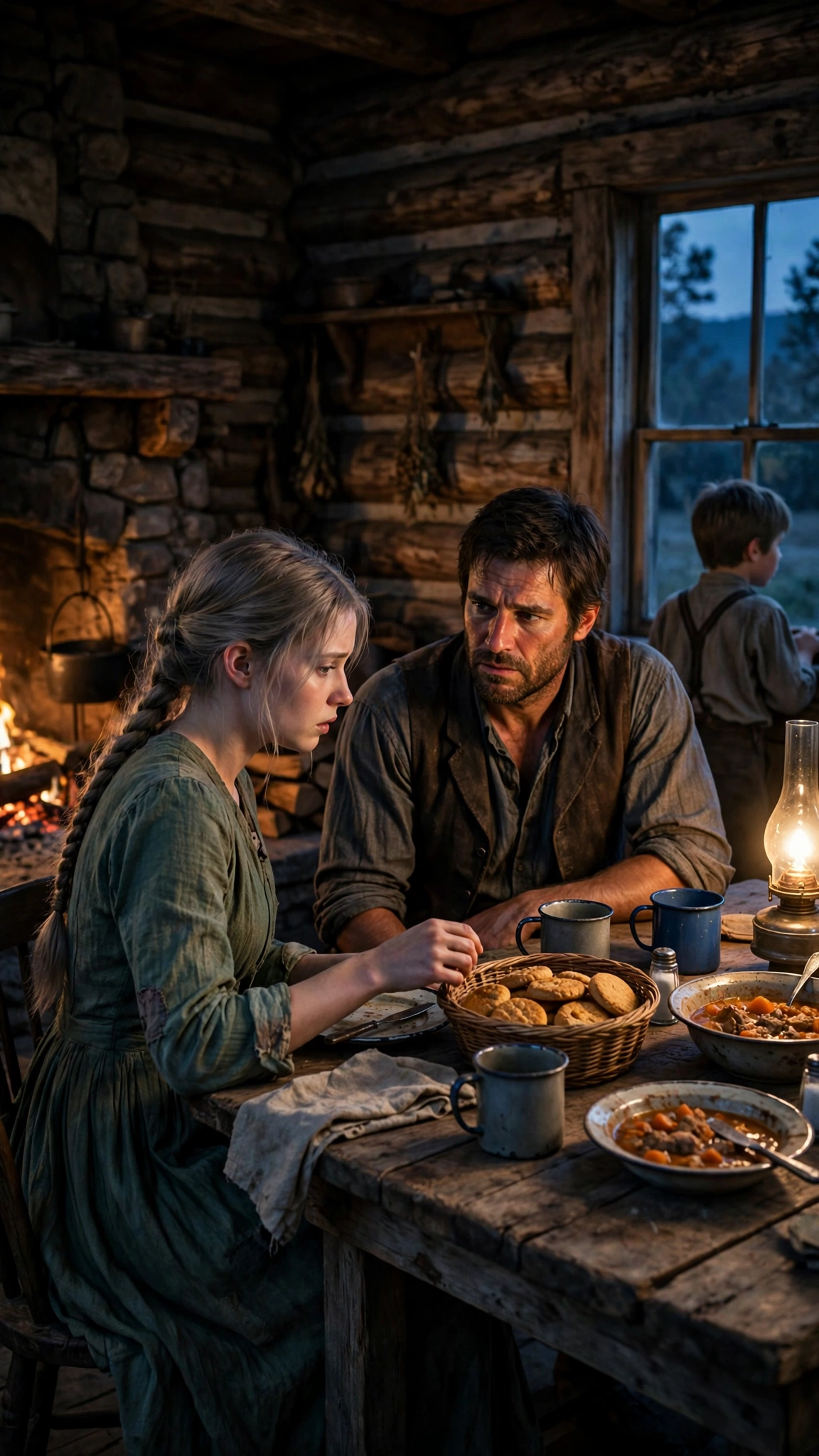
That evening, she cooked supper. It was the first time she had cooked in the house — she had always let Cole cook, or Noah, because she had been afraid of doing it wrong — but that evening she stood at the stove, in her faded green dress, with her braid down her back, and she made beef stew, and potatoes, and carrots, and greens, and she baked a pan of biscuits, golden on top, and she set the table herself, with the enamel mugs, and the spoons, and the wicker basket in the middle, full to the top, and she lit the oil lamp, and she waited for the men to come in from the barn.
They came in, Cole and Noah, washing their hands at the pump, hanging their hats on the pegs by the door, and they sat down at the table, and Hannah sat down across from them, and the lamp burned low and warm, and outside the window the blue evening was coming down over Red Creek, and the table was full.
Cole looked at her. He did not say anything. He did not need to. He picked up the basket, and he slid it toward her, the way he had slid it toward her on the first night, and the basket scraped softly across the wooden table, and the biscuits were golden, and warm, and the smell of them rose up into the lamplight.
Hannah looked at the basket. She looked at Cole. She looked at Noah, who was watching her with his spoon in his hand, and his eyes wide, and his face full of hope.
And she reached out, and she took a whole biscuit, with one hand, without hesitating, without looking for permission, without flinching — and she broke it in half, and she ate one half, slowly, in the lamplight, in front of them both, and then she held out the other half to Cole, and she said, "Here. You have this one."
Cole took it. He ate it. He smiled. And Noah laughed — a real laugh, loud and bright, the laugh of a boy who has been waiting for a long time to hear his house sound happy — and he took a biscuit for himself, and he ate it, and he said, with his mouth full, "This is the best supper we ever had."
After supper, Hannah went out onto the porch, and she stood there for a long time, looking at the mountains, and at the stars coming out over Red Creek, and at the dark shape of the barn, and at the creek running silver in the moonlight. And Cole came out, and stood beside her, and they did not speak for a while, because there was nothing that needed to be said.
"Are you happy?" he asked, finally.
She thought about it. She thought about the house in Kansas, and the padlock on the pantry, and the black book, and the belt, and the bread, and the pieces nobody wanted. She thought about the train, and the platform, and the wagon ride, and the room with the window over the creek. She thought about the supper table, and the basket, and the folded cloth, and the words she had said that first night, and the words she had said on the porch on Saturday, and the words she had said in the courthouse on Monday.
"Yes," she said. "I am happy."
"Good," he said. "Because I am, too."
They stood on the porch together, in the starlight, and inside the house, the lamp burned low and warm, and Noah was already asleep in his room, and the wicker basket sat on the table, still half full of golden biscuits, and there was no lock on the pantry, and there never would be again.
In the spring, Hannah planted a garden behind the house — beans, and squash, and carrots, and herbs, and a row of sunflowers along the fence, because her mother had loved sunflowers, and because she wanted something beautiful that was hers, that no one could take away. She wrote a letter to the bank in Topeka, and the twelve hundred dollars came back, every cent of it, with interest, and she put it in the bank at Red Creek, in her own name, and she used some of it to buy Noah new boots, and a book of stories, and a saddle of his own, and she used some of it to mend the roof of the barn, and she saved the rest, because she had learned, long ago, that money kept is money that cannot be stolen.
And the forty acres in Kansas — she sold them, in the end, to a good family, a family with children, for a fair price, because she never wanted to go back to Kansas, and because she did not need land in Kansas when she had a ranch in Montana, and a house, and a husband, and a boy who called her Hannah, and then, one day in the summer, when the sunflowers were tall, called her something else entirely.
He called her Mother. Not because she had asked him to. Because he wanted to. Because she had earned it — not by asking permission, not by taking the broken pieces, not by hiding half a biscuit under a cloth — but by standing on a porch, and speaking the truth, and refusing to break.
And Hannah Brooks Turner, who had once been afraid to take food from her own husband's table, sat down to supper every night of her life, in a log farmhouse on Red Creek, with a wicker basket of golden biscuits in the middle of the table, and she ate what she wanted, and she gave what she wanted, and she never asked anyone for the pieces nobody wants again.
Because there were no pieces nobody wanted anymore. There was only supper, and lamplight, and family, and home. And that was enough. It had always been enough. It had only taken her fifteen years, and a train ride, and a man who slid a basket across a table, to learn it.
A year later, in the winter, when the snow lay deep over Red Creek and the creek ran black and slow under the ice, Hannah stood at the kitchen window and watched Noah — ten now, and taller, and still all elbows — come in from the barn with an armful of firewood, stamping the snow off his boots, his cheeks red with cold. And Cole came in behind him, shaking snow from his hat, and he hung the hat on the peg by the door, and he looked at her, and he smiled, the way he always smiled now, the way a man smiles when he comes in from the cold and finds his house warm.
She had baked that day. The whole house smelled of bread. There was a pan of biscuits on the table, golden on top, and a pot of stew on the stove, and the oil lamp was lit, even though it was only afternoon, because in winter the light goes early, and Hannah liked the lamplight. She liked the way it made the log walls glow. She liked the way it made the table look like a place where people belonged.
They ate supper together, the three of them, and Noah told them about the calf that had been born that morning, and about the schoolteacher who had given him a book, and about the snow fort he was building behind the barn, and Hannah listened, and she laughed, and she ate, and she did not think about Kansas, or about the pantry, or about the black book, or about the man who had once told her she was only good for the broken pieces.
After supper, when Noah had gone to bed, she went to the pantry — the pantry with no lock on it, the pantry that had never had a lock on it, and never would — and she took down a tin of flour, and she measured out enough for the morning's bread, and she put it back, and she closed the door, and she did not lock it, because there was nothing to lock. There was only food, and a house, and a family, and a woman who had learned, at last, that she was allowed to eat.
She stood in the kitchen for a moment, in the lamplight, with the flour on her hands, and she thought about her mother — Willa Brooks, who had sung in the kitchen, and who had written a will, and who had loved her daughter enough to try to protect her from beyond the grave — and she thought about what her mother would say, if she could see this house, and this table, and this life.
And Hannah Brooks Turner, standing in her own kitchen, in her own house, with flour on her hands and lamplight on her face, said it out loud, to no one, and to everyone: "Thank you, Mama. I kept the promise. I am home."