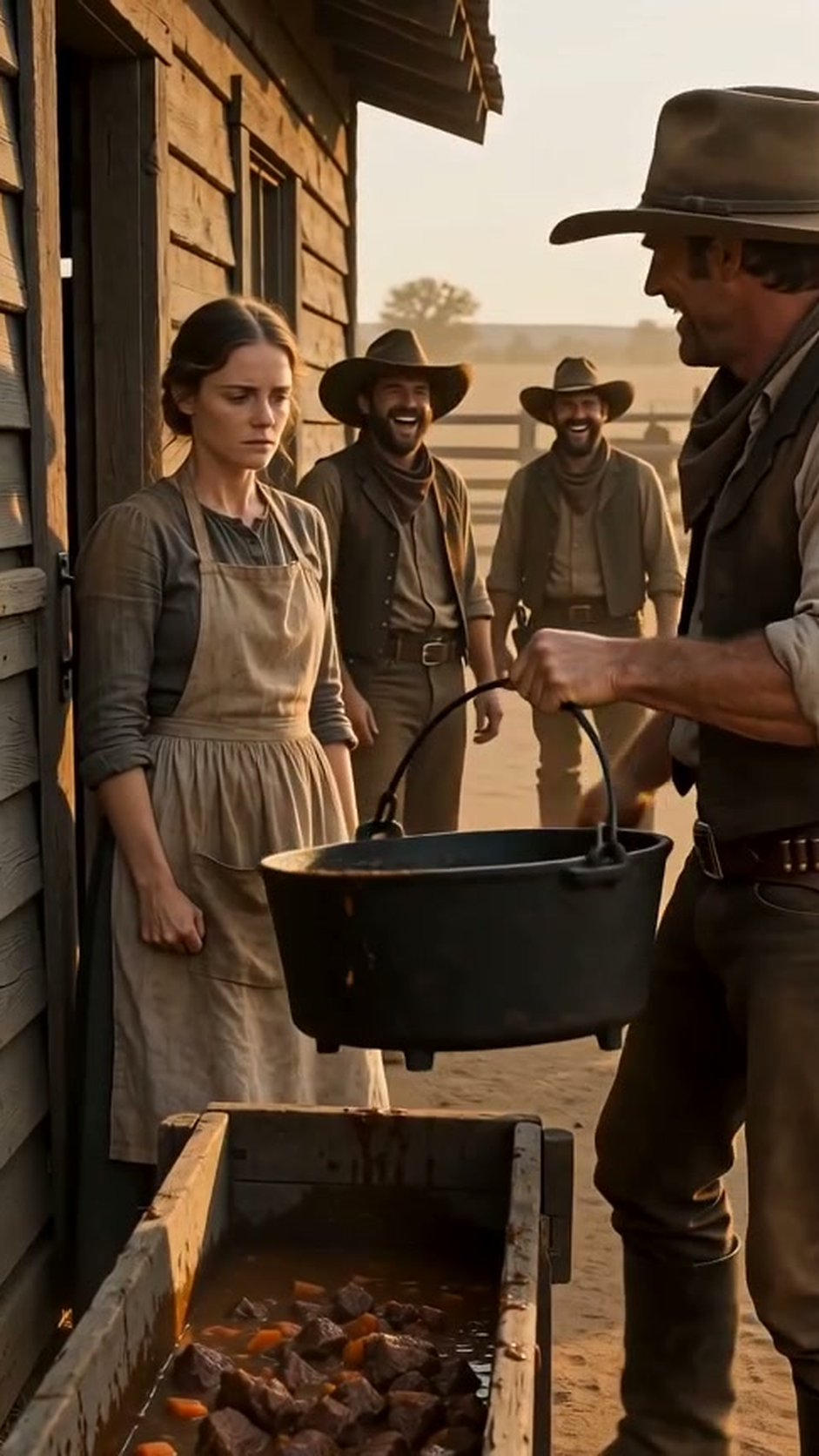
Bertha rode to Dryfork at dawn on her day off, in her good dress, with her hair pinned like armor and Lonnie Pruitt's sprained wrist healed enough that he had no business riding with her — and rode with her anyway, appearing at the barn as she saddled the ranch's gentle mare, with his hat already on and his jaw set at an angle she recognized from her own mirror.
"Andrew saw Buck ride in last night and ride out again before midnight," Lonnie said. "Andrew says Lester's called in a man from Fort Worth. Not an auditor, Miss Bertha. A *man*." He swung up on the remuda gelding. "So you're not riding in alone, and that's the whole of the discussion, so don't start it."
She didn't start it. She was learning that help, on the Bar Seven, came from the young and the old and hardly ever from the middle, where Buck stood.
Dryfork at nine in the morning was a different animal from Dryfork at supper time — shutters up, drunks swept off the boardwalk like leaves, shopkeepers holy with brooms. The Gilded Steer stood at the end of the street with its gilt sign freshly painted and its doors shut, and Lester Oler himself opened them to her knock, because Lester Oler had been expecting, for some days now, that the Platt girl would eventually arrive at his door like a bill coming due.
He was a small man, Lester, which surprised her — she had built him tall out of three dollars and a leather book. Small, and neat, and smiling with every part of his face except the part that counted, in a waistcoat with a watch chain thick as a fence wire.
"Miss Platt," he said. "The famous cook. Come in out of the sun. I don't open till noon, but for Buck's girl I'll make—"
"I'm not Buck's girl," Bertha said, and stepped past him into the cool, beery dark of the saloon, and stood where she could see the kitchen door at the back — and the beef hanging beyond it, Bar Seven beef, she'd have known her own butchering marks blindfolded, the rounds she had reported walking out of the spring house in the night. "And you know why I'm here, Mr. Oler, so let's not spend the morning on the parts we both know."
Lonnie closed the door behind them and stood with his back to it, seventeen years old and trying to look like a wall. Lester looked at the boy, and something in his face recalculated.
"You overheard a conversation once, I believe," he said pleasantly. "Behind my own establishment. Eavesdropping's a poor foundation for an accusation, Miss Platt. It's a boy's word and a cook's word against — "
"Against a book," Bertha said.
The saloon went very still. A fly worked at the window glass. Somewhere out back, a bottle tipped and rolled and settled.
"I don't know what book you mean."
"The leather one. The one that's *square*, Mr. Oler — I believe that was your word for it, the night you laughed about it behind this building. Buck keeps it in his desk, in the tack room, wrapped in oiled cloth, and it's got eleven months of your arrangement in his hand. Dates. Head counts. Three dollars a week for a crew delivered to your tables like cattle to a pen — and the beef, Mr. Oler. The beef and coffee and flour he steals off the Bar Seven and sells to your kitchen at prices no honest store would match, with every pound of it in the book too, because Buck Thorp is too careful a man to trust your memory."
She took one step closer, into the lamplit smell of beer and sawdust and other men's money.
"In a fortnight, an auditor from Fort Worth opens that ranch's accounts. Buck believes the book protects him — that it proves the money was yours and the idea was yours and he was just the hired hand who carried it. Maybe it does. But I've come to tell you what he rode in here to say last night, in case he dressed it up prettier for you than the truth: he came to tell you the ranch is hot. He came to tell you he's finished. And when Buck Thorp is finished, Mr. Oler, he will not go down holding your book like a shield for *you*. He'll hand it to Silas Merritt and an auditor and a deputy, and he'll say the saloon keeper corrupted him, and he'll ride out of it regretful and reasonable — and you'll be the man who bought stolen beef from a foreman and paid him to starve a dead woman's daughter off a ranch table, in writing, in eleven months of Sundays."
Lester Oler's smile had gone somewhere to die quietly. His hand rested on the bar, flat, and she saw it was not a young hand and not a steady one.
"You're bluffing about the book," he said. "Buck wouldn't—"
"Buck left his drawer standing open an inch," Bertha said, "because Buck wanted to find out if I'd run to it. I'm still here, and he's the one who rode twelve miles in the dark. Ask yourself which of us is bluffing."
The saloon keeper looked at her a long moment, and then he did the thing she had ridden in half-expecting and wholly dreading: he smiled again — a new smile, thinner than the old — and raised his voice toward the back of the saloon. "Mr. Corrigan. Would you step out here, please."
The kitchen door swung. The man who came through it had to turn a little sideways to do it, and he filled the back of the saloon the way a stove fills a small room — present, radiating, impossible to plan a path around. He was not a cowboy. His coat was a town coat and his hands were a town arrangement too, knuckles like a row of walnuts, and he looked at Bertha and at Lonnie with the mild, appraising interest of a man pricing livestock.
"Mr. Corrigan came in on the morning stage," Lester said, almost apologetically, "to help me with a — labor matter. I believe Buck mentioned you'd grown difficult, Miss Platt. Mr. Corrigan is going to see you back to the ranch. Quietly. And on the way, you're going to reconsider some of the stories you've been telling yourself about books."
"You'd put a woman on a road with your hired stranger," Bertha said, "to save three dollars a week."
"I'd put a *liar* on a road home," Lester said, "to save a business I've built for eleven years. Nobody's going to hurt you, Miss Platt. Mr. Corrigan is going to *persuade* you. There's a difference, and the difference is the whole of my defense if it ever comes to—"
"It'll come to it now, then," said Lonnie Pruitt.
The boy had moved. She hadn't seen him do it — nobody in the room had — but he stood now between Bertha and the big man with a saloon chair held in both hands by its back, legs out, the way a lion tamer holds one in a circus poster, and his sprained wrist's hand was white-knuckled on the wood and his voice shook and did not stop. "Because you'll have to *persuade* me first, and I ain't as polite as Miss Bertha, and this whole town's going to hear the noise, and I reckon a man with a book to hide don't want noise. Do you, Mr. Oler? Do you want noise? Because I can give you noise like a church bell."
Corrigan looked at the boy. Corrigan looked at the chair. And Corrigan — professional, expensive, a man who could tell the difference between a job and a brawl the way a cook can tell salt from sugar in the dark — arrived, visibly, at a conclusion, and sighed, and took his hat off, and held it.
"Mr. Oler," he said, "you hired me to scare a cook. You didn't say nothing about a kid with a chair, and you didn't say nothing about" — he nodded at Bertha, with something that in another face would have been respect — "a lady who talks like a bank examiner. I don't do noise. Noise is extra, and I don't think you can afford my extra."
It was then — because confrontations, like stews, come to their boil in their own time and not yours — that the door behind Lonnie opened against the boy's back and let the morning in, and with it, Andrew Coburn, dusty to the eyebrows from a hard ride, and behind Andrew, moving slow and unbothered as a verdict, Silas Merritt himself, who had ridden out of the Bar Seven at dawn behind his cook and his youngest hand, having decided sometime in the night that a man of seventy who lets his house be run by whispers deserves whatever the whispers build him.
"I'll hear it all," Merritt said, to the room, to Lester, to the fly on the window, "from the beginning. And Lester — " the old man looked at the kitchen door, and the beef beyond it, and his face set like cooling iron — "you'll open that kitchen to me, and whatever book-keeping you keep of your own, you'll open that too. Because I believe my cook. I've had fifteen years of her mother's word and six weeks of hers, and neither of them ever lied to me over a table."
What followed took an hour, and it was not dramatic, which is how you could tell it was real. It was figures. It was Lester Oler, pale as his own bar towels, producing his saloon ledger from a drawer behind the bar — because Lester, cornered between a foreman's book and a rancher's wrath, chose the rancher, the way small men always choose the ground that isn't moving. It was Merritt's spectacles coming out. It was Andrew sent at a gallop for Deputy Bledsoe. It was Lonnie, asked straight out by a man of seventy what he had heard behind the Gilded Steer in March, standing straight as a fence post and telling it plain: twelve men at the hotel, eighteen at Lester's, *you keep the three dollars ready, Lester. I'll keep the boys hungry for town.*
And it was Buck Thorp, riding in at noon with his Fort Worth solution nowhere in evidence and his confidence arranged for a different meeting entirely, walking into his employer, his deputy, his saloon keeper, and his cook — and understanding, in the doorway, in one half-second of counting faces, that the table had been set for him this time, and every plate on it had his name.
He did not run. Bertha would say that for him later, once, and only once: he stood in the door of the Gilded Steer and heard the charges read out of his own leather book — which Merritt had taken from the tack-room desk that morning on his cook's word, wrapped in its oiled cloth, dry as a bone — and Buck's face went through its whole weather, water and regret and reason, and found no climate that fit, and settled at last on silence.
Bledsoe took him to the little jail behind the courthouse to wait for the circuit judge, on charges of theft and fraud that the auditor from Fort Worth — who arrived a fortnight later and found the kitchen accounts, kept in pencil on a cottage door, to be the only honest books in the county — would spend a tidy week confirming, line by stolen line.
Lester Oler paid restitution to the Bar Seven in an amount Merritt set and Lester did not argue with, and the Gilded Steer got a new cook — an honest one, from the hotel — and a smaller crowd.
And Bertha rode home in the late light with Lonnie beside her and Andrew behind, quiet, like an honor guard nobody had appointed, and the whole way home nobody said much of anything, because there are victories that feel less like trumpets than like the end of a long day's work — and those, Bertha thought, are the only kind that last.