The guardianship was granted on a Tuesday, three weeks later, in a courtroom in Savannah, with the sun coming through the tall windows and the judge reading the papers in a calm, even voice.
Matthew sat beside Gabriel, in a chair that was too big for him, wearing a clean white shirt and a navy tie — a new tie, one Gabriel had bought him, because the old one had been lost somewhere on the road, in the dust — and he listened while the judge said the words, and he understood most of them, and the ones he did not understand, Gabriel explained to him afterward, in the hallway, in a low voice, kneeling down so they were eye to eye.
"It means," Gabriel said, "that I am your guardian now. It means that I am responsible for you, and that you are my family, and that no one can take you away from me, and that no one can take you away from yourself. It means that the house is yours, in trust, until you are twenty-one, and that the money is yours, in trust, and that I will take care of it, and I will take care of you, and I will do it properly, because that is what your father asked me to do, and that is what I promised him I would do."
Matthew nodded. He had been nodding a lot lately, because there was so much to take in, and nodding was easier than finding words for all of it. But this time, he found the words.
"Does it mean I have a home?" he asked.
Gabriel looked at him, and his eyes were wet, and he smiled, a real smile, the first real smile Matthew had seen on his face since the day he had stepped out of the dark sedan.
"Yes, Matthew," he said. "It means you have a home. And it means you have a family. You have me. You have Mrs. Bennett. You have a house, and a school, and a garden, and a future. You have all of it. Your father made sure of that."
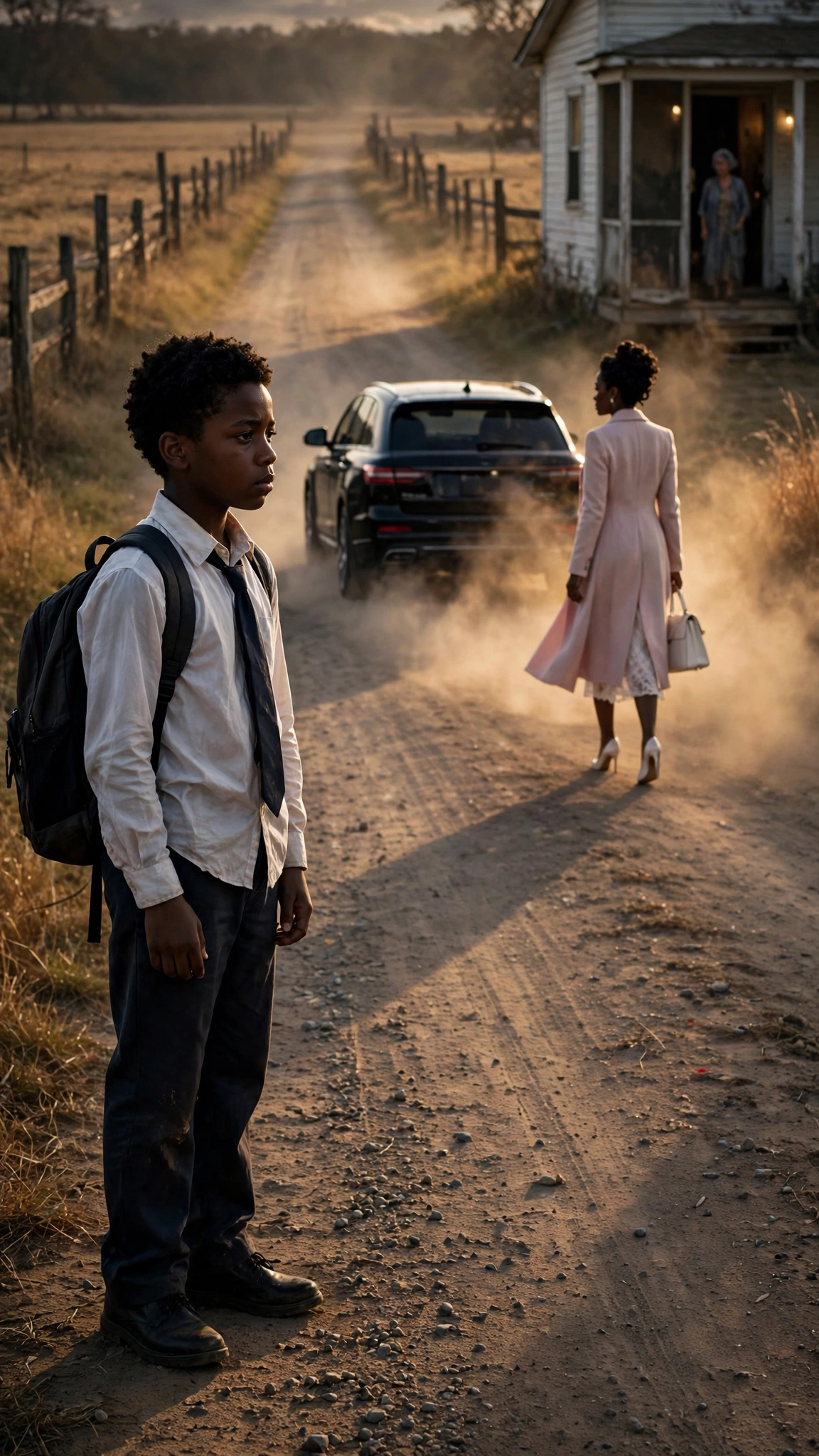
They drove back to Georgia that afternoon, Gabriel and Matthew, in the dark sedan, with the windows down and the warm air coming in, and Matthew sat in the passenger seat, with his backpack on his lap, and he watched the fields go by, and he thought about how different the road looked now, going the other way, with someone beside him, and he thought about his father, and he did not cry, because for the first time in a long time, he did not need to.
Rosa was waiting on the porch when they arrived, with a pitcher of lemonade and a plate of cookies, and she hugged Matthew so hard that he laughed, and then she hugged Gabriel, and then she made them both sit down, and she told them that she had already spoken to the school, and that Matthew would be in her class in the fall, and that she had already picked out his desk, right by the window, where he could see the garden.
"And," she said, and she looked at Gabriel, "I have a spare room, and it is always open, and if Matthew ever wants to stay over, or if you ever need anything, you only have to call. That is not a favor. That is family. That is what family does."
Gabriel nodded, and he thanked her, and he meant it, and then he took Matthew to see the house.
It was not the house with the blue shutters. That house was still in Atlanta, and it was still in trust, and it would be Matthew's when he was twenty-one, and until then it would be rented out, and the money would go into the trust, and that was all very sensible and very proper, and none of it mattered to Matthew at all. What mattered was the house Gabriel had found, a small house not far from Rosa's, with a porch and a garden and a room with a window that looked out over the fields, and Matthew walked through it slowly, touching the walls, looking out the windows, and he thought, this is mine. Not because his father had bought it. Not because a judge had said so. But because Gabriel was standing in the doorway, watching him, and smiling, and because Rosa was just down the road, and because for the first time since his father had died, Matthew felt like he belonged somewhere.
That evening, they went to the cemetery.
It was the first time Matthew had been back since the burial, and he was nervous, the way a person is nervous before doing something important, but Gabriel walked beside him, steady and calm, and Rosa walked on his other side, and they went to the place where Alexander Carter was buried, under a simple stone with his name on it, and Matthew stood there for a long time, looking at the stone, and then he knelt down, and he put something on the grass in front of it.
It was the folded paper. The paper his father had given him in the hospital. The paper with the telephone number on it. The paper that had been in his pocket on the road, and in his pocket on the walk to Rosa's house, and in his pocket when the telephone rang, and in his pocket when Gabriel stepped out of the sedan. He had kept it safe, the way his father had asked him to, and now he was giving it back, because he did not need it anymore. The number had done its work. The door had opened. The uncle had come. The paper was finished.
But he did not leave it there. He picked it up again, after a moment, and he folded it, carefully, and he put it back in his pocket, because Rosa had told him, once, that some things are worth keeping, not because you need them, but because they remind you of who you are and where you came from. And Matthew wanted to keep it. He wanted to keep it forever, in a drawer, or in a frame, or in a box with his father's photograph, so that when he was older, and when he had children of his own, he could show it to them and tell them the story — the story of a father who loved his son so much that he prepared for him, even as he was dying, and the story of a boy who walked down a long road and found a door that was open, and the story of an uncle who came, and a teacher who helped, and a family that was made, not born, but made, out of kindness and courage and a folded piece of paper with a telephone number on it.
"Hi, Dad," Matthew said, very quietly, to the stone. "It's me. I'm all right. I'm home now. Gabriel is here, and Mrs. Bennett is here, and I'm going to be all right. I promise. I'm going to be all right."
Gabriel put a hand on his shoulder, and Rosa put a hand on his other shoulder, and they stood there together, the three of them, in the evening light, with the crickets starting up in the grass and the sun going down over the fields, and Matthew felt his father's presence, not as a sadness, but as a warmth, like the sun on his back, like a hand on his shoulder, like a voice saying, very softly, "He'll help you, son."
And he had. He had helped him. And Matthew was home.
In the weeks that followed, life settled into a shape that Matthew recognized as happiness, although he did not have a word for it yet. He went to school, and Rosa was his teacher, and she was strict, and kind, and fair, and she never treated him differently from the other children, which was exactly what he wanted. He played in the garden, and he learned the names of the vegetables, and he helped Gabriel fix the fence, and he learned to ride a bicycle, and he made a friend — a boy named Tommy, who lived down the road, who had a dog named Biscuit, who thought Matthew's story was the most interesting thing he had ever heard, and who never once made him feel sorry for it.
Veronica left Atlanta. She took the small sum the law required, and she went to live with a cousin in Florida, and Matthew never saw her again, and he did not miss her, and he did not hate her, either. He thought about her sometimes, late at night, when the house was quiet, and he thought about the road, and the door slam, and the dust, and he thought about the apology she had sent through Gabriel — "Tell him I am sorry. Not for the money. For the road." — and he thought about what Gabriel had said, that an apology is not a door, that it does not open anything, that it does not undo anything, and he thought that Gabriel was right, and that it was all right, because Matthew did not need her apology. He had something better. He had a home. He had a family. He had a future.
And on the first day of school, in the fall, when Rosa called the roll and said, "Matthew Carter," he raised his hand, and he said, "Here," and his voice was clear and steady, and he smiled, and the sun came through the window, and the garden was bright outside, and everything was exactly as it should be.
He was ten years old. He had lost his father. He had been left on the side of a road. He had walked a long way, in the heat, with nothing but a folded piece of paper in his pocket. And he had found his way home.
There was one more thing, and Matthew did it on a Saturday morning in October, when the air had finally cooled and the leaves were starting to turn. He and Gabriel planted a tree in the garden of the small house — a young oak, no taller than Matthew himself, with roots wrapped in burlap and leaves still green. They dug the hole together, and Gabriel showed him how to spread the roots, and how to pack the earth down gently, and how to water it, and Matthew did all of it carefully, the way his father had taught him to do things carefully, and when they were finished, Gabriel stepped back, and he wiped his hands on his trousers, and he said, "That tree will be here long after we are both gone, Matthew. It will grow, and it will stand, and it will give shade to people we will never meet. That is what a home is. It is something you plant, and something you take care of, and something that outlasts you."
Matthew looked at the little tree, standing straight and brave in the middle of the garden, and he thought about his father, and he thought about the road, and he thought about the paper, and he thought about all the people who had helped him get here — Rosa, with her porch and her pancakes; Gabriel, with his folder and his steady hands; Tommy, with his dog Biscuit and his endless questions; and his father, who had loved him enough to plan for him, even as he was dying — and he understood, in the clear, simple way that a ten-year-old boy understands the most important things, that a family is not something you are given. It is something you build, one person at a time, one kindness at a time, one planted tree at a time, until one day you look around and realize that you are home, and that home is not a place, but the people who are standing beside you.
That afternoon, he took the folded paper out of his pocket for the last time, and he put it in a small wooden frame, the kind with glass on the front, and he hung it on the wall of his bedroom, next to his father's photograph, where he could see it every morning when he woke up. It was not a telephone number anymore. It was a reminder. A reminder that his father had loved him. A reminder that he had walked a long road and survived it. A reminder that even on the worst day of his life, someone had been thinking of him, and planning for him, and making sure that he would not be alone.
And that was the end of the story. And the beginning of everything else.