"Your family says you attacked them."
Detective Voss said it the way he'd said it in the doorway of her life three days into the investigation — flatly, setting the report on the bedside table like a card dealt face-up. The heading caught the light: EMERGENCY PSYCHIATRIC EVALUATION REQUEST. He was watching her, Tessa understood, for the flinch. For the breakdown. For the madness her family had described in such loving detail.
She didn't give it to him. Her breathing quickened — the monitor betrayed that much — but she shook her head slowly, and when she spoke, her voice, though hoarse, was steady.
"I didn't attack anyone, Detective. I was attacked. There's a difference, and it's the whole of this."
The door opened.
Bridget Colton entered carrying the banker's box, and set it on the table, and opened it with the deliberate care of a woman defusing something. From inside she took a sealed evidence sleeve, and from the sleeve — with gloved fingers, holding it to the cold hospital light — a small USB drive.
"I found it," she said, softly, to Tessa. And then, to Voss: "Detective, before you go any further with that report, you're going to want to see this. All of it. It's why they left her in an alley to freeze. It's why that evaluation request exists. They weren't trying to help her. They were trying to make sure that when she talked, nobody would ever believe her."
Bridget plugged the drive into the laptop. The screen lit. Rows of folders appeared: FINANCIAL RECORDS. HIDDEN ACCOUNTS. VIDEO EVIDENCE. CONFIDENTIAL TRANSFERS.
Voss leaned closer. His eyes widened.
"Tessa…" he said. "What is this?"
"Everything," she whispered.
They started with the financial records, because Bridget was a lawyer and knew that paper convicts where emotion only persuades. For forty minutes, in that white room, with the monitor beeping and the snow melting off the windowsill outside, the architecture of Vivian Ashford's second, secret empire assembled itself on the screen: the shell companies, the ghost vendors, the Cayman accounts, the transfers bleeding the foundation white — $6.4 million over three years, not the $1.9 million Tessa had first found, the rot went deeper than she had known. Voss stopped taking notes at some point. He just watched, and his face did the thing Bridget had predicted in her office weeks ago: skepticism, then attention, then alarm.
"This is enough for the state police and the AG," he said quietly. "This is enough for the FBI, if the wires crossed state lines, and they did." He looked at Tessa. "Miss Ashford— Tessa. Why didn't you come to us?"
"Because until ten minutes ago," Tessa said, "I was the crazy daughter who attacked her mother. You had their statement, their doctor, their video. I had this — and me. And my family has spent three days making sure 'me' was worth nothing."
"Walk me through one," Voss said. "Not the biggest. A normal one. I want to understand how an empire steals in business hours."
So Tessa — propped on pillows, a woman with two broken ribs explaining embezzlement to a homicide detective in the key of a lullaby — walked him through the Corvus Trust endowment transfer, step by step: the scholarship fund's quarterly surplus, identified by the foundation's own analyst; the "program services agreement" generated by outside counsel; the approval chain that rose, always, one floor above her own desk, into the office where her mother's signature lived; the staircase of intermediaries; the arrival, forty days later, of the same money in an account whose statements were addressed to a post office box and a set of initials. V.A. Vivian Ashford had initialed her thefts the way she initialed Christmas cards, with a flourish, out of habit, because in forty years no one had ever once asked her to stop.
"And the scholarship money," Voss said. "It was earmarked. For actual—"
"For actual students." Tessa's voice stayed level with an effort that cost her. "Eleven that cycle. We know their names; the foundation sent them letters — acceptance letters, Detective, signed by my mother, congratulating them — and then the money wasn't there, and the letters were withdrawn on administrative grounds. One of them, a cellist from Dayton, wrote back asking what she'd done wrong." She stopped. The monitor ticked. "My office answered her. Not me — I never saw the letter; my mother ran interference on all of it — but the foundation told that girl there'd been an error in her file. She'd done nothing wrong. She was seventeen. Her file was fine. The money was in the Caymans."
Voss was writing now, fast, the professional shorthand of a man whose anger has found its paperwork. "Miss Ashford, in my experience, people who do this — the letters, the withdrawals, the signatures — they rely on the victims staying scattered. Eleven kids who think they each made a mistake. An accountant who thinks he's alone. A daughter who thinks she's crazy." He looked up. "The drive works because you did the one thing the whole system was designed to prevent. You compared notes with yourself. You made it one story."
"It always was one story," Tessa said. "She just made sure everyone only got to read their own page."
Then Bridget opened VIDEO EVIDENCE, and the room changed temperature.
The first file was the loading dock, fourteen months old: Vivian in purple, Dwayne Pell trembling, the still stranger nodding. Voss went very quiet. "I know that man," he said at last, of the stranger. "His name is Anton Reber. We've been trying to connect him to three intimidation cases for two years. Three. People who were going to talk." He looked at Tessa with something new in his face — not pity. Respect, and a cop's anger on her behalf. "Your mother is standing in my three cases."
The second video was the one that ended it.
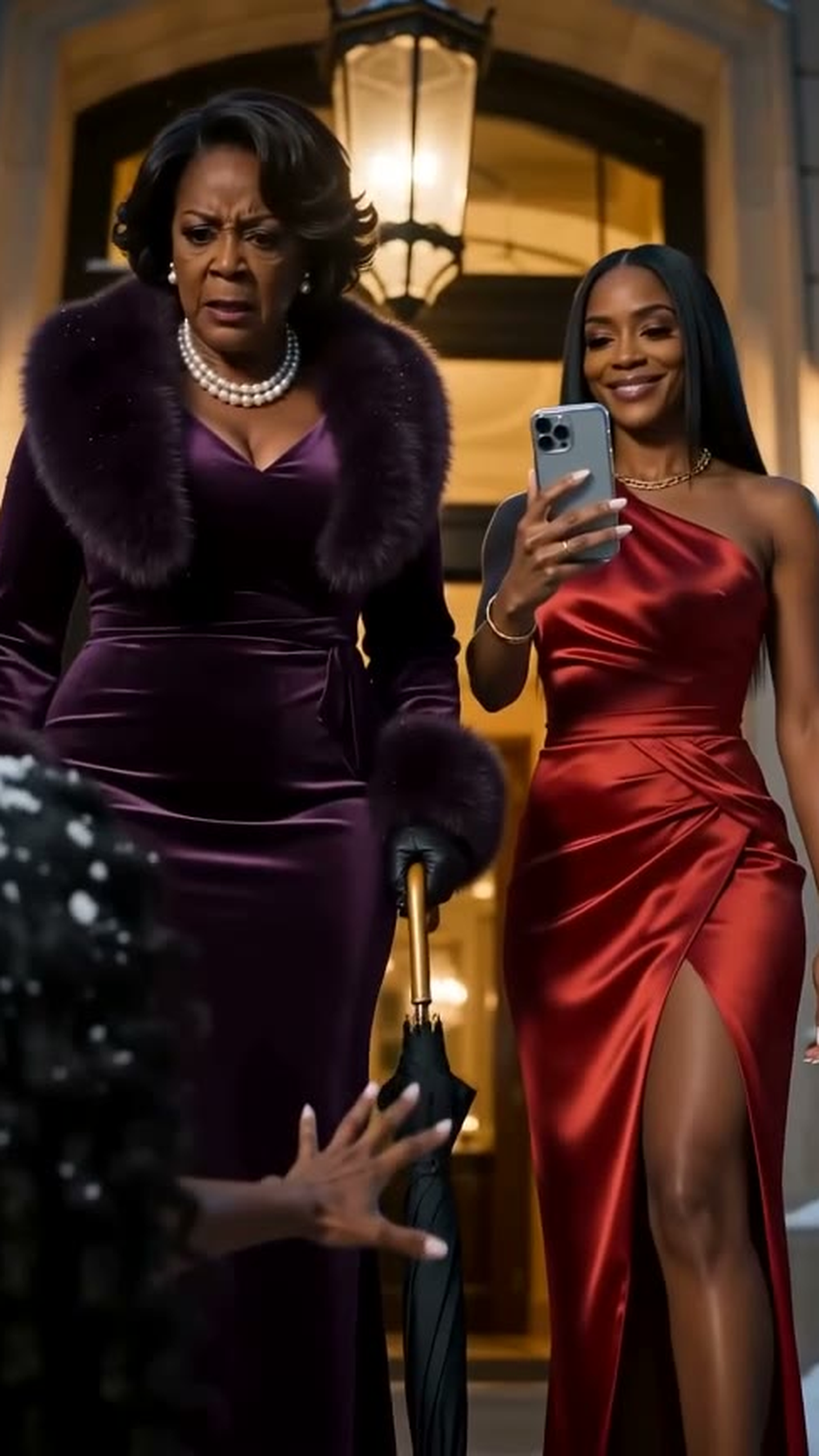
It was the hotel's own porte-cochère camera, the night of the gala — footage Tessa had copied from the security archive without knowing, in her panicked thoroughness, exactly what treasure she had. The camera watched from above the lanterns, impartial, in high definition: the side door opening. The family emerging. Tessa stumbling on the ice. Her mother's umbrella coming down beside her hand with a crack the camera's microphone caught like a gunshot. The grip on the forearm. The fall to one knee. The father in the golden doorway, turning away. The SUV. The hands under her arms. Her feet dragging two thin lines through the snow.
And Emma, in red, walking backward, phone raised, smiling, filming all of it.
Voss watched it twice. The second time, nobody spoke. The monitor beeped. Somewhere down the corridor a cart rattled.
"That," he said finally, very quietly, "is not a family dispute. That's conspiracy, assault, unlawful imprisonment, attempted—" He stopped himself, a professional remembering a victim was in the room. He closed the laptop with great care, the way you handle something that is now evidence in a case that will be on the news. "Miss Colton. Miss Ashford. As of this moment, I'm suspending the complaint investigation and opening a criminal investigation into the Ashford family. I'm calling my captain, the state police, and the attorney general's financial crimes unit. That evaluation request—" he picked up the folder from the bedside table, and there was something almost satisfying in the way he slid it into his own case file, evidence now, theirs turned against them — "will be entered as an overt act in furtherance of the conspiracy. They tried to have you declared insane to bury this. Instead, they documented their own motive."
Bridget's hand found Tessa's then, and held it, and Tessa discovered she was shaking — not from cold this time, though her body seemed to have forgotten the difference. Thirty years of being the quiet one, the difficult one, the one at the edge of the portrait. It was ending. Not with her mother's permission. Not with her family's forgiveness. With a folder opening on a laptop in a hospital room, with a detective's eyes widening, with one word.
Everything.
The third video was twelve seconds long, and it was the one that would later run on every screen in America.
It came from a camera Tessa hadn't known existed — a service camera over the alley-side door of the hotel's loading bay, archived in the same system she'd copied in her frightened thoroughness, grabbing directories whole because she had not known which of them mattered. It mattered. The angle was high and grainy and utterly without mercy: the black SUV nosing into the alley behind the strip mall at 12:51 a.m. The rear door. Two figures — the family's driver, and a man Tessa recognized as the head of hotel security — lifting a third figure out of the back seat. The gown gave her away even in grain and darkness: silver, catching what light there was, unmistakable, a woman in an evening dress being set down on freezing asphalt like a delivery. The men did not arrange her. They did not cover her. One of them — the security chief, a man named Garrity who had worked for her mother for nineteen years — bent and took her phone from the clutch still looped at her wrist, and pocketed it. Then the doors. Then the taillights, red on the wet black ground, dwindling.
Twelve seconds. Voss played it three times without a word. On the third viewing, Tessa made herself watch her own body being set down in the cold, and found that the woman in the silver dress seemed to belong to someone else — a character in a story she was being told — and that this was, perhaps, the injury under all the injuries: that her family had converted her into a character in a story they were telling, a cautionary tale for donors, the mad daughter, the tragic daughter. The video gave her back. It said: here is what a person looks like when other people have decided she is cargo.
"Miss Colton," Voss said at last, and his voice was not steady, and he did not seem to mind that it wasn't, "I want you to know that I will be recommending charges on the basis of this footage alone, and I will be putting in writing that I was handed the family's complaint first. I want it on the record that they came to us. They walked into a police station and filed a false report against a woman they left to freeze, while she was still in intensive care. I've been a detective nineteen years. I've seen families do terrible things in passion. This—" he gestured at the screen, at the folders, at the whole cold architecture of it — "this was done in administration. In business hours. With forms."
"Yes," Tessa said quietly. "That's my family. Everything is filed."
He laughed once, without humor, and stood, and began making the calls — captain first, then the state police liaison, then a number he dialed from memory that made Bridget raise an eyebrow: the attorney general's financial crimes unit, direct line. While he talked, Bridget moved to the window and stood looking out at the afternoon going grey over the hospital parking lot, and Tessa watched her attorney's reflection in the glass and saw that Bridget was smiling — not triumphantly, but with the private satisfaction of a woman who had been called alarmist for weeks, by colleagues, by a managing partner, by the careful voices that protect institutions, and who had kept a banker's box in a vault anyway, on the word of a friend everyone else had filed under fragile.
"You believed me," Tessa said. "From the first night. Before there was proof. Why?"
Bridget didn't turn around. "Because I knew you at nineteen," she said. "Before they finished editing you. You were the only person at that school who read the fine print on everything, including the friendship." A pause. "And because unstable people don't build dead man's switches, Tessa. They just die. You built one. That's not madness. That's the sanest thing I've ever seen anybody do."
But Vivian Ashford had not ruled an empire for forty years by surrendering at the first reverse. By nightfall, her lawyers had filed an emergency petition of their own: the competency hearing would proceed — accelerated, in fact, at the family's insistence — on the grounds that Tessa, clearly manipulated by an unscrupulous attorney and a rogue detective, was being exploited in her fragile state. The family demanded the hearing be held in two days. They demanded their daughter back.
Bridget read the filing, and smiled for the first time since the gala — a thin, bright, dangerous smile.
"Let them," she said. "They've just subpoenaed themselves into a room where we get to play the video."