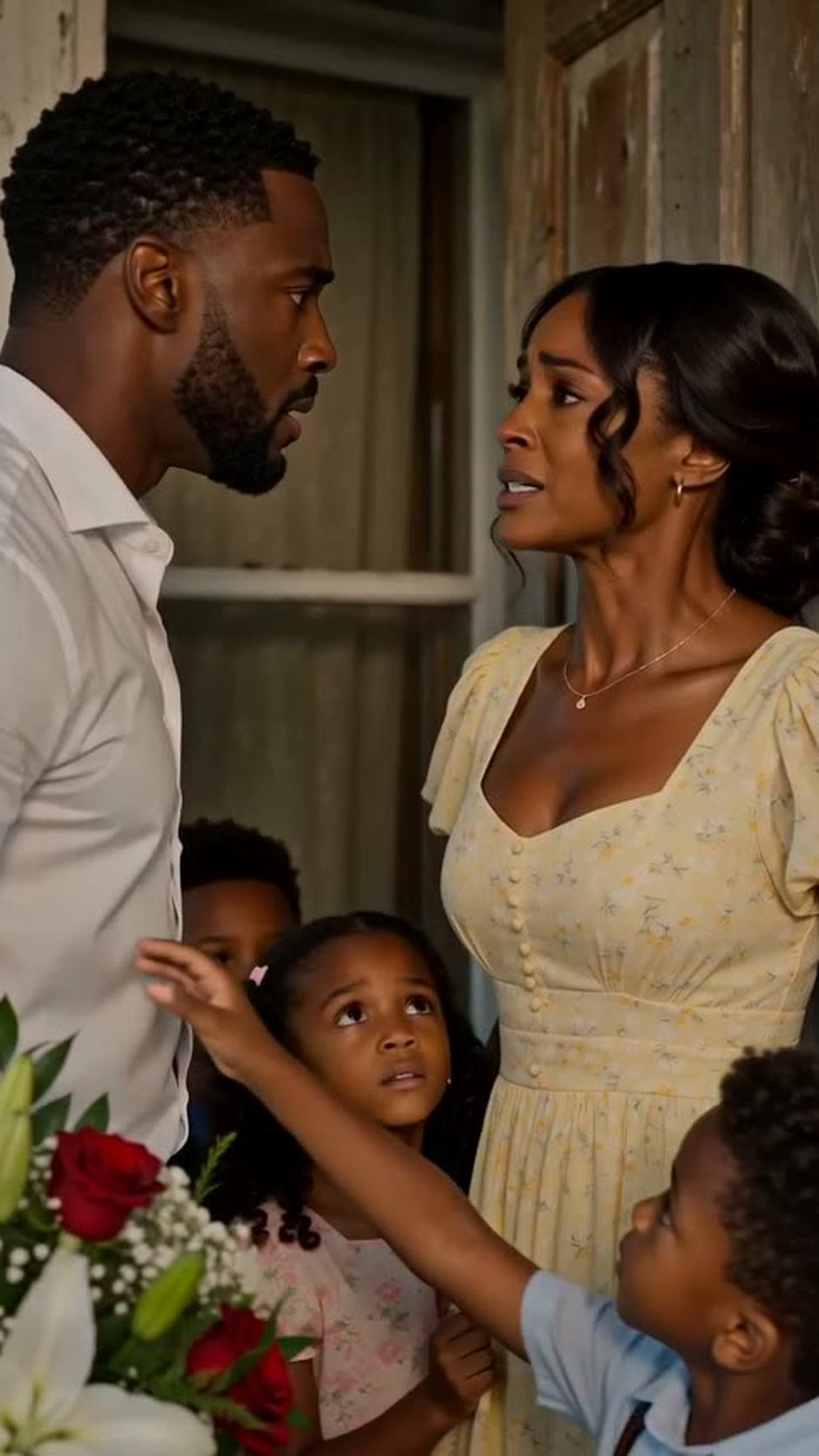
Afterward, Daniel would understand that the moment on the porch had been two moments: the one he had imagined for eleven hours in the car, and the one that was given to him. In the one he imagined, he spoke first. In the one he was given, his wife opened a door and a little girl with his own eyes ran to hide behind her mother's skirt, and everything he was — the fortune, the name, the whole armored architecture of Daniel Whitmore — was reduced in one second to a man holding flowers he no longer knew what to do with.
This is what happened in the doorway, the second time, with the shock worn down to the bone of it:
He asked who they were, in a voice he didn't know he had. The letter fell, and neither of them would ever forget that it fell — that Emily looked down at nine words on a folded sheet and went white, that she asked *where did you get that* in the voice of a woman watching a grave open. The boy stepped out and looked up at him, searching his face like a map. The memory of his own voice came back off the walls of nine years — *Leave* — and Daniel did the only thing left in him to do. He stepped back. Half a pace. Then another inch. He yielded the doorway like a man surrendering a country.
"I should have come sooner," he said.
Emily's eyes shone and did not spill. The girl's hand was fisted in her dress. "What haven't you told me?" he asked her, trembling, and he watched her arrive — visibly, the way a wave arrives — at the edge of the thing she had carried alone for nine years.
"Daniel…" she said.
And the boy, Eli, who did not know he was standing at the hinge of two families' history, reached out his small hand and touched a red rose petal with one finger, gently, the way you touch something asleep.
Emily's hand shook on the doorframe. She looked down at her son's hand on the rose, and up at Daniel, and she made the decision that Hannah would have made, and her grandmother would have made, and that she had been making in installments since a bathroom floor in the dark: she told the truth.
"There's something you never knew about—" she began, and stopped, and began again, and this time she finished it.
"Her name is June. She's eight years old. She was born the February after—" Emily's voice held, barely. "Daniel. She's yours."
The porch, the yard, the whole green Kentucky afternoon went silent in a way Daniel would hear for the rest of his life.
He looked at the girl. June looked back at him — unwinking, assessing, with his own dark eyes, in her mother's face, from behind her mother's skirt — and Daniel Whitmore felt his knees do something they had never done in a boardroom, in a crash, in a courtroom. He sat down. Not gracefully. On the top step of the porch, with the bouquet spilling sideways against his knee and the letter under his shoe, a billionaire sat down in the dirt-road dust in his white shirt because his legs had declined, unanimously, to continue.
"Eight," he said. His voice was a stranger's. "She's eight. She's — June. Her name is June. I have a daughter named June and she's eight years old."
"Yes," Emily said.
"I have a daughter. And I said — I told you to — " He pressed the heels of both hands into his eyes. His shoulders shook once, hard, without sound. "I missed — Emily. I missed *everything*. Her first — all of it. I missed all of it on purpose. I did it. Nobody did it to me. I stood behind a desk and I *did* it."
"Yes," Emily said again, and it was not cruelty. It was the plainest mercy she had: she was not going to lie to him, even to comfort him. She had never once lied to him. That had been, in the end, the entire evidence — the face that couldn't — and he had looked directly at it and chosen paper.
"June," Daniel said, from the step, hoarsely. "June what? What's your whole name? I need to — I should know your whole name."
The girl regarded him with the severity of a small headmistress. "June Rose Whitmore."
"Whitmore," he repeated.
"Mama kept your name for me." June said it the way she said everything, like reading from a record. "She said a name is a promise somebody made. She said promises stay promises even when the person is being—" she checked with her mother, briefly, for the approved wording, "—a *disappointment*."
Daniel made a sound that was not a laugh and was not not a laugh. "Your mama," he said, "is the most honest person in the world. Nobody has ever survived being known by her. I didn't. It took me nine years dying of it to come back and try again." He turned his wet face up to the girl, his daughter, and did not tidy himself at all. "I'm going to earn the name back, June Rose. You can put that in the book."
It was June who moved first. Children are braver than nations. She detached her hand from her mother's dress, took one step down out of the doorway, and stood in front of the stranger sitting wrecked on her porch steps, and studied him with her father's eyes.
"You brought flowers," she informed him.
Daniel lowered his hands. His face was wet. He did not wipe it. "Yes."
"We have flowers," June said. "Mama does weddings. But nobody brings them *to* her. Eli, look, he brought them *to* her." And Eli, emboldened, came down the steps and took possession of the bouquet's ribbon with the gravity of a customs official, and Daniel — laughing, wrecked, astonished — began, carefully, to breathe again.
Emily watched it from the doorway with her hand at her throat. She did not come down the steps. Nine years do not come down steps in an afternoon, and Daniel, to his credit — to the first credit he had earned in a decade — saw it, and did not ask her to.
The afternoon that followed was the strangest of Daniel's life, and he had once spent a weekend negotiating with the government of a small nation.
He did not go inside. He understood, without being told, that the threshold was not yet his to cross, so he sat on the porch steps where his legs had put him, and the children — released by their mother's failure to forbid it — conducted their inspection. Eli climbed into his lap with the total lack of ceremony of a cat, examined his watch, his shirt buttons, and the stubble on his jaw, and announced his findings to the yard: "He's a real one." June stood at a judicial distance with her arms crossed and asked him the questions of a border official. What was his full name. Where did he live. Why was his car that color. Did he know how to swim, ride a horse, fix a fence, or catch a fish — the four competencies of a man, in her taxonomy, and he failed two and a half of them, which she recorded in a small purple notebook produced from the pocket of her pink dress.
"You're keeping notes," Daniel said faintly.
"Deciding during is how mistakes happen," June informed him, and wrote something else down.
Emily called them to wash for supper at six, and her voice from the doorway did what it had always done to him. He washed his hands at the pump in the yard because the children washed at the pump and he was, he understood, applying for membership. Eli showed him how the handle stuck. June showed him where the towel lived. Neither of them looked at their mother for permission to be kind to him, and Emily, watching from the doorway with a dish towel over her shoulder, said nothing at all — but she set four places at the table, and Daniel, carrying the water jug in, saw the fourth plate land at the place where no one had sat in nine years, and had to stand still in the kitchen for a moment with his back to the room.
The children talked through supper the way children do, a river around stones: school, a frog, a boy named Caleb who had eaten a crayon on a dare. Underneath it, in the silences, nine years sat down at the table with them. Daniel learned that June's birthday was in February, that she read three grades up, that her teacher was Miss Pruitt, and that she intended to be a judge or a florist and had not yet decided which was more powerful. He learned that Eli feared thunder and loved being read to and had decided, at some point in the afternoon, that Daniel was his. He learned these things the way a man dying of thirst learns the names of rivers.
What he asked, at dusk, sitting at her kitchen table because Eli had decreed that a man who brings flowers stays for supper and June had seconded it, was only this: "Tell me what to do. Not what I want. What to *do*."
And Emily, who had rehearsed nine years of speeches for this man and discarded them all, discovered that the true one was short.
"You leave tonight," she said. "You get a room in town. You come back tomorrow at ten, and you come back the day after that, and you let them learn you at their speed, not yours. You don't buy them anything. You don't promise them anything you can't keep. And Daniel — " her voice dropped, and the whole kitchen went still, " — you answer my questions now, the way I once begged you to answer yours. Starting with that letter." She laid the anonymous sheet flat on the table between them. "I didn't send this. I never wrote to you but once, and you never answered, and I've made my peace with believing you chose that. So who sent this? Who knew where I was — and who decided, after nine years, that it was time you did?"
"But first," Daniel said, "Eli. Please. I need to stop doing arithmetic in the dark. Is he—" He stopped. Even now, with every card he owned face-down on the table, the question felt like a trespass.
"Eli is Hannah's son," Emily said.
Daniel stared at her.
"My sister was killed four years ago, on Route 62, in the rain. Eli was fourteen months old. His father was a soldier who sent one letter." Her voice did not shake; this grief was older, and had been given its room in the house. "There was nobody else, Daniel. So he's mine. The court says so, and June says so, and he says so, and I say so loudest of all. He is not a secret and he is not a complication. He's my son. If that's arithmetic you ever have to do again, do it with those numbers."
"Hannah," Daniel said. "Hannah is — God. Emily. I didn't — nobody told me. Garrett used to—" He stopped, because the enormity of what else nobody had told him was arriving, carriage by carriage, like a train. "I sent flowers to the foundation dinner that year. For a *dinner*. I didn't know your sister was dead. I didn't know because I arranged not to know anything about you, because knowing was the one thing—" He put his hand flat on the table, an old negotiator's gesture, grounding himself. "I am sorry about Hannah. She was the best laugh in any room she ever stood in. And for what it's worth to you — he's a fine boy. He's — you raised a boy who walks toward strangers to check if they're real. That's not nothing. That's the whole of something."
"He walked toward *you*," Emily said quietly. "On the porch. Children know things, Daniel. It doesn't mean I have to know them yet."
Daniel looked at the letter for a long moment. And in the stillness, understanding arrived the way it had arrived in the library nine years before — as a cold, clarifying dread — because there were only two people alive who knew where Emily Whitmore had gone, and one of them was sitting at this table, and the other one was his mother.
His phone rang in his pocket. He almost didn't answer it. The number was the house in Connecticut, the housekeeper's line, and Mrs. Abernathy was crying before she got his name out.
"Mr. Whitmore — it's your mother. The ambulance is here. They say — sir, they say you should come now."