Vivian Whitmore died the way she had lived: precisely, and on a schedule she attempted to control. She held on through the night Daniel drove back from Kentucky — drove like the road was on fire, arrived at the hospital in Hartford at three in the morning with his white shirt still carrying a smear of porch dust — and she waited, the nurses said, with her eyes open, watching the door.
She had things to say and she had arranged, with the last of her strength, to say them to an audience of one.
"Alone," she told the nurse, in a voice like paper tearing. "Send the priest away. I am not confessing to God. I am confessing to my son."
So Daniel sat beside the bed of the woman who had built him like a company, and he took her hand because hers was reaching, blindly, the way hands do at the end, and Vivian Whitmore looked at her only child and did the thing she had burned a dozen letters rather than do.
"I sent you to her," she said. "The letter. No signature — I was always a coward about signatures. Daniel. Listen to me, because I have arranged to only have to say this once."
And she told him all of it.
She told him the photograph was real and the moment was not — that Emily had been laughing at a stranger's joke at a benefit of four hundred people, and that the hand at her back had belonged to a man paid, through two intermediaries, to be standing in that garden. She told him the hotel receipt was a forgery, the email thread a construction, the money in the foundation account moved by Garrett Cole's own instructions through a clerk who believed he was correcting an error. She told him she had commissioned all of it, and Garrett had executed it, because Garrett wanted the Ashford merger and the port contracts it carried, and because she — his mother — had wanted a daughter-in-law who was an asset, and had looked at a girl from Kentucky arranging flowers and had chosen, instead, to arrange *her*.
"Nine years," Daniel said. His voice sounded to him like it was coming from the bottom of a well. "And the — she wrote to me. Emily. She wrote to me once. I never got—"
"The February after," Vivian whispered. "She was pregnant." Her eyes, filmed and ancient, filled with something that might have been the first honest thing to cross her face in forty years. "It came to the penthouse. I was — managing your affairs. You were so *low*, Daniel, you were not sleeping, Garrett said if she got her hooks in with a child it would all begin again. I told myself it was mercy. I have had nine years to learn the word for it and the word is *theft*. I stole — " her breath caught, and the monitor marked it, " — I stole your daughter out of your life before she was born, and I stole her father out of hers. It is the only thing I ever built that I am ashamed of. It is a very large thing."
Daniel could not speak. In his mind he was standing at a mailbox on a dirt road in the sun, red flag up, with all his life in an envelope.
"She said to burn it, if I didn't want to know her," he said at last. "In the letter. Emily said that. *If you do not, burn this.* And you—"
"I couldn't burn it." Vivian's fingers tightened on his with a ghost of her old grip. "That is my damnation, Daniel, do you understand? I burned all of mine. Hers is in the lacquer box. In the library. Under the Whartons. Read it and then hate me *accurately*."
He read it at dawn, alone in his mother's library, sitting in the chair Garrett had sat in nine years before — he did not know that, and it would not have mattered; the chair was only the last of the furniture his mother had arranged. The letter was eight lines long. It had been opened carefully, along the crease, and refolded along it a hundred times, a thousand — his mother's guilt, worn into the paper like a handrail. *I am pregnant. The baby is yours; there has never been anyone else, and the fact that I must write that sentence is the saddest thing I own… If you want to know your child, you know where I am.*
He knew where she was. He had always known where she was. That was the furnace at the center of it — a part of him had known the whole time, the way you know a room in your house is on fire even with the door closed, and he had let his mother and his friend and his own pride keep the door shut for nine years while his daughter learned to walk, and talk, and ask the door why it was closed.
Before he left Connecticut, Daniel walked out into his mother's garden at dawn, into the garden where the photograph had been taken — four hundred guests, a summer benefit, a stranger paid to stand too close and rest a hand where a hand should never have been hired to rest. The garden was empty now, and wet, and perfectly kept by people who would keep it perfectly for a house with no one in it. He stood where the stranger had stood. He looked up at the windows of the library, where, nine years ago, a woman had stood like a magistrate and watched her work come in. He tried to summon hatred for his mother, clean and simple, the way other sons summoned it at gravesides, and what came instead was worse: an understanding of the machinery of her, the widow at twenty-nine with an empire in her lap and a terror of softness so total that she had amputated her son's happiness the way a surgeon amputates, believing to the end that the cutting was care.
"I won't do it your way," Daniel said to the empty garden, to the wet grass, to the woman in the ground three miles away. "Not the company. Not the family. Not the door. My door stays open, Mother. That's the whole of my revenge."
Garrett Cole was arrested on a Thursday, at the Whitmore Capital offices, in front of the glass wall of the boardroom, on charges built from a foundation audit trail that a dying woman had preserved — God forgive her, she had kept records of her own crime the way she kept records of everything, as insurance — and delivered to Daniel in a sealed packet the morning after the funeral. He did not resist. He looked at Daniel across the boardroom table with an expression Daniel had never seen on his face, the expression of a man discovering the price of something, and said, "You were going to throw away the Ashford deal. Forty years of positioning. For a *florist*." And Daniel said, "Her name is Emily," and turned around and walked out of the building he had given his life to, into the noise of the city, and stood on the sidewalk breathing like a man who has been underwater.
The funeral was small and perfect and cold, the way Vivian would have ordered it, and Daniel stood in the receiving line of his own mother's burial and shook the hands of people who had profited from his marriage's destruction without ever knowing they had, and said *thank you for coming* forty-one times, and meant it exactly never.
What he did in the week that followed, he did with the methodical fury of a man dismantling his own house to reach a fire in the walls. He hired investigators who did not know Garrett. He put the foundation under a forensic audit going back ten years, and the audit found, besides the framed forty thousand, two more transfers, smaller, later — Garrett taxing the lie, annually, like rent. He sat with the district attorney's people in a room with no windows and laid out his mother's sealed packet, and his own investigator's photographs from nine years ago, and the new ones, and said, "I am not asking for privacy. I am asking you to be thorough and loud, in that order." He went before his own board and told them the truth in twelve sentences, which is eleven more than the scandal strictly required and exactly as many as Emily, at a kitchen table in Kentucky, had once demanded of him: *you answer my questions now.* He was answering everyone's now. It was the first honest week of his professional life, and it cost him a merger, a chairman's confidence, and Garrett Cole — and he recorded the whole transaction, in a ledger only he kept, as the best trade he had ever made.
On the fourth night he called the farmhouse, because he had promised June — no, because he had promised *Emily*: *you come back tomorrow at ten, and the day after that* — and he had broken the letter of it to save the spirit of it, and a broken promise, even a bent one, had to be reported to headquarters.
Emily answered on the second ring. "Is she—" she said.
"She's gone. It was — she waited for me. Emily, she confessed. All of it. The photograph, Garrett, the money. And the letter." He had rehearsed nothing; the words came up out of him like water out of a broken main. "Your letter. She intercepted it. She *kept* it. I have it. I'm bringing it to you."
The line was quiet long enough that he checked the phone. Then Emily said, in a voice very carefully level, "She kept it," and he heard what it cost her not to ask the next question, and he answered it anyway, because that was the new law of his life: "She read it until the folds wore thin. Whatever else she was, Emily — she carried it. Every year of it. I think it's what was killing her before the illness ever got started."
Another silence. Then, distantly, a small voice, and Emily muffled the phone, and came back. "June wants to know if you're coming back. She says to tell you there's a list."
"Tell June—" Daniel said, and had to stop, in a hotel room in Hartford, alone with the two letters and his dead mother's handwriting. "Tell June I'm driving down tomorrow. Tell her to put it in the book. Tell her — I keep my appointments now."
"Eleven hours," Emily said, and something in her voice had changed, some fraction of a degree, like a season turning in another county. "Drive carefully, Daniel."
He did not fly back to Kentucky. He drove. Eleven hours, the way he had come the first time, because some journeys should cost what they cost. He had his mother's sealed packet in a box and Emily's nine-year-old letter in his breast pocket, in a plain envelope, and nothing else — no flowers this time. This time his hands were empty, and it felt like honesty.
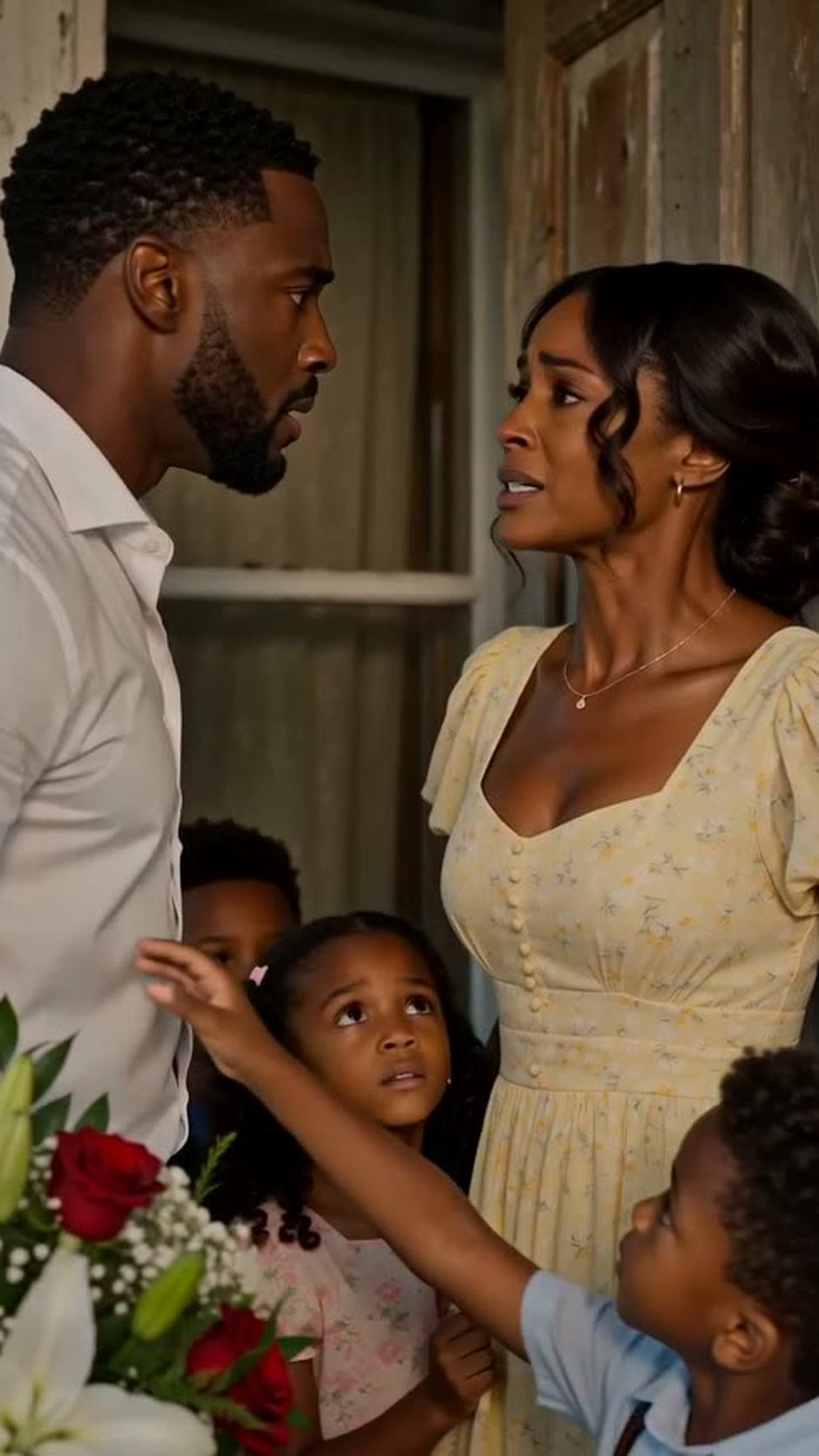
Emily opened the door before he could knock. She had been watching the road; he knew it the way you know weather. June stood at her side — not behind her, this time, but beside her, with her arms crossed and her father's eyes doing arithmetic. Eli hung off the door handle like a gargoyle.
"I read your letter," Daniel said.
Emily went very still.
"Nine years late," he said. "She kept it. She kept it in a box and she read it until the folds wore thin, and she told me everything on the last night of her life, and I am standing here to tell you that every word you ever said to me was true, and that I knew your face — Emily, I *knew* — and I chose the paper because the paper didn't ask me to be brave. There is no apology big enough and I am not going to insult you by pretending there is. I just need you to know that the letter arrived. Late, and wrong, and through the hands of the woman who stole it — but it arrived. I read it. I know."
Behind Emily, the farmhouse was warm and lit and smelled of supper. June un-crossed her arms, slowly, one degree at a time.
"Mama," she said, in the tone of a judge delivering a preliminary ruling, "is he staying for supper? He looks like he didn't eat."