The years in Kentucky did not pass the way years pass in Manhattan. They did not accelerate. They accrued, the way a house accrues — repair by repair, season by season, until one day you look up and realize that the place you meant to hide in has become the place you live.
June was born in February, in the county hospital, during an ice storm, with Hannah holding one of Emily's hands and a midwife holding the other and the power flickering like the whole world was deciding whether to stay lit. She came out furious and dark-eyed and complete, and Emily, wrecked and laughing and crying in the same breath, looked into her daughter's face and saw — immediately, undeniably, with a pang she would feel a thousand times — Daniel's eyes. Not similar to his eyes. His. The same dark, intent, unblinking stare, already fixed on the world as if the world owed her an explanation.
"You get that from your father," Emily whispered to her, in the hospital quiet. "God help us both, you get the stubborn from me."
There was no answer to the letter. Emily allowed herself one winter of checking the mailbox with her heart in her throat, and then, with the discipline of a woman caulking a boat, she stopped. She taught herself the farm. She took work arranging flowers for weddings and funerals at a shop in town — her hands remembered beauty even when her life had none to spare — and she raised her daughter in a house that leaned a little and smelled of rain and cornbread, and if June asked, as she began to at four, at five, at six, why she had no father, Emily answered with the plain truth cut to a child's measure: "Your father made a mistake before you were born, and he doesn't know about you. If that ever changes, I'll tell you the same day."
Eli came to her the way sorrow comes: in the night, by telephone, four years after June.
Hannah — bright, stubborn Hannah, a nurse by then, engaged to a kind man, the whole future finally arranged — was killed on Route 62 on a wet October night by a driver who crossed the center line and walked away from the wreck without a scratch. Her son was fourteen months old. There was a father, briefly, in a uniform, overseas, who sent one letter and then no more. There was no one else. There was only Emily, standing in a hospital corridor at three in the morning, taking a sleeping toddler out of a social worker's arms — her sister's son, with Hannah's mouth and Hannah's temper already installed — and saying, "Mine. He's mine. Where do I sign?"
She signed. June, at five, solemnly inspected the baby and declared him acceptable. The farmhouse, which had arranged itself around two, arranged itself around three, and then around four heartbeats under its leaning roof. Emily added a line to June's answer, for Eli, when he was old enough to ask why his mama was in photographs instead of at the table: "Your mama loved you so much that when she had to go, she made sure you landed with me." He accepted this the way children accept weather. He grew up calling Emily Mama, and the law and the county and the shape of his whole life agreed with him, and if there was a difference between the children it existed only on paper, in a courthouse drawer, where differences go to be forgotten.
The flower work became a small business in the fourth year — Emily's arrangements, loose and garden-gathered in a way the county had never seen, started appearing at weddings two towns over, and then at the governor's niece's wedding, which June, aged six, attended in a supervisory capacity and judged "acceptable, except the cake was in the wrong place." Emily hired help. She bought the truck outright, in cash, and cried in it afterward, in the dealership parking lot, from the simple astonishment of owning anything outright that could not be taken back by a lawyer. She named the business *Rose's*, for her grandmother, and if anyone from her old life had ever driven past the little shop on Main Street with the hand-painted sign, they would not have recognized the woman in the window as anyone's discarded wife. They would have seen a woman the town consulted about weddings and funerals, whose daughter read three grades up and whose son had never once, in his whole life, been left anywhere he was not wanted.
June asked about her father the way she asked about everything: on schedule, with preparation. She was seven. She had a notebook — she would keep the habit all her life; the notebook had a purple cover — and the question arrived at the supper table between the beans and the bread, delivered in the tone of a journalist who has done her research.
"I know he's alive," June said. "Miss Pruitt says everybody's father is somewhere. I know he made a mistake and doesn't know about me. What I want to know is—" she consulted the notebook, "—whether the mistake was about money or about *believing*. Because those are different."
Emily set down her fork. Eli, aged four, watched both of them with his fork suspended, sensing weather.
"Believing," Emily said. "Some people told him lies about me, and he believed the lies instead of me. That's the whole of it, June. It isn't a small thing. It's the biggest thing there is. But that's the size of it, and when you're older I'll show you every piece of paper there is, and you can judge it yourself."
"Okay," June said, and wrote something in the notebook, and then, in the same tone: "If he ever finds out about me, he might come. What are we going to do if he comes?"
"I don't know, baby."
"You should decide before," June said. "Deciding during is how mistakes happen." She closed the notebook. "More bread, please."
Out of the mouths of babes, Emily thought, and looked at her daughter — her father's eyes, her mother's plainness, her grandmother's entire spine — and felt the old grief move in her chest, not smaller after seven years, just more familiar, like a room she'd learned to cross in the dark.
So the years accrued. June grew long-legged and fierce and funny, with Daniel's eyes and her mother's terrible honesty. Eli grew round-faced and watchful, a boy who studied every stranger the way other children study weather vanes — for signs of which way the world was about to blow. The porch got its rail repaired. The barn stayed red. Nobody came.
And in Manhattan, in a penthouse that appeared twice in architectural magazines, Daniel Whitmore became the man the newspapers said he was. He doubled the fortune. He won the port contracts. He sat at the head of tables in three time zones and felt, at each of them, the particular loneliness of a man being served dinner in a house with no one in it. He did not remarry. He told interviewers he was married to the work, and the line always got a laugh, and he would drive home afterward through the lit city and stand in his own doorway and be unable, for a moment, to remember why he had come home at all.
He thought of Emily every day. He had built a shrine of the thought and he visited it like a punishment he administered to himself: her face across the library desk, aligning a photograph with the edge. *Ask me whether I love you.* He had not asked. The not-asking had calcified into the architecture of his life. There were years he nearly hired Sloane again, to find her — just to know she was alive, just to know — and each time he stopped, because finding her would mean looking at what he had done, and Daniel Whitmore, who feared nothing in a market, feared that the way other men fear deep water.
On his thirty-fourth birthday, Garrett threw him a party on the Whitmore Capital terrace — ice sculptures, a jazz quartet, two hundred people who owed him money or feared him — and seated beside Daniel, with the care of a man placing a centerpiece, a woman named Charlotte Ashford, who was clever and kind and entirely blameless, and who laughed, at one point in the evening, at something a senator said, and Daniel heard it and stood up in the middle of his own birthday dinner and left the terrace, the party, and the building, and drove for an hour without deciding to.
He ended, the way he always ended, at the office. On the top floor, in the dark, he opened the bottom drawer of his desk, where he kept — he had never once admitted to himself that he kept it, let alone why — the original envelope. The photograph. He took it out and he stood at the window and he looked at his wife laughing up at a stranger in a garden, and he looked for the guilt in her face the way he had looked a thousand times.
What he saw, at thirty-four, in the dark, was her left hand. It was at her side, half-turned, and the light caught her wedding ring. In nine years of studying the photograph he had never once looked at her hands.
He put the photograph back in the drawer. He closed the drawer. He went home to the penthouse and slept, and in the morning he called Garrett and said he didn't think Charlotte Ashford would be hearing from him, and Garrett — after a pause one beat too long — said, "Your mother will be disappointed," and Daniel said, "My mother has been disappointed since 1987. It's her native country," and hung up, and thought no more about the pause at all.
His mother grew old, and then she grew ill, in the brisk, unsentimental way she did everything. The diagnosis came in the spring. Vivian received it in her doctor's office with a nod, declined the scenic route, and went home to the house in Connecticut, where she had lived alone with her staff and her correctness for forty years, and she began — methodically, in the evenings, in a hand that had started, slightly, to shake — to write letters.
Most of them she burned in the fireplace, one by one, watching.
One of them she did not burn.
The envelope that arrived at Daniel's penthouse on a Tuesday in June bore no return address and no stamp of any firm. Inside was a single folded sheet, and on it, in handwriting he did not know — younger than his mother's, steadier, the hand of a nurse or a secretary sworn to silence — were nine words and an address in rural Kentucky:
*If you still remember Emily, come here.*
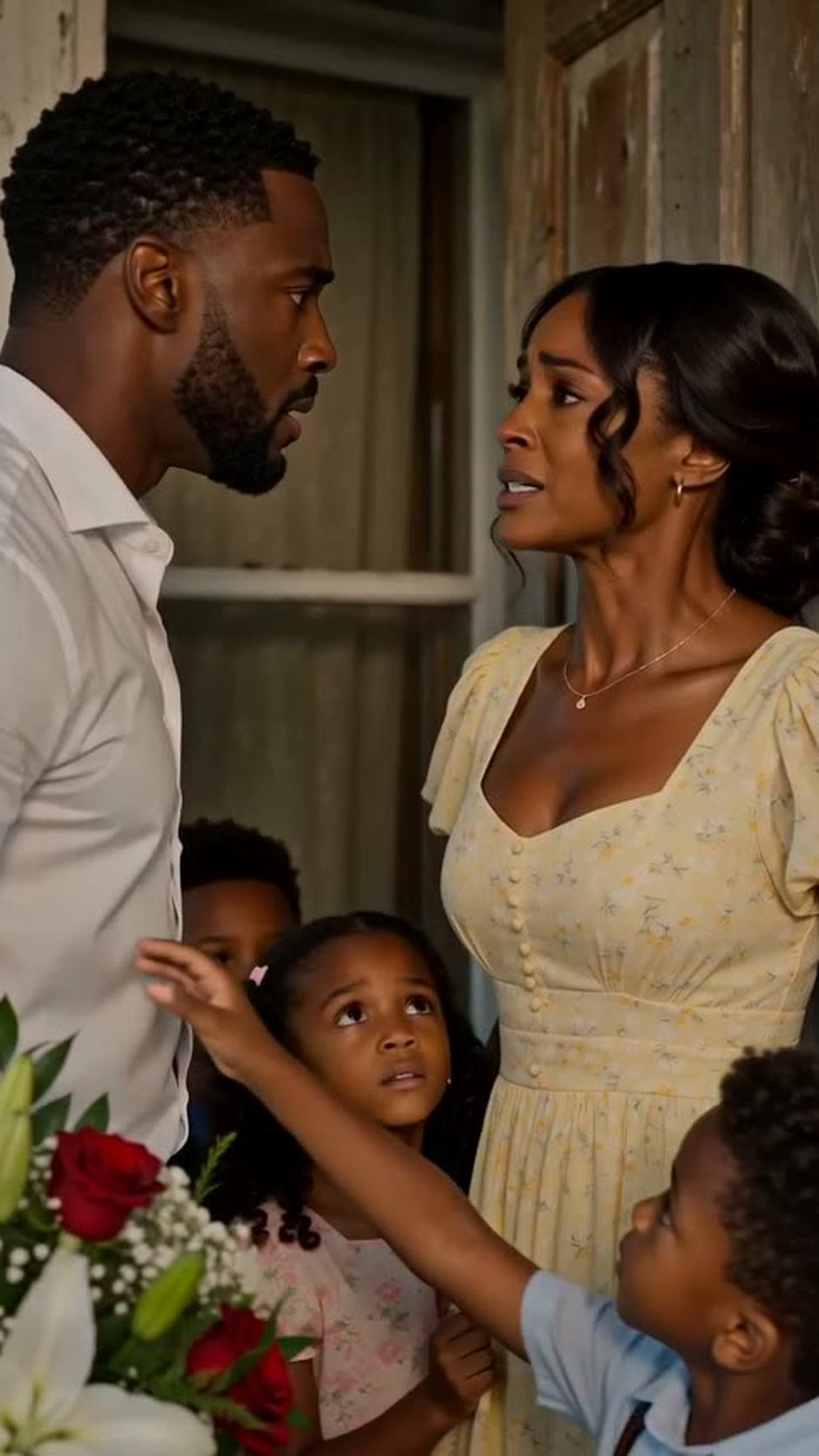
Daniel read it standing in his foyer with his coat still on. He read it four times. He called his office and heard his own voice, from very far away, cancel a week. He told no one where he was going — not the board, not Garrett, especially not Garrett, though he could not have said why the name rose in his mind like a warning bell. He bought the flowers himself, at dawn, from a florist who asked if they were for a wedding, and Daniel, holding red roses and white lilies against his chest like something he was carrying out of a fire, said, "No. They're an apology," and the woman, wisely, asked nothing more.
He drove eleven hours. He practiced speeches in three states and abandoned all of them in the fourth. By the time the car turned up the dirt road — past the red barn, past the leaning fence, past the mailbox with its red flag standing down and quiet — he had reduced nine years of regret to the only honest sentence he owned, and it was not a sentence at all. It was a question he had no right to ask and could not survive not asking.
He parked beside an old pickup. He climbed the porch steps with the bouquet in both arms, the anonymous letter folded against it in his fist, his heart going like a fist on a door.
He raised his hand to knock.
The door swung open before his knuckles touched the wood.