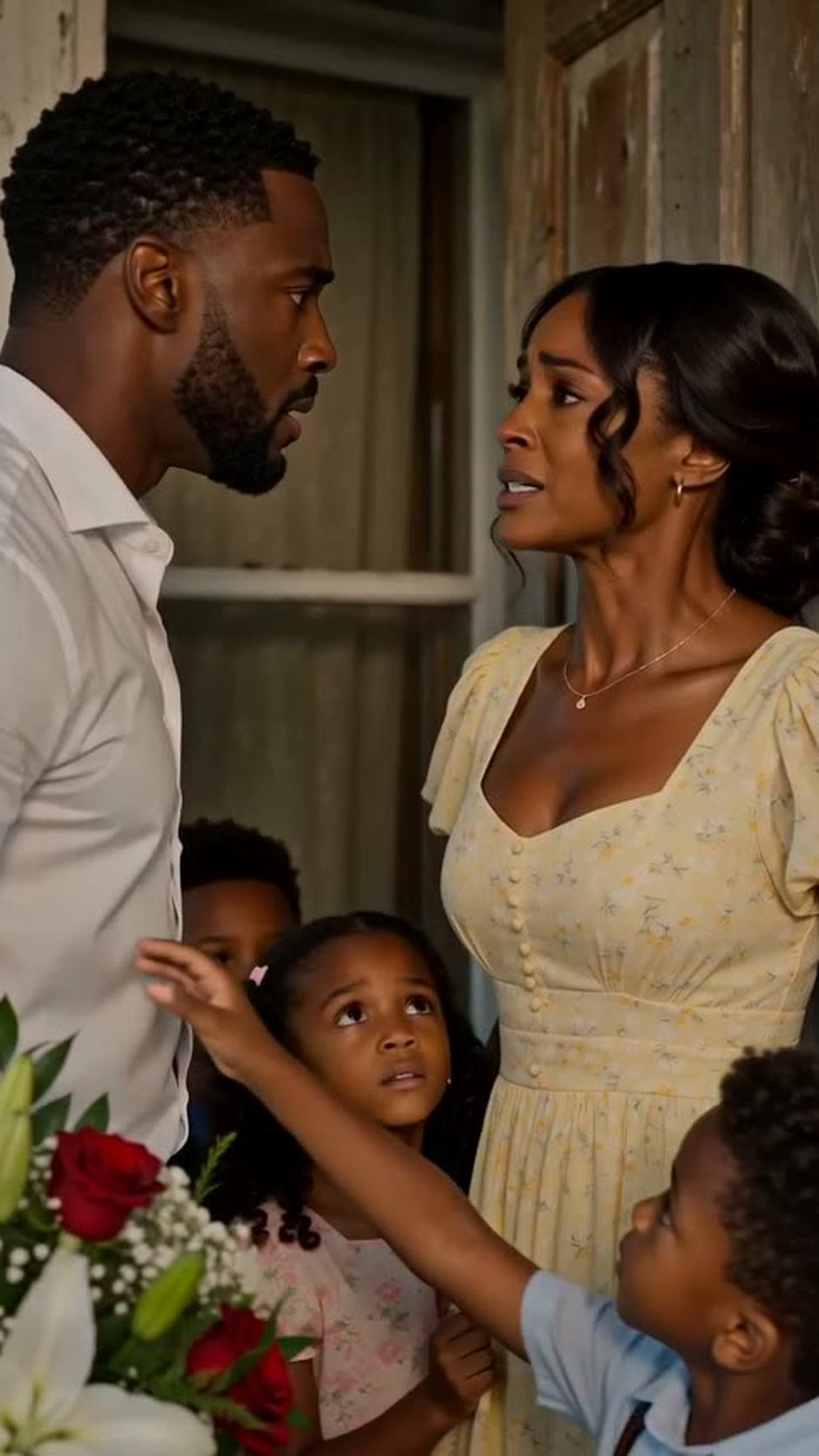
He stayed for supper. He stayed, in the end, for everything — but he stayed the way you cross a river on stones: one at a time, testing each one, in the order Emily set.
He took the room over the hardware store in town, the one with the loud radiator, and Daniel Whitmore, who owned a penthouse and a house in Connecticut and a chalet he had visited twice, learned the sound of a small town waking up. He came at ten, as ordered. He came at ten the next day, and the next. He did not bring gifts. He brought, instead, the only currency the farmhouse honored: he showed up, and he worked. He fixed the porch rail that had been loose since Hannah's day. He split firewood badly and then less badly under Eli's merciless supervision. He sat through June's interrogations — she had a list; she had literally written a list, in purple ink, in a notebook labeled *QUESTIONS*, and he answered every one of them standing, sitting, kneeling in the dirt of the garden, without once saying *because I said so* or *you're too young*, because she was his daughter and she had inherited his eyes and her mother's honesty and she deserved the arithmetic done in front of her.
"Why did you believe them and not Mama?" was question one. It was also, Emily told him later, the only one that mattered.
"Because believing them was easier," Daniel said. "Your mama asked me to be brave, and I wasn't. I think about it every day. I'm not asking you to forgive it. I'm asking you to watch me be brave now, until it adds up."
June considered this with her whole face. "Okay," she said, and turned the page of the notebook. "Question two. Can you swim?"
It added up the way the years in Kentucky did everything: by accrual. By September, Eli — who had claimed him first and fastest, the way the youngest hearts do — was riding on his shoulders at the county fair and calling him Dan, because five-year-olds cannot be bothered with anybody's whole history. By October, June had moved her interrogation notebook to the kitchen table and was asking him questions about *his* childhood, which was the same as forgiving him, in her dialect. And Emily — Emily watched him the way she had watched the weather all her life on that farm, for signs, for seasons turning, and what she saw, month over month, was a man becoming the one she had married in a ballroom's aftermath: the one who held the chair. The one who told the truth with his whole schedule. The one who, when June fell off the porch step in November and scraped her knee and howled, was on his knees in the dirt before Emily could move — not because he was faster, but because some part of him had been kneeling toward that child for nine years.
He sold the Connecticut house. He restructured Whitmore Capital so that it could be run by people who did not have a family in Kentucky, and if the financial press thought Daniel Whitmore had gone mad, Daniel Whitmore — who read the coverage at Emily's kitchen table, with a mug that said *WORLD'S OKAYEST BOSS*, a gift from Eli, in his hand — found he could not locate a single feeling about it.
It was not a straight line. In October there was a school concert, and June — who had extracted from Daniel a promise, notarized in purple ink, that he would sit where she could see him — came out with her class to sing, and found his seat empty, and sang the whole concert at the empty seat with her jaw set. He had been on the highway for three hours by then. A Whitmore Capital emergency, an actual one, fraud in a subsidiary, the kind with prosecutors in it, had eaten his afternoon whole, and by the time he got free and drove the eleven hours he arrived at midnight to a dark farmhouse and a notebook page taped to the porch door. *Question 43,* it said. *Where were you.*
He did not knock. He sat on the porch steps until the sky went gray, in the cold, in his suit, and when the door opened at six he was still there, frost on his shoulders, holding the notebook page in both hands.
"I was wrong," he said to his daughter, who stood in the doorway in her nightgown with her arms crossed like a small judge. "Not about the reason. About the order. I put the company first for four hours because it was shouting loudest, and you can't hear a concert from a boardroom, and nobody can. I'm not asking you to cross it out. I'm asking you to write underneath it that I sat on the porch all night, and that it won't happen again because nothing is ever going to be first again. If the whole company burns down, June. I'll watch it from your concerts."
June studied him for a long time, the way her mother studied weather. "Your ears are red," she said at last. "Come in before you freeze and Mama has to add it to *her* list." And that — being forgiven by his daughter in the doorway at dawn, badly, partially, in the currency of children — undid him more completely than the porch had, because it taught him the thing the whole year was teaching him: that love, this kind, the real kind, was not a verdict you won once. It was a practice. You did it at ten o'clock, daily, forever, and some days you failed, and the next day you sat on the porch in the frost until the door opened.
Thanksgiving, they did at the farmhouse, because Eli had lobbied for it and Eli, at five, had the political instincts of a senator. Daniel carved under Emily's instruction and her grandmother's ghost's supervision. June said grace, which she had written herself, and which included — Emily's eyes filled and she had to look at the ceiling — a line for "the ones who got lost coming home, and got found."
On the first Sunday of December, Emily found the two letters in the kitchen drawer where she had put them — the anonymous one, and hers, returned to her at last — and she stood holding one in each hand for a long time.
"He wrote one line," she said, that evening, on the porch. The children were asleep. The bouquet from June — his first bouquet, eleven hours and a lifetime old — had long since dried on the piano, because Emily had not been able to throw it away, and they both knew she had kept it, and neither of them had said so until now. "Nine words. *If you still remember Emily, come here.* Your mother wrote a whole confession and signed it with nine words and no name."
"She was a coward about signatures," Daniel said.
"She sent you, though." Emily turned the anonymous letter over once. "At the end. Whatever else — she sent you. I keep arriving at that and I don't know what to do with it."
"You don't have to do anything with it," Daniel said. "That's allowed too."
In February, on a night of thunder that shook the farmhouse on its foundations, Eli appeared at Emily's bedroom door at two in the morning in the exact manner of his great-grandmother's ghost — silent, wide-eyed, resolute — and Emily, who knew the protocol of storms the way she knew everything about her children, was reaching for the phone before her son had finished climbing into her bed. Daniel answered on the first ring. He had been answering on the first ring since October.
"It's not an emergency," Emily said.
"You're calling at two in a storm," Daniel said. "Talk to me."
"Eli would like to know if the offer stands. The one about his room at the hardware store being too far if there's thunder. He would like it noted that this is a *general* question and not about tonight specifically."
There was a pause, and she could hear him smiling in the dark eleven minutes away, and then — because he had become, by then, fluent in the constitution of the farmhouse — he said, "Tell the general questioner that his father—" he stopped. Corrected himself, carefully, the way he did everything now. "Tell him Dan is coming with cocoa. Ten minutes."
He came in nine, soaked to the shoulder, with a thermos, and he sat on Eli's bedroom floor with his back against the wall and talked about thunder being sky-furniture being moved until the boy slept, and Emily stood in the doorway with her arms folded and watched the man she had married and un-married and was, inch by inch, re-learning, hold her son's whole fear in his hands like it was the only portfolio that had ever mattered. When she went to the door to lock up after midnight had become morning, she stopped, and went to the kitchen drawer, and took out the spare key to the farmhouse — the one Hannah had kept, on a ring with a tin star — and put it in his coat pocket without a word, in the dark, while he was buttoning it.
"For thunder," she said.
"For thunder," he agreed, and closed his hand over the pocket like a man carrying a heart transplant in a cooler.
The spring came early that year. In April, on a Saturday, Daniel Whitmore stood on the porch of a leaning farmhouse in Kentucky holding no flowers at all — because Emily had told him, laughing, in March, that a man who has to bring his own flowers to her door has misunderstood the entire arrangement — and he asked her to marry him for the second time, in front of an audience of two children and one extremely uninterested chicken, with his grandmother's ring, which he had carried out of the wreck of his old life for no reason he could name.
"Mama," said June, with her arms crossed, in the doorway, in her father's eyes. "He practiced that in the barn. Eli heard him. It took *eleven* tries."
"It took nine years," Daniel said. "Eleven tries is nothing." He looked up at Emily from one knee in the porch dust, where he had sat down once before in despair and where he knelt now in something else entirely. "I am not asking you to go back. There's no back; I burned the road. I'm asking you to go forward — all of us — and let me spend the rest of my life being the man who shows up at ten. Emily Carter. Will you—"
"Yes," she said, and then, because she was Emily, and because her face had never in her life been able to hold two weathers at once, she said it again with tears standing in her eyes and laughter breaking straight through them. "Yes. Get up off my porch, Daniel Whitmore, you're getting dust on—" He got up. The children hit them both at a run, the way children do, like weather, like grace, and the four of them stood tangled together in the doorway while the ring went on crooked and got straightened by three extra sets of hands.
They were married in June, in the yard, by the judge from the county seat, with flowers arranged by the bride — she refused, on principle, to let anyone else do them — and June walked her mother down a path of mowed grass carrying a bouquet of red roses and white lilies, because June had decreed it, in purple ink, as a matter of historical record. Eli carried the rings on a cushion and only dropped them once, in the grass, where they were found in eleven seconds, which the family agreed was a record of its own.
And on the following Sunday, and on every Sunday after, the door of the farmhouse stood open to the morning — open the way it had not stood in nine years, open on purpose, open as a policy of the house — with children's shoes by the porch rail and a man's watch on the kitchen counter and a woman's laughter coming from somewhere inside, and if you had stood on that porch in the sunlight you would have seen, framed and hung in the hallway where everyone who entered had to pass it, a single folded sheet of paper under glass.
Nine words.
*If you still remember Emily, come here.*
Underneath it, in Emily's plain hand, on a card she had lettered herself, were the four words she had decided were the end of the story, and the beginning:
*He came. He stayed.*
THE END