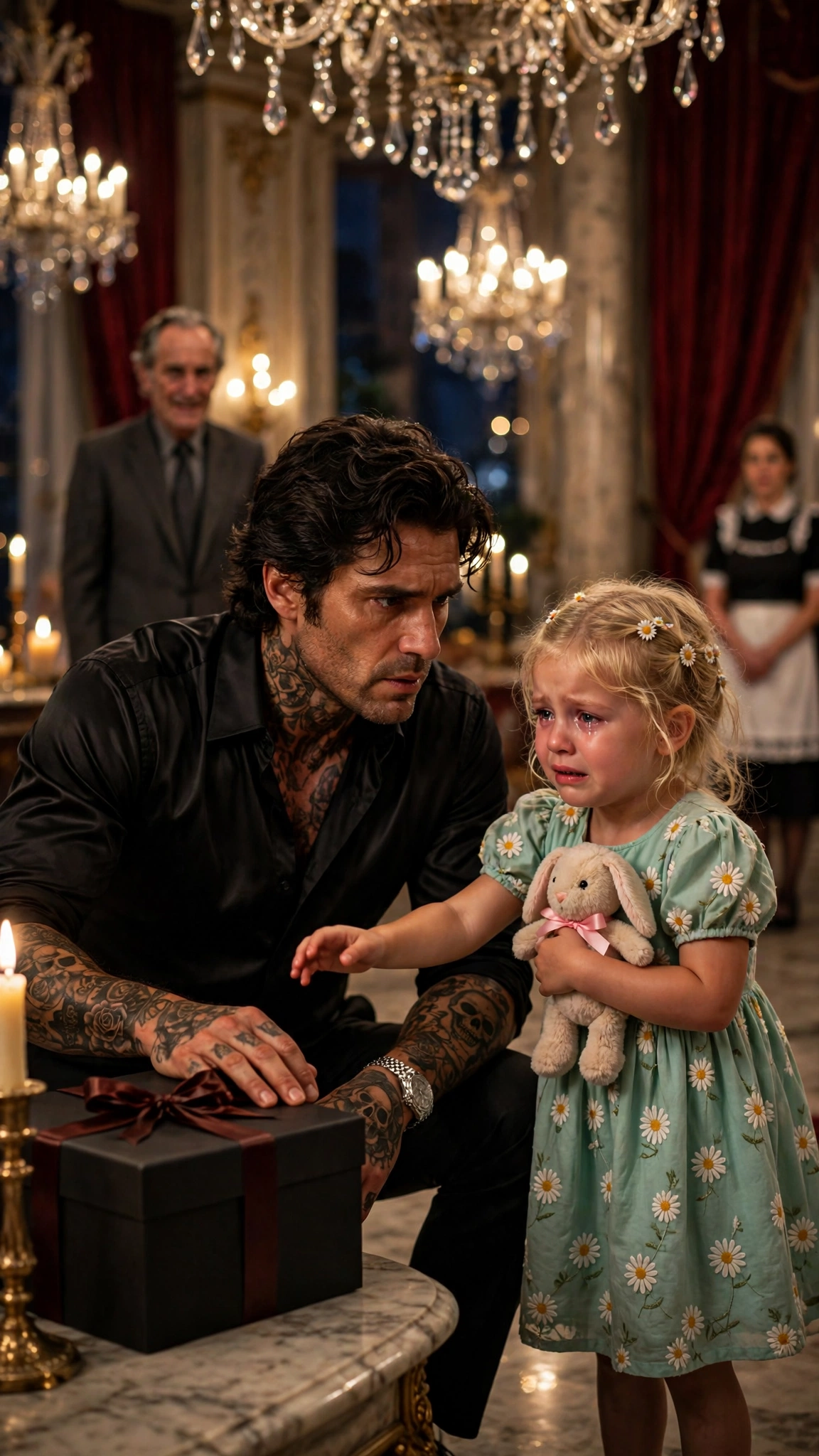
The night after the party was the longest night of Lorenzo Moretti's life.
He did not sleep. He sat in his study with the door locked, the small black recorder on the desk in front of him, the lamp turned low, and he went over everything Marcus had told him, piece by piece, the way a man goes over a map before a battle.
It was worse than he had thought. It was always worse than you thought.
Marco had been taken three weeks earlier, on a Friday night, from the back room of the De Luca casino on the waterfront. He had gone there with two friends, boys he had known since school, and they had played cards, and they had drunk too much, and Marco — who was nineteen and thought he was invincible, the way nineteen-year-old boys do — had taken money from the table. Not much. A few thousand dollars. But in the De Luca casino, it did not matter how much. It mattered that he had taken it. De Luca's men had taken him into the back room, and they had shown him what happened to thieves, and then they had called his father.
Marcus had gone to the garage alone, at midnight, three nights before the party. He had met Vincent De Luca in person. De Luca had shown him a photograph of Marco — alive, but frightened, sitting in a chair in a room with no windows — and he had given Marcus the little black recorder, and the instructions, and the choice.
"Deliver the box, and your son comes home," De Luca had said. "Refuse, and he doesn't. Warn Lorenzo, and he doesn't. It's very simple, Marcus. You're a simple man. You can understand simple things."
Marcus had understood. He had taken the recorder. He had put it in the box. He had hidden the box in the study, behind the books, where no one would find it until the morning. He had told the gate guard to expect a delivery. He had done everything De Luca had asked him to do, and he had hated himself for every second of it, and he had not slept in three weeks, and he had not told anyone, because De Luca had told him that if he told anyone — anyone at all — Marco would die.
And then Mia had seen him. A five-year-old girl, playing hide-and-seek behind a curtain, had seen the thing that no one else in the world had seen, and she had told Rosa, and Rosa had believed her, and Mia had stood up at her father's birthday table and saved his life.
Lorenzo sat in his study and thought about that, and he thought about what De Luca had really wanted.
De Luca had not wanted to kill Lorenzo with a bomb. A bomb was crude. A bomb was for amateurs. De Luca had wanted something much worse. He had wanted Lorenzo to kill his own best friend.
That was the trap. That was the real weapon. If Lorenzo had played the recording at the table, in front of a hundred guests, they would have heard De Luca's voice, and they would have known Marcus had betrayed him, and in that world — in Lorenzo's world — a betrayal like that could only end one way. His men would have expected him to kill Marcus on the spot, in front of his daughter, on his birthday. And if he had refused — if he had shown mercy, if he had hesitated — they would have thought him weak, and the family would have begun to crack, and De Luca would have been waiting, patient as ever, to push the crack wider.
And if Lorenzo had destroyed it — if Marcus had warned him, if the two of them had tried to handle it quietly — then Marco would have died, and De Luca would have known the trap had failed, and he would have come for Lorenzo another way. The recording had said so, in De Luca's own voice: destroy it, and the boy dies instead.
Either way, someone died. Either way, De Luca won.
Lorenzo had refused both choices. He had closed the box. He had retied the ribbon. He had sent his men home. And now he sat in his study at three in the morning, with a small black recorder on his desk and a war to plan, and he knew that the next move was his.
He called Marcus into the study at dawn.
Marcus came in looking like a man who had not slept in three weeks, which was exactly what he was. His suit was wrinkled. His hair was uncombed. His eyes were red. He sat down in the chair across from Lorenzo's desk, and he waited, the way a man waits for a sentence to be passed.
"Here's what I need to know," Lorenzo said. He did not raise his voice. He did not need to. "Where is Marco being held?"
"I don't know," Marcus said. "They never told me. They showed me a photograph. A room with no windows. A chair. That's all I know."
"How do they contact you?"
"By phone. A number that changes every time. They call. I answer. They tell me what to do."
"How would De Luca know?" Lorenzo asked. "If you had warned me — how would he have known?"
"He always knows," Marcus said. "He has men everywhere. He told me that if I warned you, if I told anyone, Marco would die before morning. I believed him. I still believe him."
Lorenzo nodded. He believed him. Marcus was telling the truth — Lorenzo could tell, the way he could always tell with this man, because he had known him for twenty-five years, and because a man who is lying does not look like that. A man who is lying does not sit in a chair at dawn with his hands shaking and his eyes red and say, "I don't know," when he could make something up.
"Marcus," Lorenzo said. "I want you to listen to me, and I want you to hear me. You betrayed me. You betrayed this family. You put my daughter in danger. In our world, there is only one punishment for that, and you know what it is."
Marcus closed his eyes. "I know."
"But," Lorenzo said, and his voice hardened, "I am not going to do it. Not tonight. Not ever. Not in front of my daughter, and not behind her back either."
Marcus's eyes opened. He stared at Lorenzo as if he had spoken in a language he did not understand.
"Why?" he whispered.
"Because you are my oldest friend," Lorenzo said. "Because you held my daughter at her christening. Because for twenty-five years you stood at my right hand and you never once asked for anything for yourself. And because the man who did this to you — Vincent De Luca — is the man who deserves to pay for it, not you. De Luca took your son. He used your son to turn you into a weapon. That is not your crime, Marcus. That is his."
Marcus was crying now, openly, without shame, the way a man cries when he has been holding it in for three weeks and someone finally says the thing he needed to hear. "Lorenzo," he said. "I don't deserve this."
"No," Lorenzo said. "You don't. You deserve to be punished. And you will be. But not like this. Not by me. Not tonight."
He leaned forward, across the desk, and his gray-brown eyes were sharp and cold and absolutely clear.
"Here is your punishment, Marcus. You are going to help me get your son back. You are going to do everything I tell you to do, exactly when I tell you to do it, without question. And when this is over — when Marco is home, and De Luca is finished — you are going to leave. You are going to leave New York, and you are going to leave this family, and you are going to start over somewhere far away, where no one knows your name. I will give you money. I will give you enough to live on. But you will never come back. That is your punishment. Exile. Not death. Exile."
Marcus stared at him. "You would do that? For me? After what I did?"
"I would do it for Mia," Lorenzo said. "Because my daughter loves you, Marcus. She calls you Uncle Marcus. And I will not have her grow up knowing that her father killed her godfather on her father's birthday. I will not do that to her. I will not do that to you. And I will not do that to the twenty-five years we had before De Luca got his hands on you."
There was a long silence. Outside, the rain had stopped, and the sun was coming up over the water, pale and gray, and the house on the hill was waking up — Rosa in the kitchen, Mia still asleep upstairs, the men arriving at the gate for the morning meeting.
"Now," Lorenzo said, and he stood up, and he was the boss again, tall and broad in his shirtsleeves, his watch catching the morning light. "Tell me everything De Luca said. Every word. Every detail. And then we are going to turn his trap around on him."
Marcus told him. He told him about the garage, and the photograph of Marco, and the phone calls, and the instructions, and the choice De Luca had given him. He told him about the fear, and the sleepless nights, and the way he had stood in the study with the recorder in his hand and said, "God forgive me," to an empty room.
And when he had finished, Lorenzo nodded, and he said, "Good. Now here's what we're going to do."
It was a simple plan. It was the kind of plan Lorenzo was good at — the kind that used the enemy's own weight against him. De Luca had built a trap that depended on Lorenzo doing what he was expected to do: playing the recording at the table, in front of his guests, and killing his best friend. Lorenzo was not going to do that. Instead, he was going to give De Luca exactly what De Luca wanted — the appearance of a betrayal, the appearance of a family tearing itself apart — and he was going to use that appearance to walk straight into De Luca's house and take Marco back.
"You are going to call De Luca," Lorenzo said. "You are going to tell him that the plan worked — that I played the recording at the table, that I heard his voice, that I threw you out of the house in front of my guests. You are going to tell him that I am furious, that the family is in chaos, that I am vulnerable. And you are going to ask him for a meeting. You are going to tell him that you want to make a deal — that you will give him the Moretti docks, if he gives you Marco back."
Marcus stared at him. "He won't believe it."
"He will believe it," Lorenzo said, "because it is what he wants to believe. Men like De Luca always believe the story they wanted to hear. And while he is busy believing it, we are going to find out where Marco is being held, and we are going to bring him home."
"And if it doesn't work?" Marcus asked. "If he sees through it?"
"Then we will deal with that when it happens," Lorenzo said. "But it will work. Because De Luca made one mistake. He thought the weapon was the box. He thought the trap was the recorder. He forgot the most important thing in this whole story."
"What did he forget?"
Lorenzo looked at him, and for the first time since the party, he smiled — not the easy, practiced smile, but the real one, the dangerous one, the smile of a man who has just seen the whole board and knows exactly how the game ends.
"He forgot my daughter," Lorenzo said. "A five-year-old girl saw through his plan. A five-year-old girl, playing hide-and-seek behind a curtain, understood what his best men could not. If a child can see through him, Marcus — what chance does he have against me?"
Upstairs, Mia was waking up. She stretched in her bed, and she reached for Mr. Buttons, and she thought about the night before — about the box, and the ribbon, and her father's hand on her wrist — and she felt the small cold feeling in her chest begin, very slowly, to go away.
Downstairs, her father was going to war. And for the first time in three weeks, Marcus Bellini — the man who had betrayed his best friend to save his son — felt something he had not felt in a very long time.
He felt hope.