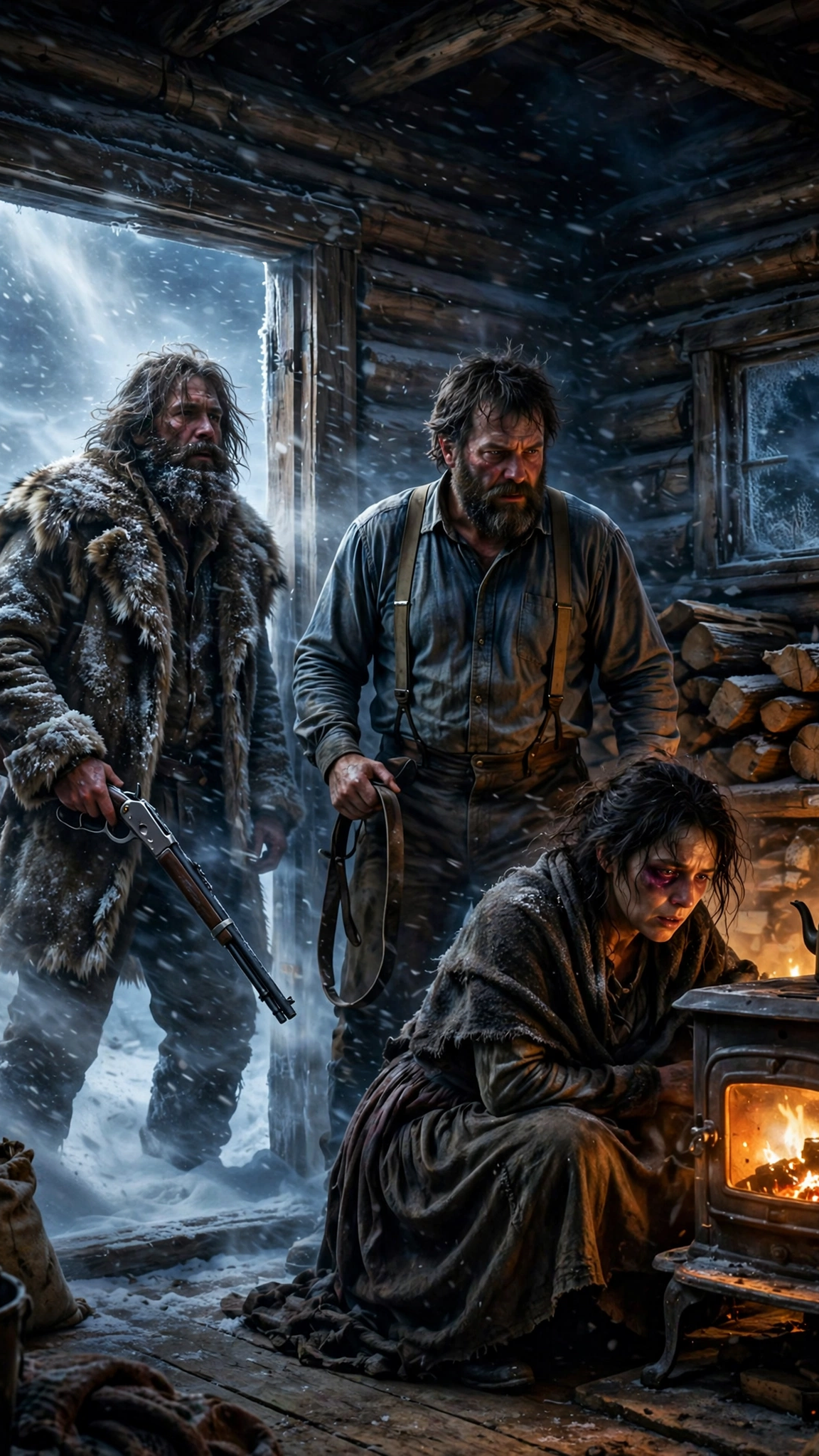
It happened on the second night, after the supper, after the bottle, after the storm had raged for two days and the cabin had grown so small that the three of them could barely move without touching each other.
Hazel was washing the supper plates at the bucket. Harlon was by the stove, feeding the fire. Baron was at the table with the bottle, and the bottle was nearly empty, and his eyes were on Hazel, and his eyes were on Harlon, and his face was red, and his hands were shaking, and Hazel knew, the way she had always known, what was coming.
"You think you're something now," Baron said. His voice was thick with drink. "You think because he's here, you're something."
Hazel did not answer. She kept washing the plates. Her hands were steady. She was proud of her hands being steady. She had not known they could be steady.
"You think I don't see it," Baron said. "The way you look at him. The way you talk to him. Whoring yourself to a stranger in my own house."
Harlon looked up from the stove. His face did not change. But something behind his eyes went still and cold, the way a lake goes still before it freezes.
"Baron," he said, quietly. "That's enough."
Baron stood up. The chair scraped back across the plank floor. He was swaying, but he was big, and he was drunk, and he was furious, and he came around the table toward Hazel, and his hand went to his belt, and the leather scraped through the brass buckle as he pulled it free.
Hazel did not move. She stood at the bucket with her hands in the wash water, and she looked at Baron, and she looked at the belt in his hand, and she felt the old fear rise up in her belly like a cold stone, and then she felt something else rise up behind it, something she had not felt in three years.
She felt angry.
Not afraid. Angry. Angry at the belt, and at the bottle, and at the three years, and at the swollen eye, and at the bruises, and at the silence, and at the cabin, and at the storm, and at all of it, and the anger was hot and clean, and it burned the fear away, and she stood at the bucket with her hands in the water, and she did not crouch, and she did not cover her head, and she did not move.
"Put it down, Baron," Harlon said. He was standing now. The Winchester was in his hands. It was not aimed at anyone. It was held low, across his body, the way a man holds a tool he does not want to use.
Baron did not put it down. He came toward Hazel, the belt in his hand, and his face was white now, and his mouth was working, and he said, "She's my wife. She's my wife, and I'll do what I like with her in my own house."
He raised the belt.
Harlon moved. He did not hurry. He did not shout. He crossed the cabin in three long strides, and he was between Baron and Hazel before the belt could come down, and he caught Baron's wrist in one big hand, and he held it, and he looked at Baron, and he said, very quietly, "No."
It was one word. It was enough. It had been enough the night before. But tonight was different, because tonight Baron was drunker, and angrier, and more humiliated, and the stranger had been in his house for two days, and his wife had talked to the stranger, and the whole world had turned upside down, and Baron was not going to be told "no" in his own house by a man who had walked in out of a storm.
Baron tore his wrist free. He spun away from Harlon, and he went to the woodpile by the door, and he took up the firewood axe — the heavy splitting axe with the long handle and the keen edge — and he turned, and he raised it over his head, and he came at Harlon with a roar that shook the cabin.
Hazel screamed. She had not screamed in three years. She had learned not to scream. But she screamed now, because the axe was coming down, and Harlon was standing there, and the axe was going to kill him, and she could not watch it happen, and the scream tore out of her before she could stop it.
Harlon did not move. He stood with the Winchester in his hands, and he watched the axe come down, and at the last moment, he stepped aside.
The axe missed him by inches. It came down on the doorframe, and it buried itself in the wood with a sound like a gunshot, and the whole cabin shook, and Baron was pulled forward by the weight of his own swing, off balance, stumbling, and Harlon turned, and he brought the butt of the Winchester around in a short, hard arc, and it caught Baron on the side of the head, and Baron went down.
He did not get up. He lay on the plank floor with his arms spread out and his face turned toward the ceiling, and his eyes were open, and he was breathing, and Hazel saw his chest rise and fall, and she understood that he was alive, and that Harlon had not killed him, and that Harlon had never meant to kill him.
Harlon set the Winchester down. He went to the corner where the rope hung — the rope they used for hauling wood, thick and strong — and he took it down, and he rolled Baron onto his side, and he tied his hands behind his back, and he tied his feet together, and he did it all with the calm, practiced movements of a man who had tied up animals before, and who knew how to do it so that the knots held and the blood still flowed.
Then he sat Baron up against the wall, and he looked at him, and he said, "You stay there until morning. You stay there, and you think about what you just did. And if you move, I'll know."
Baron stared at him. His head was bleeding a little where the rifle butt had caught him, a thin line of red running down the side of his face. His eyes were wild. His mouth was working. He said, "You can't do this. This is my house. She's my wife."
Harlon did not answer. He went back to the stove, and he sat down, and he held his hands out to the fire, and Hazel stood at the bucket with her hands in the wash water, and she looked at Baron tied up against the wall, and she looked at Harlon by the stove, and she looked at the axe buried in the doorframe, and she felt something she had never felt before.
She felt free.
Not safe. Not yet. But free. Free in the way a bird is free when the cage door has been left open, even if the bird has not yet flown out. Free in the way a person is free when the thing that has owned them for three years is sitting tied up against a wall, bleeding a little, and staring at the floor, and unable to do anything at all.
She went to Baron. She stood over him, and she looked down at him, and he looked up at her, and his eyes were afraid, and she said, in a voice she barely recognized as her own, "You raised your hand to me for the last time, Baron. Do you understand me? The last time."
Baron did not answer. He looked at the floor. His hands were tied. His feet were tied. The blood ran down the side of his face. And Hazel stood over him, and she felt the anger in her belly, hot and clean, and she felt the fear gone, and she felt the three years gone, and she said, "I am leaving this cabin, Baron. When the storm breaks, I am leaving. I don't know where I'm going. I don't know what I'll do. But I am not staying here, and I am not your wife anymore, not in any way that matters."
Baron stared at her. His mouth worked. He said, "You can't leave. You have nowhere to go. The fort is forty miles. The snow is four feet deep. You'll die out there."
"Maybe," Hazel said. "But I'll die free."
She turned away from him. She went to the stove, and she sat down across from Harlon, and Harlon looked at her, and he did not say anything, and he did not need to say anything, because his face said it for him: that he had heard her, and that he understood, and that he would not let her die out there in the snow.
"The storm will break by morning," Harlon said, after a while. "The sky's been changing all evening. I can feel it in my bones. When it breaks, we'll have a day, maybe two, before the next one comes. That's enough time to get to the Odegards, if we leave at first light. Six miles. Slow going, but doable. From there, the road to the fort is packed down. A week, if the weather holds."
Hazel looked at him. "We?" she said.
Harlon nodded. "I'm going that way anyhow. My lines are north of here, and the season's done. I was headed for the fort to sell my pelts and lay in supplies for the spring. You're welcome to come with me, if you want. No obligation. No price. Just a ride to the fort, and a chance to start over."
Hazel did not answer right away. She looked at the fire. She looked at Baron, tied against the wall. She looked at the axe buried in the doorframe. She thought about her mother's trunk, and the knife inside it, and the salve under the floorboard, and the six miles to the Odegards, and the forty miles to the fort, and the girl she had been, and the woman she had become, and the one question that had kept her alive through all of it.
She looked at Harlon, and she said, "Yes. I'll come with you."
Harlon nodded. He poked the fire with a stick, and the coals shifted, and the flames rose, and the cabin grew a little warmer.
Outside, the blizzard raged on, white and blind and merciless. Inside, the iron stove glowed orange, and the axe stood buried in the doorframe, and Baron sat tied up against the wall, and Hazel stood by the stove with her hands wrapped around a tin cup, and the cabin was quiet, and the night came on, hour by hour, and the rifle leaned against the stool, and the storm did not break.
But something else had broken. Something that had held Hazel down for three years had broken, and she could feel it, the way a person feels a bone set right after it has been broken for a long time — painful, and strange, and right.
Hazel did not go to sleep right away. She lay awake in her blanket by the stove for a long time, listening to the storm and to the fire and to Harlon's slow breathing, and she thought about the day that had just passed, and about the axe in the doorframe, and about the ropes around Baron's wrists, and about the words she had said to him, and she wondered if she had really said them, and if she would still mean them in the morning, and she knew that she would, and that knowing was the strangest and the best thing she had felt in three years, and she lay there with her eyes open in the firelight, and the night went on, and the storm went on, and the fire burned, and the rifle leaned against the stool, and she thought about the road to the fort, and about the Odegards, and about the mountains, and about the man by the stove who had kept watch all night, and she thought about how far she had come, from a crouched girl beside a chair to a woman who had stood up to her husband and told him she was leaving, and she felt the anger in her belly, hot and clean, and she felt the fear gone, and she felt something else, something she had not felt in a very long time, and it was hope, and it was hers, and nobody could take it from her, and she held on to it, and she lay awake, and she waited for the morning, and she was not afraid, and the night passed, hour by hour, and the storm raged on, and the fire burned, and the woodbox was full, and the world was quiet, and the world was still, and she was still awake, and she was still alive, and she was still free, and she was still herself, and that was enough, and that was everything, and she closed her eyes at last, and she slept, and she dreamed of the road, and of the mountains, and of a cabin of her own, and of a life of her own, and of a future that was hers to choose, and she slept, and the fire burned, and the storm raged on, and the night passed, hour by hour, and the morning came, and the storm was breaking, and the sky was turning pale, and the world was coming back.
She slept that night. She slept by the stove, wrapped in the blanket, with the fire burning and the rifle within reach and Baron tied up against the wall, and she slept without listening for footsteps, and she slept without dreaming, and when she woke in the morning, the storm was breaking, and the sky was turning pale, and the world was coming back, and she knew, without knowing how she knew, that everything was about to change.