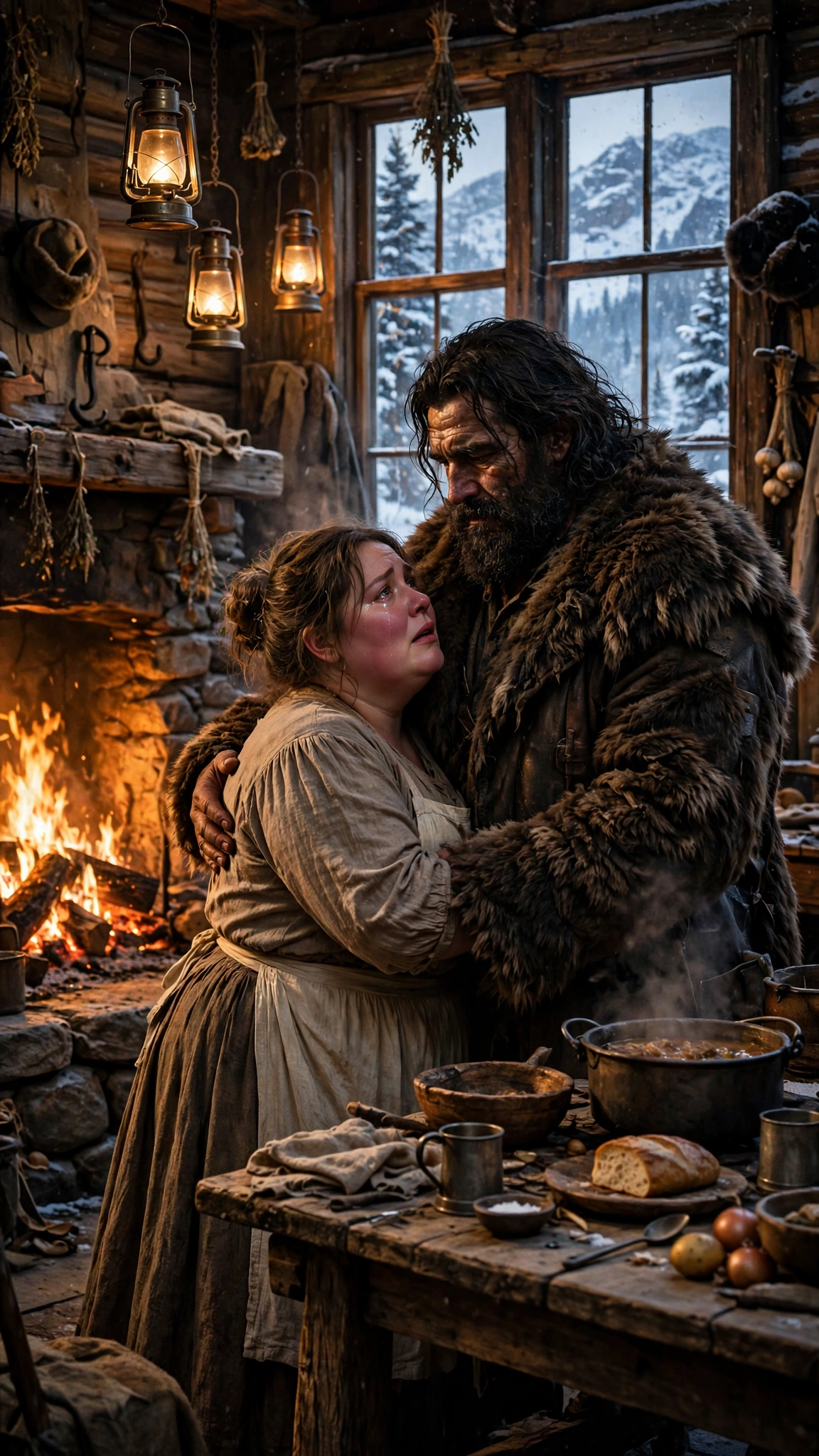
Jedodiah Boon had not planned to come down from the mountain that day.
His cabin stood high on Cutthroat Creek, a single room of logs and stone with a roof of split shakes and a door that faced south, away from the wind, and he had lived there alone for seven winters. He trapped beaver and marten and fox, and he cut his own wood, and he spoke to no one for weeks at a time, and that was the way he wanted it. The mountain did not ask him questions. The mountain did not look at him with pity, the way people in town did when they learned his story. The mountain only gave him work, and cold, and silence, and those were things he could bear.
But on the morning of the blizzard, he stood at his door and looked at the sky, and the sky was the color of a bruise, and the wind had a sound he had learned to respect — a low, rising moan that meant the storm would kill anything caught out in it. His firewood was stacked high. His cabin was tight. He could have stayed. He had stayed through worse.
Instead, he saddled his mule, tied his bedroll and his rifle behind the saddle, and rode down the mountain toward the Thatcher Boarding House, and he did not entirely know why.
He knew why, of course. He had known since the first night he had ever slept under that roof, three winters before, when a storm like this one had driven him down and Abigail Thatcher had taken his money with a stiff nod and pointed him to a room. He knew because of the way the house smelled — of bread and woodsmoke and stew — and because of something he had not felt in a long time, which was the feeling of being expected. The cowboys nodded at him. The fire was warm. Nobody asked him about his wife.
His wife. Sarah.
She had died in the winter of 1871, in a cabin not unlike his own, giving birth to a child who had never drawn breath. Jedodiah had been away, checking his trap line sixty miles from home, and by the time he got back the snow had covered everything, and the neighbor woman who had sat with Sarah had already dug the graves — two of them, side by side, small and smaller — in the frozen ground behind the cabin. He had stood over those graves until dark, and he had not wept, and he had never wept since, and he had never forgiven himself for being sixty miles away when his wife needed him.
The winter after Sarah died, he shot the grizzly. It had been killing his traps and taking his bait, and one morning it came for his dog, and Jedodiah went after it with a rifle and a knife, and the bear nearly killed him — it took a piece out of his shoulder that still ached when the weather turned — but in the end he stood over it in the snow, and he skinned it, and he made the coat. He wore it the way other men wore armor. It was warm, and it was heavy, and it was his. He had never taken it off in another person's house. He had never lent it to anyone.
And then there was Thomas Hart.
Jedodiah had met Thomas in the winter of 1872, on the Arkansas River, when the ice gave way under Jedodiah's feet and the black water closed over his head. He remembered the cold like a fist. He remembered going under twice, and the third time he did not think he would come up at all. And then a hand — a strong, ordinary hand, the hand of a man who trapped and hauled and worked for his living — had closed around his wrist, and Thomas Hart, a lean young fellow with a scar on his chin and a laugh like a creek in spring, had dragged him out onto the ice and sat on his chest and pounded the water out of him and then built a fire and given him his own coat to wear while his clothes dried.
"You owe me nothing," Thomas had said, when Jedodiah tried to thank him. "A man on the river is a man on the river. But if you ever meet my Matilda, you tell her you knew me. Tell her I talked about her stew every night on the trap line. Tell her I said it could bring a dead man back to the table."
Jedodiah had never met Matilda. He had not even known, until that night at the boarding house, that Thomas Hart was dead, or that his widow was the woman in the kitchen with the trembling hands and the cream apron. But when the spoon went into his mouth, and the broth — venison and onion and potato, with that dark sweet depth underneath it, like nothing he had tasted in seven years — spread across his tongue, he knew. He knew before his mind had time to put the words together. His hand came down on the table before he could stop it, and the spoon cracked against the wood, and the whole room froze, and the only question in the world was the one that came out of his mouth.
"Who cooked this?"
Afterward, when the fire had burned low and the cowboys had gone to their rooms and Abigail had swept out of the dining room without a word, Jedodiah sat in the chair by the fireplace and looked at the woman in the grizzly coat, and he told her the story of the river.
Matilda listened with her hands folded in her lap, and her eyes filled, and when he finished, she said, very quietly, "He talked about you, too. He said there was a trapper on the Arkansas who was the biggest man he had ever seen, and the quietest, and that you had a coat made from a bear, and that if I ever met you I should feed you first and ask questions later."
"He was a good man," Jedodiah said.
"He was," Matilda said. "He died of the fever, on the trail, in a wagon with a broken wheel. I buried him under a pine tree beside a creek. I do not know the name of the creek."
Jedodiah nodded, and he looked into the fire for a long time, and then he said, "I owe him my life. A debt like that does not go away because the man is dead."
Matilda shook her head. "You owe me nothing, Mr. Boon. Thomas would not want —"
"I will pay Mrs. Thatcher for a room," Jedodiah said, as though she had not spoken. "For the winter. I will stay until the thaw. And while I am here, no one will throw you out of this house."
It was the longest speech Matilda had ever heard him make, and she did not know what to say to it, and so she said nothing, and the fire crackled, and outside the blizzard howled against the walls, and for the first time since Thomas had died, she felt something she had almost forgotten how to feel.
She felt safe.
The next morning, before dawn, Jedodiah saddled his mule and rode out to check his trap line, the way he did every morning when he was on the mountain, and the cold air cut at his face, and the snow squeaked under the mule's hooves, and his mind went back — as it always did on cold mornings — to the river.
He remembered the ice giving way with a sound like a rifle shot. He remembered the black water closing over his head, so cold it felt like fire, and the current pulling at his coat, and his hands clawing at the edge of the ice and finding nothing to hold. He remembered going under twice, and the third time, when his lungs were bursting and the light above the ice was going grey, a hand had closed around his wrist — a strong, ordinary hand — and Thomas Hart had hauled him out onto the ice and rolled him onto his back and pounded the water out of him with both fists, and then built a fire on the bank with hands that shook almost as much as Jedodiah's, and given him his own coat to wear while his clothes dried by the flames.
"You owe me nothing," Thomas had said, grinning through chattering teeth. "A man on the river is a man on the river."
But Jedodiah had never believed that. A life is a life. A debt like that does not wash away with the spring thaw. He had carried it for six years, through seven winters on the mountain, and he had begun to think he would carry it to his grave, because Thomas Hart was dead — or so he had believed — and there was no one left to pay.
Now there was. A widow in a kitchen, with trembling hands and a recipe book, who cooked the stew Thomas had described a hundred times on the trap line. And Jedodiah Boon, riding through the cold dawn with the sun just touching the peaks, made up his mind about two things: he would stay at the boarding house until the thaw, no matter what Abigail Thatcher said, and he would find out why the woman who owned the house wanted her cook gone.
A house does not turn on its cook for nothing. He had lived long enough to know that. There was something underneath it — something about money, or fear, or both — and he meant to dig it up, the way you dig a trap out of the snow: carefully, and all the way to the bottom.
—
Abigail Thatcher did not sleep that night.
She sat in her small parlor with her ledger book open on her lap, and the lamp burning low, and she added the same column of figures three times, and three times they came out the same, and three times they told her what she already knew: the house was failing. The boarders paid late or not at all. The roof needed new shakes. The mortgage on the house — the mortgage her late husband Edmund had taken out in 1875, when the silver mines were booming and everyone believed the boom would never end — was held by Cornelius Vane of Leadville, and Vane had sent his clerk, Mr. Pritchard, up the mountain three weeks ago with a message, and the message had been very simple.
Clear the house by spring, and I will forgive the debt and pay you two hundred dollars besides, and you may go and live with your sister in Denver. Refuse, and I will call in the note in full, and the house will be sold at auction, and you will have nothing.
Two hundred dollars. A clean end. A sister in Denver with a spare room.
It was a good offer. It was the only offer. And Abigail, who had buried her husband and carried this house alone for three years, who had scrubbed floors and cooked for cowboys and kept the ledger down to the last penny, had told herself that she would take it — that she would clear the house, room by room, boarder by boarder, until it was empty and ready for Vane's men.
She had started with the easy ones. Old Ephraim Doyle's cousin had left in October. A drifter named Cole had moved on to the mines. That left Silas, and Tom, and Wade, and the cook.
The cook. Matilda Hart. A fat widow in a stained apron, who had come walking up the mountain road with a carpetbag and a recipe book, and who had, in three short months, made herself the heart of the house. The cowboys loved her stew. They loved her bread. They carried her firewood and mended her stove and lingered at the table after supper, telling stories, and the house — Abigail's house — had begun to feel like Matilda's house, and Abigail, who had never had a rival in her life, found that she could not bear it.
It was not only the offer. It was not only the money. It was the way Silas McCready smiled when Matilda set down his plate. It was the way Tom Ellery looked at her, like a boy looking at his mother. It was the way the trapper — a man who had never spoken ten words together in this house — had risen up like a mountain and said, "She stays," and the whole room had obeyed him, as though Abigail Thatcher were not the owner of the house at all.
She closed the ledger and set it aside, and she sat in the dark parlor, and she thought about Edmund — her husband, dead three years, a kind man and a careless one, who had borrowed against the house to buy into a silver claim that had never paid a cent — and about the silver pocket watch he had left behind, the one she kept in her sewing basket, the one she wound every Sunday out of habit, though it had stopped keeping time the day he died.
And she thought about the cook, asleep in the small room at the back of the kitchen, wrapped in a grizzly-fur coat that was worth more than everything in the house, and she made a decision.
The trapper would leave when the storm passed. Trappers always left. And when he was gone, the cook would go too. One way or another, Matilda Hart would be out of this house before spring.
She would see to it herself.
In the kitchen, in the small back room, Matilda slept in the trapper's coat, and she dreamed of Thomas — not of the fever, not of the wagon, but of an evening long ago, in St. Louis, in her mother's kitchen, when she was a girl and the stew was on the stove and the whole world smelled of bread and chokecherries, and her mother had said, "A good stew can hold a family together, Matty. Remember that. A good stew can hold a family together."
She slept, and the blizzard beat against the walls, and the house stood firm, and the fire burned low and steady in the hearth.
=== STEP 3 — APPEND Chapter 3 ===