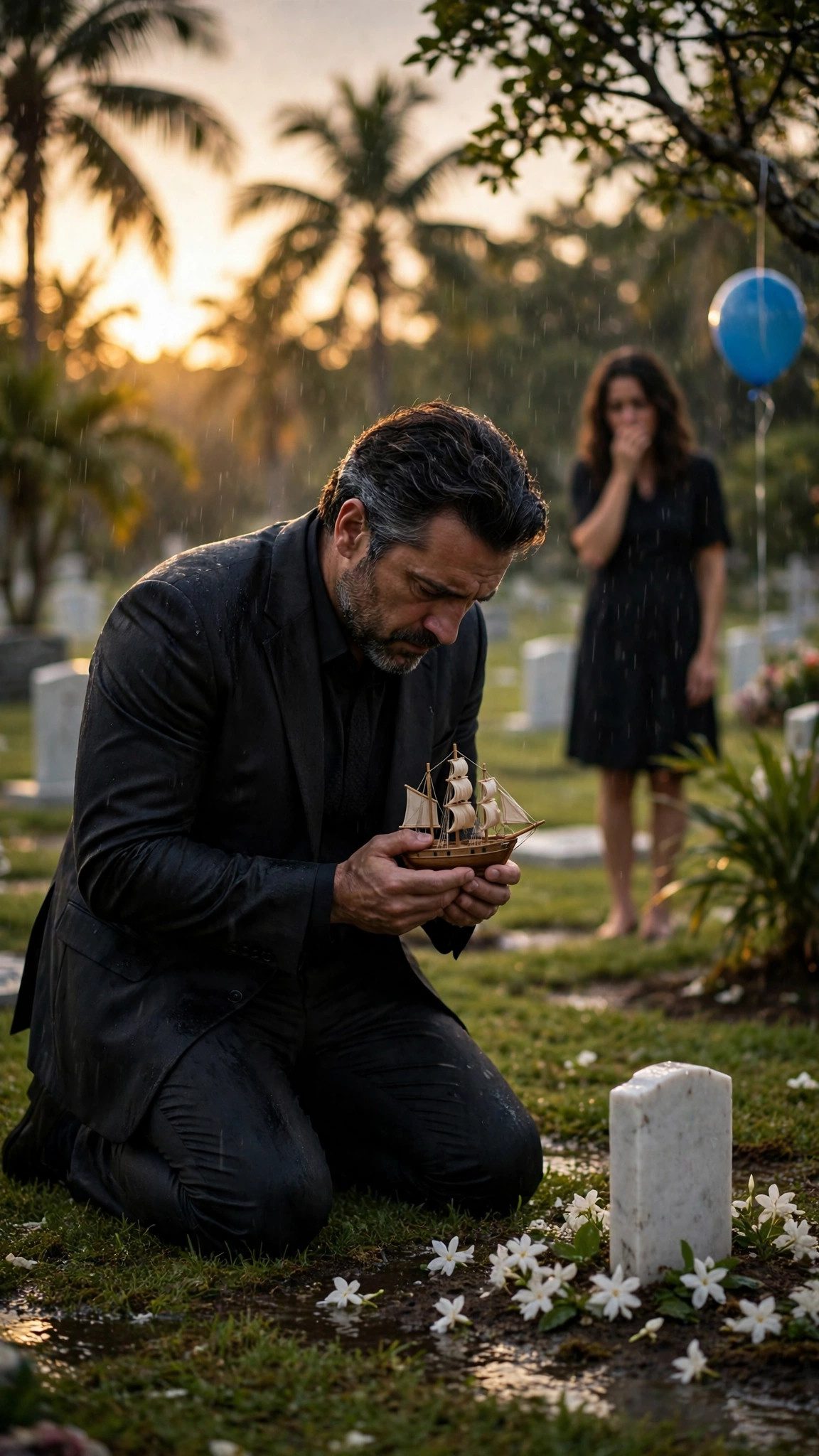
One year after Noah's death, Damian opened that final video again.
He was sitting in his study, in the house that had been so quiet for so long, and the birthday balloons were long gone, and the cake was long gone, and the only thing that remained of that night was the hard drive on his desk, and the letter in his jacket pocket, and the number forty-three, folded into a small square of paper that he carried everywhere, like a prayer.
He opened the file. 1907_FIRST_STEPS_11-43PM.
Noah stood beside the couch. A car passed outside.
"Daddy!"
One step. Two steps. Three steps.
Damian paused it before our son fell. Noah's little arms were outstretched. His eyes were fixed on the door. Waiting for Daddy.
And Damian Moretti finally understood that his son had spent his entire life waiting for him to come home.
Even on the last day of his life, Noah was still waiting.
He sat there for a long time, looking at that frozen image of his son, and then he did something he had not done in a year. He picked up his phone, and he opened his messages, and he typed a message to me, the way he did every month, through Elena.
But this time, the message was different.
"I opened the video again today," he wrote. "I paused it before he fell. He is still waiting, Claire. And I am still here. I will always be here. But I understand now, if you never come back. I understand that some things cannot be fixed. I just wanted you to know that I finally understand what I did, and that I will spend the rest of my life trying to be a man Noah would have been proud of."
He sent the message, and he put the phone down, and he went to the window, and he looked out at the garden, where the first flowers of spring were beginning to bloom.
He did not know that I was already on my way home.
I had read the message the moment Elena forwarded it to me, sitting in my small apartment in Fort Lauderdale, with Noah's toy ship on the windowsill and the box of Damian's messages on my nightstand. I read it three times, and then I did something I had not done in a year. I packed a bag.
Not much. A few dresses. The toy ship. Noah's hospital bracelet. The box of messages. I left the apartment key on the kitchen table, and I got into my car, and I drove south, toward Miami, toward the house with the empty chair, toward the man who had finally learned to wait.
I did not call Elena. I did not call Matteo. I did not call anyone. I just drove, and as I drove, I thought about the year that had passed, and about everything Damian had done, and about everything I had felt, and I realized something that surprised me.
I was not going back to forgive him. Forgiveness was too big, too sudden, for what had happened to us. I was going back because I had finally understood something about myself: I had spent a year teaching my son to wait for his father, and then I had spent a year waiting myself, waiting to feel ready, waiting to feel strong enough, waiting for a sign. And Damian had spent that same year waiting for me, without knowing if I would ever come.
We had both been waiting. And waiting, I had finally learned, was not the same as living.
I arrived at the house in the late afternoon. The gate was open. The garden was full of flowers. The house looked the same, and yet entirely different, the way a place looks when someone has finally started taking care of it again.
Damian was in the garden, kneeling beside a rose bush, his hands in the dirt, his suit jacket off, his sleeves rolled up. He looked up when he heard my footsteps on the path, and he froze.
For a long moment, neither of us spoke. We just looked at each other, across the garden, across a year of silence and grief and waiting, and I saw in his face everything I had been afraid to see: the lines around his eyes, deeper now. The gray in his hair, more of it. The sadness, still there, because sadness like ours does not go away. But underneath it, something else. Something steadier. Something quieter. Something that looked, finally, like a man who had come home.
"Claire," he whispered.
"Hello, Damian," I said.
He stood up slowly, wiping his hands on his trousers, and he took a step toward me, and then he stopped, because he did not know if he was allowed to come closer.
"You came back," he said.
"I came back," I said. "Not because everything is all right. It's not all right, Damian. It will never be all right. Noah is gone, and nothing will ever make that all right."
"I know," he said.
"But I came back," I said, "because I read your messages, all of them, and because Elena told me about the foundation, and about Castellano, and about Sofia, and because I finally understand something I didn't understand before."
"What?" he asked.
"I understand that you can't bring Noah back," I said. "And I can't bring him back. And no amount of waiting will change that. But I also understand that Noah spent his whole life waiting for you to come home, and that you are finally home, and that if I stay away forever, then he waited for nothing."
Damian's eyes filled with tears, and he took another step toward me, and this time I did not stop him. He reached out, slowly, carefully, like a man approaching something precious and fragile, and he took my hand in his, and his hand was warm, and it was shaking.
"I'm sorry," he said. "I know those words aren't enough. They will never be enough. But I'm sorry, Claire. For the videos. For the empty chair. For Saint-Tropez. For all of it. I'm sorry."
"I know," I said. "I know you are."
We stood there in the garden for a long time, holding hands, not speaking, and then he led me into the house, and the house was clean, and the air smelled of jasmine, because Rosa had been there that morning, and on the table in the living room, where the hard drive had sat for a year, there was a vase of fresh flowers.
"Rosa comes every day," Damian said. "She says the house needs to be ready. She says, 'One day, señora will come home.' She never stopped believing it."
I smiled, and then I cried, because Rosa had believed it when I had not, and because sometimes the people who love us believe in us before we believe in ourselves.
That night, we sat on the couch in the living room, on the same couch Noah had pulled himself up on, one year ago, and Damian told me everything. He told me about the forty-three videos. He told me about Sofia, and Castellano, and Sal Ferraro, and the FBI, and the foundation. He told me about the nights he had sat in his study, watching the videos, and the mornings he had woken up and reached for my side of the bed, and found it empty.
And I told him everything too. I told him about Fort Lauderdale, and the small apartment, and the toy ship on the windowsill, and the box of messages on my nightstand. I told him about the nights I had dreamed of Noah, and the mornings I had woken up and reached for his crib, and found it empty.
We talked until dawn, and when the sun came up, we were still on the couch, holding hands, and for the first time in a year, the house did not feel empty.
In the weeks that followed, we began again. Slowly. Carefully. The way you rebuild a house after a fire, one brick at a time, not because you have forgotten the fire, but because you have decided that what comes next matters too.
Damian took me to the hospital wing the foundation had built, and I walked through the playroom, full of toys and bright colors, and I stood in the garden where sick children sat in the sun, and I cried, because it was beautiful, and because it was Noah's, and because it meant that something good had grown out of something unbearable.
He took me to the playground in Rosa's neighborhood, where the small wooden ship stood, painted bright red, and children climbed on it, laughing, and I thought of Noah, and of the toy ship on my windowsill, and I thought, this is what it means to remember someone. Not to keep them frozen in a video, but to let their name mean something in the world.
And then, on what would have been Noah's second birthday, we opened the playground together, Damian and I, standing side by side in front of a crowd of neighbors and children and nurses from the hospital, and Damian spoke, his voice steady, his hand in mine.
"My son lived for one year," he said. "In that year, I was present for forty-three moments. Forty-three. I have spent the last year trying to understand what that number means, and I have finally understood. It means that presence is not a promise you make once. It is a choice you make every day. I failed to make that choice when it mattered most. But I am making it now, every day, for the rest of my life. This playground is for Noah. And it is for every child who deserves a father who comes home."
The crowd applauded, and children ran to the swings, and Rosa cried, and Matteo hugged me so hard I could barely breathe, and Damian looked at me, and I looked at him, and I knew that we were going to be all right. Not the way we were before. Never the way we were before. But all right, in a new way, a way that had room for grief and for hope at the same time.
That night, back at the house, I took Damian's hand, and I placed it on my stomach, and I said, "There's something I need to tell you."
He looked at me, and he understood before I said it, because he had always understood me, even when he was failing me.
"You're pregnant," he whispered.
"Yes," I said. "A girl, the doctor thinks. Due in the spring."
He knelt down in front of me, right there in the living room, on the rug where Noah had taken his first steps, and he pressed his forehead against my stomach, and he wept, quietly, gently, the tears of a man who has been given something he does not deserve and will spend the rest of his life trying to deserve.
"I will be there," he said, his voice shaking. "For every moment. Every feeding. Every fever. Every first. I will be there. I swear it, Claire. I swear it on Noah's name."
"I know," I said, and I ran my fingers through his hair, and I believed him. Not because he had promised before, but because he had spent a year proving that a man can change, and because I had spent a year learning that waiting is not living, and because we were both finally home.
We named her Hope. Not because hope is easy, but because hope is the thing you hold on to when everything else is gone. Hope Moretti, born in the spring, with dark curls and her father's gray eyes and her mother's smile, and when Damian held her for the first time, in the same delivery room where Noah had been born, he cried, and he whispered, "Daddy won't miss a thing."
And this time, he didn't.
He was there for her first laugh. He filmed it himself, on his own phone, and he did not send it to anyone, because he was there, and that was enough. He was there for her first tooth. He was there when she had a fever, holding her against his chest all night, refusing to leave her side. He was there when she crawled, and when she pulled herself up on the couch, and when she took her first three steps toward the front door, calling "Daddy!" because she knew, with the absolute certainty of a child who has never once been disappointed, that her father would be there to catch her.
And he was. He was there to catch her, and he was there to hold her, and he was there to spin her around in the air while she laughed, and I stood in the doorway, filming it on my phone, because old habits are hard to break, and because some moments deserve to be kept.
But this time, the video was not a substitute for his presence. It was a record of it. It was proof, not of what he had missed, but of what he had finally learned to do.
Video number one. Hope's first steps. All toward a father who was there.
And as I watched them together, my husband and my daughter, in the living room where my son had once walked toward a door, I thought of Noah, and I thought of the forty-three moments, and I thought of the empty chair, and I understood something at last.
Noah had spent his entire life waiting for his father to come home.
And in the end, his father did come home. Not in time to save him. Never in time to save him. But in time to save himself, and to save us, and to make sure that the next child who waited for him would never have to wait at all.
That is the forty-fourth moment. The moment after the videos end. The moment when a man stops watching his child's life on a screen, and starts living it, right there, in the room, with his arms open.
Damian Moretti finally came home.
And this time, he stayed.
The End.
THE END