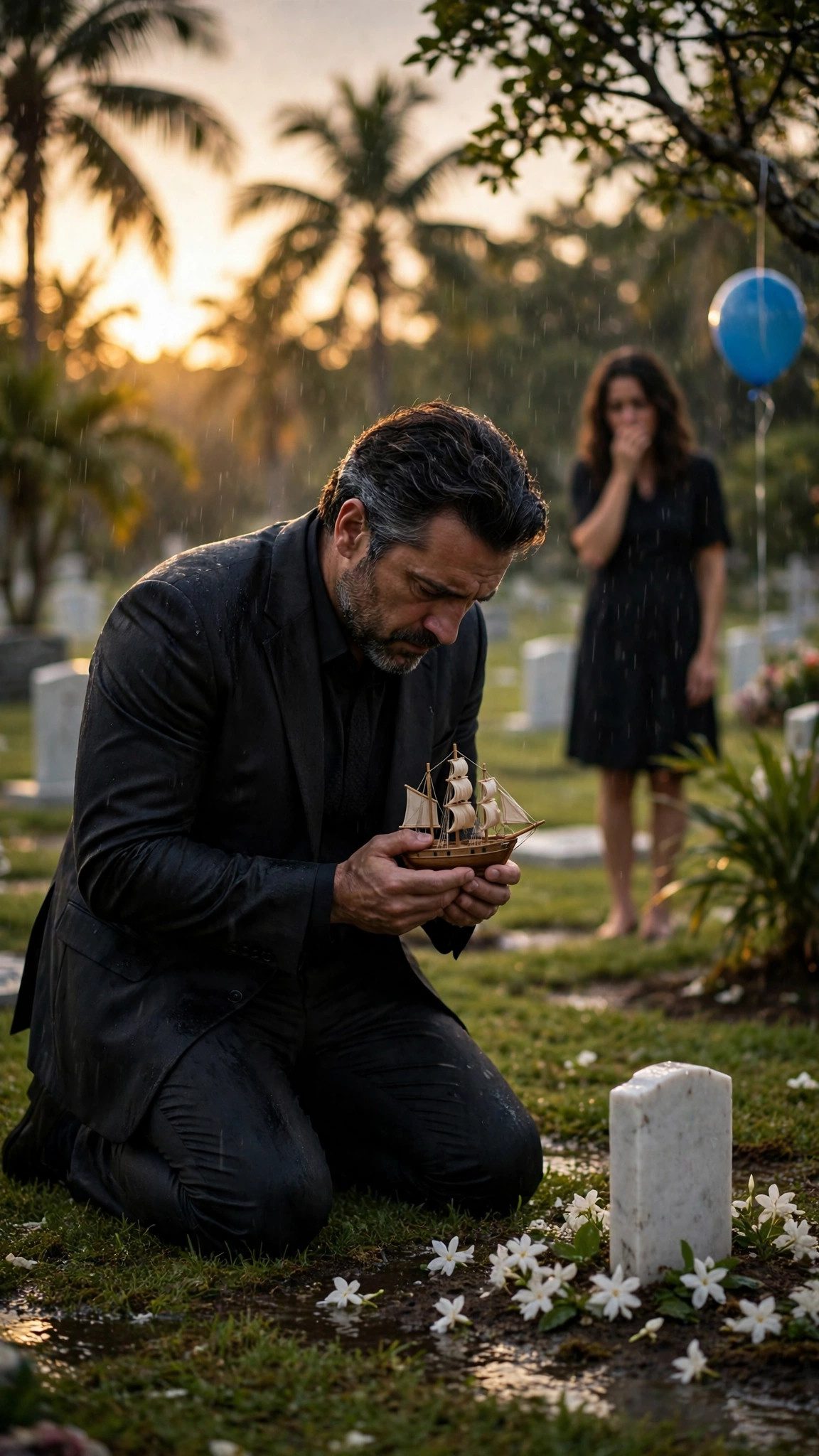
Three weeks later, Damian asked his security chief to count the videos in which he appeared.
Rocco was fifty-eight years old, a man who had been with the Moretti family since he was a boy, and he had the instincts of a man who had survived three wars by noticing what other men missed. He sat in Damian's study with a laptop and a pot of black coffee, and he went through all 1,907 videos, one by one, marking each time Damian's face appeared on the screen.
It took him two days.
Out of 1,907 recordings, Damian was in only forty-three.
Forty-three moments in his son's entire first year.
Sofia appeared in more photographs on his phone from a single month.
Rocco brought Damian the number on a piece of paper, and he laid it on the desk, and he did not say anything, because there was nothing to say. Damian stared at the number for a long time, and then he folded the paper, very carefully, and put it in his jacket pocket, next to my letter, over his heart.
"Forty-three," he whispered. "My son lived for one year, and I was there for forty-three moments."
That was the day Damian Moretti began to change. Not all at once. Men like Damian do not change all at once. They change the way a great ship changes course, slowly, with enormous effort, and with a great deal of noise below the deck. But he changed, and the first thing he changed was Sofia.
He flew to Saint-Tropez, to the villa where they had spent so many weekends, and he found her on the terrace, waiting for him with champagne, as if nothing had happened, as if his son had not died, as if his wife had not left him.
"Damian," she said, smiling. "You're back. I missed you."
He looked at her for a long time, this beautiful woman who had cost him everything, and he felt nothing. Not love. Not anger. Not even hatred. Just a vast, cold emptiness, like a house after everyone has moved out.
"It's over, Sofia," he said.
Her smile faltered. "What do you mean?"
"I mean it's over. The alliance. The weekends. All of it. My son is dead, Sofia. He died while I was sitting on this terrace with you, drinking champagne. He took his first steps toward a door he thought I was coming through, and the next morning he was gone, and I was here, with you. I will carry that for the rest of my life. But I will not carry you with it."
"You can't just end the alliance," she said, her voice rising. "My father controls Marseille. If you break this, there will be consequences."
"Let there be consequences," Damian said. "I have already lost the only thing that mattered. What else can anyone take from me?"
He left her on the terrace, and he flew home to Miami, and he never saw her again. Her father, Henri Bellini, sent messages, then threats, then finally silence, because even a man like Henri Bellini understood that there are some losses after which a man has nothing left to negotiate with.
The second thing Damian changed was the investigation.
He sat Rocco down in his study, and he said, "I want to know everything. Who ordered it. Who paid for it. Who sold the route. I want names, and I want proof, and I want it before the week is out."
Rocco was already working on it. He had been working on it since the night of the attack, because Rocco was a man who understood that the truth does not wait for permission. He had traced the truck to a shell company in the Bahamas. He had traced the money to an account in Geneva. And he had traced the route leak to a young bodyguard named Sal Ferraro.
Sal was twenty-six, ambitious, and angry, and he had sold the route of my car for fifty thousand dollars. He had told himself it was nothing, that he was only selling information, that whatever Castellano did with it was not his business. He had told himself fifty thousand dollars would change his life.
Rocco found him in a bar in Hialeah, drinking alone, his hands shaking, his eyes red. Sal did not run. He did not fight. He looked at Rocco, and he said, "I didn't know there was a baby in the car. I swear to God, I didn't know."
"There was," Rocco said. "His name was Noah. He was one year old. He had just learned to walk."
Sal wept. He wept the way Damian had wept, great tearing sobs, and he told them everything: the man from Castellano who had approached him, the money, the route, the time. He told them that Castellano had been waiting for months, watching Damian fly to Saint-Tropez again and again, waiting for the moment when the boss was distracted and the guard was down.
And the man who had ordered it was Vincent Castellano, the head of the rival family, a man who had lost territory to Damian a decade earlier and had never forgiven it. Castellano had not wanted to kill a baby. He had wanted to kill Claire, to wound Damian where it would hurt most, to send a message that the Moretti family could be reached. He had not known, or had not cared, that a one-year-old boy would be in the car.
Damian listened to all of it, sitting in his study with my letter in his pocket and the number forty-three burned into his mind, and then he did something no one expected.
He did not kill Castellano. He did not send his men to burn down Castellano's house, or to settle the debt in blood, the way the old Damian would have. He called his brother Matteo, and Matteo called a man he knew in the FBI, a federal agent named Daniel Reyes, and Damian gave him everything: the shell company, the Geneva account, Sal Ferraro's confession, recorded, signed, witnessed.
Three weeks later, Vincent Castellano was arrested on federal charges: conspiracy, murder, racketeering. The news showed him being led out of his house in handcuffs, his face gray, his hands shaking. Sal Ferraro testified against him in exchange for a reduced sentence, and then he disappeared into the federal witness program, a young man who would spend the rest of his life looking over his shoulder, knowing that fifty thousand dollars had cost him everything.
Damian did not attend the trial. He did not need to. Justice, he was learning, did not always have to wear his face.
The third thing Damian changed was the empire itself.
He called a meeting of his captains, the men who ran the docks, the clubs, the trucks, the money, and he told them that the war was over. Not a truce. Not a pause. Over. He would no longer fight for territory. He would no longer take contracts that put families at risk. He sold the Saint-Tropez villa. He closed the gambling rooms. He gave the docks to a trust that would be run by people who had never held a gun.
Some of his men left. Some of them called him weak. Some of them went to work for other families, men who still believed that power was the only thing that mattered. Damian let them go. He had learned, at a price no man should ever have to pay, that power was not the only thing that mattered. It was not even the most important thing.
And then he did the last thing, the thing that mattered most. He built something in Noah's name.
The Noah Moretti Foundation. A children's hospital wing, first, at Jackson Memorial, the hospital where Noah was born, with the best pediatric equipment money could buy, and a playroom full of toys, and a garden where sick children could sit in the sun. And then a playground, in the neighborhood where Rosa lived, with swings and slides and a small wooden ship, painted bright red, like the rocking horse Matteo had given Noah on his birthday.
He funded it with his own money. All of it. He did not ask for donations. He did not put his name on a plaque. He put Noah's name on everything, because it was Noah's, and because it was the only way he knew to make something good out of something unbearable.
He visited the construction site every week, standing in the dust in his suit, watching the walls go up, talking to the workers by name, asking the foreman about the playroom windows, about whether the garden would get enough sun. One afternoon, while he was there, a nurse from the children's ward brought out a little girl named Lucia, seven years old, thin and bald from chemotherapy, with a stuffed rabbit tucked under her arm. She looked up at Damian, this tall, frightening man in a dark suit, and she said, "Are you the man building the garden?"
"I am," Damian said, kneeling down so he was at her level, the way he had once knelt to be at Noah's level.
"My brother says gardens are where flowers go to be happy," Lucia said. "Will there be swings?"
"There will be swings," Damian said. "And slides. And a little wooden ship, painted red. Would you like that?"
Lucia nodded, and she smiled, a small, brave smile, and she said, "My brother died last year. He was nine. I think he would have liked the ship."
Damian felt something break open in his chest, and he had to turn away for a moment, because he was crying, and he did not want a seven-year-old girl to see the most powerful man in Miami crying in a construction site. But Lucia reached out, and she took his hand, her small fingers closing around his, and she said, "It's all right. I cry too, sometimes. It doesn't mean you're weak. It means you loved somebody."
He carried those words with him for the rest of the year. "It doesn't mean you're weak. It means you loved somebody." He wrote them on a piece of paper, and he kept it in his jacket pocket, next to my letter, next to the number forty-three, and whenever he doubted himself, whenever he wondered whether he was doing the right thing, he would touch that pocket, and he would remember.
Rosa came back to the house in the third week after Noah's death. She had stayed away out of respect, out of grief, because she did not know if Damian wanted to see anyone, least of all the woman who had rocked his son to sleep. But one morning, she appeared at the kitchen door with a pot of soup, and she said, "You need to eat, Mr. Damian. And this house needs to be lived in. A house that is not lived in forgets how to be a home."
She cooked for him. She cleaned. She opened the windows and let the air in. She put fresh jasmine in the vases, the same white jasmine she had brought for Noah's birthday, and she said, "One day, señora will come home. I don't know when, but she will. And when she does, this house needs to be ready."
Damian did not argue with her. He ate the soup. He let her open the windows. And in the evenings, after she had gone home, he would sit at the kitchen table, and he would write his monthly message to me, in a notebook, in his strong, slanting hand, before he sent it through Elena.
"I am here," he would write. "I am not looking for you. I am waiting. Whenever you are ready, I will be here."
He wrote those words twelve times over the course of a year, and each time, they meant more than the time before, because each time, he was a slightly different man than the one who had written them the month before.
All the while, he searched for me. Not with his men, not with helicopters and phone calls and threats, the way he would have searched for an enemy. He searched for me the way a man searches for something he has lost and does not deserve to find: quietly, patiently, through my attorney.
Elena Vasquez was my friend before she was my lawyer. She had been my college roommate, and she had held my hand through my father's funeral, and she was the first person I called from the hospital, before I called anyone else. She found me a small apartment in a quiet neighborhood in Fort Lauderdale, under a different name, and she told no one where I was, not even Matteo, not even Rosa, though it broke her heart to lie to them.
Through Elena, Damian sent me one message a month. Not letters. Not pleas. Just one message, always the same.
"I am here. I am not looking for you. I am waiting. Whenever you are ready, I will be here."
I read every message, sitting in my small apartment with Noah's toy ship on the windowsill, and I cried every time, because I could hear the change in them. The first messages were desperate, full of promises and apologies. The later ones were quieter. Simpler. A man who had stopped trying to convince me, and had started trying to become someone worth coming back to.
Elena told me about the foundation. She told me about Castellano's arrest. She told me about Sofia, and the closed gambling rooms, and the sold villa. She told me these things carefully, the way you tell a woman who has lost a child about the world continuing to turn without him, because she knew that every piece of news was both a comfort and a wound.
"He's different, Claire," she said one evening, sitting across from me at my small kitchen table. "I don't know if it's enough. I don't know if anything will ever be enough. But he's different."
I did not answer. I was not ready to answer. I was still the woman who had spent a year teaching her son to wait for a father who never came home, and I did not know how to forgive myself for that, let alone how to forgive Damian.
But I kept the messages. All of them. I kept them in a box on my nightstand, next to Noah's hospital bracelet, and some nights, when the apartment was quiet and the toy ship cast a small shadow on the wall, I would take them out and read them again.
"I am here. I am not looking for you. I am waiting."
And I began, very slowly, to wonder if waiting was the one thing Damian had finally learned to do.