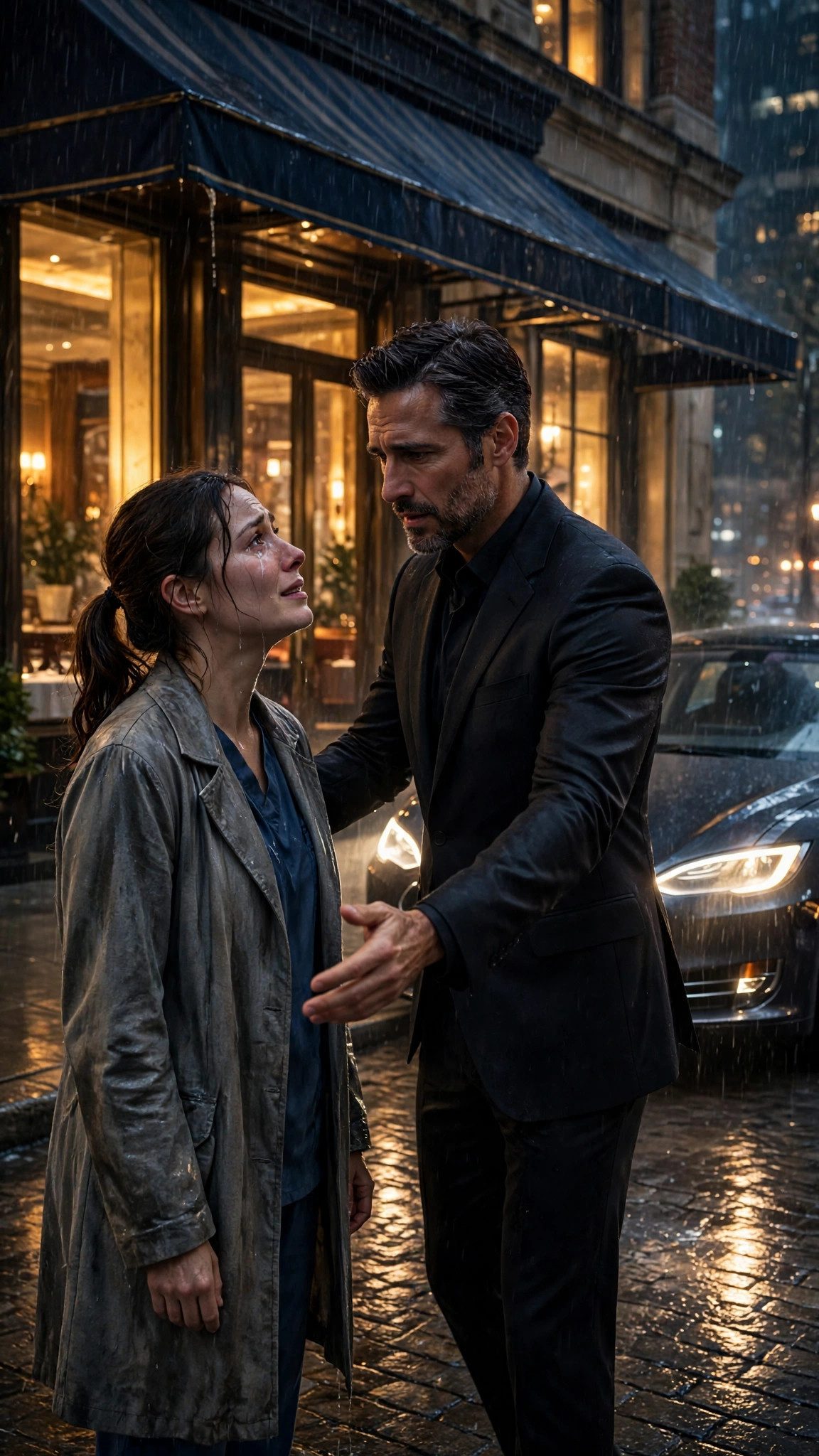
The plan, as Alexander explained it to me over cold tea in a warm room while the rain fell outside, was simple. That was the thing about Alexander Moretti. He did not make things complicated. He made them simple, and then he made them happen.
"Your husband's whole scheme depends on three things," he said. "A forged document. A real estate agent who believes him. And a buyer who wants a fast close. We take away all three, and the scheme falls apart. We do it legally, in the open, with paperwork — the same way he tried to steal from you, only this time the paperwork is real."
The first thing we did was the forgery. Sarah Whitfield filed a motion with the court the next morning, attaching a handwriting expert's report that compared the signature on the power of attorney with my real signature on twenty different documents — my nursing license, my tax returns, Jason's school forms, my mother's funeral arrangements. The expert's conclusion was one sentence long: "The signature on the power of attorney was not written by Clara Bennett."
The second thing we did was the real estate agent. Mr. Doyle called Dana Cole himself, and he read her the will over the phone — the whole will, slowly, every word — and then he told her about the forgery, and the police report, and the injunction. Dana Cole was quiet for a long time. Then she said, "I had no idea. He told me his wife had agreed. He showed me the paperwork. I believed him." And she withdrew the listing that same afternoon.
The third thing we did was the buyer. Alexander's lawyer — a thin, precise man named Mr. Hart who wore glasses and spoke in a voice so soft you had to lean in to hear him — called the developer from out of state and explained, in very polite and very specific terms, that the house on Linden Lane was not for sale, had never been for sale, and that any attempt to proceed with a purchase based on forged documents would result in a lawsuit that would cost the developer considerably more than the house was worth. The developer withdrew his offer within the hour.
Three days. That was all it took. Three days, and Marc's plan was in pieces on the floor.
I should have known he would not accept that. A man like Marc — a man who has lied to his wife for two years, forged her signature, planned to sell her father's house behind her back — does not simply give up when his plan falls apart. He finds a new plan. A worse plan.
On the fourth day, I came home from my shift at the hospital — to the apartment in Evanston, not the house on Linden Lane, because Sarah Whitfield had told me not to go back to the house alone until the injunction was final — and I found Rosa waiting for me in the hallway outside my door.
"Clara," she said, and her face was white. "You need to call the police. Now."
"What happened?" I asked.
"Your husband was at the house," Rosa said. "On Linden Lane. My cousin drove past this afternoon and saw his car in the driveway, and the front door was open, and there were two men with him, men she didn't recognize, carrying boxes. She called me right away."
My blood went cold. The house. My father's house. Marc was in it, with strangers, carrying boxes.
I called the police. I called Sarah Whitfield. I called Alexander. And then I got in my car and I drove to Linden Lane as fast as I legally could, with Rosa beside me, praying the whole way that Jason was safe at school, that nobody had touched my mother's things, that my father's oak table was still standing in the kitchen where it belonged.
When I got there, the police were already there. Two squad cars in the driveway. And Marc was standing on the front porch — my father's porch, the porch my father had built with his own hands — arguing with an officer, his face red, his voice loud, saying, "This is my house! I have a right to be here! This is my house!"
It was not his house. It had never been his house. But he was saying it as if saying it enough times would make it true.
The two men with him were already gone. They had left when the police arrived, slipping away down the street like smoke. But the boxes were still there, stacked on the porch — my mother's china, wrapped in newspaper. My father's tools, in a cardboard box, the ones from the toolbox he had left to Marc in his will, the ones Marc had never once used. Photo albums. Jason's baby clothes. Things Marc had been packing up to sell, or to throw away, or to take — I never found out which, and I never wanted to know.
I walked up the driveway. My legs were shaking. Rosa held my arm. The officer saw me coming and stepped forward.
"Ma'am, are you Clara Bennett?" he asked.
"Yes," I said. "This is my house. My father built it. It's mine."
"Your husband says —"
"I don't care what my husband says," I said, and my voice was louder than I meant it to be, but I did not care. "Show him the will. I have it right here."
I took the folder out of my bag — the folder with WILL written on it in my mother's neat handwriting, the folder I had carried with me everywhere for two weeks — and I handed it to the officer. He read it. He read it twice. Then he looked at Marc, and he looked at me, and he said to Marc, "Sir, this house belongs to Mrs. Bennett. You need to leave. Now. And if you come back without a court order, you will be arrested for trespassing."
Marc stared at me. His face was twisted with rage, and for a moment I saw him clearly — really clearly, maybe for the first time in eleven years — and what I saw frightened me. Not because he was angry. Because he was desperate. Because he was a man who had run out of options, and desperate men do desperate things.
"This isn't over, Clara," he said. "You think you've won. You haven't won. Falco doesn't care about your will. Falco doesn't care about your father's house. Falco wants his money. And if I don't pay him, he's going to come looking for it. And when he does, he's not going to care whose name is on the deed."
He turned and walked to his car. He did not look back. He drove away, and I stood on my father's porch with a police officer and my best friend and a stack of boxes full of my mother's china, and I felt something I had not felt since the morning my mother died.
Fear. Real fear. Not for the house. For Jason. For my son. Because Marc was right about one thing: Nico Falco did not care about wills or deeds or who built what with whose hands. Nico Falco cared about money. And Marc owed him a hundred and eighty thousand dollars.
That night, Alexander came to the apartment in Evanston.
He did not call first. There was a knock on the door at nine o'clock, and I looked through the peephole, and there he was, standing in the hallway in his black suit, holding a paper bag from a bakery, looking like a man who had come to visit a friend.
"May I come in?" he asked.
I let him in. Jason was asleep. Rosa had gone home. The apartment was quiet, and the radiator was clanking, and Alexander Moretti — one of Chicago's most powerful mafia bosses, a man feared by people who knew exactly what his name meant — sat down on my secondhand couch and opened the paper bag and took out two cannoli, and set them on the coffee table between us.
"I brought dessert," he said. "I thought you could use something sweet."
I almost laughed. I almost cried. I did neither. I sat down across from him and I said, "Marc was at the house today. With two men. Packing boxes. He said Falco is going to come looking for his money."
"I know," Alexander said. "I know about the house. I know about the men. And I know about Falco. That is why I'm here."
He set a folder on the coffee table, next to the cannoli. It was a thin folder, black, with no label on it.
"Inside that folder," he said, "is a document. It is a transfer of debt. As of this morning, Marc Johnson's debt to Nico Falco no longer belongs to Nico Falco. It belongs to me. I bought it. All of it. A hundred and eighty thousand dollars. I paid Falco in full, this afternoon, in cash, in his own office, while he sat across from me and tried very hard not to look afraid."
I stared at him. "You bought my husband's debt?"
"I bought it," Alexander said, "so that Nico Falco will never come near you or your son. Falco is out of the picture. He has been paid. He is done. He will not call. He will not visit. He will not send anyone. Because he knows that if he does, he will be answering to me."
"But now Marc owes you," I said slowly. "A hundred and eighty thousand dollars. To you."
Alexander nodded. "Yes. He owes me. And I am a very different kind of creditor than Nico Falco, Clara. Falco would have broken his legs. I am going to do something much worse. I am going to make him sign papers."
He opened the folder. Inside, alongside the debt transfer, were three more documents. A divorce settlement, already drafted. A quitclaim deed, giving up all rights to the house on Linden Lane. And a restraining order, ready to file.
"Tomorrow morning," Alexander said, "your husband is going to come to Mr. Hart's office. He is going to sit down at a table. And he is going to sign all three of these documents. He is going to sign the divorce settlement, giving you full custody of Jason and the house and everything in it. He is going to sign the quitclaim, giving up any claim to the house, forever. And he is going to agree to the restraining order, staying away from you and Jason unless you invite him."
"And if he doesn't sign?" I asked.
Alexander looked at me with those winter-sky eyes, and for a moment I saw the man the whole city feared — not cruel, not violent, but absolutely, immovably certain.
"Then he will owe me a hundred and eighty thousand dollars," he said, "and he will have no house to sell, no wife to steal from, and no one left in this city who will lend him a dollar. I do not need to threaten him, Clara. His own choices have already done that. I am simply giving him a way out. A clean way out. He signs the papers, and the debt is forgiven. He walks away, free and clear, and he never comes near you again. That is the deal. It is more generous than he deserves. But I am offering it because you asked me to stand beside you — not to destroy him. And I keep my word."
I sat there for a long time, looking at the folder on the coffee table, at the cannoli, at the man in the black suit sitting on my secondhand couch in my small apartment with the clanking radiator, and I thought about my father.
My father had built a house with his own hands. He had told me it was mine. He had written it in his will. He had asked a mafia boss in a hospital hallway to watch over me if I ever needed him.
And now, twelve years later, that mafia boss was sitting in my living room, eating cannoli, holding a folder full of papers that would give me my house back, and my son back, and my life back.
"Thank you," I said. And then, because it was not enough, I said it again. "Thank you, Alexander."
He shook his head. "Don't thank me, Clara. Thank your father. He is the one who asked me to come. I am just keeping a promise."
He stood up then, and he put on his coat, and he walked to the door, and he turned back and looked at me one more time.
"Tomorrow morning," he said. "Ten o'clock. Mr. Hart's office. Bring the will. Bring your father's toolbox, if you like. I think he would want to be there."
And then he was gone, down the hallway, into the night, and I sat alone in my apartment with a folder full of papers and two cannoli and a radiator that clanked, and for the first time since my mother died, I slept through the night without waking up once.
I woke the next morning to sunlight coming through the window and the smell of coffee — Rosa had let herself in with the spare key and made breakfast, and Jason was already up, sitting at the little kitchen table in his pajamas, eating toast with jam and telling Rosa about a dream he had where Grandma was a bird, a blue bird, flying over the house on Linden Lane.
"She said the house is okay, Mommy," Jason told me, jam on his chin. "She said the house misses us, but it's okay, because we're coming home soon."
I kissed the top of his head. "Your grandma is right, baby. We're coming home soon."
After breakfast, Rosa and I drove back to Linden Lane together, to put the boxes back where they belonged. The police had gone. The porch was empty. The front door was locked — I had the only key now, and the spare Marc had copied was in a police evidence bag somewhere downtown, which felt strangely satisfying.
We carried the boxes inside, one by one. My mother's china, back into the cabinet where it had lived for forty years. The photo albums, back onto the shelf in the living room. Jason's baby clothes, folded neatly, back into the cedar chest at the foot of my old bed. And my father's tools, back into the toolbox, each one in its place — the hammer on top, the screwdrivers in a row, the measuring tape coiled neatly.
At the bottom of the toolbox, underneath the level, I found something I had never seen before. A small envelope, yellowed with age, with my name written on it in my father's handwriting. CLARA, in his careful capital letters.
My hands shook as I opened it. Inside was a single sheet of paper, and on it, in my father's hand, were five sentences. Five sentences that I have carried with me ever since, that I have read a hundred times, that I know by heart now.
"Clara-bear. If you are reading this, it means you need it. The house is yours. The will says so, and I say so, and no piece of paper anyone else writes can change that. Be strong. Your mother and I are so proud of you. Love, Dad."
I sat down on the kitchen floor, in the middle of my father's house, holding that letter, and I cried — not the crying of grief, but the crying of a woman who has just been told by her dead father that she is strong enough, and who finally believes it.
Rosa sat down beside me on the floor. She did not say anything. She just put her arm around me, the way she had done in the hospital a hundred times, and we sat there together, in the house my father built, with the sun coming through the window seat and the smell of old wood and lemon polish in the air, and I knew that whatever happened tomorrow morning at Mr. Hart's office, I would be all right.
Because my father had left me more than a house. He had left me a letter. He had left me his belief in me. And nobody — not Marc, not Falco, not anyone — could take that away.