I called Marco the next morning. My hands shook so hard I could barely hold the phone.
"Meet me," I said. "Not to fight. To talk. I found Sofia's letters, Marco. I know the truth now. I know who she was, and I know who killed her, and it wasn't Adrian."
There was a long silence on the other end of the line. Then Marco said, "Where?"
"The restaurant," I said. "Orelio. Tonight, after closing. Just you and me. Please, Marco. For her. For Sofia."
He agreed. He did not sound convinced. He sounded like a man who had already made up his mind and was only coming to say goodbye.
Before I left the house that night, Giulia found me in the hallway, putting on my coat. She took one look at my face and knew exactly where I was going.
"You're going to see your brother," she said. It was not a question.
"Yes."
"Then take this." She pressed something into my hand. It was a small silver locket, warm from her own skin. Inside was a photograph of Sofia, laughing in a garden in a white dress. "She gave it to me the week before she died. She said, 'If anything happens to me, give this to the girl with my face. Tell her it was mine, and now it is hers.' I have been carrying it ever since, waiting for you."
I closed my fingers around the locket. It felt like holding my sister's hand.
"Be careful," Giulia said. "Your brother is a good man, Elina. But grief makes good men do terrible things. If he won't listen, you come home. You come straight home, and you do not look back. Do you understand me?"
"I understand," I said. And then, because I could not help it, I hugged her. She held me tight, the way a sister would, the way Rosa used to hold me, and for a moment I was not afraid at all.
Rocco drove me to the restaurant. He did not speak the whole way, but when we pulled up across the street, he turned to me and said, "Miss Elina, I have worked for Mr. Romano for twenty years. I have seen a lot of things. But I have never seen him the way he was tonight, when you called. He was afraid. Not for himself. For you. I just thought you should know that."
"Thank you, Rocco," I said.
He nodded. "I'll be across the street. Ten seconds away. You call out, and I'll be there."
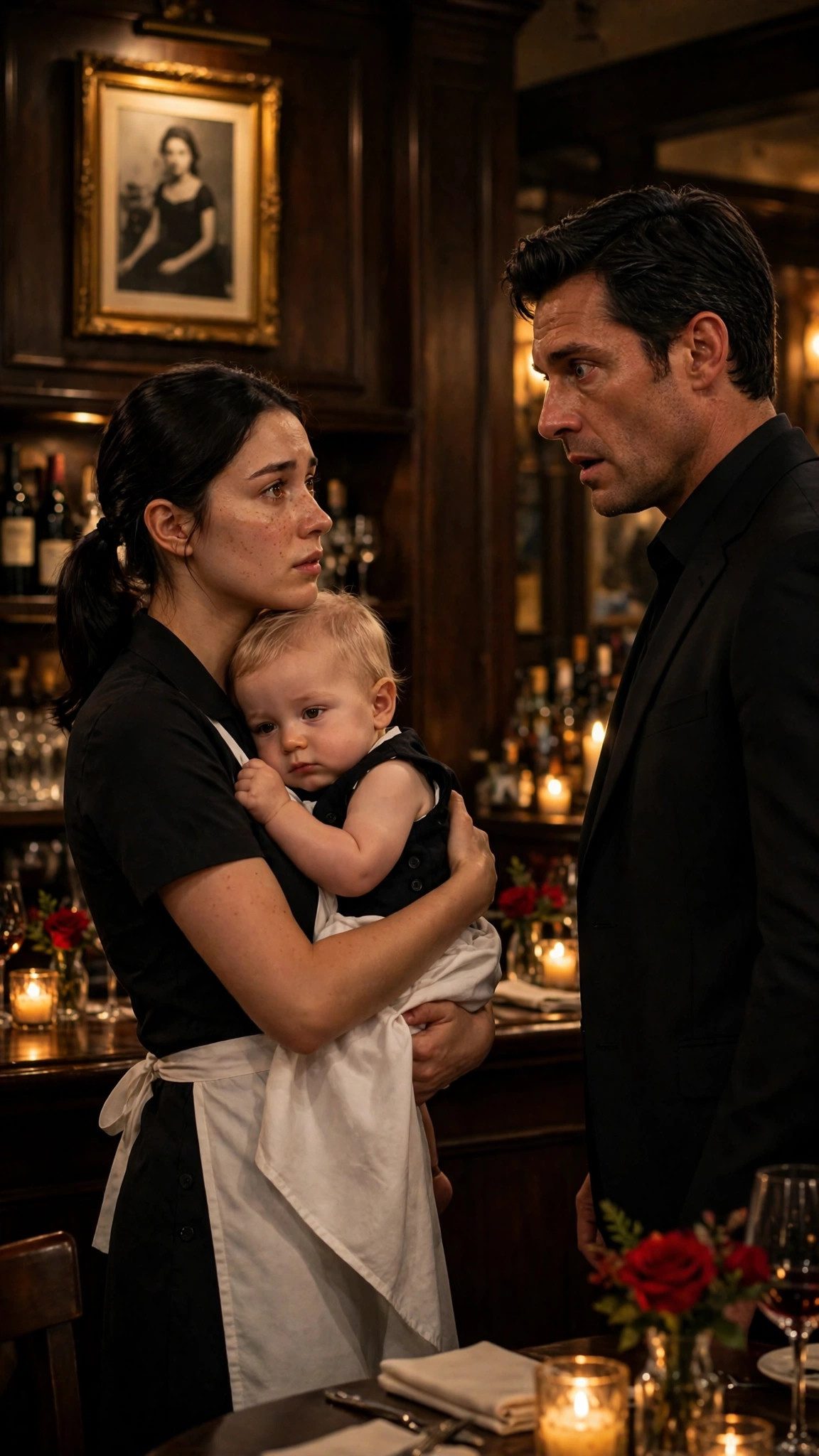
I went inside, and I waited in the dark restaurant, sitting at the bar under the photograph of my sister, holding her locket in one hand and her letters in the other, listening to the clock tick and the refrigerator hum, and I prayed, to Rosa, to my mother, to Sofia, to anyone who might be listening, that my brother would hear the truth and believe it.
Adrian wanted to come with me. He wanted to bring Rocco, and men, and guns. I said no.
"If he sees your men, he'll run," I said. "If he sees you, he'll fight. He needs to hear it from me first. He needs to hear it from his sister."
Adrian did not like it. I could see it in his face. But he nodded. "Rocco will be across the street," he said. "Not in the restaurant. Across the street. If anything happens, you call out, and he will be there in ten seconds. That is not negotiable."
"Fine," I said. "Across the street."
I spent the day with Matteo, feeding him and bathing him and singing him the river song, and all the while my mind was turning over the same terrible thought: what if Marco would not listen? What if twenty-six years of grief and anger were stronger than the truth? What if my brother had already decided that Adrian Romano had to die, and nothing I said could change it?
At midnight, the restaurant was dark except for the small lamp over the bar. Mr. Orelio had left the back door unlocked for us, and he had gone home, because I had asked him to, and because he was an old man who had already seen enough trouble in his life.
Marco came through the back door at twelve fifteen. He was taller than I remembered, broader, with a scar on his chin I had never seen before and eyes that looked older than thirty-four.
For a moment, we just looked at each other. My brother. The boy who had taught me to ride a bicycle. The boy who had walked me to school. The man who had disappeared into a world I did not understand.
"Elina," he said.
"Marco," I said.
He sat down across from me at the bar, and I put Sofia's letters on the counter between us. The letters from Agnes DeLuca. The letters Sofia had written to Rosa. The letter Sofia had written to me.
"Read them," I said.
He read them slowly, one by one, his face going pale, then red, then pale again. When he finished, he sat very still for a long time, staring at the photograph of Sofia on the wall behind the bar.
"She knew about you," he whispered. "She was looking for you. She was going to find you."
"Yes," I said. "And then she died. And you blamed Adrian. But Marco, Adrian didn't plant that bomb. Vincent Castellano did. Castellano ordered it. He wanted Adrian dead, and Sofia took the car instead. And now Castellano is using you. He's using your grief to get to Adrian, and when he's done with you, he'll throw you away, just like he threw Sofia away."
Marco's hands were shaking. "How do you know this? How do you know Castellano ordered it?"
"Because Adrian has a man in custody," I said. "A man who worked for Castellano. A man who knows who planted the bomb, and who paid for it, and who gave the order. Adrian can prove it. He wants to show you. He wants you to see the proof with your own eyes."
Marco stood up so fast his chair fell over. "No. No, this is a trick. This is Romano trying to turn me. Castellano told me—"
"Castellano told you what he wanted you to hear," I said, standing too. "Castellano is the man who killed our sister, Marco. And you are working for him. You are helping the man who murdered Sofia kill the man she loved. Is that what you want? Is that how you honor her?"
For a moment, I thought he was going to hit something. His fists clenched. His jaw tightened. Then, slowly, his shoulders sagged, and he put his hands flat on the bar, and he bowed his head.
"Show me," he whispered. "Show me the proof."
I had my phone in my hand before he finished the sentence. I called Adrian. "He'll listen," I said. "Bring the proof. Bring Rocco. But come alone into the restaurant. No guns in sight. Please."
Adrian arrived in ten minutes, with Rocco beside him and a folder in his hand. He set the folder on the bar, and he opened it, and inside were photographs, bank records, and a signed statement from a man named Eddie Marcone, a mechanic who had worked for Castellano for twelve years.
Eddie Marcone had planted the bomb. Castellano had paid him fifty thousand dollars. The target was Adrian Romano. The bomb was set to go off when Adrian started the car in the morning. Sofia took the car at nine fifteen to pick up medicine for Matteo. The bomb went off at nine twenty.
Marco read the statement twice. Then he read the bank records, showing the transfer from a Castellano shell company to Marcone's account, dated the day before Sofia died.
Then he put his head in his hands, and he wept.
It was the first time I had seen my brother cry since we were children. Great, shaking sobs that came from somewhere deep in his chest, the sound of a man whose whole world had just been turned inside out.
I went to him then, around the bar, and I put my arms around my brother, the way I had held him when we were small and the world was frightening and Rosa was the only safe thing in it. His shoulders shook under my hands. His tears wet my sleeve. I did not say anything. There was nothing to say that would make seven months of grief and guilt go away. There was only this: his sister, holding him, telling him without words that he was not alone anymore, that he had a family again, that the truth had finally found him, even if it had come too late for Sofia.
"I've been working for the man who killed her," he said, his voice broken. "For seven months. I've been taking his money. I've been following his orders. I've been planning to kill an innocent man for the man who murdered my sister."
Adrian stood very still. Then he did something I did not expect. He walked around the bar, and he put his hand on my brother's shoulder.
"I blamed myself too," he said quietly. "For seven months, I blamed myself every single day. If I had taken the car that morning. If I had gone to the pharmacy myself. If I had been anywhere else. Sofia died because of my life, Marco. That is true. But the man who ordered it is Vincent Castellano. And he is still out there. And he is still coming for my son."
Marco looked up, his face wet with tears. "What do you want from me?"
"I want you to help me stop him," Adrian said. "I want you to tell me what Castellano has planned. I want you to stand with your family, instead of against it."
And that was when the front window of the restaurant shattered.
Glass exploded across the floor. A black car had pulled up outside, and men were coming through the door, and I heard Rocco shout, "Down!" and Adrian threw himself across the bar toward me, and Marco pulled a gun from his jacket, and the whole world became noise and breaking glass and shouting.
It happened so fast I could barely follow it. Rocco had his gun out. Adrian had his arm around me, pulling me down behind the bar. Marco was firing back through the broken window, shouting something I could not hear over the ringing in my ears.
Then, as suddenly as it had started, it was over. Tires screeched outside. The black car was gone. Rocco was on his phone, calling for backup, his voice calm and steady. Adrian was checking me for injuries, his hands gentle and thorough, his face white.
"Are you hurt?" he asked. "Elina, are you hurt?"
"No," I said. "I'm fine. I'm fine."
But I was not fine. Because in the middle of the chaos, one terrible thought had cut through everything else.
Matteo. Matteo was alone in the house on the hill, with only Giulia and a nanny, and if Castellano's men had come to the restaurant, then someone else might have gone to the house.
"Matteo," I whispered.
Adrian's face went white. He was already moving, already pulling out his phone, already shouting at Rocco to get the car.
We drove through the night like the devil was behind us, and Adrian gripped the steering wheel so hard his knuckles went white, and Rocco sat in the back seat with his gun in his lap, checking his phone every ten seconds for updates from the house.
"Talk to me, Rocco," Adrian said, his voice tight. "Who is at the house?"
"Giulia and the night nanny," Rocco said. "And two men on the gate. That's all. The day men went home at eight."
"And the men who came to the restaurant?"
"Three of them. One is down, in the alley behind the restaurant. The other two drove away. The police are on their way."
Adrian's jaw tightened. "Castellano sent them to the restaurant to keep us busy while another team went for Matteo. He knew Marco was meeting Elina tonight. He knew we would be distracted. This was planned, Rocco. All of it was planned."
"Then we were lucky," Rocco said quietly. "Giulia is not a woman to be underestimated. She held that nursery door with a fireplace poker and a mother's fury. Those men did not expect that."
Adrian did not answer. He just drove faster, and I held onto the door handle with both hands, and I prayed, the same prayer I had prayed in the restaurant, to Rosa, to my mother, to Sofia, to anyone who might be listening.
Please let him be all right. Please let Matteo be all right. Please let us get there in time.
When we reached the house, the front gate was open, and a window on the ground floor was broken, and Giulia was standing in the doorway holding Matteo, crying, with a cut on her forehead and a fireplace poker in her hand.
"They came," she gasped. "Two men. They tried to take him. I locked the nursery door, and I held it, and then they left. They left when they heard the sirens."
Adrian took Matteo from her arms and held his son against his chest, and the baby, who had been crying, went quiet the moment he felt his father's arms around him.
But then Matteo saw me. He saw me standing in the doorway, and his arms stretched out, and he made the small eager sound, and Adrian handed him to me, and the baby melted against my chest, and the deep little sigh came out of him, and the whole terrible night seemed to fold itself into that one small sound.
Marco stood behind me in the doorway, his gun still in his hand, his face streaked with tears and dust, and he looked at his nephew in my arms, and he looked at Adrian holding his sister's photograph in his mind, and something in his face changed.
"I'm sorry," he said to Adrian. "I was wrong. About all of it. I was wrong."
Adrian looked at him for a long moment. Then he nodded. "Then help me finish this," he said. "Help me make sure no one ever comes for my son again."
And Marco, my brother, the boy who had taught me to ride a bicycle, nodded back.
"Tell me what Castellano has planned," Adrian said. "All of it. Every detail. And tomorrow, we end this."