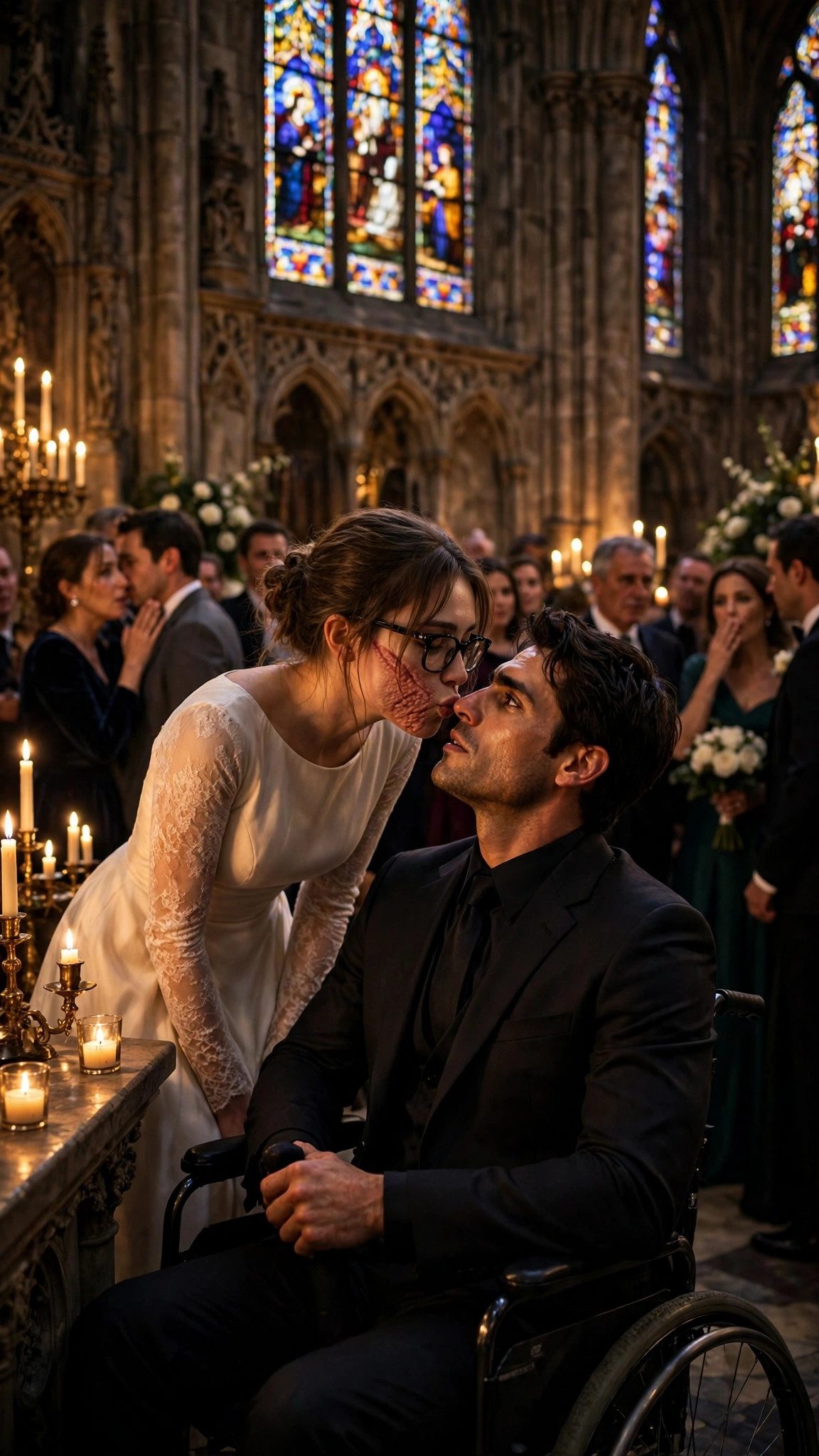
My father arrived at seven o'clock the next evening, in a black car, with Celeste beside him in a blue dress, and two men I did not recognize walking behind them, and he walked into Adrian's house as if he owned it, because in his mind, he did.
Adrian was waiting in the dining room, in his wheelchair, in a dark suit, with a glass of water in front of him and a look on his face like a man waiting for a train. I sat beside him, in a green dress that one of Adrian's housekeepers had found for me, with my real face bare — no scar, no glasses, no dull hair, my dark gold hair brushed and shining — and I watched my father's face when he saw me.
He stopped in the doorway. Just for a second. Just long enough for me to see it — the flicker of shock, the quick calculation, the rage underneath, all of it passing across his face like clouds over the moon.
Then he smiled, the way a shark smiles, and he said, "Adrian. My daughter. You both look well."
"We look like a married couple," Adrian said, "which is more than I can say for last night, when my bride was wearing another woman's face."
Celeste's head snapped toward me. Her eyes went to my cheek, to the place where the scar had been, and her mouth opened, and for a moment, she looked almost frightened.
"Where is your scar?" she asked.
"I took it off," I said. "It was never mine. It was yours."
My father sat down at the table, slowly, and folded his hands, and looked at Adrian, and said, "I don't know what game you're playing, Vitali, but my daughter's appearance is a private family matter."
"It stopped being private," Adrian said, "when your other daughter handed my wife a bottle of poison and told her to pour it for me before midnight."
The silence in the dining room was so complete that I could hear the clock ticking on the wall, and the ice settling in the water glasses, and my own heart beating in my ears.
Celeste went pale. Not the pale of a woman who is surprised. The pale of a woman who has been caught.
"I don't know what you're talking about," she said, but her voice shook, and she reached for her water glass, and her hand shook too.
"Don't," Adrian said, and his voice was very quiet, and very cold. "Don't lie to me in my own house. I had the bottle tested. Aconite. Enough to stop two hearts. Your chemist in Cicero was very talkative, once my men explained to him that he could either talk to us or talk to the police."
My father laughed then, a short, hard laugh, like a cough. "A bottle of amaro. A wedding gift. You can't prove anything with a bottle of amaro."
"I don't need to prove it with the bottle," Adrian said. "I can prove it with Tommy Falco."
At the name, my father's face changed. The smile stayed, but the eyes went flat and cold, and I saw, for the first time in my life, fear in my father's face. Not fear of Adrian. Fear of being caught.
"Tommy Falco shot me eleven months ago," Adrian said, "for fifty thousand dollars, paid through three accounts, by a man who works for you. He has told the FBI everything. He has told them about the envelope. He has told them about the diner on Cicero Avenue. He has told them about the instructions — wound him, don't kill him, make him weak, make him need a wife."
He leaned forward in his wheelchair, and his voice dropped lower.
"And do you know what else he told them, Salvatore? He told them that you were the one who chose the wife. That you offered me Celeste, and when she refused, you offered me her sister, the girl you had hidden for ten years behind a fake scar, because you thought a girl who had been taught to apologize for existing would do whatever you told her to do. Even murder."
Celeste stood up then, so fast her chair fell over behind her, and she pointed at me, and her voice was shrill with panic.
"She's lying! Mara is lying! She made it all up! Father, tell him she's lying!"
"I didn't say a word," I said, and my voice was steady, which surprised me, because my hands were shaking under the table. "He knew before I did."
"Then who—" Celeste began, and then she stopped, and she looked at Adrian, and she looked at me, and she understood, and her face went white.
"The chemist talked," Adrian said. "Tommy talked. And your father is going to talk too, because in about ten minutes, a man named Daniel Reyes is going to walk through that door with a warrant, and your father can either walk out of here in handcuffs, or he can walk out of here in a body bag, and I am in a generous mood tonight, so I am going to let him choose."
My father stood up slowly, and he looked at Adrian, and he looked at me, and I saw the calculation happening behind his eyes, the way a man counts his exits and finds them all closed.
"You think you've won," he said to Adrian. "You think this changes anything. I still own the girl's foster mother. I still pay for Ruth Delaney's care. One phone call, Mara, and she is out on the street."
"No," I said, and I stood up too, and I looked my father in the eye, in my real face, with my real voice, and I said the words I had been waiting ten years to say.
"Ruth is gone. She's safe. She's in a facility you will never find, paid for by a man who actually protects his family. You don't own her anymore. You don't own me anymore. You never did."
My father stared at me, and for a moment, I thought he might hit me, right there at the dinner table, in front of everyone. His hand twitched. His jaw tightened. And then he looked at Adrian, and he saw something in Adrian's face that made him sit back down, slowly, like a man who has just realized the gun is pointed at him.
"You're bluffing," he said to Adrian. "About Reyes. About the warrant."
"Am I?" Adrian said, and he looked at the clock on the wall. "It's seven forty-five. He said eight o'clock. Would you like to wait and see?"
Celeste began to cry then, not the loud, dramatic crying she did when she wanted attention, but quiet, frightened tears, the tears of a woman who has finally understood that her father cannot protect her.
"Father," she whispered. "Father, what did you do?"
"What I had to do," my father said, and his voice was tired, suddenly, and old. "For the family. For the business. For you."
"For me?" Celeste said. "You were going to let me marry him. You were going to let Mara die. You were going to—"
"I was going to make us rich," my father said. "I was going to make us safe. You don't understand what it takes, either of you. You don't understand what men like me have to do."
"I understand," Adrian said, and he put his hands on the armrests of his wheelchair, and he pushed himself up, and he stood, tall and steady, on two good legs, in the middle of his dining room, in front of my father and my sister and God and everyone.
And my father's face, when he saw Adrian Vitali stand up out of the wheelchair, was the most satisfying thing I had ever seen in my life.
"You're not crippled," my father whispered.
"No," Adrian said. "I haven't been crippled for eight months. I stayed in the chair so that men like you would think I was weak, and would get careless, and would walk into my house and confess to attempted murder over dinner. Thank you for that, by the way. It saved me a great deal of time."
He walked around the table, slowly, and he stopped beside Celeste, and he looked down at her, and he said, in a voice that was almost gentle:
"Your sister is going to testify against your father. You can testify with her, and the FBI will be kind to you, or you can refuse, and they will not be. That is your choice, Celeste. It is the first real choice anyone has ever given you. I suggest you take it."
Then he walked to the door, and he opened it, and a man in a dark suit walked in, with a badge on his belt and a folder under his arm, and he looked at my father, and he said:
"Salvatore Barone. I'm Special Agent Daniel Reyes, FBI. I have a warrant for your arrest."
My father did not run. He did not fight. He stood up, slowly, and he held out his hands, and the agent put the handcuffs on him, and as they led him out of the dining room, he turned back and looked at me, and he said, in a voice I had never heard from him before — small, and tired, and almost human:
"Mara. Your mother would have been proud of you."
Then he was gone, and the dining room was quiet, and Celeste was crying, and Adrian was standing by the window, looking out at the garden, and I was standing at the table in my green dress with my real face, and I realized, all at once, that I was free.
Not safe. Not yet. But free.
And freedom, I was learning, felt a lot like standing up straight after ten years of making yourself small.
The hours before dinner were the longest of my life.
I spent the morning with one of Adrian's housekeepers, a kind woman named Sofia, who helped me choose a dress — green, simple, fitted, the kind of dress I would never have been allowed to wear in my father's house — and who did my hair, brushing it until it shone dark gold in the mirror, and who looked at my real face and said, "You are a beautiful bride, Mrs. Vitali," and meant it.
Then Marco Santini came to find me, and he took me into Adrian's study, and he laid out the plan, the way a general lays out a battle, calmly and clearly, with no room for misunderstanding.
"At seven o'clock, your father and your sister will arrive," Marco said. "They will be shown into the dining room. Mr. Vitali will be in his wheelchair. You will sit beside him. You will be yourself — your real face, your real voice. Do not wear the scar. Do not wear the glasses. Do not apologize for anything."
"What if my father tries to take me away?" I asked.
"He won't," Marco said. "He thinks he owns you. Men who think they own something don't grab for it. They just expect it to stay where they put it. And besides —" he smiled, a small, hard smile, "— there will be four of my men in the house, and two more outside, and Special Agent Reyes will be in a car down the street, waiting for my call. Your father is not taking anyone anywhere tonight."
"What do I say?" I asked. "When he asks about the scar? When he asks about the bottle?"
"You say the truth," Marco said. "That's all. The truth is the trap, Mara. Your father has spent his whole life lying. He won't know what to do when someone tells him the truth to his face."
I practiced it in my head, all afternoon. I will say: I took it off. It was never mine. It was yours. I will say: Ruth is safe. You don't own her anymore. You don't own me anymore. I will say: the bottle was poison, and you knew it, and Celeste knew it, and I know it too.
And then, at six o'clock, Adrian came to find me, and he was standing — not in the wheelchair, but on his own two feet, in the hallway outside my room — and he looked at me in the green dress, with my real face, and he said, "You look like yourself," and I said, "I am myself," and he took my hand, and he walked me downstairs, slowly, so I would not be afraid, and we went into the dining room together, and we waited.
The wait was the worst part. Seven o'clock came, and the doorbell rang, and I heard my father's voice in the hallway, and Celeste's laugh, and the sound of their footsteps coming closer, and my heart beat so hard I thought it would break my ribs, and Adrian squeezed my hand under the table, once, hard, and then he let go, and he settled back into his wheelchair, and he became, once again, the crippled boss, the broken man, the breathing corpse — and the trap was set.
After dinner, after the arrest, after my father was led away in handcuffs, Celeste sat alone in the dining room, crying quietly, and Daniel Reyes came to her, and he sat down across from her, and he spoke to her gently, the way you speak to a frightened animal, and he said:
"Miss Barone, your sister has told me everything. I know you were afraid of your father. I know you did what he told you to do. But I need to hear it from you. I need you to tell me, in your own words, what happened with the bottle."
Celeste looked at me, and I nodded, and she took a deep breath, and she began to talk, and she did not stop for a long time, and Reyes wrote it all down, and when she was finished, he closed his notebook, and he said, "Thank you. That was very brave."
And it was brave. It was the bravest thing Celeste had ever done. And I was proud of her, in a way I had never expected to be proud of my sister, because for the first time in her life, she had told the truth, and the truth had not destroyed her.
It had set her free. The same way it had set me free.