The week after my father was arrested, I learned what the law could do, and what it could not do, and how long justice takes when it is done properly, instead of quickly.
Special Agent Daniel Reyes was a patient man. He was in his forties, with tired eyes and a neat suit and a way of asking questions that made you want to tell him the truth, even when the truth was ugly. He came to the estate three times in the first week, and each time, he sat at the kitchen table with me, and he drank coffee, and he asked me to tell him everything, from the beginning, slowly, so he could write it down.
I told him about Vincent and the silicone. I told him about the ten years. I told him about Ruth and Sunrise Gardens and the nine thousand dollars a month. I told him about the morning Celeste refused to marry Adrian, and the words my father had said over breakfast — "Then send the other girl" — and the way Celeste had handed me the receipt for Ruth's care, and then the bottle, and the words she had said: "He drinks first. You drink afterward. Don't get it backwards."
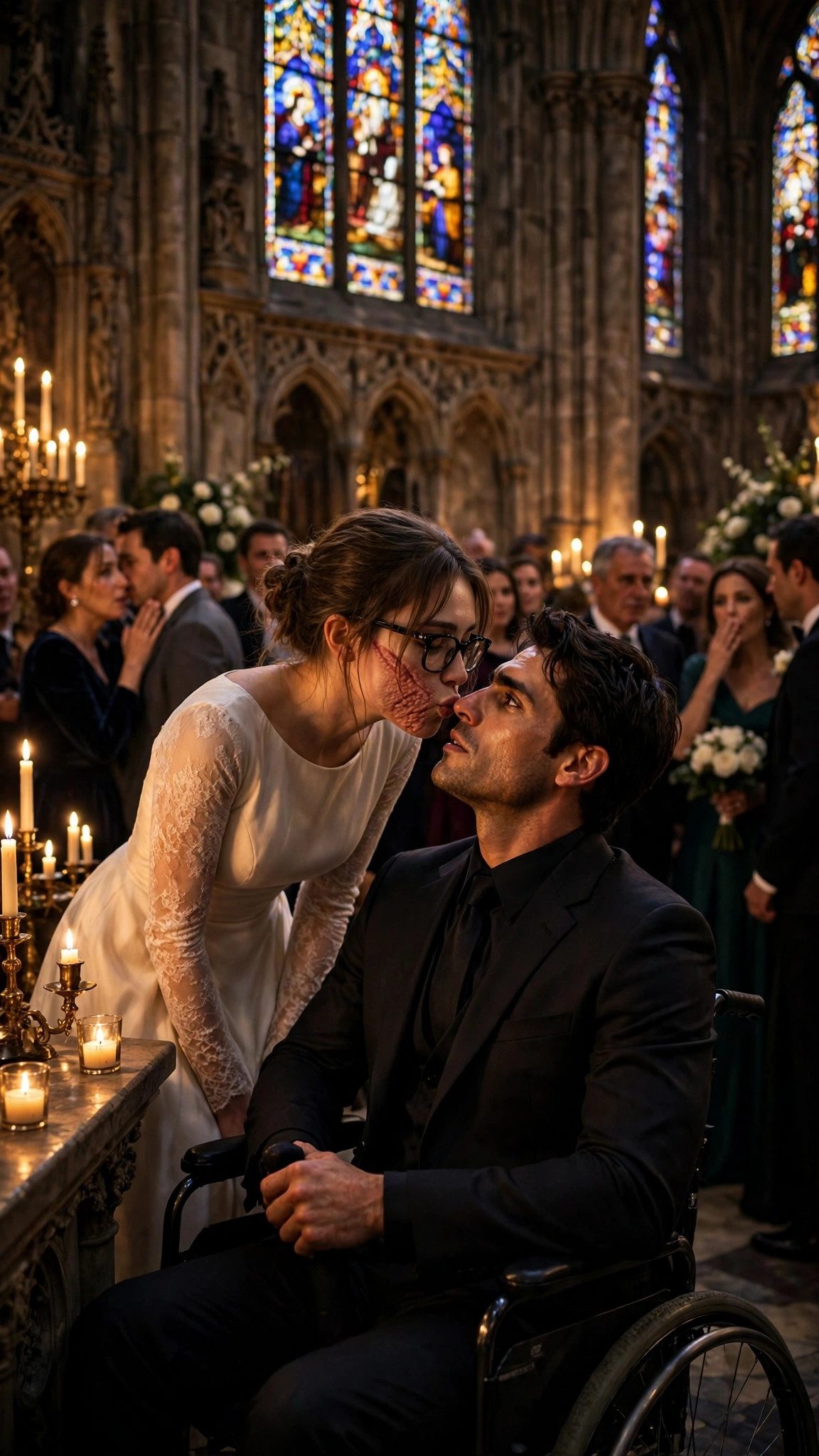
I told him about the cathedral. I told him about the reception. I told him about the bedroom, and the scar coming off, and Adrian standing up out of his wheelchair. I told him everything, and when I was finished, Reyes closed his notebook, and he looked at me, and he said:
"Mara, I have been doing this job for eighteen years, and I have never met a witness like you. Most people lie to me for the first hour and then tell me the truth. You told me the truth from the first sentence."
"I've spent ten years lying about my face," I said. "I'm done lying."
He nodded, and he told me what would happen next.
The bottle of amaro was already at the FBI lab, and the lab had confirmed it: aconite, a fast-acting poison, enough to kill two adults. The chemist in Cicero had been arrested, and he had given them Celeste's name, and the date, and the amount she had paid, and a description of the car she had arrived in. Tommy Falco had already given his statement, and the payment records — three accounts, all traced back to companies my father controlled — had been subpoenaed, and the money trail was clean and clear and damning.
My father was charged with attempted murder, conspiracy to commit murder, and fraud. He was denied bail. He sat in a federal detention center in downtown Chicago, in an orange jumpsuit, waiting for a trial that would take months, and his lawyer told the newspapers that it was all a misunderstanding, and that Salvatore Barone was a legitimate businessman, and that his daughter was confused.
Nobody believed him. Not after the bottle. Not after Tommy Falco. Not after the money.
Celeste was charged too, at first — conspiracy, attempted murder — and she spent one night in a cell, and she cried, and she called her lawyer, and she called her father, and her father did not answer, because he could not, and then she called me.
It was two in the morning, and I was sitting in the kitchen of Adrian's house, in a robe, drinking tea, because I could not sleep, and my phone rang, and it was a number I did not recognize, and I almost did not answer it.
"Mara," Celeste said, and her voice was small and shaking, the way it had never been small before. "It's me. Please don't hang up."
I did not hang up. I listened.
"I'm scared," she said. "I've never been scared before. Father always fixed everything. And now he's in jail, and they're saying I tried to kill someone, and I don't know what to do."
"You poisoned a bottle and handed it to me," I said. "You told me to pour it for my husband and then drink it myself. What did you think would happen?"
"I didn't think," Celeste whispered. "That's the truth. I didn't think about you at all. I never thought about you at all. You were just… the other girl. The one with the scar. I didn't think you were a real person."
She cried then, quietly, and I sat in the kitchen with the phone against my ear, and I thought about all the years I had spent being invisible to her, and I thought about Ruth, and I thought about the scar lying in a drawer in my bedroom, and I said:
"Come and tell them the truth, Celeste. Tell Reyes everything. Tell him Father ordered it. Tell him you were afraid of him too. And they will be kind to you. But if you lie, they won't be."
There was a long silence on the other end of the line.
"Will you come with me?" she asked. "When I talk to them? I don't want to go alone."
I thought about it. I thought about saying no. I thought about all the years of cruelty, all the laughter, all the times she had looked at my scar and smiled. And then I thought about Ruth, who had taught me that the people who want us small do not get to decide who we are, and I thought about Adrian, who had come back to a flower shop four times just to see if I was still there, and I said:
"Yes. I'll come with you."
The next morning, Celeste walked into the FBI field office with me beside her, in her real face — no makeup, no jewelry, her hair pulled back — and she told Daniel Reyes everything. She told him about the bottle. She told him about the chemist. She told him about the morning she refused to marry Adrian, and the way her father had looked at her, and the fear she had felt, and the way she had decided, in that moment, that if she could not be the bride, then no one would be the bride, and if her father wanted a dead son-in-law, then she would help him get one, because helping him was the only way she had ever known to be safe.
Reyes listened, and he wrote it down, and when she was finished, he said, "Thank you, Miss Barone. That took courage."
Celeste cried again, and I put my hand on her arm, and she looked at me, and she said, "I'm sorry, Mara. For all of it. For the scar. For the bottle. For everything."
"Say that again," I said, and then I laughed, because it was the same thing Adrian had said to me on the altar, and because it was funny, in a sad way, how the same words could mean such different things.
"I'm sorry," Celeste said again, and this time, she meant it. I could tell. There is a difference between an apology you have been trained to say and an apology you actually feel, and I had spent ten years learning that difference.
In the end, Celeste made a deal. She testified against our father, and in exchange, the charges against her were reduced, and she was sentenced to two years of probation and two hundred hours of community service, working in a women's shelter on the south side, serving meals to women who had nowhere else to go.
She wrote me a letter, months later, from the shelter, on lined paper, in her neat handwriting. It said: "I served soup today to a woman who reminded me of you. She apologized for taking two rolls. I told her not to apologize for being hungry. I thought you would like that."
I did like that. I liked it very much.
My father went to trial in the spring. The trial lasted three weeks. Tommy Falco testified. The chemist testified. Celeste testified. I testified. I sat in the witness box in a blue dress, with my real face, and I told the jury everything, from the beginning, slowly, the way Reyes had taught me, and when the prosecutor asked me why I had worn a fake scar for ten years, I said:
"Because my father told me that my face was a problem, and that if I hid it, the woman who raised me would be safe. And I believed him, because I was seventeen, and he was my father, and I did not know yet that a father who makes his daughter hide her face does not love her. He owns her."
The jury was out for six hours. When they came back, the foreman stood up, and he said the word "guilty" three times, once for each charge, and my father sat very still, and he did not look at me, and I did not look at him, and it was over.
He was sentenced to life in prison, without the possibility of parole, and the judge said, in her closing remarks, that she had seen many kinds of cruelty in her courtroom, but that she had never seen a father try to murder his own daughter by using her as a poisoner, and that she hoped he would spend the rest of his life thinking about that.
After the trial, I went to see Ruth. She was in her new facility in Evanston, in a room with a window that looked out on a garden full of roses, and a nurse named Anna who knew the way she liked her tea, and a small table where she did jigsaw puzzles in the afternoon.
She looked at me when I came in, and she smiled, and she said, "There you are," and then she frowned, and she said, "Where is your scar, Mara?"
"I took it off, Ruth," I said, and I sat beside her, and I took her hand, and it was thin and warm, and I said, "I don't need it anymore."
"Good," Ruth said, and she patted my hand. "You were always too pretty for that ugly thing. Your mother would have hated it."
"Tell me about her," I said, because I was always hungry for pieces of my mother, and Ruth told me the story about the bread burning, and the rent being late, and the laughing, and I listened, and I thought about how far I had come, from a girl in a flower shop who apologized for existing, to a woman who had testified against her own father in a federal courtroom, and I thought about Adrian, waiting for me at home, in a house that was starting to feel like mine.
And I thought about the future, and for the first time in my life, it did not frighten me.
It felt like a door, opening.
The morning after the trial ended, I went to see Ruth, and I brought her flowers — white roses, with the stems all even and the paper folded twice, the way my mother used to wrap them — and I set them on the table beside her bed, and she looked at them, and she smiled, and she said, "Those are beautiful, Mara. Did you arrange them yourself?"
"I did," I said. "I used to arrange flowers for a living, you know. At the shop on Division Street. I was good at it."
"You were always good with your hands," Ruth said. "Your mother was the same. She could make anything beautiful. A loaf of bread. A table setting. A life."
I told her about the trial then, slowly, in simple words, because her memory slipped in and out like the tide, and I wanted her to understand the important part.
"My father is in prison, Ruth," I said. "He can't hurt us anymore. You're safe. I'm safe. We're both safe."
Ruth looked at me for a long moment, and her eyes were clear, clearer than they had been in months, and she said, "Good. That man was a storm, Mara. He blew through your mother's life and he blew through yours, and storms always pass, if you wait long enough. You waited. I'm proud of you."
Then she reached out, and she touched my cheek, with her thin fingers, and she said, "No scar today."
"No scar," I said. "Not anymore. Not ever again."
"Good," Ruth said, and she closed her eyes, and she smiled, and she fell asleep in her chair, with the white roses on the table beside her, and I sat with her for a while, listening to her breathe, and thinking about how much had changed, and how much had stayed the same.
A month later, I went to see Celeste at the women's shelter on the south side, where she was serving meals as part of her community service. The shelter was a big, plain building with a kitchen that smelled like soup and bread, and Celeste was standing behind a counter in an apron, with her hair pulled back, ladling soup into bowls, and she looked up when I came in, and she looked almost… happy. Not the bright, sharp happiness she used to perform, but something quieter. Something real.
"Mara," she said, and she came around the counter, and she hugged me, and it was the first time my sister had ever hugged me, and I stood very still, because I did not know what to do with it, and then I hugged her back, because that is what sisters do.
"How is it here?" I asked.
"It's hard," Celeste said. "The women here have nothing. Less than nothing. And they apologize for everything, the way you used to apologize. For taking an extra roll. For asking for a blanket. For existing. And every time one of them apologizes, I think of you, and I tell them not to apologize. I tell them they deserve to be here. I tell them they deserve to eat. And sometimes they believe me."
She showed me around the shelter then — the dining room, the dormitory, the little garden out back where the women grew tomatoes in the summer — and she introduced me to a woman named Grace, who had three children and no husband and a laugh like a bell, and Grace told me that Celeste was the kindest volunteer they had ever had, and that she stayed late every night to help clean up, and that she never complained, and I looked at my sister, in her apron, with soup on her sleeve, and I thought about how strange life was, and how people could change, if you gave them a reason to.
On the way home, I thought about Ruth's words — storms always pass, if you wait long enough — and I thought about my father, sitting in a cell, and Celeste, serving soup to women who had nothing, and Adrian, waiting for me at home, and I thought about how the storm had passed, at last, and how the sky, after a storm, is always clearer than it was before.