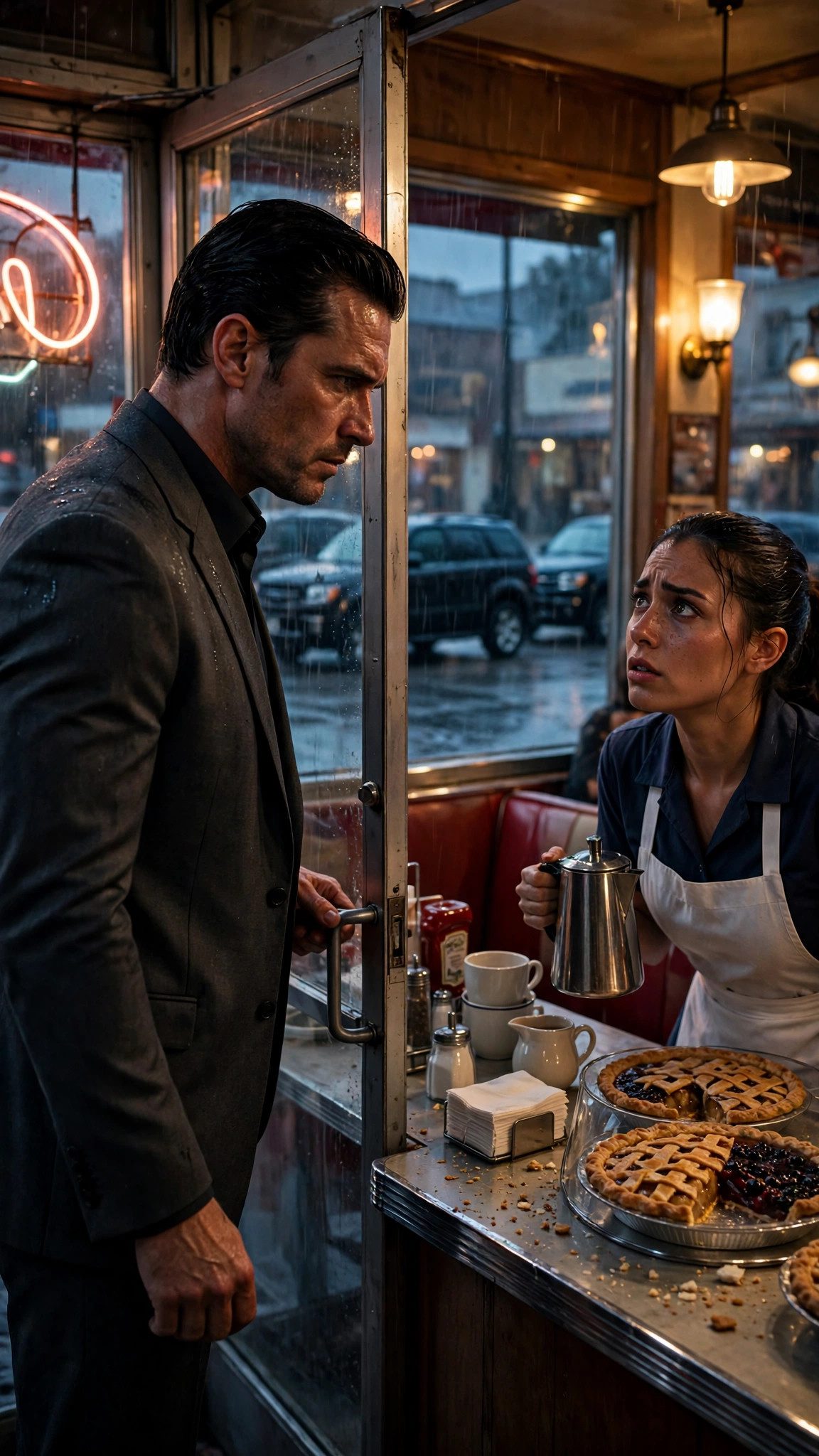
Three black SUVs surrounded Rosie's Diner at 6:47 on a Thursday evening, and I knew, the way you know when a storm is about to break the sky open, that my life was about to change forever.
I was wiping down the counter with a rag that had seen better days, and the bell over the door had not rung in twenty minutes, and the pie case was half empty, and the coffee was going bitter in the pot because Al had gone home sick and I was covering his shift on top of my own. The street outside the window was the same street it always was: cracked sidewalk, the laundromat with its buzzing sign, Mrs. Kowalski's bodega with the crates of oranges out front. Then the first SUV pulled up to the curb, black as a hearse, windows so dark they looked painted on. Then the second. Then the third, boxing the diner in from both ends like the street had been closed for a parade nobody told me about.
My hand stopped moving on the counter.
The doors of the SUVs opened in unison, and men in dark suits stepped out, and they did not look at the diner the way customers look at a diner. They looked at it the way soldiers look at a building they have been told to secure. One of them stood by the door. One of them walked to the corner and looked up and down the street. One of them opened the back door of the middle SUV, and the man who stepped out was the man I had dragged from a burning car three weeks earlier.
I knew him the moment I saw him, even though the last time I had seen him he had been unconscious and bleeding and half dead on the shoulder of the highway with his shirt soaked through and his face black with smoke. He was tall, and broad through the shoulders, and his dark hair was combed back from a face that looked like it had been carved out of something hard and then left out in bad weather. He wore a charcoal suit that probably cost more than I made in six months, and he moved the way men move when the whole world is used to getting out of their way.
Dominic Salvatore. I did not know his name yet. But I knew his eyes. Dark, piercing, the kind of eyes that look at you once and seem to see straight through you and into the ground beneath your feet.
He walked toward the diner door, and his men fell in behind him, and the bell over the door rang, and every head in the place turned, and the whole diner went quiet the way a room goes quiet when a gun has just gone off somewhere far away and everyone is waiting to find out where the bullet landed.
He stopped three feet inside the door. His eyes found me behind the counter. And he said, in a voice like gravel rolling downhill, "Emma Hart."
It was not a question. He knew my name. I had never told him my name.
That was Thursday. But the story started three weeks earlier, on a Tuesday night in October, on the highway outside the city, in the rain.
I had been at Rosie's since dawn that Tuesday because Al was sick and my shift had started again before it had properly ended. Al had called that morning, his voice thin and apologetic through the phone, and asked if I could cover, and I had said yes because that is what I always said, because the rent did not care whether I was tired and Lily did not care whether I was tired and the electric bill did not care whether I was tired. I had worked the breakfast rush and the lunch rush and the long slow afternoon when the only customers were the truckers and the old men who nursed one cup of coffee for two hours and talked about baseball like it was still 1978.
By nine o'clock that night my feet were screaming inside my shoes and my apron was stained with ketchup and coffee and something I did not want to identify, and all I wanted was to get home to the little apartment on the highway, where Lily was asleep in her bed with her stuffed rabbit, and Mrs. Deluca from downstairs was watching her for me, and the whole world was small and quiet and mine.
The rain started just as I pulled out of the diner parking lot. Not a drizzle. A real October rain, the kind that comes down sideways and turns the highway into a black mirror and makes the headlights of every car smear across your windshield like wet paint. I turned the wipers up to high and slowed down to fifty and told myself, twenty minutes, just twenty minutes, and then home.
I was seven minutes from the exit when I saw the lights.
At first I thought it was a jackknifed truck. There were headlights pointed the wrong way, and brake lights, and something burning orange against the black rain. Then I got closer, and I saw that it was not a truck at all. It was a black sedan, a big expensive one, and it had gone off the road and down the shallow embankment and hit the guardrail post hard enough to fold the front end in like a crushed tin can, and the engine was on fire.
I have thought about what happened next a thousand times since, and I still do not have a good explanation for it, except that there are some moments in your life when your body decides before your brain does. I pulled over. I put on my hazard lights. I got out of my car in the rain, in my waitress uniform, with my apron still on, and I ran down the embankment toward a burning car without thinking about it at all.
The heat hit me from ten feet away. The smoke was thick and black and it smelled like gasoline and melted plastic. The driver's door was jammed. I could see a man inside, slumped over the steering wheel, not moving. Blood was running down the side of his face from a cut on his temple, and his suit was dark with it, and his hands were still on the wheel like he had been holding on when the world ended.
"Boss? Sir?" I called softly, because my voice did not seem to want to work properly. "Are you okay?"
He did not answer.
"Hey, buddy, are you okay?" I said, louder, and I yanked at the door handle with both hands, and the door screamed on its hinges and came open two inches and stuck.
The fire was in the engine, but it was spreading, licking along the hood toward the windshield, and the smoke was getting thicker, and I knew, in the part of my brain that still worked, that I had maybe a minute before the whole thing went up. I put my foot against the door frame and pulled with everything I had, and the door gave way all at once, and I nearly fell backward down the embankment.
I reached in and grabbed him under the arms. He was heavy. He was so much heavier than he looked, all muscle and dead weight, and his head lolled back, and his eyes were closed. I dragged him out of the car and down onto the wet grass, away from the heat, and I laid him on his back and pressed my ear to his chest, and I heard his heart beating, slow and uneven, but beating.
"Stay with me," I told him. "Stay with me, okay? You are not dying on the side of the highway tonight. Not on my shift."
I called 911 with hands that were shaking so hard I could barely hold the phone. I told the dispatcher where we were, and I told her there was a man unconscious and bleeding and a car on fire, and she told me to stay on the line, and I did, and I kept talking to him the whole time, because someone had once told me that people in comas can hear you, and I did not know if he was in a coma but I was not taking any chances.
"My name is Emma," I told him. "I work at Rosie's Diner. I am going to stay right here with you until the ambulance comes. You are going to be fine. You hear me? You are going to be fine."
The rain was coming down on both of us, washing the blood off his face in thin pink streams, and his eyes were still closed, and then, just as the sirens started to wail in the distance, his eyes opened.
His eyes locked onto mine, dark, piercing, and it appeared as if a single glance could burn a hole through me and into the ground. His lips moved. His voice came out rough, like a man who had been shouting for a very long time.
"Oh, thank God," he said. "It's you."
I stared at him. "What?"
"It fits perfectly," he said, and his eyes were already closing again. "I mean… I know who you are."
And then the paramedics were there, and the firefighters were there, and the whole embankment was full of flashing lights and shouting men, and they loaded him onto a stretcher, and one of them asked me if I knew him, and I said no, I had just pulled him out of the car, and they asked me for my name, and I gave it, and then they were gone, and the car was a black skeleton steaming in the rain, and I stood there in my wet uniform with my apron soaked through, and I realized my hands were covered in his blood.
I stood there for a long time after the ambulance left, in the rain, with the burned-out car steaming in front of me, and I thought about how close I had come to driving past, how easy it would have been to keep going, to tell myself that someone else would stop, that it was not my problem. Seventeen cars had passed before me. Seventeen people had looked at a burning car and kept driving. I did not feel proud of myself for stopping. I felt shaken, and cold, and grateful in a way I could not explain, grateful that my hands had known what to do even when my brain had not, grateful that the man was alive, grateful that I had been there at all. The smell of smoke was in my hair and on my clothes, and it stayed there for days, no matter how many times I washed, as if the night had marked me somehow, as if it had chosen me for something I did not yet understand.
I drove home in a daze. Mrs. Deluca was asleep on my couch. Lily was asleep in her bed with her stuffed rabbit tucked under her chin.
The next morning, Lily found my uniform in the laundry basket and held it up with both hands, staring at the dark stains on the front.
"Mommy, what is this?" she asked. "Did you hurt yourself?"
"No, baby," I said, kneeling down so my eyes were level with hers. "I helped a man who was hurt. He is going to be okay because I stopped."
She considered this with the grave seriousness only a seven-year-old can manage. "Were you brave?"
"I was scared," I told her honestly. "But I did it anyway. That is what brave means."
She nodded, satisfied, and went back to her cereal, and I stood in the kitchen with my coffee going cold in my hands, thinking about how simple the world looked from her side of the table. Brave meant doing it anyway. I wished it were that simple for me.
Mrs. Deluca came downstairs an hour later with the morning paper tucked under her arm, and she spread it open on the counter while Lily brushed her teeth. There it was, on page three, a short article with a photograph of a burned-out car on the highway: a black sedan had been run off the road late Tuesday night, the driver had been pulled from the wreck by a passing motorist before the car caught fire, and he was in critical condition at St. Vincent's Hospital. The police were looking for a truck that had fled the scene.
"A truck hit him and drove away," Mrs. Deluca said, shaking her head. "Animals. And you were the one who stopped, Emma. You were the only one."
"I was just there," I said.
"No," she said, and her voice was firm in the way only a woman who has buried a husband and raised four children alone can be firm. "You were the one who stopped. That is never just anything."
I washed my hands until the water ran clear, and I changed out of my uniform, and I sat at the kitchen table for a long time, staring at nothing, thinking about the man's eyes and the strange things he had said.
It fits perfectly. I know who you are.
I did not know what he meant. I decided it did not matter. He was alive. That was enough. I had done a good thing, and good things were rare enough in my life that I decided to take this one and hold onto it and not ask too many questions.
I went back to work the next day. I served pie. I poured coffee. I helped Lily glue silver stars onto a piece of cardboard for her school play, because she was going to be a star, she informed me, the brightest star in the sky, and she needed a costume, and costumes cost money, and money was the thing I never had enough of.
Three weeks passed. The rain stopped. October turned toward November. My landlord slipped a note under my door saying the rent was going up to three thousand dollars starting in January, and I read it twice, and I did the math in my head, and the math did not work, and I folded the note up and put it in the drawer with the other bills and tried not to think about it.
And then, on a Thursday evening at 6:47, three black SUVs surrounded Rosie's Diner, and the man from the burning car walked through the door, and he knew my name, and he said it like a man who had been waiting three weeks to say it.
"Emma Hart," he said again, and he took one step closer, and his men stayed by the door, and the whole diner held its breath. "My name is Dominic Salvatore. And I am here because I owe you a debt I can never repay."