The conversation that started in the hallway ended in Dante's home office.
It was past midnight. The mansion was quiet, the way it always was, but tonight the quiet felt different — thinner, like ice on a pond in early spring, the kind of quiet that might crack under your feet at any moment. Sophie sat in the leather chair across from Dante's desk, with her gray coat folded over her knees and her hands clasped so tightly her knuckles were white. Anna slept in the next room, on the couch in the library, with Paolo sitting in the armchair beside her, reading a newspaper he was not really reading, watching the door the way only an old soldier watches a door.
Dante sat behind his desk. The black box was open in front of him. The receiver. The tapes. The notebook. All of it, laid out in the lamplight like evidence at a trial.
"Tell me the rest," he said. His voice was quiet, but it was not the quiet of silence. It was the quiet of a man holding something very heavy very carefully, so as not to drop it.
Sophie looked at her hands. "There is nothing else," she said. "I told you about the bag. I told you about the tapes. I told you about Marcus and the cabinet. That is everything."
"No," Dante said. "That is not everything. There is something else. You started to say it in the car, before the phone rang. You said, 'Anna is —' and then you stopped. Finish it, Sophie. Please."
Sophie closed her eyes. She had carried this secret for seven years. She had carried it through the pregnancy, through the birth, through the two-room flat above the laundry, through the forty-minute walks to the bistro, through every night she had sat by the window and watched the rain. She had carried it so long it had become part of her, like a bone, like a scar. She did not know how to set it down.
"The baby was never mine," she said. Her voice was barely a whisper, but in the quiet office it filled the room. "It's his. It's his. I know who he is, and I know what he will think about it, and I have been afraid to tell you for seven years."
Dante went very still. "Whose?" he asked.
Sophie opened her eyes. She looked at him across the desk — at the gray at his temples, at the charcoal suit, at the cold gray eyes that had once laughed in a kitchen at midnight — and she said the words she had practiced a thousand times and never once spoken aloud.
"Yours, Dante. Anna is your daughter."
The silence in the office changed. It stopped being quiet and became something else — a held breath, a stopped heart, a room full of air that no one was breathing.
"Eight years ago," Sophie said, and the words came faster now, the way water comes when a dam breaks. "After Isabella died. The night in the kitchen. You remember it. I know you remember it, because I have seen it in your face every time you look at me and cannot remember where you have seen me before. We talked until dawn. You laughed once. And then morning came, and you became the silent king again, and I became furniture again."
She stopped. She took a breath. "Three weeks later, I learned I was pregnant. And I thought about telling you, Dante. God help me, I thought about it every day. But your father had taught you never to show weakness, and a child with a maid would be weakness, and weakness in your world is a weapon other men use to cut your throat. Castellano would have learned of her in a week. She would have grown up with a target on her back before she could walk. So I left. I left in the middle of the night, and I never told you, and I raised her alone, and I told myself that was love. That keeping her away from you was the only way to keep her safe."
Dante did not speak. He sat behind his desk with his hands flat on the wood, and his face did not change, and Sophie could not read him, because no one could read Dante Moretti. That was the rule. That was what made him terrifying.
But his hands changed. His hands, flat on the desk, curled slowly into fists. And then, very slowly, they opened again, and they trembled. Just slightly. Just enough for Sophie to see.
"She is seven," Sophie said. "She was born on a cold morning in March, in a charity hospital, and the midwife held my hand and told me I was brave. I named her Anna, after my mother. She remembers everything she sees. That is her gift. And she saw the barber's thumb, Dante. She saw it because she was looking, and no one else was looking, and that is the only reason you are alive to hear this."
Dante stood up. He walked to the window, and he looked out at the rain coming down over the gardens, and he stood there for a long time with his back to her, and Sophie sat in the leather chair with her heart hammering, waiting to find out what kind of man he was.
She had been waiting seven years to find out. And now she would know.
"I have a daughter," Dante said. His voice was so quiet she almost did not hear it. "I have a daughter, and I did not know. I have a daughter, and she saved my life, and I did not know her name until tonight."
He turned around. And his face had changed. The silence was gone. In its place was something raw and open and unguarded, the face of a man who had just been given the world and lost it in the same breath.
"Why didn't you come to me sooner?" he asked. "I would have taken care of you. I would have taken care of both of you. I would have —"
"You would have what?" Sophie said, and her voice broke, because she had waited seven years for this question, and she had an answer for it. "You would have put her in this house, behind these walls, with these men around her? The same men who planted a device behind your ear? The same men who have been listening to you for months? Dante, the men in your house are the danger. I kept her away from them. I kept her away from all of it. And I would do it again."
Dante looked at her. He looked at her for a long time, and then he did something she had never seen him do. He came around the desk. He knelt down in front of her chair — the most feared man in the state, on his knees in front of a maid in a gray coat — and he took her hands in his.
"Thank you," he said. "Thank you for keeping her safe. Thank you for bringing her to me. And I swear to you, Sophie, on my mother's name, on everything I have — no one will ever hurt her again. Not Castellano. Not Marcus. Not anyone. I will burn this city to the ground before I let anyone touch my daughter."
And then the door opened.
Marcus Hale stood in the doorway, with two men behind him, and his hand was inside his jacket, and his eyes were flat and dark, and he did not look surprised. He looked like a man who had been listening outside a door for a long time, and who had heard everything he needed to hear.
"Boss," Marcus said. "We need to talk."
Dante stood up slowly. He stepped in front of Sophie's chair, putting his body between her and the door, the way a man puts his body between his family and a gun.
"Talk," Dante said.
Marcus looked at the black box on the desk. He looked at the tapes. He looked at the notebook. And his face did not change either, because Marcus Hale had spent nine years learning the same silence Dante had learned.
"You found the box," Marcus said. "I wondered when you would. Enzo said the maid was asking questions. I told him not to worry. I told him maids don't ask questions that matter."
"Enzo told you," Dante said. "And you told Castellano. For four months. For money? Or for something else?"
Marcus smiled. It was a small smile, and a cold one. "For the future, boss. Castellano offered me the future. You offered me the past. Your father is dead. Your wife is dead. Your empire is dying, and you are sitting in the dark, whispering to yourself, while the world moves on. I chose the man who is moving."
Dante did not move. He did not raise his voice. He simply looked at Marcus, and his voice, when it came, was so quiet that the two men behind Marcus leaned in to hear it.
"Get out of my house," Dante said.
Marcus laughed. "Your house, boss? This house belongs to whoever is strong enough to hold it. And you — you are not strong anymore. You are a man who kneels in front of maids. You are a man with a daughter he did not know about. You are a man with a listening device behind his ear, and you did not even know it was there. You are weak, boss. And weak men lose."
He stepped forward. The two men behind him stepped forward too. And Sophie, in the leather chair, felt her heart stop, because she understood what was happening. Marcus had come to take the box. And he had come to take her, and Anna, because they were witnesses, and witnesses did not live long in Marcus Hale's world.
But Dante Moretti did not step back. He stood in front of Sophie's chair, and he looked at Marcus, and he said, very quietly, "Sophie. Take Anna and go to the library. Lock the door. Do not open it for anyone but Paolo."
Sophie stood. Her legs shook. She walked to the door of the library, and she did not look back, because she was afraid that if she looked back, she would see something she could not unsee.
Behind her, she heard Dante's voice, low and cold and final, the voice of the silent king, the voice that had ruled this state for ten years.
"Marcus," he said. "You have been listening to me for months. So you should know exactly what I am about to do."
And then the library door closed, and Sophie locked it, and she held Anna in her arms, and she listened to the sounds from the office — the shouting, the crash of furniture, the sound of a man who had been silent for ten years finally, finally speaking — and she understood that the war for the Moretti empire had begun, and that it would be fought over a black box, and a maid, and a little girl who had whispered in the rain.
In the library, Sophie held Anna against her chest, and Anna held her mother's hand, and they listened.
They heard the shouting first — Marcus's voice, raised, the gravel in the bucket turning to broken glass. Then the crash of furniture, the desk chair going over, the lamp shattering against the wall. Then a sound Sophie had never heard before, and hoped never to hear again: the sound of Dante Moretti speaking. Not whispering. Speaking. Loud, and cold, and furious, his voice filling the house the way it must have filled it before his wife died, before the silence came.
"Four months, Marcus! Four months you have been selling my words! My men! My family!"
Then a thud. Then another. Then silence — a different silence than before, a silence that came after violence, heavy and ringing.
Anna looked up at her mother with wide eyes. "Mama," she whispered. "Is Mr. Moretti all right?"
Sophie did not know. She held her daughter tighter, and she pressed her ear to the library door, and she listened for footsteps, for voices, for any sound that would tell her who was still standing on the other side.
After a long time, there was a knock. Soft. Three knocks, the way Paolo always knocked.
"Sophie," Paolo's voice said, low and steady. "It is Paolo. You can open the door."
Sophie unlocked the door with shaking hands. Paolo stood in the hallway, his white hair ruffled, his jacket torn at the shoulder, a bruise darkening on his cheek. Behind him, the office door stood open, and Sophie could see the wreckage inside — the overturned chair, the shattered lamp, the papers scattered across the floor like fallen leaves.
"Where is he?" Sophie asked.
"In the office," Paolo said. "He is all right. Marcus is not."
Sophie walked into the office with Anna's hand in hers. Marcus Hale lay on the floor beside the desk, his hands tied behind his back with his own belt, his face bloody, his eyes open and furious. The two men who had come with him sat against the wall, guarded by two of Dante's loyal men — men Sophie recognized from the bistro, men who had always been polite to her, men who had never once looked through her the way the others did.
Dante stood by the window, with his back to the room, looking out at the rain. His jacket was torn. His knuckles were bloody. But he was standing, and he was breathing, and when he turned around and saw Sophie and Anna in the doorway, his face changed — the fury draining out of it, replaced by something softer, something she had seen only once before, in a kitchen at midnight, eight years ago.
"Anna," he said, and his voice was gentle now, the way a father's voice is gentle when he is speaking to a child he has just met and already loves more than his own life. "Are you all right?"
Anna nodded. She looked at Marcus on the floor, and at the blood on Dante's hands, and at her mother, and then she walked across the office — small boots on the marble, steady as a soldier — and she stood in front of Dante Moretti, and she looked up at him, and she said, "You talked loud, Mr. Moretti. I heard you all the way in the library. Mama says talking makes the sad come out. Did the sad come out?"
Dante looked down at her. He looked at her for a long moment, and then he did something no one in that room had ever seen him do. He knelt down, in his torn jacket, with his bloody knuckles, in front of a seven-year-old girl in a gray coat, and he said, "Yes, Anna. The sad came out. And do you know what I found underneath it?"
"What?" Anna asked.
"Anger," Dante said. "And underneath the anger, I found something else. I found you."
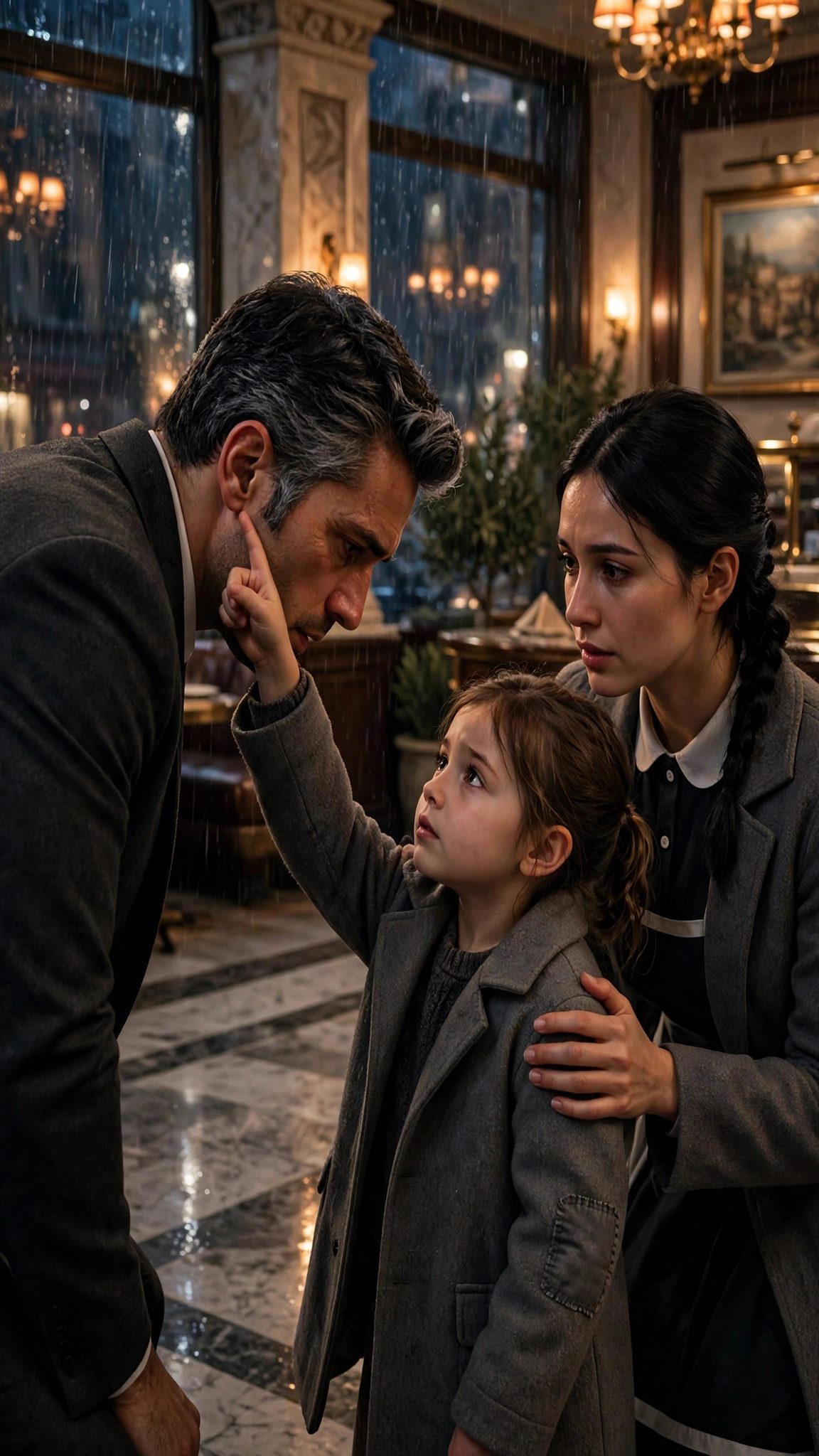
Anna thought about this. Then she reached up, very carefully, and she touched the spot behind his ear, where the tiny black dot had been. Dante had torn it off in the office, in the first minute of the fight, and the skin was red and raw.
"Does it hurt?" she asked.
"A little," Dante said. "But it will heal. Things heal, Anna. That is the secret no one tells you. Things heal, if you let them."
Sophie watched them — the most feared man in the state, on his knees in front of her daughter, in a wrecked office, in the rain — and she felt something break open in her chest, something she had kept locked for seven years, something she had thought was dead.
It was not dead. It was hope. And hope, Sophie was learning, is the most dangerous thing in the world, because once you let it in, you can never be invisible again.
Dante stood up. He looked at Marcus on the floor, and his face hardened again, the king returning, the silence returning — but it was a different silence now. Not the silence of a man who has nothing to say. The silence of a man who is deciding what to do next.
"Paolo," Dante said. "Call Agent Reyes. Tell him we have a gift for him. Three men, and a black box full of tapes, and a notebook full of times. Tell him Castellano's name is in every page of it. And tell him to come now, before Castellano learns that his line has gone dead."
Paolo nodded and left the room, and Dante turned to Sophie, and he said, "I need you to do one more thing for me. I need you to tell Reyes everything you told me. About the bag. About the tapes. About Anna seeing the barber. All of it. Can you do that?"
Sophie looked at him. She looked at Anna. She looked at Marcus on the floor, and the wrecked office, and the rain on the window. And she said, "Yes. I can do that. I have been invisible for eight years, Mr. Moretti. I think it is time I was seen."
Dante nodded. "Good," he said. "Because from tonight on, no one in this house will ever look through you again. I swear it. You are the mother of my daughter. You are under my protection. And anyone who touches you will answer to me."
And Sophie Miller, who had spent seven years hiding a black box and a baby and a truth, finally understood what it meant to be safe. It did not mean being invisible. It meant being seen — by the right man, at the right time, for the right reason.
And the right man was standing in front of her, with bloody knuckles and a torn jacket, looking at her daughter like she was the only light in the world.