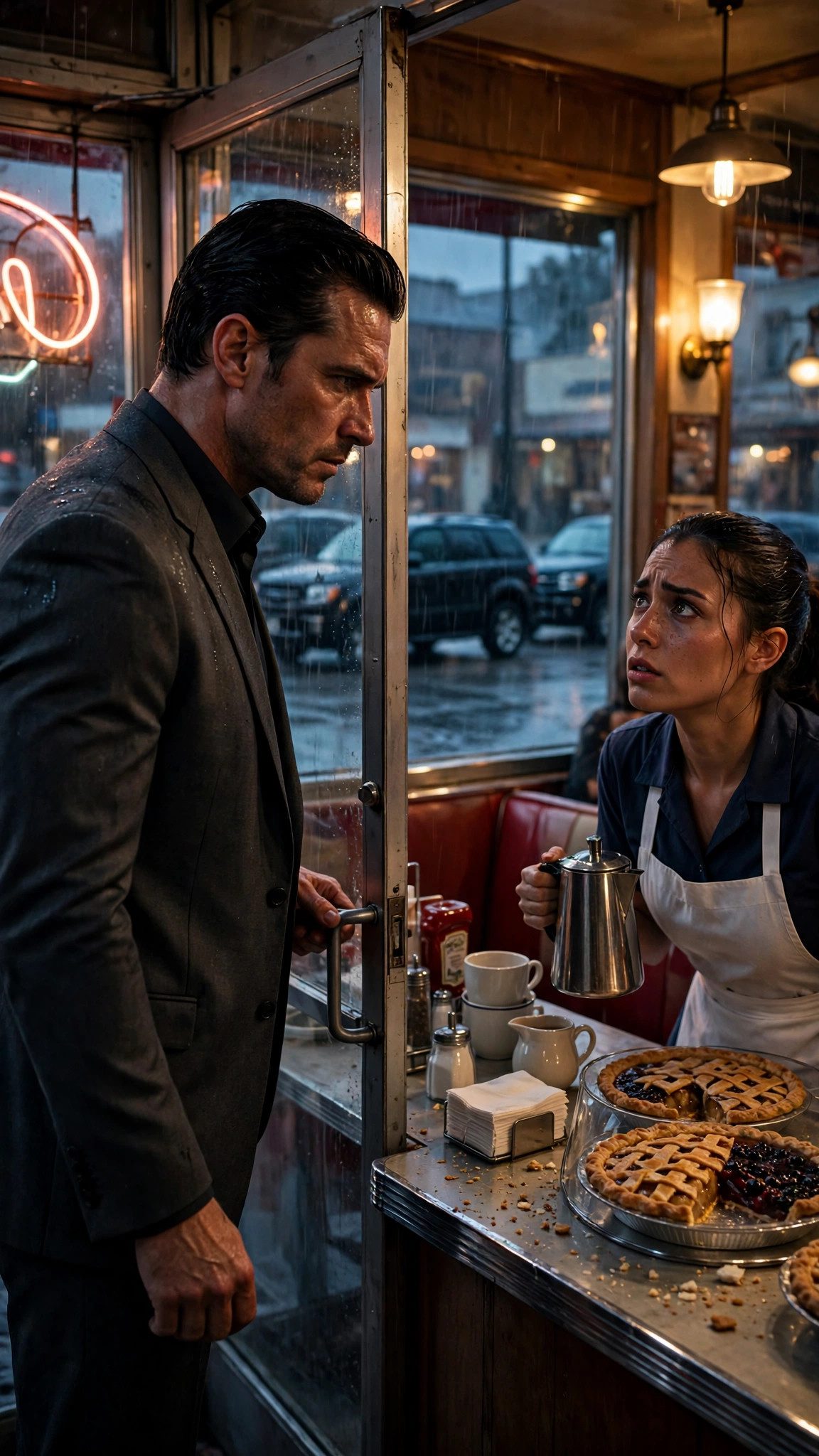
My alarm went off at 4:45 every morning, and every morning I hated it for exactly three seconds before I remembered Lily and got up.
The apartment was small and cold in the dark, and I moved through it the way I had moved through it for six years, by memory and by habit: coffee on, lunchbox out, bread in the toaster, Lily's clothes laid out on the chair the night before. Lily's room was the warmest room in the apartment because the radiator in there actually worked, and she slept curled around her stuffed rabbit with her hair spread across the pillow like spilled ink, and every morning I stood in her doorway for one extra second just to look at her, because she was the whole reason for everything.
"Mommy, five more minutes," she would mumble without opening her eyes.
"No, baby. School. Up."
She was seven years old, all elbows and questions, with my dark hair and her father's grey eyes. Her father had been Daniel Hart, a firefighter with the kind of laugh that filled a whole room, and he had died six years ago in a warehouse fire on the West Side, and Lily had been one year old, and she did not remember him at all. She knew him from the photographs on the mantel and from the stories I told her, and sometimes she asked me questions about him that I could not answer, and I had learned to say, "Your daddy loved you very much," because it was true and because it was the only answer that ever helped.
I still wore my wedding ring. It was a plain gold band, worn thin on one side from six years of dishwater and diner coffee and living. People sometimes looked at it and then at me, and I could see them doing the math, and I never explained. The ring was not a promise anymore. It was a memory. It was the last thing Daniel had ever given me, and I was not ready to let it go.
By six in the morning, Lily was dressed and fed and out the door with Mrs. Deluca, who walked her to school every day for twenty dollars a week that I could barely afford and Mrs. Deluca pretended not to need. By six-thirty I was at Rosie's Diner, tying my apron, clocking in, breathing in the smell of coffee and bacon grease and floor cleaner that had been the smell of my life for eight years.
Rosie's Diner was not a beautiful place. The vinyl on the booths was cracked and patched with tape. The neon sign in the window buzzed and flickered, and one letter had been dead for two years. The pie case had a chip in the glass. But it was warm, and it was honest, and the people who came there were the kind of people who said good morning and meant it, and Al, the owner, was the kind of man who had given me the job when I was a pregnant widow with no references and no money, and I owed him more than I could ever pay.
Al was seventy-one years old, with hands like tree roots and a heart that the doctor had been warning him about for a decade. That October he had caught a cold that turned into bronchitis, and he had gone home sick, and the diner had fallen to me and to Marco, the cook, who was sixty-four and moved like a man carrying an invisible piano on his back.
The oven broke on a Wednesday, right in the middle of the lunch rush. One minute it was fine, and the next minute there was a pop and a smell like burning wire, and Marco opened the door and swore in Italian, and I stood there with three orders of meatloaf on my pad and no oven to cook them in.
"We will manage," Al said on the phone, his voice thin and wheezing. "Sandwiches. Soup. Pie. People come for the company as much as the food."
So we managed. I served pie while the regulars complained about the oven and then stayed for an extra cup of coffee anyway, because that is what regulars do. Eddie Kowalski, the trucker, told me the same story about the blizzard of '09 he told me every week. Old Mr. Peterson did the crossword and asked me for the answer to seven-down, which was always the same answer I gave him last week. The morning crowd came and went like the tide, and I poured coffee and cleared plates and smiled until my face hurt, and at the end of every shift I counted my tips in the back room and did the math in my head, and the math never quite worked.
One morning, I found a drawing on the kitchen table that Lily had made the night before, in crayon, on the back of a grocery bag. It showed our little apartment, and me in my waitress uniform, and her in her sunflower costume, and a tall dark man standing beside us, holding my hand. Underneath, in her careful second-grade handwriting, she had written: "My family." I stood there looking at it for a long time, because Lily had never drawn a man in our family before. Our family had always been just the two of us, me and her, and Mrs. Deluca downstairs, and the photographs of Daniel on the mantel. I folded the drawing up carefully and put it in the drawer with the bills, on top of the credit card statement, because I did not know what else to do with it, and because something about it made my chest ache in a way I did not understand yet.
The rent notice came on a Monday. My landlord, Mr. Hendricks, was a thin man with thin lips who owned half the block and smiled like a man who enjoyed bad news. He slipped the envelope under my door, and I found it when I got home that night, and I read it twice standing in the hallway with my coat still on.
Starting in January, the rent on my apartment would go up to three thousand dollars a month. Three thousand dollars. I made twenty-two hundred in a good month, and that was with double shifts and tips, and Lily's school needed fifty dollars for the field trip, and the electric bill was due, and my car needed new brakes, and the numbers did not add up no matter how many times I added them.
I folded the note up and put it in the drawer with the other bills, on top of the credit card statement and the dentist's reminder, and I stood in my kitchen for a long time, looking at the drawer, thinking about the fact that I was a woman who had dragged a dying man out of a burning car and I could not figure out how to pay three thousand dollars a month for a two-bedroom apartment with a radiator that only worked in one room.
Lily's school play was the one bright thing in those three weeks. She was going to be a sunflower. Not the star, the way she had first announced, but a sunflower, which she informed me was even better, because sunflowers were tall and brave and they always faced the light. She needed a costume, and costumes cost money, and I did not have money, so I went to the thrift store on my day off and bought a yellow curtain for three dollars and a green tablecloth for two, and I stayed up late for three nights with a needle and thread, sewing petals out of the curtain while Lily slept, pricking my fingers and swearing under my breath and then apologizing to the empty room.
"Mommy, are you making my costume?" she asked me on the third night, standing in the doorway in her pajamas, rubbing her eyes.
"I am making the most beautiful sunflower costume anyone has ever seen," I told her.
"Will it have a face?" she asked.
"It will have your face," I said. "That is the most beautiful part."
She beamed at me, and she went back to bed, and I sat there with the needle in my hand and the yellow curtain in my lap, and I thought about how much I loved her, and how tired I was, and how I would sew a thousand costumes if that was what it took.
The detective came on the Friday of the second week. He was a tall man in a grey suit, with a tired face and a notebook, and he sat at the counter and ordered coffee and then showed me his badge and asked if he could ask me some questions about the accident on the highway.
"Of course," I said.
He asked me what I had seen. I told him: the sedan, the fire, the man unconscious, the truck that had fled the scene. He wrote it all down in his notebook in small neat handwriting, and then he asked me if anyone had contacted me since that night. Anyone at all. A phone call. A visitor. Anything strange.
"No," I said. "Why would anyone contact me?"
He looked at me for a long moment, and then he said, "The driver of that car is a man with a great many enemies, Miss Hart. Powerful enemies. The crash may not have been an accident. If anyone approaches you, about the crash or about him, I want you to call me." He slid a card across the counter. Detective Ryan Cole. "Do not talk to strangers about that night. Do not accept anything from anyone. And do not go anywhere with anyone you do not know."
I took the card because it seemed rude not to, and I put it in my apron pocket, and I forgot about it almost immediately, because detectives and warnings and powerful enemies belonged to a world that had nothing to do with me. I was a waitress. I served pie. I sewed sunflower costumes out of thrift-store curtains. Men with powerful enemies did not come into my life, except for one night on a rainy highway, and that night was over.
On Sunday, Mrs. Deluca invited us upstairs for dinner, the way she did every Sunday, and Lily sat at her kitchen table eating spaghetti with meatballs while Mrs. Deluca told her stories about the old country, and I sat by the window with a glass of wine I had not paid for and let myself breathe for the first time all week.
"Mommy," Lily said, with sauce on her chin, "tell me the story about how Daddy asked you to marry him."
I had told her the story a hundred times, and she asked for it every Sunday, and I told it again, because some stories are worth telling a hundred times.
"Your daddy took me to the lake," I said, "on a cold night in November, and he had a ring in his pocket, and he was so nervous he dropped it in the grass, and we spent twenty minutes on our hands and knees looking for it with a flashlight, and when we finally found it, he held it up and said, 'Emma Hart, will you marry me, even though I just lost your ring in the grass like an idiot?' And I said yes."
Lily giggled. "Did he cry?"
"He cried a little," I said. "And then he pretended he had something in his eye."
Mrs. Deluca reached across the table and patted my hand, and her eyes were kind, and she did not say anything, and she did not need to. She had known Daniel. She had been at our wedding. She had held Lily the day she was born. She was the closest thing to a mother I had left in the world, and on Sundays, in her warm kitchen with the smell of garlic and tomatoes in the air, I could almost pretend that the world was a gentle place.
After dinner, Lily fell asleep on Mrs. Deluca's couch with sauce still on her chin, and I carried her downstairs and put her in her bed, and I sat at the kitchen table with the yellow curtain and the needle and thread, and I sewed the last petal onto the sunflower costume, and I held it up in the lamplight, and it was not perfect, but it was beautiful, because I had made it with my own hands for a little girl who believed she was the brightest sunflower in the whole world.
I found Detective Cole's card the next morning when I was changing my apron. It was folded in the pocket, soft from being carried around for days, and I stood in the back room of the diner holding it, thinking about what he had said. Powerful enemies. The crash may not have been an accident. Do not accept anything from anyone.
I almost threw it away. Then I thought about Lily, and I thought about the truck that had fled the scene, and I put the card in the drawer under the counter instead, next to the spare pens and the sugar packets, where I would know where to find it if I ever needed it. That night, after Lily was asleep, I stood in the hallway of our little apartment and checked the lock on the front door twice, and then a third time, and I told myself I was being foolish, and I checked it a fourth time anyway, because a detective had told me that the crash might not have been an accident, and mothers do not take chances with their daughters, not even chances they do not believe in.
I did not know, standing there in the back room of Rosie's Diner with a detective's card in my hand, that I would need it sooner than I thought. I did not know that the man from the burning car had spent three weeks in a hospital bed, asking for me, and that his people had spent three weeks finding out everything there was to know about me: my name, my daughter's name, my rent, my dead husband, my little apartment on the highway. I did not know that he was coming.
That was what I believed, right up until Thursday evening at 6:47, when three black SUVs surrounded Rosie's Diner, and the man from the burning car walked through the door, and said my name like a man who had been waiting three weeks to say it.