I began searching at 5:11 in the morning.
The first eight minutes after I understood that Nora had left belonged to disbelief. The next eight belonged to fear. By 5:11, fear had become movement. I called my head of security, ordered every available man to the penthouse, and told him to bring the vehicle keys, the camera records, and the names of every person who had entered or left the building since midnight.
“Quietly,” I added. “No police broadcast. No public alert. No one approaches Nora if you find her.”
“Understood, sir.”
“And the children?”
“We'll find them.”
“That isn't an answer.”
He paused. “We'll do everything we can.”
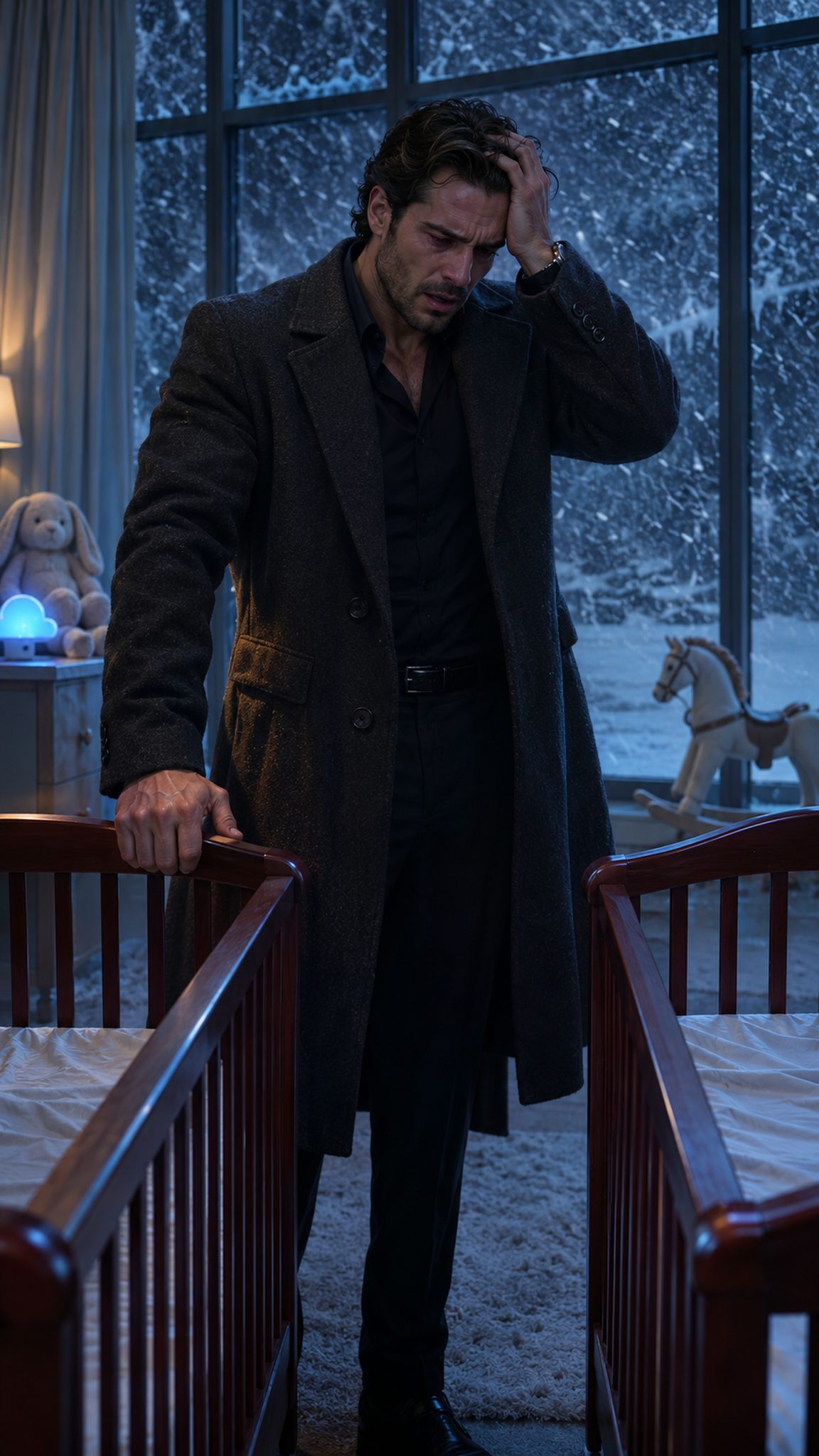
I ended the call and looked again at the nursery. The two empty mahogany cribs stood beneath the blue nightlight. I had already touched Leo's sheet once. I touched it again, as though the shallow indentation might tell me how long ago he had been lifted from it.
Nora had taken him carefully. That mattered. She had not dragged him out in panic or left his blanket tangled. The fitted sheet was smooth except for the faint impression where his body had rested. Mia's white rabbit was missing because Nora knew her daughter liked to have it close. The medicine pouch was gone because the twins were premature and their care did not pause simply because their mother had reached the end of her patience.
I forced myself to stop thinking of the departure as a single desperate act. It had been a sequence of decisions. Nora had made each one while I was somewhere else.
I walked back through the apartment and tried to see it as she must have seen it.
The kitchen first. She would have checked the formula, counted what remained, and decided how much she could carry. She had taken the bottle sterilizer, which meant she had considered where she would prepare the next bottles. The diapers were gone, not merely the open package beside the changing table but the supply we kept in the cabinet. The insulated medicine pouch from the nursery refrigerator had gone with them. She had thought about temperature, doses, and the next feeding. She had not simply grabbed two babies and run.
In the bedroom, the empty hangers told the same story. Her winter coats were missing. So were the practical boots she wore when the sidewalks froze and the nursing sweaters she reached for because they were comfortable and easy to wash. Two overnight bags had disappeared from the upper shelf. She had packed for herself and two infants, not for a weekend away.
I opened the wardrobe and stared at the spaces again.
A woman who intended to return in an hour would not take every warm coat she owned. A woman who expected to come back after an argument would not remove the babies' passports from a biometric drawer. Nora had taken the things that would let her keep moving and left behind the things she did not need.
The money remained. Fifty thousand dollars, untouched.
I had built that reserve for emergencies. I had imagined fires, threats, sudden departures, a need to move the family without warning. I had never imagined Nora deciding that the emergency was me.
My backup passports were still in their sleeves. Hers was gone. The new passports issued for Leo and Mia after their early delivery were gone too. The choice was exact. She had not taken everything she could reach. She had taken what belonged to her and the children.
I called my security chief again.
“Tell me what the cameras show.”
“We're pulling the interior feeds now. The private elevator log shows an authorized access event, but we need to match it to the footage.”
“Do it.”
“Sir, the storm has affected the exterior cameras. Visibility is poor.”
“Then use the garage feeds. The service entrance. The loading bay. Every angle.”
“Yes.”
“Find the time she left.”
“We will.”
I put on another coat, took my keys, and went down to the garage. The elevator seemed to descend more slowly than it ever had before. When the doors opened, two guards were already waiting beside the black SUV.
“Where is the driver?” I asked.
“Getting the vehicle ready.”
“I'm driving.”
One of them started to object. I looked at him, and he stepped aside.
The garage doors opened onto a city I barely recognized. Snow had covered the pavement in uneven drifts. The wind pushed loose powder across the ramp, and the headlights caught flakes moving sideways through the beams. The roads beyond the building were almost empty. A plow had passed once, leaving two dark tracks that were already filling again.
I drove toward the main avenue, looking at every bus shelter, every recessed doorway, every place a person might wait out of the wind. I knew Nora's practical habits. She would avoid a route with icy steps. She would look for somewhere warm before the babies became cold. She would not take unnecessary risks with two infants who had come home from the hospital only weeks earlier.
But the storm made every ordinary calculation dangerous. A short walk could become a struggle. A delayed bus could leave her exposed. A car could slide through an intersection. I imagined Leo's small body beneath a blanket and Mia tucked close against Nora, and the fear in me sharpened until it was almost physical.
My phone rang. It was the security chief.
“We have a partial camera match,” he said. “The private elevator opened at 4:26. Nora appears to have been carrying one infant carrier. There's another bag on her shoulder.”
“Which way?”
“The elevator went to the garage level. We're checking the vehicle exits.”
“Was she alone?”
“We can't tell from that angle.”
“Get me the footage.”
“I'm sending it now.”
The clip arrived while I was stopped at a red light. The image was grainy, but there was no mistaking Nora's winter coat. She moved carefully, one hand steadying the carrier, the other holding the strap of a bag. Her head was lowered. She did not run. She did not look over her shoulder.
I watched it again.
There was no struggle. No second figure forcing her forward. No sign of anyone carrying the babies away from her. She had walked into the elevator by choice.
“Check the next camera,” I said when the chief called back. “I want to know which vehicle she used.”
“We haven't found her in the garage exit footage yet.”
“Then she didn't leave in one of our cars.”
“That is possible.”
I gripped the steering wheel. “She didn't take one of the cars?”
“We're checking every vehicle. But the first review shows no obvious departure in a Rinaldi vehicle.”
Nora had left the money, the backup passports, and the cars I controlled. She had used none of the resources I had arranged for her.
She had planned not to be found by my people.
I drove toward the hospital district. The first hospital on my list was the one where the twins had been born. I called ahead, gave my name, and asked whether a woman with two premature infants had arrived during the night. I did not describe Nora as missing. I said there was a family emergency and I needed confirmation that the babies were safe.
The administrator transferred me to the overnight supervisor.
“No one matching that description has been admitted,” she said after checking.
“Check the emergency department.”
“I have.”
“Check the maternity ward. The neonatal unit. Any private entrance.”
“Mr. Rinaldi, I can't disclose patient information without—”
“I'm their father.”
“I understand, but I still have to follow procedure.”
I almost threatened her. The words came easily to the back of my throat. I could have told her who I was and how quickly the hospital's board would answer my calls. I could have made her afraid.
Then I remembered Nora leaving the penthouse with two babies because she had decided she could no longer trust the man who controlled the people around her.
I swallowed the threat.
“Please,” I said. “They were born prematurely. They need their medicine. I only need to know they're safe.”
Her voice softened, but her answer did not change. “I don't have a record of them here.”
I called the next hospital.
Then another.
At each one, I asked the same questions. Had two infants arrived? Had a woman in a winter coat asked for help? Had anyone come in from the storm with a baby who needed medical attention? I gave their names when necessary. I gave the approximate ages and explained that they had been premature. I kept my voice level, but my hands were tightening around the phone.
No one had seen them.
By six, my men had spread across the city. I sent teams to hospitals, urgent-care centers, twenty-four-hour pharmacies, transit stations, and shelters. I asked them to look without frightening anyone. I told them not to approach a woman carrying two infants unless they were certain it was Nora and I had given permission.
One of my captains questioned the order.
“Boss, if we find her, we should bring her home.”
“No.”
“Sir?”
“You heard me. You tell me where she is. You don't touch her. You don't take the children. You don't block her exit.”
“If she's in danger—”
“Then you get medical help. You do not make her more afraid.”
He lowered his eyes. “Understood.”
I knew what my men expected. In their world, a missing wife was a problem to be solved by locating her and returning her to the house. They had spent years watching me make decisions that other people carried out without question. They could not understand why I was asking them to find someone and then leave her free to refuse me.
I was beginning to understand it myself.
The next call came from the camera team. They had traced Nora's movement from the elevator to the garage. She had not used a car registered to me. A service camera showed her crossing toward the pedestrian exit, carrying one infant carrier and a bag. Another angle suggested she had a second carrier, partly hidden by her coat and the angle of the camera.
“Can you identify where she went after that?” I asked.
“Not from our property cameras.”
“Street cameras?”
“We're requesting access where we can. The weather is making the feeds unreliable.”
“Then send people to the nearby intersections.”
“We have.”
I stared at the frozen image. Nora's face was turned away. Her shoulders were set against the wind. She was walking with the careful, measured pace of someone carrying something precious.
I remembered the first time she had carried Mia from the hospital. She had been afraid of the cold air touching the baby's face. She had wrapped the blanket around her so carefully that only a small portion of her forehead showed. I had stood beside her, holding Leo, and promised that I would keep them safe.
Now she had taken both children into a storm because she did not believe she could stay.
The thought made my stomach turn.
I went to the hospital where Nora had attended the twins' follow-up appointments. I spoke to the security desk and asked whether she had called. They could not tell me anything. I left my number with the administrator and asked them to contact me if either baby needed care.
Outside, the snow had thickened. The sidewalks were nearly indistinguishable from the curb. A bus moved slowly through the intersection, its windows fogged. People walked with their heads down, shoulders hunched, hands buried in their pockets.
I searched each face.
I looked for Nora's dark coat, for the shape of an infant carrier, for the white edge of a blanket. Every woman carrying a bag made my pulse jump. Every stroller beneath a plastic cover made me slow down. I stopped beside a shelter where a man sat with his collar pulled over his mouth and asked whether he had seen a woman with two babies.
He shook his head.
I gave him my number and told him to call if he remembered anything. He looked at the SUV, then at me.
“Is she in trouble?” he asked.
I could not answer honestly without explaining the part I had played.
“I don't know,” I said.
He studied me for a moment. “Maybe she just needs to get somewhere warm.”
The sentence stayed with me after I drove away.
At seven, the security chief reported that none of the nearby cameras had provided a clear route. There were fragments: a figure crossing an intersection, a dark coat near a bus shelter, a vehicle moving slowly through the snow. None was enough to confirm Nora.
“Could she have taken public transportation?” I asked.
“Possibly. Several routes are delayed.”
“Check the stations.”
“We have teams there.”
“Every one?”
“Every major station.”
I looked at the snow. “What about taxis?”
“We're checking dispatch records and contacting the companies.”
“Do it without putting her name on a public alert.”
“Understood.”
I had spent years building a network that could locate people through their business dealings, their friends, their habits, and the smallest mistakes they made. Nora knew that network. She had lived inside its reach. She knew the cameras in the penthouse, the guards at the entrances, the drivers who answered to me, and the people who would tell me if she asked for help.
She had not left without considering those things.
The thought changed the shape of the search. I stopped asking only where she might have gone and began asking what she would have avoided. She would avoid our properties. She would avoid anyone who knew my men. She would avoid the private clinics where my name could open a door and also make her location easy to discover. She would avoid using a credit card connected to our accounts. She would avoid the vehicles I owned.
She would avoid me.
I called the security chief.
“Pull the family account activity. Any card, any transaction, any location linked to Nora. Don't freeze anything. Don't alert her.”
“We can review the accounts.”
“Do it.”
“And if we find a transaction?”
“You tell me. You do not cancel it.”
He hesitated. “Sir, if she uses one of the cards, we can trace it quickly.”
“I know.”
“Then—”
“She's allowed to buy food. She's allowed to pay for a room. She's allowed to get medicine. Do not make it harder for her.”
The silence on the line was brief.
“Yes, sir.”
I ended the call and looked at the passenger seat. I had placed a folded blanket there without thinking. It was one of the blankets from the SUV emergency kit, thick and gray. I imagined Nora needing it. I imagined her refusing it if I offered it.
I could not decide which possibility frightened me more.
By midmorning, the storm had closed several roads. My men reported accidents and stranded vehicles. A pharmacy had closed early because its staff could not reach the building. The hospitals were busy with weather-related injuries. Every update made the search harder.
I called the hospital where Leo and Mia had spent their first weeks. The neonatal nurse who answered recognized my voice.
“Mr. Rinaldi?”
“Have you seen Nora?”
“No. Is something wrong?”
“I need to know whether Nora called about the twins.”
There was a pause. “I can't discuss her calls without her permission.”
“They're my children.”
“And they're her children too.”
I closed my eyes.
The nurse continued, more gently. “If the babies need urgent care, bring them in. We'll help them.”
“They aren't with me.”
“I see.”
“Have you heard from her?”
“I can't confirm that.”
I wanted to demand an answer. I wanted to remind her that I had paid the bills, arranged the private room, and made sure the hospital had everything it needed. But Nora had spent those first weeks learning to care for the twins. The nurse knew her as the mother who asked careful questions and remembered every instruction. She was not going to betray that trust because I was frightened.
I thanked her and ended the call.
For the first time, I understood how much of the twins' early care had belonged to Nora. I knew their medical history because she had told me. I knew their feeding schedules because she had written them down. I knew which medicine belonged in the insulated pouch because she had explained it. I had been present for some of the appointments, but she had carried the details from one day to the next.
If I had to answer a doctor about the last dose Leo received, I would have needed to check the notes.
Nora would know.
I drove back toward the penthouse, then stopped before turning into the garage. I could not bear the thought of entering the nursery again without knowing whether the babies were warm.
My phone rang. One of my captains had found a woman at a shelter who matched Nora's general description. I drove there immediately. The building was crowded with people escaping the storm. A volunteer met me at the entrance and asked what I needed.
“I'm looking for my wife and two infants.”
“Are they missing?”
“They left home.”
The volunteer looked at me carefully. “Did she ask you to come?”
“No.”
“Then I can't tell you who is here.”
I felt the old response rise in me. I could make a call. I could have the building emptied. I could send men through every room. But the volunteer stood between me and the doorway with nothing but a simple refusal, and I understood that using force would prove exactly what Nora feared.
“I don't want to frighten her,” I said.
“Then don't bring a crowd.”
“I came alone.”
She glanced past me at the SUV and the two men waiting near it.
I turned and signaled them to stay outside.
The volunteer studied my face. “If she's here, she may not want to see you.”
“I know.”
“Do you?”
I looked at her. I had no answer that would make her believe me.
She did not let me inside. I left my number, promised not to return with the men, and went back to the SUV. I sat behind the wheel for several minutes without starting the engine.
A shelter was the kind of place Nora might choose. Warm, public, and full of people who would help without asking for a family history. But she would also know that my men could search shelters. She might choose somewhere else. She might already have moved.
I thought of the two overnight bags. She had packed them before the storm reached its worst. She had taken the babies' passports, the formula, the diapers, and the medicine pouch. She had left the cash because she did not want to depend on money that came from me, or because she had another plan for paying her way. I could not know which.
The details were beginning to tell me something I did not want to accept: Nora had not been improvising.
She had prepared quietly, perhaps over days. She had chosen what mattered and left what would slow her down. She had considered the weather. She had considered the children. She had considered my resources and avoided them.
The escape had been planned with the same care she used to prepare the twins' medicine.
I returned to the penthouse in the early afternoon. The front door was closed now. A guard stood in the foyer, and the living room remained unnaturally clean. I walked into the nursery and turned off the blue nightlight, then turned it back on. The room looked worse in daylight. Two empty cribs. Two empty spaces where their blankets should have been. The white rabbit was still gone.
I sat in the chair Nora had used.
From there, I could see both cribs. I could see the place where she had kept the feeding notes. I could see the small refrigerator that had held the medicine pouch. I tried to imagine the final hour before she left. Had she checked the weather one last time? Had she dressed Leo first? Had Mia cried? Had Nora stopped at the doorway and looked back at the room?
I imagined her standing there, listening to the apartment.
Perhaps she had waited to be sure I was not coming home.
Perhaps she had hoped I would come home and give her a reason to stay.
That thought was more painful than the storm.
I called my security chief again. “Any confirmed sighting?”
“No, sir.”
“Any hospital admissions?”
“Nothing matching the twins.”
“Any transaction?”
“None from the family accounts.”
“Keep looking.”
“We will.”
“And don't send anyone to the places she used to volunteer unless I approve it.”
“Understood.”
I hung up and looked at the nursery door. The search had become a map of the places Nora would not go. My buildings. My hospitals. My accounts. My drivers. My people. Every resource I had built to protect my family was now something she had needed to avoid.
I had once promised her that no one would use my power to threaten her. I had not understood that my power itself could become the threat.
At dusk, the storm was still falling. The city had begun to disappear behind a white curtain. My men continued checking stations and shelters. The hospitals had no record they could share. The cameras had given us fragments but no destination. I had no confirmed route, no location, and no proof that the twins were safe.
I stood at the window with my phone in my hand. I could see the roads below, their dark lines vanishing beneath fresh snow. Somewhere out there, Nora was making decisions without me. She was keeping the babies warm, feeding them, checking their medicine, and finding a place where they could sleep.
I wanted to call her again. I wanted to tell her I would not be angry. I wanted to tell her she could come home without answering questions. I wanted to promise that everything would change.
But I had made promises before. I had made them in the hospital, in the nursery, in the kitchen, and at the door while she held Mia against her chest. She had heard them all.
A promise from me was no longer enough.
I opened her contact and typed a message.
I know you're afraid. I won't send anyone to bring you back. Please tell me the twins are warm and safe.
I read it several times. Then I sent it.
The message showed as delivered. No reply came.
I waited.
Five minutes passed. Then ten. The storm moved across the glass, and the city lights blurred behind it. I kept the phone in my hand until the screen went dark.
I did not send another message.
That evening, my chief came to the penthouse with a report. He had found no confirmed sighting. The teams had checked the major hospitals, shelters, and transit points. There were no records under Nora's name. The camera footage still did not show a vehicle or a clear onward route.
“She may have left the city,” he said.
“In this weather?”
“She may have had somewhere to go.”
I looked at him. “You think she planned this?”
He chose his words carefully. “The items she took suggest she prepared.”
“She took the medicine pouch.”
“Yes.”
“The formula. The diapers. The passports.”
“Yes.”
“And left fifty thousand dollars.”
He said nothing.
I turned toward the nursery. “She knew what she needed.”
My chief followed my gaze. “Sir, we'll find her.”
I shook my head. “You don't understand. She didn't want to be found by us.”
He stood very still.
I had spent years searching for a missing woman and two missing children. Now I was beginning to understand that the word missing was wrong. Nora had not vanished by accident. She had not been taken from the penthouse. She had not left because someone had forced her.
She had chosen the storm.
She had chosen the cold, the uncertain roads, and the danger of traveling with two premature infants because she believed those things were preferable to staying where I could reach her.
I looked at the two empty cribs and felt the truth settle more deeply than it had at 5:03 that morning.
My wife had not simply left our home.
She had made a plan to get away from me.
And for the first time, I understood that finding her would not mean bringing her back. It would mean discovering whether I could become someone she no longer needed to escape.