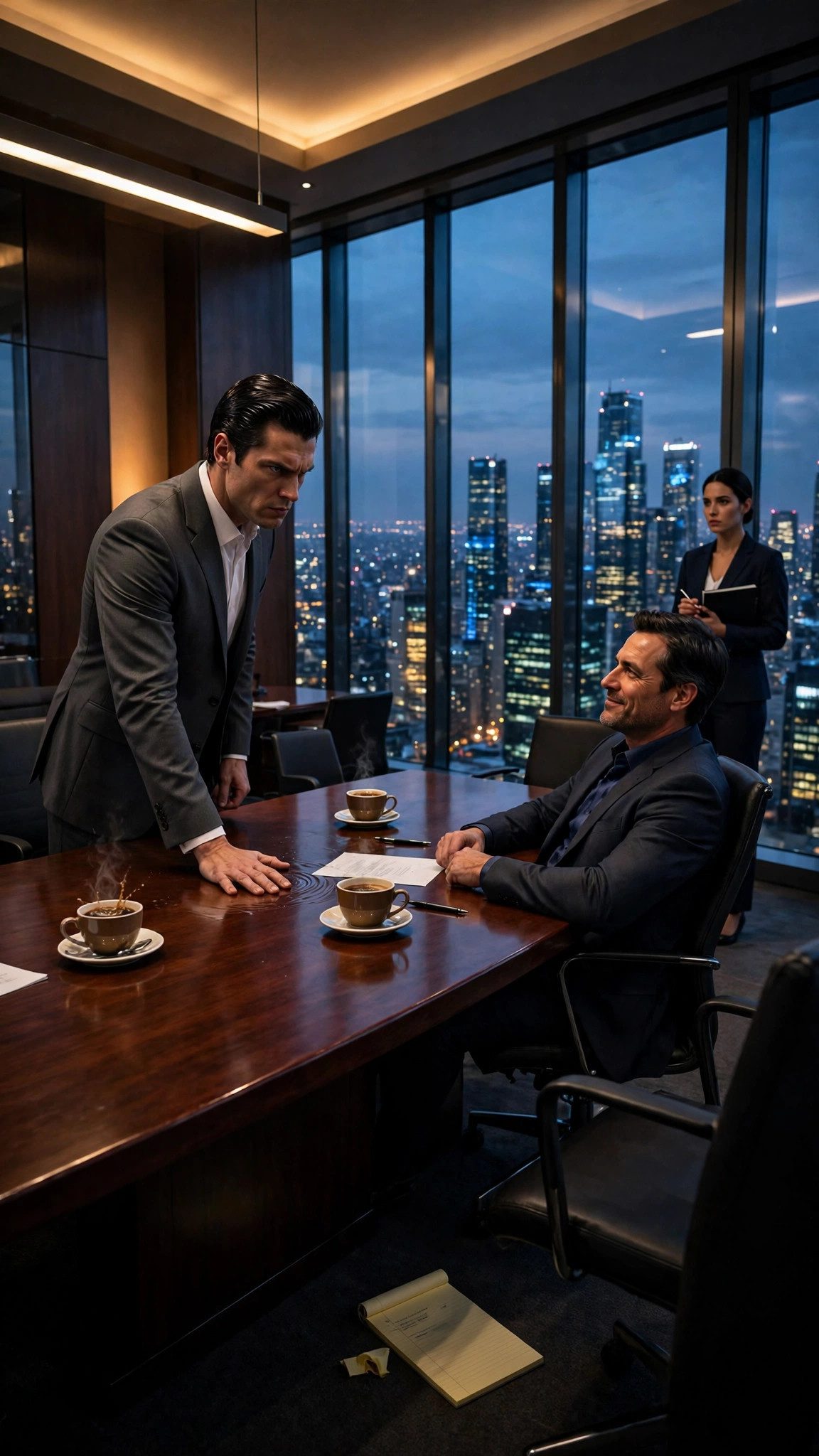
Adrian Vescari had learned to be silent when he was nine years old, the day his father took him to the docks for the first time and showed him how the family business really worked.
"Listen," his father had said, standing on the wet concrete while the cranes moved containers overhead and the men shouted to each other in the rain. "Everyone in this world is talking. The men who talk the most are the ones with the least to say. The dangerous men are the quiet ones. They listen. They watch. And when they finally speak, everyone else stops talking. Do you understand?"
"I understand, Father."
"Good. Now watch that man over there." His father had pointed to a foreman arguing with a truck driver, his face red, his arms waving. "He is loud because he is afraid. Fear makes men loud. Never be loud, Adrian. If you are ever afraid, be silent. Silence makes other men afraid of you."
Adrian had remembered that lesson for twenty-six years. He had built his whole life on it. He had become the quietest man in every room he entered, and the most feared. He had learned to let other men fill the silence with their own voices, and to listen to what they revealed when they thought no one was paying attention.
It was how he had survived. It was how he had built Vescari Holdings from a family of dock operators into an empire of warehouses, shipping routes, and distribution contracts that moved goods across half the country. And it was how he had buried, for two years, the one thing in his life that silence could not protect.
Her name was Tessa Morgan. And he had loved her since the first morning she walked into his office.
He had not meant to. He had hired her the way he hired everyone — quickly, coldly, with three questions and no sentiment. He had needed a secretary. The last one had quit after three weeks, frightened by the hours and the silence and the photograph on the shelf. Tessa Morgan had not been frightened. She had looked at him with steady brown eyes and told him she needed the job, and that she would keep his secrets, and something in her voice — something plain and unafraid — had made him say yes before he had time to think about it.
He had regretted it within a week. Not because she was bad at the job. She was the best secretary he had ever had. She was early, exact, and invisible, the way a good secretary should be. She learned his schedule in three days. She learned his coffee in one. She never asked questions. She never gossiped. She never made a mistake that mattered.
He regretted it because she was kind.
Kindness was the one thing Adrian Vescari could not afford. Kindness was a door, and doors could be opened, and what came through them could be taken away. He had learned that lesson on the fourteenth of March, two years ago, when the car bomb meant for him had killed Sofia Marchetti instead.
Sofia had been twenty-nine years old. She had laughed easily. She had loved music, and dogs, and the smell of rain on hot pavement. She had been the only person in Adrian's life who had ever made him forget, for an hour at a time, that he was the head of a family that other men feared. She had been sitting in his car because he had asked her to wait for him outside a restaurant while he finished a meeting. She had been waiting for eleven minutes. The bomb had gone off at 6:42 in the evening. Adrian had been forty feet away, inside the restaurant, arguing about a warehouse lease. He had heard the sound. He had run outside. He had seen the fire. And he had known, before anyone told him, that the only woman he had ever loved was gone, and that she had died because she had been sitting where he was supposed to sit.
The police had never found who planted the bomb. The FBI had investigated for six months and found nothing. But Adrian had known. He had known from the first night, when he sat alone in his apartment and went through the list of his enemies, one by one, and stopped at a single name.
Vincent Calder.
Vincent had wanted the northern distribution routes for three years. Adrian had refused to sell them. Vincent had made threats — quiet ones, polite ones, the kind of threats that sound like business advice if you are not listening carefully. "A man who holds too much territory makes too many enemies, Adrian." "Accidents happen to men who don't know when to share." Adrian had ignored him. And then Sofia had died, and Vincent had sent flowers to the funeral, white lilies, with a card that said only: "My deepest condolences."
Adrian had kept that card. He had kept it in a drawer in his desk, under a stack of contracts, and he had looked at it every time he needed to remind himself why he could never let anyone close to him again. Because the men who wanted to hurt Adrian Vescari had learned something on the fourteenth of March: they did not need to touch him. They only needed to touch the people he loved.
So he had made himself a vow. He would never love anyone again. He would never let a woman into his life. He would never give his enemies a second target. He would be silent, and cold, and alone, and he would keep the people around him at exactly three feet of distance, and that would be enough. That would keep them safe.
And then Tessa Morgan had walked into his office with a borrowed suit and a secondhand briefcase, and she had not been afraid of him, and she had stayed, and she had been early and exact and invisible, and somewhere between the first winter and the second spring, Adrian had realized that his vow was already broken.
He loved her. He had loved her for two years. And he had buried it so deep, under so many layers of silence and rules, that he had almost convinced himself it was not there.
Almost.
He had tried to protect her the only way he knew how: by keeping her at a distance. He called her Miss Morgan. He never touched her. He never asked about her life. He never stayed in a room with her after six o'clock. He told himself that if he never looked at her the way a man looks at a woman, then no one would ever know, and no one would ever use her against him.
But Vincent Calder had known. Vincent had watched, and waited, and on the morning of the negotiation, he had walked into the conference room and asked the one question that could break two years of silence in a single second.
"Does your secretary have a boyfriend?"
It had not been a question. It had been a declaration. Vincent was telling Adrian: I see her. I know what she means to you. And if you do not give me what I want, I know exactly where to hurt you.
And Adrian had done the one thing he had sworn he would never do. He had lost control. He had slammed his hand against the table. He had ended a forty-million-dollar deal in front of sixteen men. He had told Vincent, in front of everyone, "Don't look at her again."
He had marked her. He had claimed her. He had done, in five seconds, what two years of silence had been designed to prevent.
The night Sofia died, Adrian had sat in the hospital corridor for six hours while the surgeons worked on a woman who was already gone. He had not cried. He had not spoken. He had simply sat there, in his suit, with blood on his cuffs from where he had pulled her from the car, and waited for someone to come and tell him what he already knew.
At two in the morning, his uncle — his father's brother, a man named Salvatore Vescari, who had been the family's consigliere for forty years — had come and sat down beside him. Salvatore was seventy years old then, with white hair and hands that shook, and he had put one of those shaking hands on Adrian's shoulder and said, "We will find who did this. And we will make them pay. That is the way of our family. That is what your father would have done."
"No," Adrian had said. It was the first word he had spoken in six hours. "No. That is not what I will do."
Salvatore had looked at him. "Adrian—"
"Finding them and killing them will not bring her back," Adrian had said. "And it will not stop the next one. The next one will come for someone else I love. And then another. And another. Until there is no one left. So I will do something different. I will become a man who loves no one. I will become a man with nothing to lose. And then they will have nothing to take from me."
Salvatore had been quiet for a long time. Then he had said, "A man with nothing to lose is a man who has already lost everything. Be careful, my boy. That is a lonely way to live."
"It is the only way to live," Adrian had said.
And for two years, he had lived that way. He had turned Vescari Holdings into a fortress. He had cut ties with old friends. He had stopped going to dinners, stopped going to parties, stopped letting anyone past the glass wall of his office. He had kept the photograph of Sofia on the shelf behind his desk, and he had dusted it every Friday morning, and he had told himself that grief was a private thing, and that silence was a kind of strength.
But the truth was simpler than that, and uglier. Adrian had not become silent because he was strong. He had become silent because he was afraid. Afraid that if he ever spoke honestly again — if he ever let himself want something, or love someone, or hope for a future that was not made of contracts and concrete — then the world would take it away from him, the way it had taken Sofia.
He had been afraid for two years. And he had been alone for two years. And the loneliest part of it was that he had done it to himself, with his own hands, the way a man builds his own prison, brick by brick, and then locks the door from the inside.
Until the morning Tessa Morgan walked into his office with a borrowed suit and a secondhand briefcase, and looked at him without fear, and said, "I don't know what you've done, Mr. Vescari. But I know what I need."
He had hired her because she was not afraid. He had kept her because she was good at her job. And he had fallen in love with her because, for the first time in two years, there was a person in his life who did not want anything from him except a fair day's work and a little bit of respect.
He had tried to bury it. He had called her Miss Morgan. He had kept three feet of distance. He had told himself that silence would protect her.
But silence had not protected Sofia. Silence had not protected anyone. Silence had only made the loneliness deeper, and the fear stronger, and the day Vincent Calder walked into the conference room and asked his question, Adrian had finally understood what his uncle had tried to tell him in the hospital corridor two years ago.
A man with nothing to lose is a man who has already lost everything.
And Adrian Vescari was tired of losing.
Now, standing in the empty conference room with Tessa Morgan three feet away from him, her notebook pressed against her chest, her brown eyes looking up at him with a question in them, Adrian Vescari understood the full weight of what he had done.
Vincent Calder would not forget this morning. Vincent would go back to his office, and he would make phone calls, and he would start to move. The distribution deal was dead — but Vincent had never really wanted the deal. He had wanted to know if Adrian Vescari still had a heart. And now he knew.
The question was what Vincent would do with that knowledge.
Adrian knew what he would do. He had known Vincent Calder for fifteen years. Vincent did not forgive, and he did not forget, and he did not walk away from a man who had humiliated him in front of sixteen witnesses. Vincent would come back. He would come back with lawyers, or with men, or with something worse. And the first thing he would reach for would be Tessa.
Unless Adrian reached her first.
"Tessa," Adrian said, and her name in his voice sounded like a door opening after a very long winter. "There is something I have buried for two years. And I think it is time you knew what it is."
She looked at him. She did not move. She did not speak. She simply waited, the way she had waited for two years — patient, steady, unafraid.
And Adrian Vescari, who had been silent for twenty-six years, finally told the truth.
"I love you," he said. "I have loved you since the first week you worked for me. I have loved you through every meeting, every contract, every morning you walked into this office with your notebook and your pen. I buried it because the last woman I loved died for it. Sofia died in my car, on the fourteenth of March, two years ago, and the bomb that killed her was meant for me. I swore I would never put another woman in that place. I swore I would never give my enemies another target. But Vincent knew. He has always known. And now he knows for certain."
He stopped. His hands were shaking. He had not known his hands could shake. He put them behind his back, the way his father had taught him, and he waited for her to speak.
Tessa Morgan looked at him for a long time. And then she did the last thing he expected.
She set down her notebook. She set down her pen. And she took one step closer to him, closing the three feet of distance that had stood between them for two years.
"Then tell me the rest," she said quietly. "Tell me everything. And then we will decide together what happens next."
Outside the glass walls, the city went on with its business. But inside the conference room on the thirty-fourth floor, Adrian Vescari finally understood something his father had never taught him.
Silence could protect a man. But it could not save him.
Only the truth could do that. And the truth was standing three feet away from him, in a dark suit, with a notebook and a pen, waiting for him to be brave enough to speak.