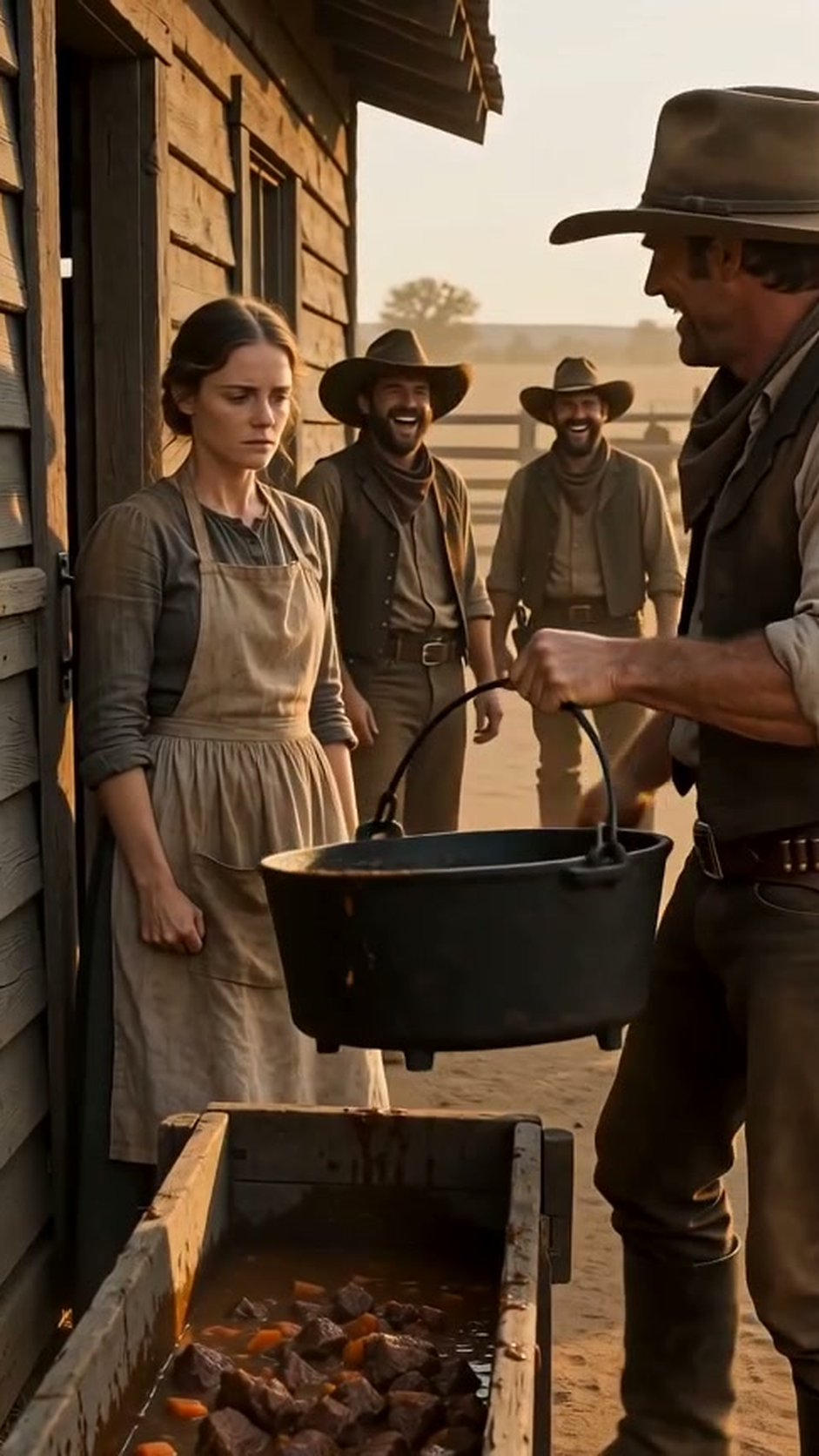
The sacks were in her cottage when she came in from the cookhouse on Tuesday night, and she knew they were there before her eyes made sense of them, the way you know a room is wrong before you can say how.
Two fifty-pound sacks of flour, standing square and brazen on the floor beside her bed. Bar Seven brand, from the ranch's own store account. A tin of coffee beside them. A side of bacon, wrapped in ranch-house paper, laid across the top like a signature.
Bertha stood in her own doorway with her hand still on the latch and understood that she had perhaps four minutes of quiet left in her life on this ranch, and that the quiet was Buck's, and that he was spending it walking from the barn to her door with witnesses.
She did the only arithmetic that mattered. The ledger was in his desk across the yard. The auditor was two weeks out. Lonnie's word was a boy's word. And the flour — the flour was here, in a dead woman's daughter's cottage, physical as sin and twice as easy to explain to an old man who wanted his problems simple.
She could hear them coming across the yard. Buck's voice, regretful already, warming up like a fiddle. Merritt's slower step. A third man's — Gus, no: heavier. The storekeeper? No — it was Deputy Tom Bledsoe, who rode out from Dryfork whenever the big ranches had trouble they wanted kept out of the newspapers, which meant Buck had planned this thoroughly and in advance, which meant the deputy was not a precaution. The deputy was the audience.
Bertha Platt did the thing she would be proudest of for the rest of her life, though no one ever praised her for it and she never told it right: she sat down.
She sat down at her little table, and she poured herself a cup of the morning's coffee gone cold, and she folded her hands, and she waited in her own chair in her own cottage for them to knock, because running — to the desk, to the ledger, anywhere — was what the next three minutes had been built to make her do, and she had finally, finally learned Buck Thorp's first lesson: the trap is never the thing in front of you. The trap is the running.
They knocked. She said, "Come in," in the voice she used for grace.
It went the way he'd written it. Buck, sorrowful: shortages, getting worse, had to bring it to Mr. Merritt, hated to, but a man gets suspicious — Merritt, looking at the sacks like a man reading his own obituary — Bledsoe, professional, lifting the bacon, checking the brand on the flour with the air of a man who has arrested people for exactly this and expects to again.
"Miss Platt," Merritt said at last, and his voice was old. "I am going to ask you a straight question, and I want you to think before—"
"They're not mine, sir. I didn't take them, and I didn't put them there." She kept her hands folded. Coffee, cold, in front of her like a prop in a play she refused to perform in. "They were put in my cottage while I was cooking supper for eleven of your men, by someone with a reason to want me believed a thief. The flour's been walking out of this ranch's stores a little at a time since April, Mr. Merritt — beef, coffee, flour, sugar — and it hasn't been walking to my cottage. It's been walking to town. To a kitchen that feeds thirty men a night."
"Bertha—" Buck began, in the tone of a man grieved by an employee's collapse.
"I'm not finished." She did not raise her voice. Her mother had taught her that too, in a way: the cook doesn't shout over the table; the cook just keeps serving until the table quiets. "In June your auditor's coming to find where this ranch's money leaks. I can't prove tonight where it leaks to. But I can tell you this much on my mother's name: the leak isn't standing in this room, and when the auditor comes, I'll open my tally book — every sack in and out since I was hired, kept on my cottage door — and my tally will show the shortages, Mr. Merritt. It'll show them starting before I ever set foot on the Bar Seven, including the week my mother was still your cook and dying, and your stores still leaked. Did they send a deputy for her, too?"
The silence had a texture. Merritt looked at the flour. Merritt looked at Buck.
"Tom," he said to the deputy, after a moment, "you'll excuse us. This is a ranch matter, and I've decided it stays one till my auditor's been. Nobody's arrested tonight."
Buck's face did something then that Bertha had never seen it do in all the weeks of his water-smooth campaign. It showed her the man under the water. Just for a second — the counted plates, the disturbed drawer, the cook who would not run, all of it arriving at once — before the regretful foreman closed over it again like a lid.
"Silas," he said reasonably, "if the girl's taking—"
It was Bledsoe, surprisingly, who spoke next — not to her, but to the flour.
"Silas," the deputy said, in the tone of a man pointing out weather, "when did the ranch last take delivery from the store?"
"Thursday week," Merritt said. "Why?"
"Because these sacks have Thursday week's chalk on 'em still." Bledsoe turned one sack with his boot, gentle, the way you'd turn a sleeping dog. The store's chalk mark sat on the canvas blue and un-smudged, and the twine at the neck was tied in the store's knot — a particular double loop Bertha knew as well as her own name, because she untied it every time she opened a sack in the pantry. "A sack that's been in a pantry a while, opened and shut and scooped out of, don't keep its chalk like a Sunday shirt. And a cook who steals flour opens it, Tom Bledsoe's experience tells him. She *uses* it. She don't stand it by her bed like a wedding present, still tied in the store's own knot, with the coffee tin unopened and the bacon in ranch-house paper — paper off the ranch house shelf, Silas, which is a shelf your cook don't keep."
The deputy straightened up and looked at Buck with an expression of mild, professional interest, the way a man looks at a poker player whose sleeve has begun to rustle.
"Whoever set this table, Thorp, set it in a hurry and set it for looking at, not for using. That's generally a man who expects it to be *found* more than he expects it to be believed."
Buck's regretful smile held, but it held the way ice holds in April — with the sound of water moving underneath it. "You're a detective now, Tom?"
"I'm a man who's carried off four rustlers and two horse thieves in ten years," Bledsoe said pleasantly, "and every one of 'em had this exact evening first: the night they explained things. Lead the way out, gentlemen. It's the lady's house."
"If the girl's taking," Merritt said, "then Eakins'll prove it in a fortnight with figures, and figures don't need a flour sack carried through a dark yard to make their point." The old man turned at the door, bent as a tree grown round a fence, and looked at Bertha a long moment. "Miss Platt. Your mother cooked for me fifteen years. In fifteen years I never locked a door against her. I'm not locking one against her daughter on a foreman's say-so. But hear me: if those figures say otherwise — "
"They won't, sir."
"— then I'll do what the figures say." He went out. Bledsoe followed, touching his hat to her, with an expression that suggested he had begun to enjoy his evening. And Buck stood in her cottage doorway last of all, with the planted flour at his feet, and spoke low enough for only her.
"You should've run," he said. "You'd have run straight to it, and I'd have had you both."
"I know," Bertha said. "That's why I didn't."
"I don't know what you think you know, cook."
"Three dollars' worth, Mr. Thorp," she said, and watched it land. "Give or take a side of beef."
He left without answering, and she sat alone at her table with the cold coffee and the stolen flour, and her hands — folded so long and so tight — shook for a full minute in the privacy of her own room, which was the only place she had ever allowed it.
She was still sitting there when the latch lifted, soft as a thief — and she was on her feet with the coffee cup in her hand like a weapon before Lonnie Pruitt's worried face came around the door.
"It's me, Miss Bertha. It's only me. — You can put the cup down, I ain't worth the china." He came in sideways, the way boys enter sickrooms, and his eyes went to the flour sacks and stayed there, and his face went through about four expressions and landed on fury, which on a seventeen-year-old looks like grief wearing a hat. "So that's what he done. Gus said there was lights and the deputy, and Andrew saddled up quiet and followed Buck out the east gate at a distance — Andrew reckons he's gone to Lester, to settle what Lester's to say when the auditor comes asking. Gus says I should tell you the bunkhouse is talking. Half of 'em think you done it, Miss Bertha, but it's the half that always thinks what Buck tells 'em by breakfast, and the other half's ashamed, and ashamed men get *mad*, in my experience of being one."
"Lonnie." She set the cup down. Her hands had stopped shaking, she noticed, the moment there was somebody else's fear in the room to tend to; that had always been her way and her mother's way, and it was, she supposed, why they were cooks. "Listen to me carefully, because I've thought it through with a clear head and I am not asking your opinion, I'm giving you your orders."
The boy straightened like a soldier.
"Tomorrow is my day off. I'm riding into Dryfork in the morning, in the open, in my good dress, to call on Mr. Lester Oler at his place of business. I am going to tell him — in front of no witnesses but whoever God sends into that saloon — exactly what I know and exactly what I can prove, and I am going to give him one night to choose which side of the auditor he wants to be standing on when the book comes out. It's a risk. It's the only risk left that isn't worse."
"Miss Bertha, you can't ride in there alone, he'll—"
"I am not asking," she said gently, "whether I can. I'm telling you where I'll be, so that one person knows. If I'm not back by dark tomorrow, you go to Mr. Merritt — not Gus, not Andrew, Mr. Merritt himself — and you tell him every word you heard behind the Gilded Steer in March, and you tell him about the flour, and you tell him to open the bottom drawer of Buck's desk in the tack room and look for a little leather book wrapped in oiled cloth. Can you carry that? All of it, straight?"
"Yes ma'am," Lonnie said, and his voice cracked on it, and he cleared his throat and said it again, steadier. "Yes ma'am. I can carry it."
"Then carry this too, tonight." She took the coffee tin off the top of the bacon — evidence, Buck's evidence, sitting in her cottage like a toad — and set it in the boy's hands. "No. Not to eat. To the bunkhouse. Set it on the table where the men can see it, and don't say a word about it, not one word, and let them wonder all night how the cook's *stolen coffee* came to be sitting unopened in their bunkhouse with the store's seal on it. Sometimes, Lonnie, the best argument is a thing set down where people can look at it."
He grinned then, sudden and wicked, the full seventeen of him. "Miss Bertha," he said, "if this cooking business ever fails you, you'd make a terror of a poker player."
"Out," she said. "And Lonnie — thank you. For March. Most men would have spent that secret by now, or sold it."
"I ain't most men," said Lonnie Pruitt, with enormous dignity, and went out into the dark with the coffee tin under his arm like a dispatch rider carrying the fate of nations.
And out in the dark yard, a single horse left at a walk, quiet as a secret, heading east toward Dryfork — and Bertha, listening, knew that whatever Buck Thorp went to tell Lester Oler tonight, the next move belonged to the saloon keeper, and Lester Oler had a book to protect, and men like Lester did not protect their books with regretful smiles.