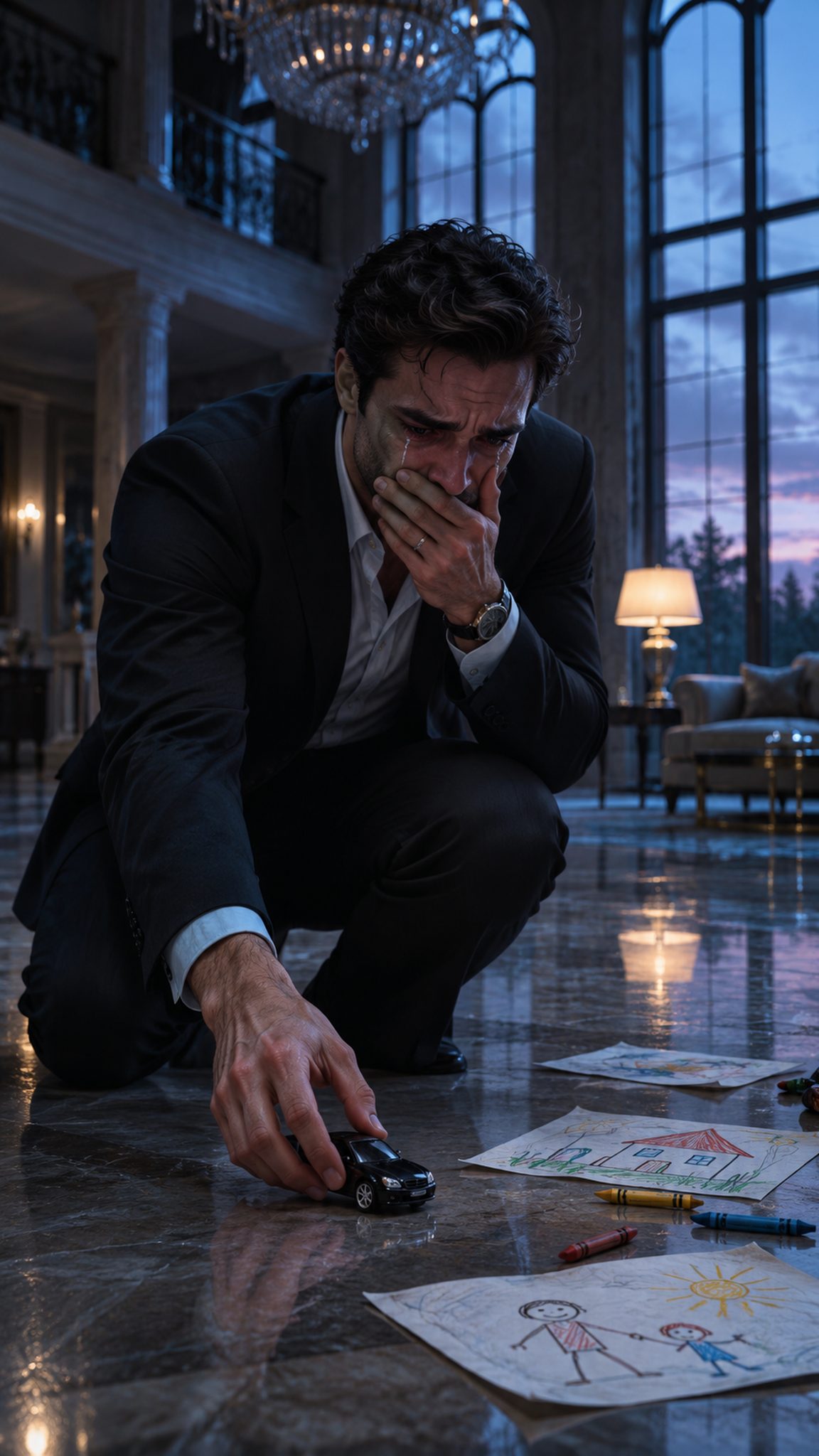
I was still holding the small black toy car when I read the note again.
So Daddy isn't alone.
The words were written in the uneven, stubborn handwriting of a six-year-old boy who had once waited by the window every evening because he believed his father would come home if he wanted him badly enough.
I stood in the middle of the living room with the toy car in one hand and the note in the other, surrounded by a silence so complete it no longer felt like the absence of sound. It felt deliberate. Planned. Arranged. As if every empty room in the mansion had joined together to tell me the same thing.
They were gone.
Not out for the evening. Not staying somewhere safe until my men finished sweeping for threats after the ambush. Gone in the way that mattered. Gone with intention.
I put the note in my pocket and began searching the house as if movement alone could undo what I was seeing.
I checked the kitchen first because Elena had always ended her evenings there, tidying things that never needed tidying, setting out breakfast dishes before bed, making the ordinary rituals of a home look effortless. The counters were spotless. The refrigerator held food, but not the things Lucas liked best. His chocolate pudding cups were gone. The small carton of strawberry yogurt Elena bought because he asked for it by name was gone. A blue plastic cup with a crack near the base was missing from the drying rack.
I went into the pantry and stared at shelves that looked full enough until I realized what had been taken. Not random things. Familiar things. The cereal Lucas wanted on Saturday mornings. Elena's tea. The crackers she packed into little bags when he had an appointment. A few things at a time, removed so gradually no one paid attention.
I went upstairs again.
Our bedroom had the cold look of a room that had once belonged to two people and now belonged to no one. Elena's side of the closet was bare. The jewelry box she kept in the second drawer was gone. The framed photograph on her bedside table had vanished, leaving a rectangle of dustless wood behind. The bathroom cabinet was half-empty. Bottles and tubes remained, but the things she used every day had been carefully removed.
I opened every drawer as if I might catch the house lying to me.
Lucas's room was worse because it still looked like him, just stripped of the things that made it alive. The bed was made. The curtains were tied back. A book lay crooked on the nightstand, but the stuffed bear he slept with was missing. The basket that used to overflow with toy cars was nearly empty. His favorite blue sweater was gone from the chair in the corner.
I checked every room, every bathroom, every closet, the garage, the terrace, the service hall, the wine cellar, and then the grounds outside. I walked the length of the back garden while the security lights cast hard white shadows across the lawn. I checked the guest house, the pool house, the garage apartment where staff sometimes slept. I opened storage sheds that no child had ever willingly entered and called Lucas's name into the cold evening air.
Nothing answered me except the distant hum of the city.
When I came back inside, Victor was waiting in the study with two of my tech men and the system administrator. The surveillance feeds were on the wall monitors, but the sections I needed were blank.
“Show me,” I said.
Victor pointed to the front-gate camera first.
The footage ran through an ordinary morning, then an ordinary afternoon, then the first part of the evening. Delivery traffic. A staff vehicle. One of my security shifts changing at the gate. Then, without drama, the timeline jumped forward.
A gap.
No static. No visible malfunction. Just a clean absence.
“The same thing happened on the service entrance feed,” Victor said. “And the rear drive. Garage exterior too.”
“Power failure?” I asked.
“No.”
The system administrator, a thin man who suddenly looked as though he regretted every career decision that had brought him into my house, cleared his throat.
“The files were deleted,” he said.
I kept my eyes on the blank section of the timeline. “Deleted how?”
“From inside the system. By someone with access or someone using credentials that had access.”
I turned to face him. “Whose credentials?”
He swallowed. “There isn't a direct log preserving the action. Whoever did it understood how the architecture worked. They cleared the record chain too.”
“That is not what I asked.”
He looked at Victor, then back at me. “Access at that level would normally be limited to you, Mr. Moretti, Mr. Hale, and me.”
“And you didn't do it?”
“No.”
“Can you prove that?”
He hesitated too long.
“I was off-site. My terminal wasn't used. But if someone had my credentials or if—”
“If someone knew exactly what they were doing?” I finished for him.
“Yes.”
I stepped closer to the monitor.
No record of Elena leaving by the gate. No record of Lucas in the back seat of a car. No record of luggage, boxes, or a driver helping them load their lives into a vehicle. If the footage had existed, it had been removed by someone who understood the value of silence.
“Recover it,” I said.
“We're trying,” he said quickly. “But if the purge was done correctly—”
I looked at him until he stopped speaking.
“Recover whatever you can,” I said. “If fragments still exist, I want them.”
“Yes, sir.”
“Who knew the front gate schedules? Who had access to staff rotations? Who knew when I would still be in recovery after the ambush and unable to question anyone myself?”
Victor answered that one. “Too many people.”
I hated that answer because it was true.
The ambush had made me look outward, toward rival families and the men bold enough to fire on my convoy. While I was doing that, my wife had disappeared from my own house.
I looked back at the blank feed.
“She didn't do this in one day,” I said.
Victor said nothing.
“She planned it.”
He nodded once.
Or someone inside my own organisation had helped her vanish so completely that even my cameras now lied to me.
The possibility struck with a new kind of anger. If one of my men had assisted her, he had either decided that my wife and child needed protection from me, or he had seen an opportunity and taken it. Neither thought sat easily in my chest.
“Bring in every guard who worked this house during the last two weeks,” I said.
Victor gave the order.
I questioned them one by one.
Not as a group. Not in the hallway where one man's answer could shape another's. I brought them in separately and made each one stand under the study lights with the empty security monitors behind me.
When had he last seen Elena? What was she carrying? Had Lucas looked frightened? Had any unfamiliar vehicle approached the property? Had any staff member been behaving strangely? Had anyone requested a blind spot, a gate delay, a favor?
The answers blurred together.
No, sir.
Nothing unusual, sir.
Mrs. Moretti came and went with the boy, sir, but only for ordinary errands.
No luggage that I noticed.
No strange vehicles.
No disturbance.
No record.
No one knew anything.
By the time I reached the last guard, I could read the fear on his face before he spoke. He was afraid of me, but he was also afraid of something else—of being the one who had missed the moment my family vanished.
“You're telling me,” I said, “that a woman and a six-year-old child emptied closets, removed personal belongings, erased their traces from the house, and left my property, and none of you saw it happen.”
His jaw tightened. “Yes, sir.”
“Do you expect me to believe that?”
He held my gaze for three seconds before dropping it. “No, sir.”
He was the first one honest enough to say it.
I dismissed him.
Then I suspended the entire security rotation attached to the house. No one who had been on those shifts would work my property again until I understood whether I had been betrayed, outmaneuvered, or both.
Victor watched me sign the orders.
“You think one of ours helped her,” he said.
“I think either one of ours helped her,” I said, “or my wife is smarter than every man guarding this house.”
A corner of his mouth moved, but it was not close to a smile. “Both could be true.”
I looked at the empty line on the monitor again.
Yes. Both could be true.
I sent Victor to interview the household staff again and told Marco to begin tracing every vehicle connected to the property. Marco had handled logistics for me long enough to understand when ordinary work became personal. He didn't ask useless questions. He took the list of plates, driver names, and access logs and moved.
I stayed in Lucas's room.
It was there, long past midnight, that I found the box under his bed.
At first I thought it was just an old storage box for toys. It was shoved so far back against the wall that I had to kneel and reach beneath the bedframe to pull it out. Dust clung to the cardboard. When I opened it, I found drawings.
Pages and pages of them.
Some were folded. Some had been crumpled and then smoothed out by small hands. There were crayon suns, crooked houses, figures with impossible proportions, black cars, blue windows, green lawns. The kind of pictures adults glance at and praise too quickly because they assume there will always be another.
I sat on the floor with the box open beside me and began sorting through them.
There we were, all three of us, standing in front of the mansion with a yellow sun over our heads.
There I was beside Lucas near a toy racetrack, my hands made out of stiff black lines, my smile too large for my face.
There we were at a table. There we were in a garden. There we were by a Christmas tree that looked more like a green triangle covered in stars.
In every picture, Lucas stood beside me.
Not near me. Beside me.
Close enough that our hands almost touched, or actually did. In some drawings, he had made me taller than the house. In others, he had made himself the same size as me, as if proximity mattered more than realism.
Then I reached the last drawing.
I knew before I looked at it for more than a second that it was different.
The same yellow sun. The same green line for grass. Elena in a red dress. Lucas holding her hand.
No father.
No dark-haired stick figure at their side.
At the bottom, in careful childlike handwriting, were two words.
Dad's busy.
I stared at the page until the letters blurred.
I had heard those words before. In the birthday video, I would later hear my son say them with quiet acceptance. But that night, on the floor of his room, they landed like a judgment rendered without anger and therefore impossible to argue against.
Busy.
Not mean. Not gone. Not dead. Not even unwilling.
Busy.
As if I had chosen everything else so often that my absence no longer required explanation.
I put the drawing down only when I realized my hands were bending the paper.
That was the night I stopped believing Elena had simply run.
She had prepared.
Not because she was impulsive. Not because she wanted to hurt me. Because she had looked at our son, listened to the questions he asked, watched him learn how to make peace with disappointment, and decided she could not let that be his childhood.
The days that followed turned into weeks, and the weeks turned into months.
The house changed first.
Not physically. The walls, marble floors, chandeliers, and expensive furniture remained exactly where they had always been. But without Elena and Lucas, the mansion stopped being a home and revealed itself for what it really was: a beautifully guarded shell.
The kitchen felt staged. The living room felt too large. Lucas's room became a place I entered only to punish myself with reminders. I left the black toy car on the table in my study for a while, then moved it to Lucas's shelf, then put it back in my desk drawer because seeing it in the open made it impossible to think.
My men noticed the change in me before I admitted it to myself.
Victor watched me work longer hours and say less.
Marco handled the logistics of the search and began bringing me thinner and thinner folders as the leads dried up.
I sent people to every address Elena had ever mentioned casually in conversation. Old friends. Distant relatives. A former neighbor from before we married. Hotels. Rental properties. Medical offices. Airports. Private airfields. Border crossings. Nothing.
If Elena had help, it was disciplined help.
If she had done it alone, she had thought about leaving for far longer than I had ever noticed.
Both possibilities made me feel like a fool.
I buried myself in work because it was the only arena where rules still made sense. A shipment delayed meant a problem with an answer. A rival pressing on territory meant a response. A meeting, a number, a threat, a negotiation—those things obeyed the structure I had built my life around.
The empty nursery of my own failure did not.
Serena stayed in the picture longer than she should have. At first I told myself nothing had changed between us because admitting that something had changed would mean admitting why. She called. She visited. She asked why I was distracted. Once she came to the mansion and stood in the doorway of the living room, looking at the empty space as if she felt none of its weight.
“She’s trying to punish you,” Serena said.
I looked at her and realized, with a clarity that came too late to matter, that she had never understood Elena at all.
Elena had not left to punish me.
She had left because she had stopped believing I would choose them.
I sent Serena away that day, though I did not end it completely yet. Cowardice has many forms. Mine had often looked like delay.
I refused to admit what I had lost. Not aloud. Not to Victor. Not even to myself in words plain enough to hurt. I spoke instead about finding them, tracing them, securing information. I used action to disguise grief.
But men who have served me for years know how to read silence. They saw the empty mansion. They saw the untouched dining room table. They saw me start and stop outside Lucas's room and then keep walking. They saw the way I let business sit unanswered longer than I once would have tolerated, then overcorrected and buried myself in twelve-hour stretches of work.
They watched me unravel without naming it.
Months passed before the next blow arrived.
It came by mail.
An ordinary envelope delivered to my office, addressed through a law firm I did not know. Victor brought it in personally, which told me he understood there was something unusual about it before I opened it.
Inside were divorce papers.
I read Elena's name at the top and then my own. The rest of the language might as well have been written in another language for the first few seconds, because all I could see was the calm finality of the act.
This had not been an emotional outburst. It had not been done in panic. She had retained counsel. She had thought it through. She wanted a formal end.
Behind the divorce papers was a storage device.
Behind that was a packet of medical records.
I sat down.
The first page had Lucas's full name.
LUCAS ADRIAN MORETTI.
Then came dates. Specialist notes. Evaluations. Recommendations. Test results. Medical terms I had never bothered to learn because I had never been present long enough to hear them spoken.
My son had a congenital heart condition.
I read the sentence once, then again, as if repetition might make it less real.
Congenital. Present from birth.
Which meant Elena had not discovered some sudden illness after she left. Which meant there had been appointments while we were still under the same roof. Warnings. Consultations. Questions. Discussions about next steps.
Possible surgery.
I turned pages and saw the evidence of a life I had not been living. Names of cardiologists. Appointment dates. Imaging. Follow-ups. Cautious language about monitoring. Sharper language about risk. Notes about fatigue, evaluation, progression.
My son had been under the care of specialists while I told myself I was too busy to come home for dinner.
Then I found the call logs Elena's attorney had included.
Dozens of calls from Elena to me.
Some during the day. Some late at night. Some clustered close together in ways that made their urgency obvious only in retrospect. I checked the dates against my memory and saw what I had been doing instead.
Meetings. Travel. Time with Serena. Nights in the office. Hours spent managing problems that now looked small enough to fit in my hand.
The storage device contained the birthday video.
I watched Lucas sitting beside the cake, refusing to blow out the candles without me. I watched Elena's smile tremble while she tried to keep the moment gentle for him. I heard my son say, “He’s busy,” with a certainty that told me he had already practiced accepting disappointment.
When the video ended, I sat motionless for a long time.
Then I played the voicemail.
I knew before I heard Elena's voice that this would be the one detail I would never forgive myself for.
I remembered the night. Hotel room. Serena. City lights. My phone facedown because I had seen Elena's name and chosen not to answer.
I pressed play.
“Adrian, the doctor says Lucas may need surgery. I know you're busy. Please call me.”
That was all.
No accusation. No drama. No pleading beyond what was already contained in the sentence itself.
The doctor says Lucas may need surgery.
Please call me.
I had not called.
I had not even listened.
The voicemail had sat there, buried in my phone, while my wife took our son to specialists, heard words that would have terrified any parent, and kept trying to reach me.
I played it again.
Then again.
Victor came back into the room and found me staring at nothing.
“What is it?” he asked.
I handed him the medical records.
He looked down at the page. “Sir?”
“Lucas has a heart condition.” My voice sounded strange to my own ears. “Congenital. There were appointments. Specialists. They were discussing surgery.”
Victor read enough to understand.
“You didn't know?”
“No.”
He looked at the call logs, the voicemail transcript, the attorney letter. I could see him piecing it together, the same way I had.
“She tried to tell you,” he said carefully.
“Yes.”
I had never hated a single word more.
Tried.
Victor set the papers down. “What do you want me to do?”
“Find every doctor in these records. Confirm which offices saw him last. Find out whether he has already had surgery. Find out where he is now.”
He nodded.
“And Marco?” he asked.
“Put him on travel, financial traces, anything tied to Elena's attorney. Quietly. No threats. No pressure. Information only.”
Victor hesitated. “If she hid this carefully, she'll have expected us to look.”
“I know.”
“But records this serious create administrative trails. Insurance, transfers, specialist networks. We may get something.”
It was the closest thing to hope anyone had offered me in months.
I spent the night with the papers spread across my desk and the voicemail playing in my head even when the room was silent.
By morning I knew the dates of Lucas's appointments better than I knew the birthdays of some of my captains. I knew when Elena had first taken him for a specialist consultation. I knew when the follow-ups happened. I knew that while I was still living in the same house, she had already been carrying the knowledge that our son might one day need heart surgery.
That knowledge changed the meaning of everything.
Every missed dinner. Every call unanswered. Every time Elena had asked whether I could come home early. Every time Lucas had seemed tired and I had dismissed it.
I had believed I was ignoring domestic inconvenience.
In reality, I had been ignoring my son's heart.
The next two days stretched like wire.
Victor and Marco worked every angle they could. Offices confirmed old appointments but would not release protected information without proper authority. A specialist network in the Midwest led to a referral path that eventually moved west. Elena's attorney, under pressure from nothing more threatening than precise legal questions, refused to give an address but confirmed that Lucas remained under active care.
That confirmation was enough to keep me breathing.
Active care meant alive.
Late on the second evening, Victor entered my office without knocking.
He never did that unless the answer mattered.
“We have something,” he said.
Marco was behind him, holding a thin file.
“Talk,” I said.
Marco opened the file. “One of the later referral authorizations routes through a children's hospital outside Seattle. A follow-up communication from Elena's attorney's office used a local courier from that area. We cross-checked with a medical transport administrative vendor. The trail is indirect, but it aligns.”
“Is he there now?”
Victor answered. “We believe so.”
Believe.
I hated that word too.
“Not enough,” I said.
Marco slid another page forward. “This came through an inquiry tied to the specialist record. It isn't a full disclosure, but it references an urgent case review completed today. Same patient identifier sequence.”
I looked at the page.
Urgent case review.
Today.
“Is he in surgery?” I asked.
“We don't know yet,” Victor said. “But whatever this is, it's current.”
I was already reaching for my coat.
The flight to Seattle blurred into fragments of motion and dread. Victor came with me; Marco stayed behind to keep tracing anything that might matter. I read the records again on the plane, not because I needed to, but because sitting still with my thoughts felt unbearable.
Possible surgery.
May need surgery.
Please call me.
Every line in the records now seemed to point toward the one place I should have been months earlier.
When we landed, the air smelled of rain. The drive to the hospital was too slow and too fast at once. Outside the windows, the city lights smeared against the glass while I watched the time and tried not to imagine Lucas frightened and asking for his mother.
Or worse.
By the time we reached the hospital, I no longer cared how I looked. I crossed the lobby without feeling the eyes that turned toward me. Victor stayed behind when I told him to. This part had nothing to do with men, power, or force.
At the desk, I gave my name and Lucas's.
The woman behind reception looked at her screen, then at me. She did not answer directly. She picked up the phone.
Every second of the wait seemed designed to punish me.
Then a nurse appeared and said, “Mr. Moretti? This way.”
I followed her down the corridor.
I saw Elena before she saw me.
She looked thinner, sharper somehow, as if the months had sanded away whatever softness my absence had left in her face. She was standing near a set of double doors at the end of the corridor. Medical staff moved quickly around her. She turned at the sound of our approach.
For a second, everything in me stopped.
I had imagined this moment so many times: anger, accusations, coldness, refusal. What I had not imagined was the look in her eyes.
Fear.
Not for me. Not even of me.
For the boy somewhere beyond those doors.
“Elena,” I said.
She looked at me as though she had no room left for surprise.
“You found us,” she said.
I took another step. “Where's Lucas?”
Her mouth parted, but before she could answer, a nurse pushed past with urgency in her stride. Someone called for Dr. Lang from farther down the corridor. The double doors at the end opened wider.
My gaze caught a flash of bright surgical light.
Movement.
Blue fabric.
The edge of a hospital bed.
Then the doors swung inward again.
“Elena,” I said, and I heard the desperation in my own voice. “Where is my son?”
She looked toward the doors, then back at me. “They just took him in.”
For surgery.
She didn't need to say the last part. It was written across her face, across the frantic rhythm of the corridor, across every page I had spread over my desk the night before.
Everything I had ignored. Every call. Every appointment. Every warning. Every time I had chosen to be busy.
All of it had led here.
I stared at the sealed doors and understood, too late, exactly what Elena had been trying to tell me from that hotel-room voicemail onward.
My son had needed me.
My son had been facing the possibility of heart surgery while I silenced calls and postponed family for later.
And now later had run out.
I took the chair outside the operating-room doors because there was nowhere else in the world I was willing to be.
The doors remained closed.
I stayed.