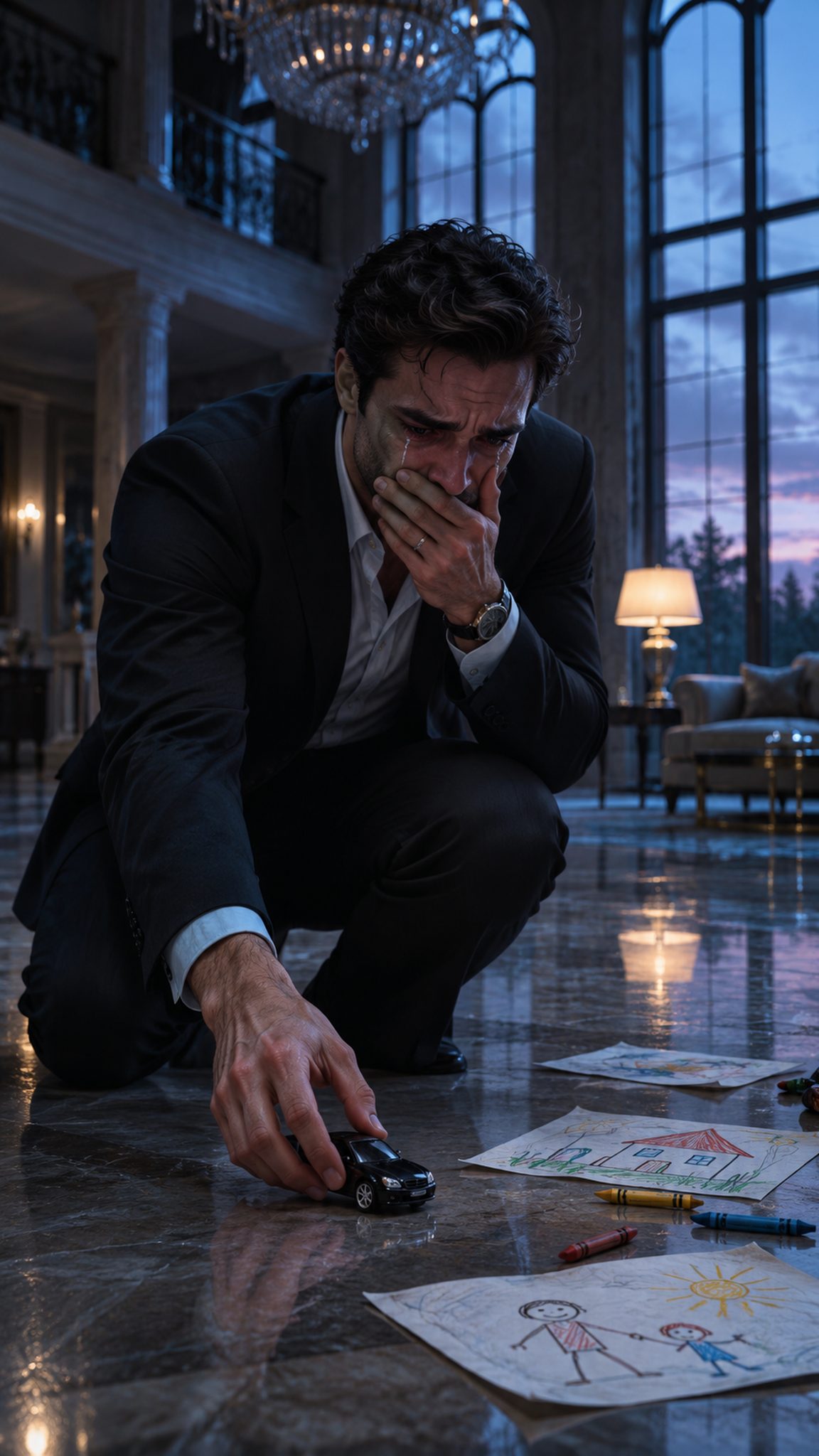
The operating-room doors remained closed.
I stood in front of them until a nurse gently asked me to move back. I obeyed because she was caring for my son, and because there was nothing else I could do. The corridor clock advanced one minute at a time. Elena sat in the chair nearest the wall, her hands clasped so tightly that her knuckles had turned pale.
Neither of us spoke for a long while.
Every sound made me look up. Footsteps. A cart rolling over the floor. A door opening somewhere beyond the nurses' station. Each time, I expected someone to come toward us with news. Each time, the person passed, and the doors remained shut.
I had faced men who wanted me dead without showing fear. I had sat across tables from people who smiled while planning to betray me. I had made decisions that determined whether entire operations continued or collapsed. None of that had prepared me for waiting outside a room where strangers were trying to keep my child alive.
I checked the time, then checked it again. My phone vibrated with messages from Chicago. Victor wanted to know whether I needed anything. My captains wanted instructions. There were questions about shipments, security, and a meeting that had already been postponed twice.
I turned the phone off.
Elena noticed.
“You don't have to do that,” she said quietly.
“Yes, I do.”
“Your people will keep calling.”
“They can wait.”
She looked at me, not reassured. “You have said that before.”
“I know.”
I did not ask her to believe me. I had used promises until they meant almost nothing. If she needed proof, I would have to give it to her in the form of decisions repeated over time, not another sentence spoken in a hospital corridor.
A nurse came out and asked whether either of us needed water. Elena accepted a cup. I declined. The nurse told us the team was still working and would update us when there was something definite. I thanked her. She gave Elena a brief, sympathetic look before returning through the doors.
I sat beside my wife, leaving space between us.
“Did Lucas know I was coming?” I asked.
“I told you what he asked.”
“I know. I just—” I stopped. “Was he frightened?”
“He was frightened when they explained that he needed surgery. He tried not to show it. He kept asking what would happen afterward.”
“What did you tell him?”
“That the doctors would take care of him. That I would be here when he woke up.”
I looked at the closed doors. “And you told him I was coming.”
“I told him you were coming because he needed to hear that someone else would be here too.”
The words were not forgiveness. They were a fact, and I accepted them as one.
I wanted to ask why she had not told me more, but the question had no place between us. She had called. She had left messages. She had sent information. I had ignored her. Any question that began with why hadn't you was another attempt to move the burden away from me.
So I asked something else.
“What does he like now? I mean, what does he do when he's not at appointments?”
Elena looked down at the paper cup. “He draws. He likes building things. He still has the black car.”
“I found it.”
“I know.”
“The note was underneath.”
Her face tightened. “He wrote that himself.”
“I thought so.”
“He wanted you to find it.”
I swallowed. “Did he say why?”
“He didn't explain it to me. He just asked me to make sure the car stayed where he left it.”
I remembered the four words and felt them settle in my chest again. So Daddy isn't alone. I had spent months interpreting them as a child's farewell. Now I wondered whether Lucas had meant that I would have something to keep, something to remind me that he had existed in that house even after he was gone.
“I'm sorry,” I said.
Elena did not answer.
I did not repeat it. An apology could not make the surgery shorter. It could not return the birthdays I had missed or erase the nights she had sat beside our son while I chose somewhere else to be.
The wait continued.
At one point, a doctor came through the doors. He was not Lucas's surgeon, and he had no update for us. I stood anyway, asking whether the procedure was progressing. He explained that the team was still working and that he could not give details. I stepped aside when he asked.
Elena watched me return to my chair.
“You can't make them hurry,” she said.
“I know.”
“You can't threaten them into giving you a different answer.”
“I know that too.”
“Then sit down, Adrian.”
I sat.
It was a small instruction, but I followed it. For years, people had moved when I entered a room. They had stood when I spoke and waited for permission to leave. Elena had never been impressed by that. Now, in a hospital corridor, her quiet request was the only order I wanted to obey.
I thought about the life I had built. I had made the organisation depend on my decisions because I believed no one else could protect it as well. Every problem came to me. Every dispute required my attention. I had treated that dependence as proof of strength.
It was also an excuse.
I could have delegated. I could have refused meetings. I could have come home. I could have answered the phone when Elena called. I had chosen to make myself indispensable everywhere except where I was needed most.
A little after midnight, Victor sent one final message. He said the Chicago situation was stable and that he had told the captains I was unavailable. I read it, then switched the phone off again. The organisation would continue without my hand on every decision. It had to.
Elena leaned her head back against the wall. Her eyes were closed, but I could tell she was not asleep.
“Have you eaten?” I asked.
“No.”
“Can I get you something?”
“I don't want anything.”
“Water?”
She lifted the cup slightly. “I have it.”
I nodded.
I remembered how often she had asked me the same questions at home. Had I eaten? Was I tired? Did I want coffee before I left? I had answered while reading messages or walking toward the door. I had treated her care as something automatic, as if it would continue regardless of how little I returned.
Now I sat beside her, unable to offer anything that would make the next minute easier.
The surgeon finally emerged after what felt like an entire night.
He was wearing surgical clothing, and his face showed the strain of concentration. A nurse followed him. Elena was on her feet before I could move. I stood so quickly that the chair scraped against the floor.
“Mrs. Moretti?” he asked.
“Yes. How is my son?”
The surgeon looked from Elena to me.
“The surgery was successful.”
For a second, neither of us moved.
“Successful?” I repeated.
“Yes. Lucas is alive. The procedure is complete, and he has been transferred to the recovery unit. He will be closely monitored in the ICU while he wakes and stabilizes.”
Elena covered her mouth. Her shoulders shook once, and she closed her eyes. I reached toward her, then stopped, unsure whether she wanted me near her. She took a breath and held the back of the chair.
“Can we see him?” she asked.
“Not immediately. The recovery team needs time to settle him and complete the first checks. We will let you know as soon as a brief visit is possible.”
“Is his heart working?” I asked.
“The procedure achieved what we intended. He is being monitored carefully, and the next period is important. I don't want to promise more than I can know tonight, but the immediate surgery went well.”
I nodded. I heard every word, especially the qualification. Successful did not mean finished. Alive did not mean out of danger. But my son had come through the operation.
“Thank you,” I said.
The surgeon gave us a brief explanation of the next steps and answered Elena's questions. I asked about pain, monitoring, and what signs the team would be watching. He explained that Lucas would remain under close observation and that they would speak with us again after the initial recovery period.
When he left, Elena sat down and began to cry.
It was not loud. She bent forward, one hand over her face, and let the tears come. I stayed beside her. After a moment, she reached for the tissues on the table. I passed them to her without touching her shoulder.
“He's alive,” she whispered.
“Yes.”
“He's alive.”
I nodded, unable to trust my voice.
We waited again, this time for permission to see him. The nurse returned with instructions. Only one parent could enter at first, and the visit would be brief while Lucas remained closely monitored. Elena looked at me.
“You should go,” she said.
I stared at her. “Are you sure?”
“You haven't seen him in nearly a year.”
“Neither have you had a break from being here.”
“I'm his mother. I've been with him.”
“I know.”
She gave a small nod toward the door. “Go. I'll come after.”
I followed the nurse.
The ICU was quieter than the corridor outside the operating room. A nurse checked a chart and showed me where to stand. She explained that Lucas was still asleep from the procedure and that I should speak softly. I nodded, though my throat had tightened.
Then I saw him.
My son lay in the bed beneath a pale blanket. His dark hair was flattened slightly against the pillow. A monitor displayed his heartbeat. There were lines and medical equipment around him, and his small hand rested beside the blanket.
For nearly a year, I had imagined finding him in a hundred places. I had pictured him running toward me, or standing beside Elena with his arms folded, or refusing to speak. I had imagined apologies and explanations. I had imagined having time.
I had not imagined seeing him so still.
“Lucas,” I whispered.
I moved closer, stopping where the nurse had indicated. I did not touch any of the equipment. I looked at his face, searching for the familiar expression he made when he was concentrating on a drawing.
He looked like me. The same dark brows, the same shape around the eyes. But there was nothing in his face that belonged to the man people feared in Chicago. He was simply my little boy.
“I'm here,” I said.
The words sounded inadequate.
I wanted to tell him I was sorry for the birthday, the picture, the missed calls, and every evening he had waited. I wanted to explain that I had been wrong about everything I thought mattered. But he was asleep, and the nurse had told me to keep my voice soft. I leaned closer.
“You don't have to wait by the window anymore,” I whispered. “I'll come to you.”
I stood beside him until the nurse told me the visit was over. Before leaving, I looked at his hand. I wanted to hold it, but I asked first.
“You may gently hold his hand,” she said, “as long as you avoid the lines.”
I slipped my fingers around his small hand. It was warm.
That warmth broke something inside me. I bowed my head and held on carefully, afraid that even the smallest movement might disturb him.
“I'm sorry, Lucas.”
I stayed until the nurse reminded me that Elena was waiting.
When I returned, Elena rose immediately.
“How is he?”
“Still asleep. They're monitoring him. He's warm. His hand—” My voice caught. “I held his hand.”
She nodded, and I could see the relief in her face. She went in next.
I waited outside. When she returned, she looked exhausted but steadier. She told me Lucas was still sleeping and that the nurses were watching him closely. She had spoken to him even though he could not answer.
“He knows my voice,” she said.
“He knows yours.”
She looked at me.
“I want him to know mine again,” I said.
“That will take time.”
“I know.”
For the next several hours, we followed the hospital's instructions. Lucas and I took turns receiving updates and sitting beside him when the staff allowed us. I learned the names of the nurses caring for him. I wrote down the information Dr. Lang gave us and asked questions when I did not understand. I did not demand special treatment. I did not try to move him to another hospital or bring in a private team. The doctors here knew his case, and I would not disrupt his care to satisfy my need to control something.
When a nurse explained that Lucas might be confused or frightened when he woke, I asked what would help. She suggested familiar voices, calm reassurance, and giving him time. I listened.
During a quiet moment, I called Victor.
“I'm stepping away from day-to-day operations,” I told him.
There was a pause. “For how long?”
“Indefinitely. You and the captains will handle routine decisions. Anything that requires my approval can wait unless it presents an immediate threat.”
“Adrian, there are matters that—”
“My son is recovering from emergency heart surgery. Nothing else gets priority.”
“I understand.”
“I want the organisation kept away from this hospital. No men in the corridors. No one asking staff questions. No one using Lucas's name to get information. The hospital's security arrangements are theirs to manage.”
“Understood.”
“And I don't want business brought to Elena. She should not receive calls, messages, or visits from anyone connected to me.”
“I'll make sure.”
I ended the call. For years, I had treated stepping back as weakness. Now it felt like the first responsible decision I had made in a long time.
There was another call I needed to make.
I waited until Elena had gone to get coffee, then called Serena. She answered after the second ring.
“Adrian. Finally. I've been trying to reach you.”
“This is not a conversation about when I'll see you.”
Her voice changed. “What's happened?”
“My son had emergency heart surgery.”
Silence.
“Is he all right?”
“He survived the operation. He's in the ICU.”
“Oh, Adrian. I'm sorry.”
I looked through the glass toward Lucas's room. “I am ending this. Completely. There will be no more meetings, gifts, calls, or visits. Do not contact me again.”
“Is this because Elena is back?”
“This is because I have a son who needs his father, and I have wasted enough of his life.”
“Adrian, you can't put all of this on me.”
“I'm not. I made my choices. I'm ending them now.”
She started to say something else, but I ended the call. I deleted her number and asked my office to close any personal arrangements that connected us. There would be no lingering promises, no secret meetings, and no excuse to return to the same life.
When Elena came back, I told her.
“I ended things with Serena. Completely.”
She placed her coffee on the table. “You don't need to tell me that.”
“I want you to know.”
“Why?”
“Because I brought her into our home. I made Lucas see things no child should have to carry. I won't bring that into his recovery.”
Elena looked at me for a long moment.
“And your business?”
“I've stepped back from running it day to day. Victor and the captains will handle it. No one from the organisation will come near Lucas or this hospital.”
“You can't simply switch off the life you've built.”
“No. But I can stop making it the center of every decision.”
“Will you?”
“Yes.”
She did not answer. Her caution was understandable. She had heard promises from me before, and the fact that I had finally acted did not erase the years when I had not.
“I don't expect you to trust me because I said it,” I added. “I'll show you.”
She looked toward Lucas's room. “Then show him. Not me.”
“I will.”
The next afternoon, a nurse told us Lucas was beginning to wake more consistently. We were allowed to visit together for a short time. Elena went to his bedside first and spoke softly. I stood on the other side, keeping my hands at my sides until the nurse said it was all right to approach.
Lucas's eyelids fluttered.
“Mom?” he whispered.
Elena leaned closer. “I'm right here, sweetheart.”
His eyes opened a little, then closed again. He seemed confused by the light and the sounds around him. The monitor continued its steady rhythm.
“Where am I?”
“You're in the hospital,” Elena said. “The doctors helped your heart. You're safe.”
Lucas shifted slightly, and the nurse reminded us to keep him still. Elena stroked his hair carefully, avoiding the medical lines.
Then his eyes moved toward me.
I felt my breath stop.
He stared for a few seconds. His expression changed, not into a smile, but into uncertainty. He seemed to be trying to decide whether I was really there.
“Dad?”
I moved closer, slowly.
“Hi, buddy.”
His eyes stayed on mine. “You came?”
The question was barely audible.
“I came,” I said. “I'm here.”
He looked at Elena, then back at me. “Are you going?”
“No.”
The word came out too quickly. I softened my voice.
“I'm staying while the doctors take care of you. I'll be here when you wake up again.”
He blinked. “Promise?”
I felt the old promise rise in my throat, the one I had used so carelessly before. This time I understood that I could not ask him to believe a word simply because I said it.
“I promise I'll do my best to be here,” I said. “And you can ask the nurses or Mom where I am. I won't disappear without telling you.”
Lucas watched me. His small fingers moved against the blanket.
“Can you hold my hand?”
I looked to the nurse. She nodded and showed me where I could touch him safely.
I took his hand.
It was a small movement, nothing more than his fingers resting against mine. But it was the first thing he had asked me to do in nearly a year, and I treated it as if he had entrusted me with something precious.
“Your car,” he whispered.
I leaned closer. “The black one?”
He nodded.
“I found it.”
“Did you see my words?”
“Yes.”
He looked at me for a moment. “I thought you might be lonely.”
I could not answer immediately.
He had left me a message because he believed I would be alone after he and Elena were gone. Even in his hurt, he had thought about what I might feel. I had been the adult, the father, the person who should have protected him from loneliness. Instead, my six-year-old son had worried about mine.
“I was lonely,” I said carefully. “But I should have made sure you weren't.”
He looked down at our hands.
“I missed you,” he whispered.
I lowered my head. “I missed you too, Lucas. I'm sorry I wasn't there.”
He did not say it was all right. He did not tell me he forgave me. He only kept his fingers against mine.
That was enough for the moment.
His eyes began to close again. Elena told him to rest. I remained beside the bed until his breathing settled and the nurse confirmed that he was sleeping comfortably.
When we stepped outside, Elena looked at me.
“He asked you to hold his hand,” she said.
“I know.”
“Don't make him regret asking.”
“I won't.”
She studied my face, searching for the certainty she had once wanted to see. I knew she could not find it in a promise. She would have to see it in the mornings I stayed, the appointments I attended, and the nights I did not leave when work called.
“I don't know what happens to us,” she said.
“I understand.”
“I haven't forgotten what happened.”
“I'm not asking you to.”
“And Lucas cannot be made responsible for fixing our marriage.”
“He won't be.”
She nodded, then turned back toward the room.
I followed at a distance.
The road ahead was uncertain. Lucas still needed recovery, monitoring, and follow-up care. The doctors had not promised that every danger was behind him. Elena and I had a long history to face, and there was no reason she should trust me quickly. I could not erase the years I had spent choosing everything except my family.
But my son was alive.
He had opened his eyes, recognized me, and asked me to hold his hand. For the first time, I had not been too busy to answer.
I returned to the chair beside his room and sat down. My phone remained silent in my pocket. Chicago could wait. The organisation could function without me. Serena was no longer part of my life. The only person whose next breath mattered to me was sleeping a few feet away, with his mother nearby and his father finally keeping watch.
I did not know whether Elena would ever come home with me. I did not know whether Lucas would remember this hospital room as the place where his father returned or as another place where he had been frightened.
I only knew what I had to do next.
Stay.
When the nurse came to check his monitor, I stood aside and let her work. When she finished, I returned to the chair. Through the glass, I could see Lucas beneath the blanket, his small hand resting near the edge of the bed.
I stayed there, waiting for him to wake again.