I did not sleep the night I found the messages on Marc's phone.
I lay in bed beside my husband — the man I had married, the man who had held my hand in the delivery room when Jason was born, the man who had once brought me coffee in bed on Sunday mornings — and I listened to him breathe, slow and even, the sleep of a man with a clear conscience, and I thought about how easy it is to live with a stranger for eleven years and never really know him.
At five in the morning, I got up. I went downstairs to the kitchen and I made coffee, and I sat at my father's oak table with my laptop, and I did what I should have done months ago. I looked.
The real estate listing was the first thing I found. A draft, saved in Marc's email, from a brokerage downtown. Four bedrooms, two baths, original hardwood floors, wraparound porch, mature garden, "priced to move." The photos were beautiful — my father's house, photographed in the golden light of a Tuesday afternoon, the window seat, the banister, the kitchen table where my family had eaten a thousand dinners — and the listing price made my stomach turn. It was less than the house was worth. Much less. Priced to move fast. Priced to sell before anyone could stop it.
The listing agent was a woman named Dana Cole. I had never heard of her. The contact number on the listing was Marc's cell phone.
I read the draft twice. Then I opened Marc's messages again, the ones I had seen the night before, and this time I read all of them. Every one. Going back months.
Her name was Abi. Abi with dark red hair. Abi who wanted a boutique in Miami. Abi who texted Marc things like, "Did you talk to her yet?" and "We need the money by June" and "I already put a deposit on the space, baby, don't let me down."
And Marc, my husband, texting back: "I'm working on it." "She doesn't suspect anything." "Her father never wrote anything down." "Once the old lady's gone, it'll be easier."
Once the old lady's gone.
My mother. He was talking about my mother. Waiting for her to die so he could sell her house.
I put my laptop down. I put my hands flat on my father's oak table. I breathed in, and I breathed out, and I thought about the will in the hallway drawer, and I thought about the line my father had written in his own hand about the fishing rods and the toolbox, and I thought about how Marc had sat in Mr. Doyle's office twelve years ago and listened to that will being read, and nodded, and said all the right things.
He had known the whole time. He had known the house was mine. He had known the will was clear. And he had decided to steal it anyway.
At seven, Jason came downstairs in his pajamas, rubbing his eyes, asking for pancakes. I made him pancakes. I cut them into small triangles the way he likes them. I poured the syrup in a spiral, the way my mother used to do for me. I smiled at my son, and my smile felt like a mask glued to my face, and Jason looked at me with those big serious eyes of his and said, "Mommy, are you sad?"
"I'm a little sad, baby," I said. "Grandma's gone, and I miss her. But I'm okay. We're going to be okay."
"Is Daddy sad?" Jason asked.
I looked at the stairs, where Marc would come down in a few minutes, yawning, asking where his coffee was, acting like this was an ordinary morning in an ordinary house.
"Daddy's fine," I said. It was the first time I had ever lied to my son about his father. It would not be the last.
After I dropped Jason at school, I drove straight to Mr. Doyle's office. I did not call first. I walked in, and his secretary looked up, startled, and I said, "I need to see Mr. Doyle. It's about my father's house. It's urgent."
Mr. Doyle came out of his office himself. He took one look at my face and said, "Clara. Come in. Sit down."
I sat down, and I told him everything. The funeral. The kitchen table. The will. The listing draft. The messages. Abi. Miami. All of it, in a rush, the words tumbling out of me like water from a broken pipe.
Mr. Doyle listened without interrupting. When I finished, he was quiet for a long time. Then he opened a drawer, took out a folder — my family's folder, thick with forty years of papers — and he set it on the desk between us.
"Clara," he said, "your father's will is ironclad. I wrote it myself. The house is yours. It has always been yours. Your husband has no claim to it, no matter what he told you at that kitchen table."
"Then why is he trying to sell it?" I asked.
"Because," Mr. Doyle said, "he is hoping you won't fight him. He is hoping you are too tired, too grieving, too afraid to fight him. Men like your husband — they don't steal houses with a crowbar, Clara. They steal them with paperwork and exhaustion. They count on the woman being too overwhelmed to notice until it's too late."
He slid a paper across the desk. It was a form, already filled out, with Marc's signature on it — a power of attorney, giving Marc the right to act on my behalf in real estate matters. The signature at the bottom, the one that was supposed to be mine, was not mine. I stared at it for a long time. It was a good forgery. Whoever had done it had practiced. But it was not my handwriting. My signature loops. This one was all sharp angles.
"Did you sign this?" Mr. Doyle asked.
"No," I said. "I never saw this before in my life."
"Then your husband forged your signature," Mr. Doyle said, very quietly. "That is a crime, Clara. And it means he has already filed this with the county. He has already started the process."
My hands were shaking. I put them in my lap, under the desk, where Mr. Doyle could not see them.
"What do I do?" I asked.
"You do three things," Mr. Doyle said. "First, you file a police report about the forgery. Second, you file an injunction to block any sale. Third — and this is the most important thing, Clara — you get yourself and Jason somewhere safe, somewhere your husband cannot pressure you, until this is over. Because a man who will forge his wife's signature will do worse when he is cornered."
I nodded. I thanked him. I walked out of his office into the bright spring sunshine, and the world looked the same as it had looked an hour ago — the same cars, the same trees, the same people walking their dogs — and nothing was the same at all.
I filed the police report that afternoon. The officer who took it was kind. He was young, maybe twenty-six, with a wedding ring that looked new, and he wrote down everything I said, and when I finished he said, "I'm sorry you're going through this, ma'am. We'll look into the forgery. But I have to be honest with you — these cases take time."
"I don't have time," I said. "He's trying to sell my father's house."
"I understand," he said. "File the injunction. That's your fastest protection."
I filed the injunction the next morning. Sarah Whitfield, the divorce lawyer Rosa had recommended, met me at the courthouse with a folder full of papers and a calm, steady voice. She was forty-five, sharp-eyed, with grey streaks in her dark hair and a wedding ring she never mentioned, and she looked at me the way a general looks at a soldier before a battle.
"Clara," she said, "I need you to understand something. Your husband is going to fight this. He is going to say you agreed to sell. He is going to say the house was a marital asset. He is going to say you are an unfit mother because you work nights. He is going to say anything he can think of, because that house is worth a lot of money, and he needs that money."
"Why does he need it so badly?" I asked. "For Abi's boutique? A boutique doesn't cost that much."
Sarah Whitfield looked at me for a long moment. Then she said, "Clara, has your husband ever mentioned gambling?"
The word hit me like a slap. Gambling. I thought about the late nights. The money that was always tight, no matter how much Marc earned. The credit card bills I had never been allowed to see. The second phone charger in his car.
"No," I said slowly. "He never mentioned gambling."
"Ask your bank," Sarah said. "Ask for the statements. All of them. And Clara — don't tell him you're asking."
That night, after Jason was asleep, I sat at my father's kitchen table with my laptop, and I logged into our joint bank account for the first time in months. Marc had always handled the money. He had always said it was easier that way, that I was too busy with the hospital, that I should just let him take care of it.
The statements told a different story. Cash withdrawals, hundreds of dollars at a time, two or three times a week, from ATMs near a casino in Joliet. Wire transfers to a man named Nico Falco. Credit card charges at a hotel in Miami — the same hotel Abi had posted photos from on social media, photos I had never seen because Marc had blocked me from seeing them.
I added it up. I added it up twice, because the first time I thought I must have made a mistake.
One hundred and eighty thousand dollars. Gone. In eighteen months. Gambled away, or paid to a loan shark, or spent on a woman in Miami. Maybe all three.
And the house on Linden Lane — my father's house, the house he had built with his own hands — was supposed to pay for it. That was the plan. Sell the house fast, pay off Nico Falco, fund Abi's boutique, and leave me and Jason with nothing.
I closed the laptop. I sat in the dark kitchen for a long time, listening to the house settle around me — the creak of the floorboards my father had laid, the sigh of the old pipes, the tick of the clock in the hallway — and I thought about my mother, and my father, and the promise my father had made me when I was four years old standing on an empty lot on Linden Lane.
"One day this will be yours, Clara-bear. Nobody can ever take that away from you."
I was not going to let Marc Johnson take it away from me.
The next morning, I packed a bag for Jason and me. Two suitcases. His dinosaur pajamas. His spelling workbook. My mother's quilt. The folder with the will in it. I waited until Marc left for work, and then I drove Jason to school, and I told the school secretary that if anyone other than me tried to pick Jason up, she was to call me immediately and call the police.
Then I drove to Evanston. I had found a small apartment there — two bedrooms, third floor, brick building, radiator that clanked, window looking out over a parking lot. It was not much. It was not my father's house. But it was ours, and nobody could sell it out from under us, and when I locked the door behind us that night, I felt something I had not felt in weeks.
Safe. Not happy. Not free. But safe.
Jason asked me that night, as I tucked him into a strange bed in a strange apartment, "Mommy, when are we going home?"
"Soon, baby," I said. "We're going home soon. I promise."
I did not know how I was going to keep that promise. I had a forged power of attorney, a police report, an injunction, a divorce lawyer, and a husband who owed a loan shark a hundred and eighty thousand dollars. I had a will that said the house was mine, and a husband who did not care what the will said.
What I did not have was a plan. What I did not have was anyone to stand beside me.
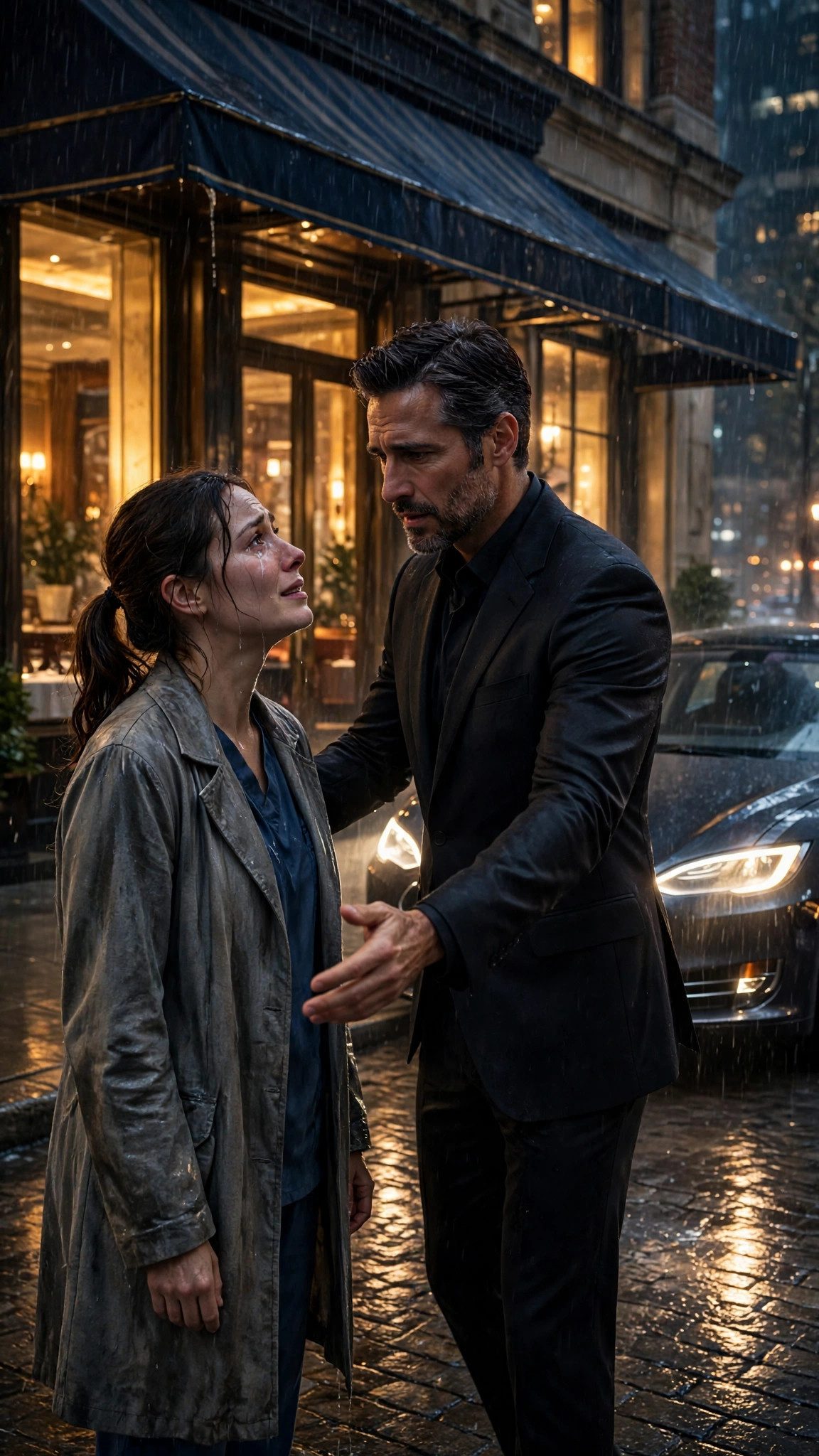
Three days later, on a wet Chicago night, I found out I had been wrong about that, too.
But before that night came, there was one more thing I had to do, and it was the hardest thing of all. I had to go back to the house on Linden Lane and face my husband.
It was the evening after I filed the injunction, and Marc was home — I could see his car in the driveway, and the kitchen light was on, and for a moment I sat in my own car outside my own father's house, afraid to go inside. Afraid of what I would say. Afraid of what he would say. Afraid that I would lose my nerve and let him talk me out of everything, the way he had talked me out of so many things over the years.
Then I thought about my mother, lying in Room 412, whispering about the house. I thought about my father, carving my name into the beam above the front door with a backwards R. I thought about Jason, asleep in a strange apartment in Evanston, asking me when we were going home.
I got out of the car. I walked up the front steps. I touched the backwards R with my fingertips, the way I had done a thousand times, and I opened the door.
Marc was in the kitchen, sitting at my father's table with a glass of whiskey, scrolling through his phone. He looked up when I came in, and for a moment his face was the face of the man I had married — handsome, charming, a little boyish around the eyes — and then it changed, and it was the face of a stranger.
"Clara," he said. "Where have you been? Jason's at school, and I —"
"Don't," I said. My voice was very calm. Calmer than I felt. "Don't pretend. I know about the listing. I know about the forged power of attorney. I know about Abi. I know about Miami. I know about Nico Falco and the hundred and eighty thousand dollars. I know all of it, Marc."
He stared at me. The color drained out of his face. His hand tightened around the whiskey glass.
"Who told you?" he asked.
"Nobody told me," I said. "I found out. Because I'm your wife, and this is my house, and you have been lying to me in it for two years."
He stood up. He came around the table toward me, and for a moment I thought he was going to grab my arm, the way he had grabbed it once before, a year ago, during a fight about money, hard enough to leave a bruise I had hidden under a long sleeve. But he stopped. He stopped because I did not move. I did not flinch. I did not step back. I stood in my father's kitchen and I looked at him, and he saw something in my face that made him stop.
"I filed for divorce," I said. "I filed an injunction. The sale is blocked. The listing is coming down. And if you ever set foot in this house again without a court order, I will call the police."
"You can't do this," he said. "Clara, you can't do this. I need that money. Falco — you don't understand what Falco will do —"
"I understand," I said. "I understand that you chose Falco over us a long time ago. And now you get to live with that choice."
I walked out of the kitchen. I walked up the stairs. I went into my mother's bedroom, and I opened her closet, and I took her quilt — the one she had made for me when I was twelve, blue and white, soft from a thousand washings — and I folded it carefully, and I carried it downstairs, past Marc, past the table, past the window seat, and out the front door.
I did not look back. I touched the backwards R one more time, and I got in my car, and I drove to Evanston, to the small apartment with the clanking radiator, to my son.
That night, Jason asked me, "Mommy, did you get Grandma's quilt?"
"Yes, baby," I said. "I got Grandma's quilt. And nobody is ever going to take it away from us."
He smiled in his sleep, and I sat beside his bed for a long time, holding the quilt, thinking about my mother and my father and the house on Linden Lane, and I knew, with a certainty that felt like stone, that I would get that house back. Whatever it took. However long it took. I would get it back.