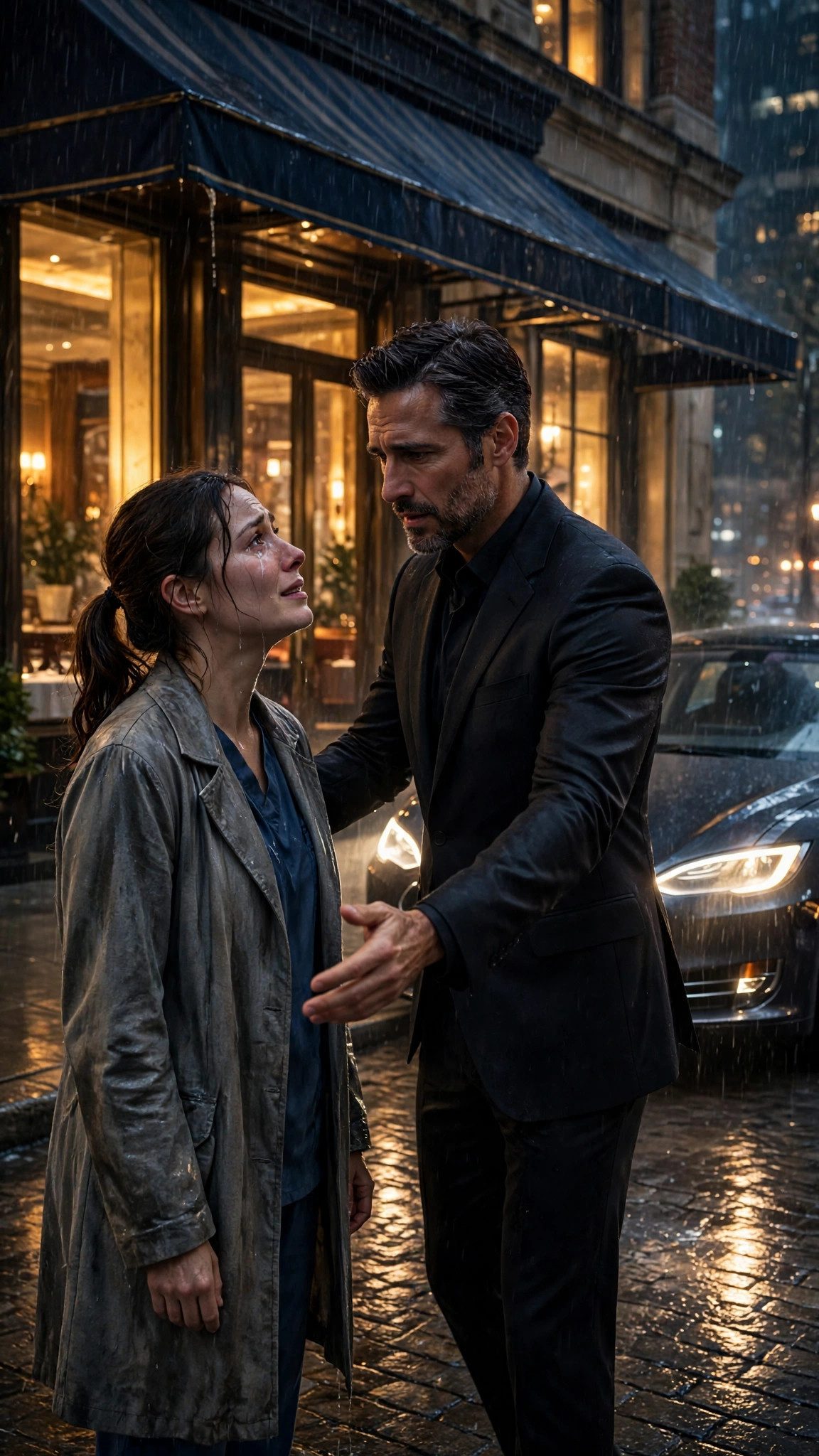
The rain was coming down hard the night I met Alexander Moretti again, the kind of hard spring rain that turns Chicago's streets into rivers and makes the neon signs blur into ribbons of color.
Jason had developed a cough. It started the day after we moved to Evanston — a small, dry cough that got worse at night, the kind of cough that keeps a mother lying awake in the dark listening to every breath her child takes. By the third night, I could not stand it anymore. I called the pharmacy near Chicago General, the one I had used for nine years, and they said the prescription was ready, and I told Rosa I would pick it up on my way home from my shift.
My shift ended at eleven. The rain was already falling when I walked out of the hospital, and by the time I got to the pharmacy it was coming down in sheets. I picked up the medicine, and I put it in my bag, and I started walking back to my car, and then I stopped.
I don't know why I stopped. I don't know why I turned left instead of right, away from the parking garage, down a street I had no reason to be on. Maybe it was exhaustion. Maybe it was grief. Maybe it was something else — something I have never been able to explain, the way you cannot explain why you take one road instead of another on the night your life changes.
I walked for ten minutes in the rain. My umbrella tilted in the wind. My shoes were soaked through. And then I looked up, and I was standing in front of a restaurant.
It was the kind of restaurant I had only ever seen in magazines. White tablecloths. Candles in tall glass holders. A doorman in a black coat holding an umbrella over the entrance. Through the windows I could see people in evening clothes, laughing, drinking wine that cost more than my weekly grocery bill, living lives that had nothing to do with mine.
And at the door, waiting in the rain like it had been waiting there all night, was a black Tesla.
I knew him the moment I saw him.
He was standing under the awning, tall and still, wearing a black suit that fit him the way only a suit made by hand can fit a man, and he was looking at me the way a man looks at someone he has been waiting a very long time to see. His hair was darker than I remembered, with grey at the temples now, and there were lines around his eyes that had not been there twelve years ago, but his eyes were the same. Grey-blue, like a winter sky. The kind of eyes that do not look away.
"Clara," he said softly.
I stopped in the rain. My umbrella tilted further. The water ran down my face and I did not wipe it away.
"I have been waiting for you," he said softly.
For a moment I could not speak. I could not think. Twelve years collapsed into nothing, and I was twenty-four again, standing in a hospital hallway at four in the morning, watching a man in a black suit walk toward me while his little brother slept behind a glass door.
"Alexander," I said. My voice sounded strange to my own ears. "Alexander Moretti. What are you doing here?"
He stepped forward, out from under the awning, into the rain with me. He did not seem to notice the water. Men like Alexander Moretti never notice the rain.
"Your father asked me to watch over you," he said. "Twelve years ago. In a hospital hallway. I gave him my word, Clara. And I keep my word."
I stared at him. "My father died twelve years ago."
"I know," Alexander said. "I was at his funeral. I stood in the back, where you would not see me. I have been watching over you from a distance ever since. I knew when your mother got sick. I knew when she died. I knew what your husband was doing to you before you knew it yourself."
The rain was running down my neck now, cold, soaking through my coat. I should have been freezing. I was not. I felt as if I were standing very close to a fire.
"How?" I asked. "How did you know?"
"Because I keep my promises," he said simply. "And because your father asked me to. He said to me, that morning in the hospital, 'Mr. Moretti, my daughter saved your brother's life. One day, if she ever needs you, I want you to come. No questions. No conditions. Just come.' And I told him I would. And I have been waiting twelve years to keep that promise."
He held out his hand. Not demanding. Not grabbing. Just holding it out, steady, in the rain, waiting for me to decide.
"Clara," he said. "I don't know how much he can lose, but he can't lose you."
I looked at his hand. I looked at the restaurant. I looked at the black Tesla waiting at the curb like a promise.
And then, before I could stop myself, I said the thing I had been thinking since the morning my mother died, the thing I had not said to anyone, not even Rosa.
"My husband is trying to steal my father's house."
Alexander did not look surprised. He did not look angry. He looked like a man who had already known the answer and had been waiting for me to say it out loud.
"I know," he said. "I know about the forged power of attorney. I know about the listing. I know about the woman in Miami. I know about Nico Falco and the hundred and eighty thousand dollars. I know all of it, Clara. I have known for weeks."
"Then why didn't you come sooner?" I asked, and my voice broke on the last word, and I hated that it broke, because I had promised myself I would not cry in front of this man, this stranger, this mafia boss standing in the rain.
"Because," Alexander said, very gently, "your father also told me something else that morning. He said, 'Don't come to her until she asks. My Clara is strong. She doesn't need a man to save her. She needs a man to stand beside her when she decides to save herself.' So I waited. I waited for you to decide."
I looked at him for a long time. The rain fell. The doorman held his umbrella. The city moved around us, cars and taxis and people hurrying home, and none of them knew that my life was changing on a wet sidewalk in front of a restaurant I could not afford.
"I'm not asking you to save me," I said finally.
"I know," Alexander said. "I'm not offering to save you. I'm offering to stand beside you."
He opened the door of the Tesla. The inside was warm and smelled of leather and something clean, like cedar.
"Come inside," he said. "You're soaked. You're freezing. Let me take you somewhere dry, and I will tell you everything I know about your husband. And then you can decide what you want to do. No pressure. No debt. Your father asked me to watch over you, Clara. That is all this is."
I should have said no. A sensible woman would have said no. A nurse, a mother, a woman in the middle of a divorce, standing in the rain at eleven o'clock at night, should not get into a car with a man the whole city feared.
But I was tired. I was so tired — tired of being afraid, tired of being alone, tired of fighting a war by myself with a forged piece of paper and a police report and a lawyer who charged by the hour. And this man had stood in a hospital hallway twelve years ago and promised my father he would come, and he had come, and he was standing in the rain holding a car door open for me like I mattered.
So I got in the car.
The restaurant, it turned out, was his. Not in the way a man owns a restaurant because he likes the food. In the way a man owns a restaurant because he owns the building, and the block, and half the street, and the restaurant is where he does his business when he wants the business to look like dinner.
He took me to a private room at the back, small and warm, with a fire in the fireplace and a table set for two, and he ordered tea — not wine, not whiskey, tea, with honey — and he sat across from me and he told me everything.
He told me about Nico Falco. Falco was a loan shark who worked the casinos in Joliet, a small man with a big reputation, and Marc owed him a hundred and eighty thousand dollars, and Falco had given Marc until the end of June to pay it, and after that, Falco had told Marc, the debt would be collected in other ways.
He told me about Abi. Her real name was Abigail Torres. She was twenty-nine. She had met Marc at a real estate conference in Miami two years ago. She did not love him. She loved the idea of a boutique, and she loved the idea of a man who would pay for it, and she had already put a deposit on a space on Ocean Drive that she could not afford to lose.
He told me about the listing. Dana Cole, the real estate agent, had been told the house was a divorce sale, that the wife had agreed, that the paperwork was in order. She had believed Marc because Marc was charming and because Marc had shown her the forged power of attorney, and the forgery was good enough to fool a busy woman with twenty other listings.
He told me about the buyer. A developer from out of state who wanted to tear the house down and build condominiums. He had offered cash, fast close, no inspection. He did not care about the oak table or the backwards R above the front door or the window seat where my mother used to read. He cared about the lot.
And then Alexander told me the thing that made me put my teacup down very carefully, so that it would not shake in my hands.
"Your husband came to see me," he said. "Three weeks ago. He came to my office and he asked me for a loan. A hundred and eighty thousand dollars. He said he had a house he could put up as collateral. He said his wife had agreed to sell. He showed me the same forged power of attorney he showed the real estate agent."
I stared at him. "What did you say?"
"I said no," Alexander said. "I said no, and then I had my people look into him, and that is when I found out everything. The forgery. The girlfriend. The gambling. The listing. All of it."
"Why did you say no?" I asked. "A hundred and eighty thousand dollars is nothing to a man like you."
Alexander was quiet for a moment. He looked into the fire. When he spoke again, his voice was lower, and there was something in it I had never heard from a man before. Not power. Not threat. Something older. Something like grief.
"Because," he said, "twelve years ago, a young nurse stayed with my little brother for six hours while he bled, and she held his hand, and she told him he was going to live, and she was right. And that nurse's father looked at me in a hospital hallway and said, 'If my daughter ever needs you, come.' And I gave him my word. And I do not lend money to a man who is trying to steal the house that woman's father built with his own hands. I do not do that, Clara. Not for any amount of money."
The fire crackled. The tea went cold. Outside, the rain kept falling on the city, washing the streets clean, and I sat across from a man the whole city feared, and I felt, for the first time since my mother's hand went still in Room 412, that I was not alone.
"Tell me what to do," I said.
Alexander shook his head. "No," he said. "I will not tell you what to do. Your father was right. You are strong. You will decide. But I will tell you what I can do. I can make sure the sale never happens. I can make sure the forgery is exposed. I can make sure Nico Falco never comes near you or your son. And I can do all of that without you owing me anything. Not now. Not ever. That is what your father asked me to do, and that is what I am going to do."
He reached across the table then, very slowly, giving me time to pull away, and he took my hand. His hand was warm. Mine was cold. He held it gently, the way a man holds something precious and breakable, and he looked at me with those winter-sky eyes, and he said the words I have never forgotten.
"Clara Bennett. Your father built a house for you with his own hands. Nobody is going to take it away from you. Not your husband. Not a loan shark. Not a developer from out of state. Nobody. I promise you that. And I keep my promises."
I sat there, holding the hand of a mafia boss in a private room in a restaurant I could not afford, with my son's medicine in my bag and my mother's will in my coat pocket and my husband's betrayal still fresh as a wound, and I believed him.
I believed him because my father had believed him, twelve years ago, in a hospital hallway at four in the morning. And my father had never been wrong about a man.
Not once. Not ever.
"All right," I said. "All right. Tell me the plan."
And Alexander Moretti smiled — a real smile, small and slow, the smile of a man who has been waiting twelve years to be useful — and he began to tell me.