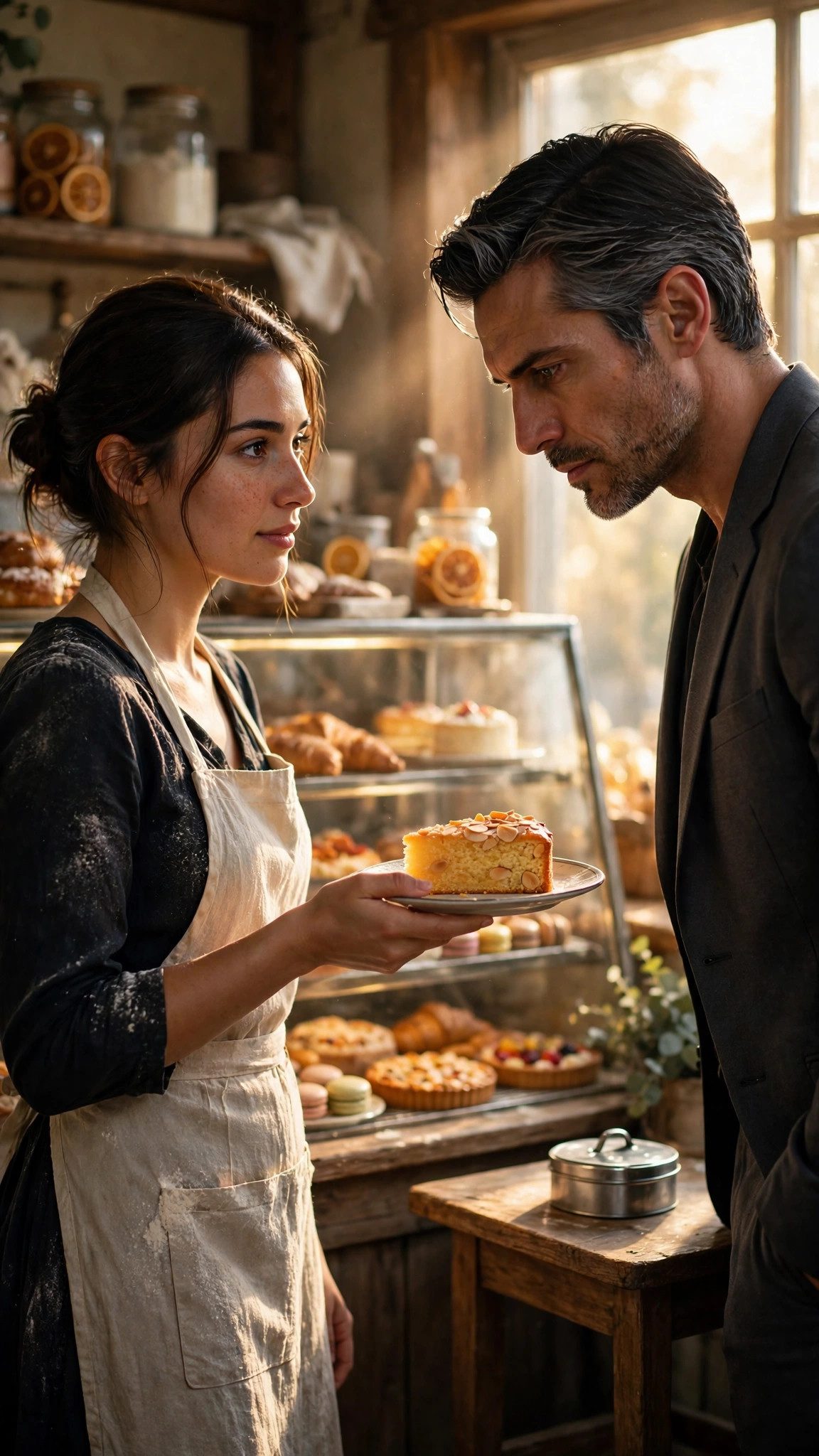
Every morning, the same impossibly wealthy man walked into my little bakery, ordered one slice of orange almond cake, and left without a word.
The feared mafia don never spoke to me.
Until the morning he did.
My grandmother always used to say that if a man looks at you the way the devil looks at temptation, then you should run the other way. Well, I wish I had listened to her. Because every morning for the past few weeks, right when the sun hit the bakery window, the same man would walk through my bakery door.
Adrien Moretti. The billionaire mafia boss.
Men with guns followed him everywhere, and he always had that look about him, the kind of look that makes you cross the street when you see him coming. He was handsome in the way devils usually are, with the smile of a man who has seen it all, the kind of smile that makes your mother cross the street when she sees him coming. And yet, every morning, he would come in, order exactly one slice of the cake my grandmother used to make, and then he would turn and walk out the door without saying a word.
One day, he did something he had never done before. He sat down.
It was a Tuesday morning, and in three years, I had never once seen him sit down anywhere except in the car he gets driven around in, or at a table where he was doing business. But this time, he sat at the small table by the window and stared at me while one of his men stood close by in the back.
I could not believe he was sitting there, watching me work. So I swallowed my nerves and asked, "Would you like anything else, sir?"
He just kept looking at me.
I could feel his eyes burning into my skin. He had this intense stare, like he had seen it all before, but there was something else, something that made me feel like he was seeing through me in ways that made me uncomfortable. It felt like he was waiting for something. Or someone.
"Would you like me to bring you the rest of the cake?" I tried again. I just wanted him to finish eating and leave. But he did not answer. "Was the cake good enough?" I asked, holding back tears. I was so nervous my hands were shaking so badly I thought I might drop the plate.
Finally, he answered, "No."
And then he folded his hands on the table, and I felt something else, something inside me that had been asleep for three years starting to wake up.
"Tell me about this cake," he said.
I was confused, but I answered him.
"My grandmother used to make it," I told him. "She called it 'the only real one.' Her mother taught her how to make it, and her mother's mother before her. It was my grandmother's legacy, and her mother left a recipe that they had been following ever since."
As I was speaking, I could feel my cheeks flush. "You have never tasted it before?"
"Only once." He paused for a beat, caught his breath, and then continued. "Maybe I'll pay for it next time I come in, because I've been eating it since I was small and I haven't been able to replicate it myself."
At that moment, the sun was shining through the bakery windows. And I felt like I was seeing him in a way I wouldn't have seen him before.
"Did your grandmother teach you how to make it?" he asked.
"My grandmother did, the woman who raised me." I answered, taking a deep breath. "She taught me all the recipes when I was still a little girl."
"Then where is she now?" he asked.
"She passed away two years ago." I whispered. "I made the recipe for my grandmother, and she passed it on to me as a gift."
He shook his head, and his piercing gaze swept over me. Adrien was a man who owned this city. He had entered into deals with some of the most powerful men in the world and made them beg for what they had, but he was not going to beg me for anything.
But then he reached into his jacket, and he pulled out a small silver tin. He opened it, and inside was a tiny bundle of tickets to the finest restaurants, all the places he would only enter with an invitation from the underworld.
"Tell me your secret," he said, staring at me intently. "Tell me how you make this cake."
I looked at him and answered, "I'm a perfectionist. I used to obsess over every detail."
Then he smiled that terrible smile that made my heart stop, and my stomach turn. At that moment, I realized that the whole city knew that this man had never eaten in someone else's home before.
Until now.
And then the door banged open, and a man with a mouth full of gold teeth started shouting at his associate right there in front of me, loud enough that every customer in the bakery went quiet. I recognized the gold-toothed man. Everyone in this city recognized him. Vincent Castellano, an associate of Adrien's late father, a man who had made a deal with the devil a long time ago and had been collecting on it ever since.
Adrien did not even turn his head. He only lifted one hand, and the shouting stopped like someone had cut a wire.
The next day, Adrien came back to my bakery.
He asked me if I would make him lemon cakes. He pulled out a list of names and numbers, names of famous bakeries, and he said, "You need to learn from the best."
I confided in him that I wanted to learn from the best.
He told me he learned from a man named Asher. "And the most important thing he taught me is that you can never be too careful about who you trust."
Then he told me, "My men will handle the paperwork, they'll take care of the money. All you need to do is the same thing every morning. The same cake. Every day. For the rest of our lives."
Those words made my eyes sting, but there was something else I could see in this man's face, a sincerity that made me stop in my tracks. He closed his eyes and gave me a crooked smile, and for one second he was not a mafia boss at all. He was just a man who missed his grandmother.
"I'll pay you whatever it takes," he said. "Just say yes."
I was still looking at him when he said the words that made my heart stop.
"I like the angle. It's different."
He asked me to remember the recipe secret, and he didn't even try to hide his desperation. It was the first time I had ever seen a real human emotion from him.
And then he said the words that would haunt me forever.
"The day my grandmother died, she asked me to bring her a slice of orange almond cake. I never got to bring her one. And in nearly three years, I couldn't bring myself to eat your grandmother's cake because every bite tasted like my grandmother's. It was her recipe, the exact one my father paid for."
Then he was a stranger again.
"Come home with me," he said. "I have a picture of my grandmother I want to show you."
He reached out and pulled me close.
"Because the cake tastes exactly like my grandmother's. They're always perfect. Always."
That was the Tuesday morning everything changed. But to understand why a mafia boss would walk into a little bakery on Taylor Street every morning for one slice of cake, you have to go back to the beginning. You have to go back to my grandmother's kitchen, to the smell of orange zest and toasted almonds, to the woman who raised me and the recipe she guarded like it was made of gold. Because the cake was never just a cake. It was the only thing my grandmother left me, and it turned out to be the only thing Adrien Moretti had ever wanted and could never buy.
My name is Lucia Benedetti. I am twenty-seven years old. I own Benedetti Bakery, a narrow little shop with a bell over the door and a window that catches the morning sun, and for three years I have baked my grandmother's orange almond cake every single morning before dawn. I thought I knew everything about that cake. I thought I knew everything about my grandmother. I was wrong about both, and Adrien Moretti was the man who proved it.
The bakery had belonged to my grandmother Rosa before it belonged to me. She bought the little shop on Taylor Street with money she had saved for thirty years, a dollar at a time, working in other people's kitchens. When I was a little girl, I used to sit on a flour sack in the corner and watch her work, and she would let me lick the spoon when the batter was done, but only after I had washed my hands twice and promised not to tell anyone the recipe. There was no written recipe then. There was only her hands, and her memory, and the smell of orange zest that lived in her skin no matter how many times she washed.
My mother died when I was nine years old. I barely remember her face now, only the sound of her humming in the kitchen and the way she used to braid my hair too tight. After she was gone, it was only Rosa and me in the little apartment above the bakery, and Rosa raised me the way she baked, with patience and with rules that never bent. You never rush the dough. You never open the oven door to check too early. You never, ever tell anyone the secret, because a secret is the only thing in this world that nobody can take from you unless you give it away yourself.
Rosa died two years ago, quietly, in her sleep, in the same bed she had slept in for forty years. She left me the bakery, the apartment above it, a tin box full of handwritten recipe cards, and one instruction she had repeated to me a hundred times: the orange almond cake is the only real one, and it belongs to our family, and no amount of money is ever enough to sell it. I promised her. I promised her on the day we buried her, standing in the rain in a black dress that did not fit me, holding a paper umbrella that kept turning inside out.
For three years, I kept that promise. I opened the bakery at six every morning. I baked the same cakes, I iced the same trays, I swept the same floor. The regulars came and went. Mrs. Delgado from the flower shop next door bought a loaf of rosemary bread every morning and told me about her grandchildren. Old Mr. Okafor came for his coffee and his newspaper and his one slice of lemon pound cake, and he always left the exact change on the counter in a neat little pile. College students came for croissants. Young mothers came for birthday cakes. Life was small, and it was ordinary, and it was mine.
And then, a few weeks ago, Adrien Moretti walked through my door for the first time.
I knew who he was the second I saw him. Everyone in Chicago knows who Adrien Moretti is, even the people who pretend they do not. He owns half the buildings on the river. He owns restaurants I will never be able to afford to eat in. His name is in the newspapers, and it is whispered in the kitchens of every restaurant in Little Italy, and it is never said out loud in his presence. Men with guns follow him everywhere, and when he walks into a room, the room goes quiet, the way a forest goes quiet before a storm.
He walked in that first morning right when the sun hit the bakery window, and the light caught the edge of his charcoal suit, and for a moment he looked like something out of a photograph, too sharp and too still to be real. He looked at the display case for a long time, the way a man looks at something he has been looking for, and then he pointed at the orange almond cake and said, in a voice so low I almost did not hear it, "One slice."
That was all. One slice. He paid in cash, exact change, and he took the little white plate and the little silver fork, and he walked out the door without another word, and his men followed him, and the bell over the door rang, and the bakery went back to being an ordinary bakery.
But he came back the next morning. And the morning after that. And every morning after that, for weeks. Always at the same time, always the same order, always the same silence. One slice of orange almond cake. Exact change. Out the door.
I started waking up earlier just to make sure the cake was perfect. I started checking the ovens twice. I started tasting the batter three times instead of once, and I told myself it was because I was a perfectionist, because I used to obsess over every detail, because that was what Rosa had taught me. But the truth was simpler and more frightening: I was baking for him. I was baking for the most dangerous man in Chicago, and I did not know why, and I could not stop.
My best friend, Priya, who works the counter three mornings a week while she finishes her nursing degree, told me I was being ridiculous. "Lucia," she said, wiping down the display case with a rag, "he is a customer. He buys a slice of cake. He pays for it. That is the entire story. You are turning a slice of cake into a novel."
But Priya had not seen the way he looked at the cake. He did not look at it the way a man looks at breakfast. He looked at it the way a man looks at a photograph of someone he has lost. He held the fork like it might break. He never ate it in the bakery. He always carried it out, wrapped in the white paper, held carefully in both hands, like it was something fragile. And one morning, when the sun was coming through the window just right, I saw him through the glass, standing beside his black car, and he was not eating the cake. He was only holding it, and staring at it, and for one second his shoulders dropped, and he looked like a man who was about to cry.
That was the morning I understood that the cake meant something to him, and that whatever it meant, it was not about hunger.
So when he sat down at the window table that Tuesday morning, I was not surprised. I had been waiting for it. I had been waiting for weeks for the morning when he would finally stop walking out the door and stay. I just did not know what he would say when he did.
And now I know. He said my grandmother's cake tasted like his grandmother's cake. He said his father had paid for the recipe. He said his grandmother died three years ago asking for a slice he never brought her. And he asked me to come home with him, to see a picture of his grandmother, because the cake tastes exactly like hers.
I did not go home with him that day. I told him the bakery was open and the ovens were hot and I had customers coming, and he nodded like he had expected me to say no, and he stood up, and he left exact change on the table for the slice he had not finished, and he walked out the door. But before he left, he turned back, and he looked at me, and he said, "Tomorrow, Lucia. I will come back tomorrow. And the day after that. I have waited three years for this cake. I can wait one more day for you."
He knew my name. I had never told him my name. Nobody in the bakery had ever told him my name. And that frightened me more than anything else he had said, because it meant he had been asking about me. It meant the most dangerous man in Chicago had been asking questions about a baker on Taylor Street, and I did not know what those questions were, or who had answered them.
That night, I could not sleep. I went downstairs to the bakery in the dark, and I opened the tin box where Rosa kept her recipe cards, and I looked at the card for the orange almond cake. It was written in her handwriting, in blue ink, in Italian, on a card that was yellowed at the edges and stained with vanilla. And at the bottom of the card, in smaller writing, there were words I had never really read before, because I had always thought they were only a note about the oven temperature. They were not. They were a name.
Caterina Moretti.
My grandmother's recipe card had Adrien Moretti's grandmother's name written on it. And in that moment, standing in the dark in my dead grandmother's bakery, holding the recipe that was supposed to be my family's secret, I understood that nothing about my life was what I thought it was, and that the cake had never belonged only to my family at all.